
LIVING THINGS A living thing is an organism
- Slides: 13
LIVING THINGS A living thing is an organism that is able to perform three vital functions: a) Nutrition b) Interaction c) Reproduction All living things are made of similar substances : • • Protein Nucleic Acid Carbohydrate Lipid
And they are formed by cells. What is a cell? A cell is the smallest unit of a living thing capable of performing the three vital functions: nutrition, interaction and reproduction.
What are cells made of? Cells are mostly water. The rest of the present molecules are: • protein • nucleic acid • carbohydrate • lipid • other
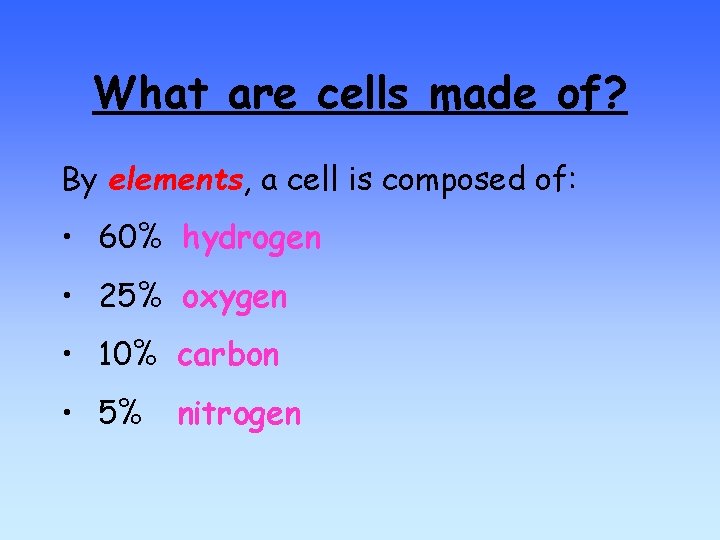
What are cells made of? By elements, a cell is composed of: • 60% hydrogen • 25% oxygen • 10% carbon • 5% nitrogen
What is a tissue? A tissue is a group of cells that have a similar structure and function Ex: muscle tissue, blood, root epidermis, mesophyll tissue in the leaf. .
Introduction to Cell Theory History of Scientists: 1655: Robert Hooke coins the term "cell" to describe chambers in cork 1674: Anton Von Leeuwenhoek perfects techniques for grinding microscope lens to make the first microscope 1838: Matthias Schleiden concluded that plants are composed of cells 1839: Theodor Schwann concluded that animals are composed of cells
History of Scientists: 1906: Santiago Ramón y Cajal, Spanish histologist with received the Nobel Prize (with Camilo Golgi), for establishing the neuron or nerve cell, as the basic unit of nervous structure. This finding was instrumental in the recognition of the neuron's fundamental role in nervous function and in gaining a modern understanding of the nerve impulse.
Cell Theory Those early scientists did experiments on living things and developed CELL THEORY Main Ideas of Cell Theory 1) All living things are made of one or more cells 2) Cells are the basic units of structure & function of living things 3) All cells come from existing cells
Task Research work about Ramón y Cajal Parts: a) His contribution in science b) One of the following points: life, studies, jobs, tissue
Task 2 - Search for different kind of cells (animal and plants), function that they have and tissue they belong to.
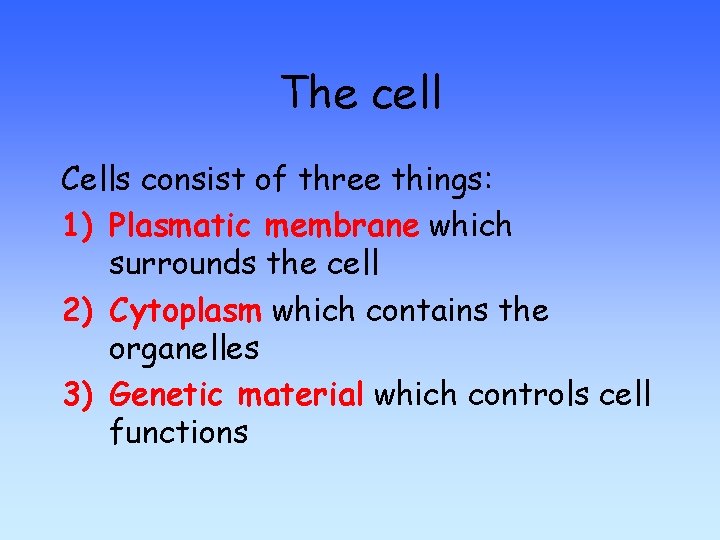
The cell Cells consist of three things: 1) Plasmatic membrane which surrounds the cell 2) Cytoplasm which contains the organelles 3) Genetic material which controls cell functions
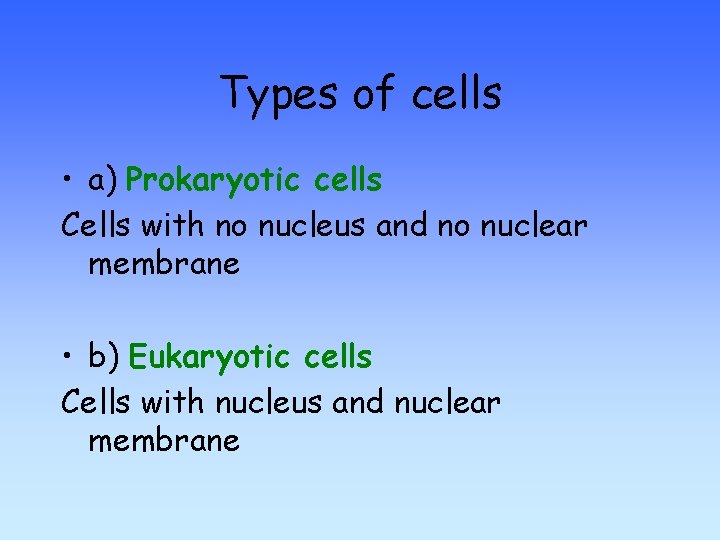
Types of cells • a) Prokaryotic cells Cells with no nucleus and no nuclear membrane • b) Eukaryotic cells Cells with nucleus and nuclear membrane
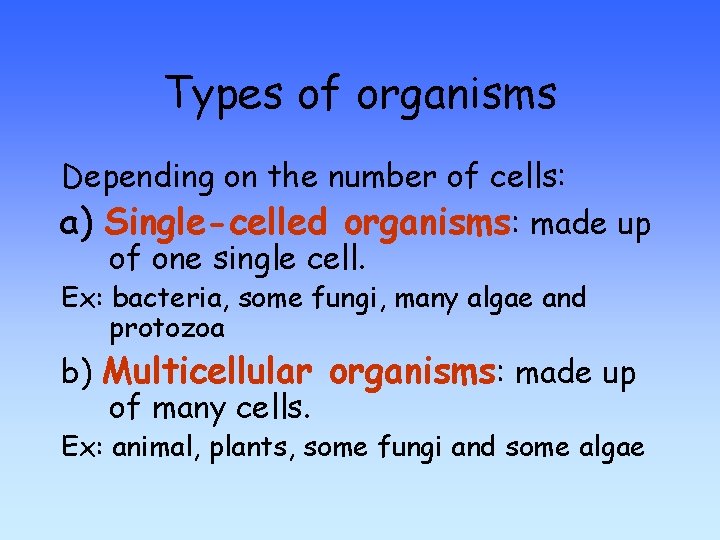
Types of organisms Depending on the number of cells: a) Single-celled organisms: made up of one single cell. Ex: bacteria, some fungi, many algae and protozoa b) Multicellular organisms: made up of many cells. Ex: animal, plants, some fungi and some algae