
LIVING OUT OF A STORY Michael Goheen Trinity
- Slides: 200
LIVING OUT OF A STORY Michael Goheen Trinity Western University Vancouver, B. C. , Canada
Romans 12. 1 -2 Therefore, I urge you, brothers and sisters, in view of God’s mercy, to offer your bodies as living sacrifices, holy and pleasing to God--this is your proper worship as rational beings. Do not conform any longer to the pattern of this world, but be transformed by the renewing of your mind. Then you will be able to test and approve what God’s will is--his good, pleasing, and perfect will.
Our whole lives are shaped by some story.
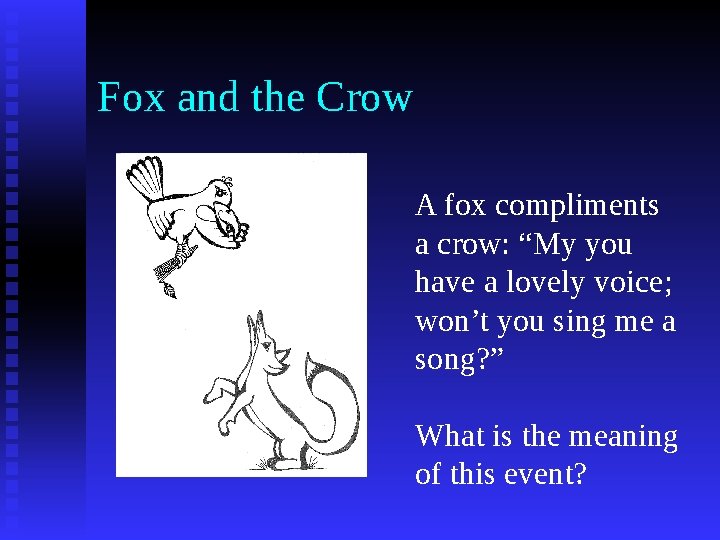
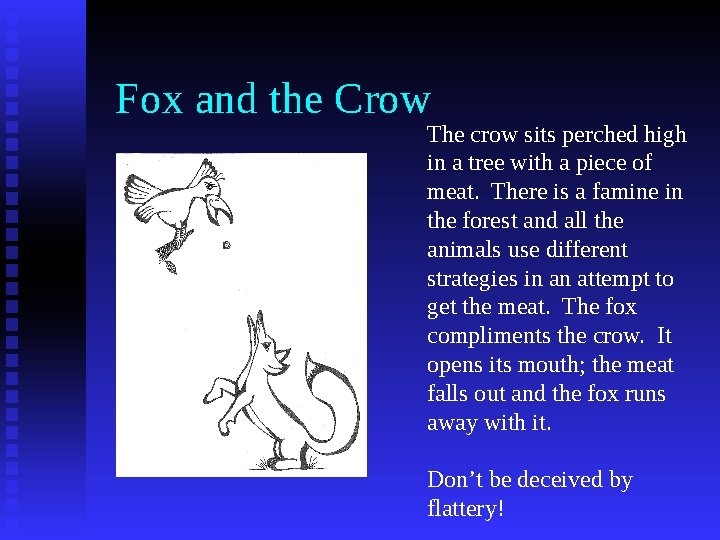
Fox and the Crow A fox compliments a crow: “My you have a lovely voice; won’t you sing me a song? ” What is the meaning of this event?
Fox and the Crow The crow sits perched high in a tree with a piece of meat. There is a famine in the forest and all the animals use different strategies in an attempt to get the meat. The fox compliments the crow. It opens its mouth; the meat falls out and the fox runs away with it. Don’t be deceived by flattery!
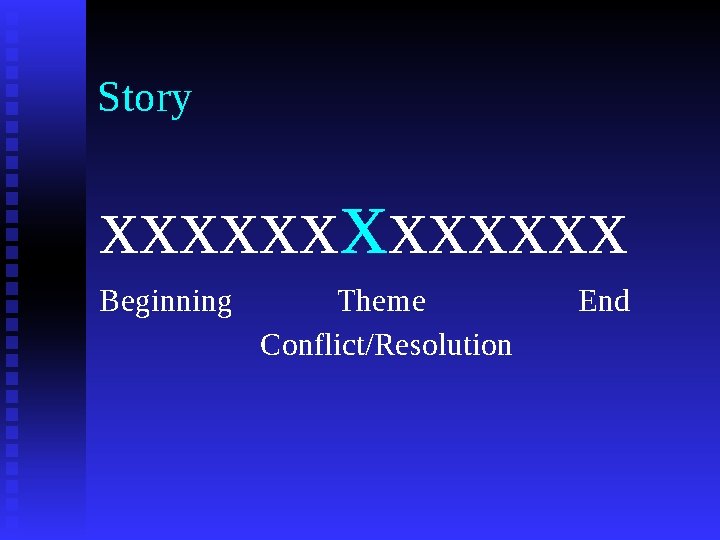
Story xxxxxxx Beginning Theme Conflict/Resolution End
“I can only answer the question “What am I to do? ” if I can answer the prior question “Of what story do I find myself a part? ” -Alasdair Mac. Intyre “The way we understand human life depends on what conception we have of the human story. What is the real story of which my life story is a part? ” -Lesslie Newbigin
N. T. Wright “. . . a story is the best way of talking about the way the world actually is. ”
Far from seeking, like Homer, merely to make us forget our own reality for a few hours, it seeks to overcome our reality: we are to fit our own life into its world, feel ourselves to be elements in its structure of universal history. . . Everything else that happens in the world can only be conceived as an element in this sequence; into it everything that is known about the world. . . must be fitted as an ingredient of the divine plan. - Auerbach, quoted by Frei, comparing Homer’s Oddyssey to Old Testament.
A story functions like: Spectacles - enable us to see, understand world Maps - show us the way in which we should go Compasses - provide us with direction Lights - illuminate path Foundations - give shape and stability to lives
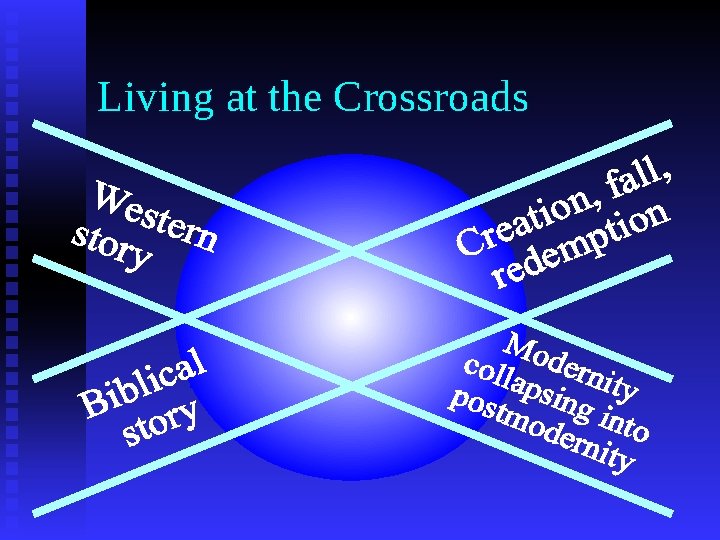
Lesslie Newbigin In our contemporary culture. . . two quite different stories are told. One is the story of evolution, of the development of the species through the survival of the strong, and the story of the rise of civilization, our type of civilization, and its success in giving humankind mastery of nature. The other story is the one embodied in the Bible, the story of creation and fall, of God’s election of a people to be the bearers of his purpose for humankind, and of the coming of the one in whom that purpose is to be fulfilled. These are two different and incompatible stories.
Both stories: Are normative: Claim to be true for all Are comprehensive: Claim all of human life Are communal: Embodied by a community Are religious: Centred in ultimate commitments Yet only one can be basic!
Living at the Crossroads
The Bible as one story. . . the whole point of Christianity is that it offers a story which is the story of the whole world. It is public truth. (N. T. Wright)
“I can’t understand why you missionaries present the Bible to us in India as another book of religion. It is not a book of religion—and anyway we have plenty of books of religion in India already. We don’t need any more! I find in your Bible a unique interpretation of universal history, the history of the whole creation and the history of the human race. And therefore a unique interpretation of the human person as a responsible actor in history. That is unique. There is nothing else in the whole religious literature of the world to put alongside of it. -Badrinath (Hindu scholar)
Danger! Breaking up the Bible into little bits—moral, sermon, theological, historical-critical, devotional “If we allow the Bible to become fragmented, it is in danger of being absorbed into whatever other story is shaping our culture, and it will thus cease to shape our lives as it should. Idolatry has twisted the dominant cultural story of the secular Western world. If as believers we allow this story (rather than the Bible) to become the foundation of our thought and action, then our lives will manifest no the truths of Scripture, but the lies of an idolatrous culture. Hence, the unity of Scripture is no minor matter: a fragmented Bible may actually produce theologically orthodox, morally upright, warmly pious idol worshippers! (Drama of Scripture, 12)
ACT ONE CREATION: GOD ESTABLSHES HIS KINGDOM Michael Goheen Trinity Western University Vancouver, B. C. , Canada
Four introductory remarks: Lives not shaped by a doctrine of creation as much as the should be Genesis 1 is not first concerned about how God made the world Genesis 1 shows us God’s original intention for creation Genesis 1 must be understood in original cultural context
Literary Structure of Genesis 1 Stage One: Gen. 1: 1 -2 “In the beginning God created the heavens and the earth. ” “The earth was dark, formless, empty. ”
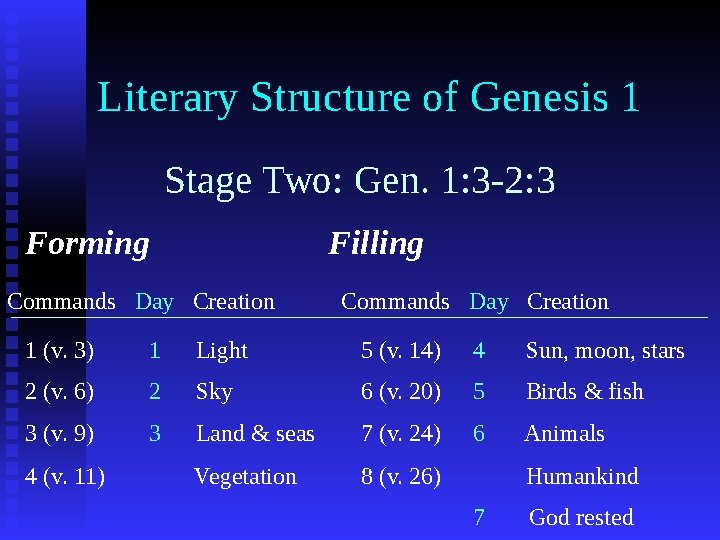
Literary Structure of Genesis 1 Stage Two: Gen. 1: 3 -2: 3 Forming Filling Commands Day Creation 1 (v. 3) 1 Light 5 (v. 14) 4 Sun, moon, stars 2 (v. 6) 2 Sky 6 (v. 20) 5 Birds & fish 3 (v. 9) 3 Land & seas 7 (v. 24) 6 Animals Vegetation 8 (v. 26) 4 (v. 11) Humankind 7 God rested
Historical and Cultural Context Moses writing just after exodus from Egypt Polemic against the myths, religion, gods of paganism
“Moses’ concerns were exclusively religious. His intent was to proclaim knowledge of the true God as he manifested himself in his creative works, to proclaim a right understanding of humankind, the world, and history that knowledge of the true God entails--and to proclaim the truth concerning these matters in the face of the false religious notions dominant throughout the world of his day. ” -John Stek
God in Genesis 1: Eternal One Utterly unique Sovereign King Powerful Good Wise Holy
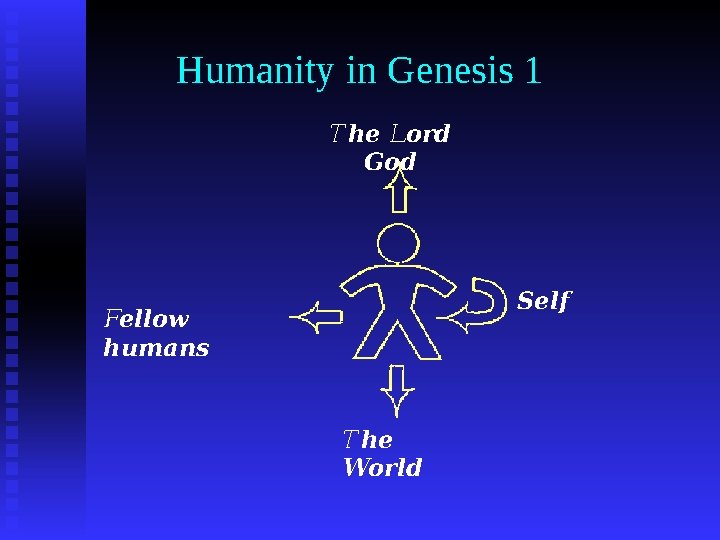
Humanity in Genesis 1: Nature: Image Like God Partner with God Relationship with God Communal Task given by God Task: Creation mandate
Humanity in Genesis 1 The Lord God Self Fellow humans The World
World in Genesis 1: Good (variety, harmony) Ordered by God’s word Historical Kingdom Revelation of God
Creation as God meant it to be World Creation of God Very good Ordered by God’s word Reveals God Humanity at centre as vice-regents Humankind Created to know/enjoy glorious Creator God As they care for, discover, and develop creation In community All for the revelation of God’s glory
End of Act 1 Curtain falls. . . Anticipation of glorious future
ACT TWO FALL: REBELLION IN THE KINGDOM Michael Goheen Trinity Western University Vancouver, B. C. , Canada
A catastrophe has occurred. We are no longer in continuity with our good beginning. We have been separated from it by a disaster. We are also, of course, separated from our good end. We are, in other words, in the middle of a mess. -Eugene Peterson
Fall into sin Tree of knowledge of good and evil (2. 15 -17) ‘Arbitrary’ command—why? Satanic temptation Doubt about divine source or fairness Unbelief Imagining life in disobedience to God’s word Willful disobedience
Sin as: Autonomy: making oneself source of right/wrong, good/bad, true/false “Man has taken leave of the relation of dependence. He has refused to obey and has willed to make himself independent. No longer is obedience the guiding principle of his life, but his autonomous knowledge and will. Thereby he ceases, in effect, to understand himself as a creature. ” (Von Rad)
Sin as: Autonomy: making oneself source of right/wrong, good/bad, true/false Covenant rebellion: refusing allegiance to rightful king
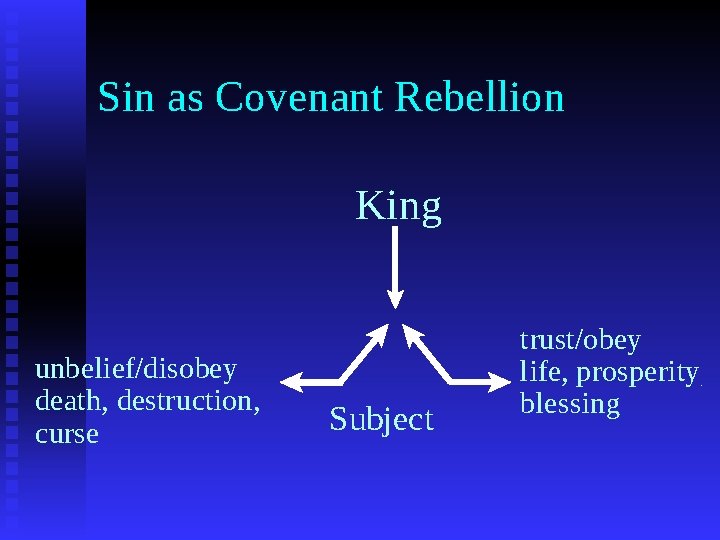
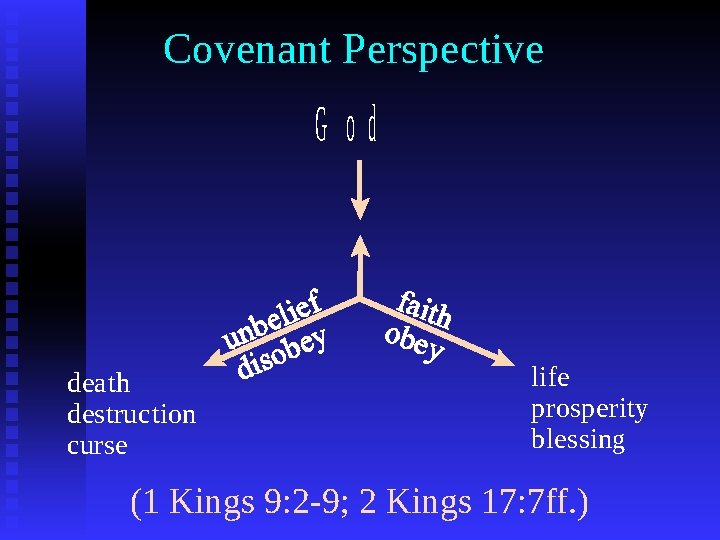
Sin as Covenant Rebellion King unbelief/disobey death, destruction, curse Subject trust/obey life, prosperity, blessing
Covenant Rebellion to Idolatry “If human beings are inescapably religious, driven always to seek an object of worship, then the fall cannot be characterised solely as revolt against the rightful Lord: It must be described further as exchange of religious allegiance. ” (Chaplin)
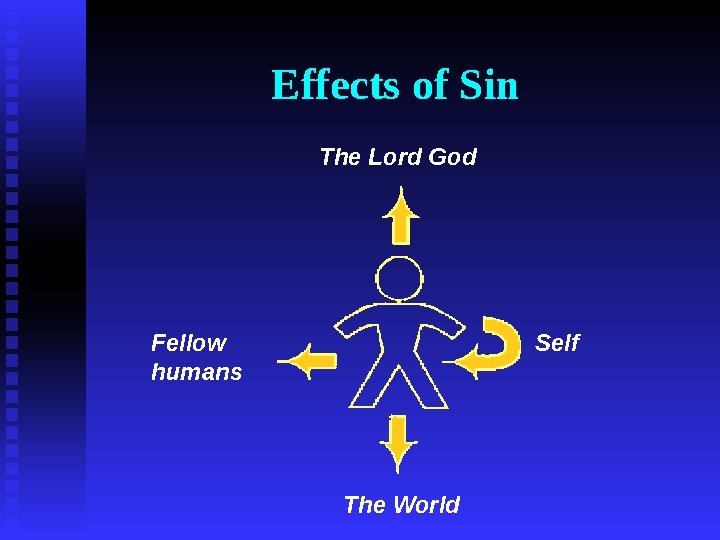
Consequences of sin: Alienated from God, v. 8, 23 Damaged relations between Adam and Eve, v. 12, 16 Death, v. 19 Non-human creation cursed, v. 17
Effects of Sin The Lord God Fellow humans Self The World
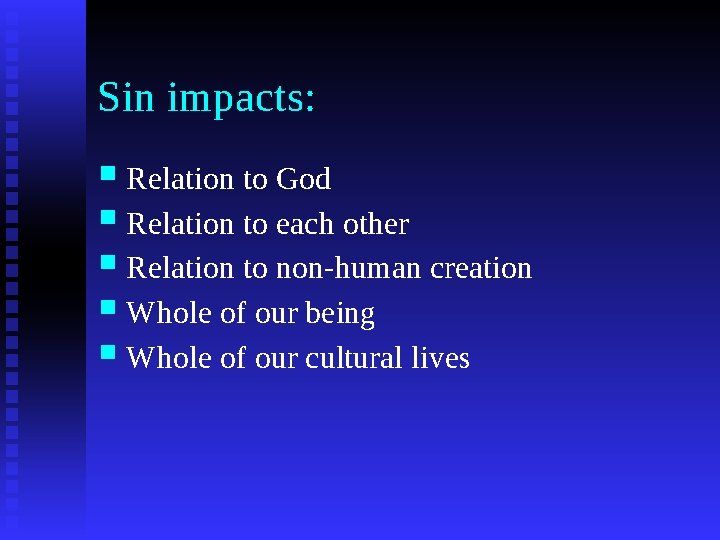
Sin impacts: Relation to God Relation to each other Relation to non-human creation Whole of our being Whole of our cultural lives
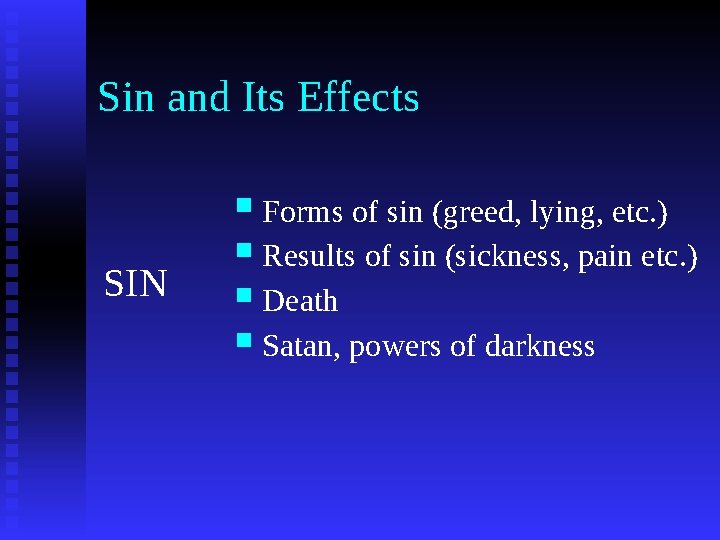
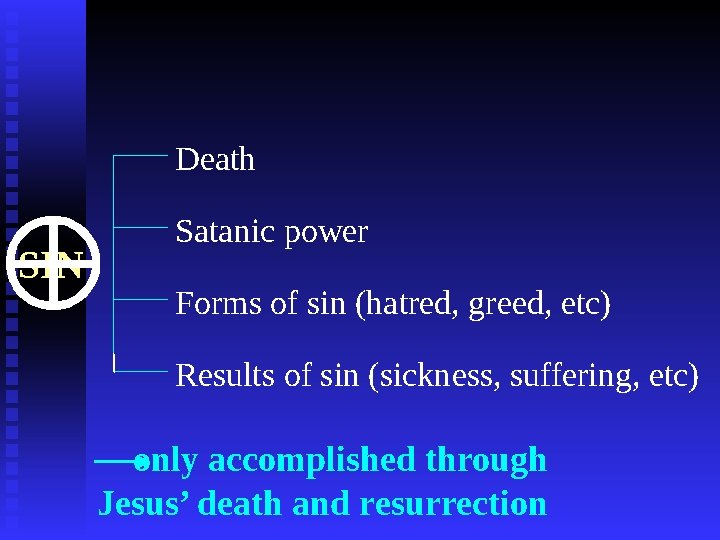
Sin and Its Effects Forms of sin (greed, lying, etc. ) Results of sin (sickness, pain etc. ) Death Satan, powers of darkness SIN
All spheres of life—marriage and family, work and worship, school and state, our play and art—bear the wounds of our rebellion. Sin is present everywhere— in pride of race, in arrogance of nations, in abuse of the weak and helpless, in disregard for water, air, and soil, in destruction of living creatures, in slavery, deceit, terror, and war, in worship of false gods, and frantic escape from reality. We have become victims of our own sin. -Contemporary Testimony, 17
End of Act 2 Curtain falls. . . Disaster! What now?
Is the Story Over? No! Clothes Adam and Eve Gives promise (Gen 3: 15)
While justly angry God did not turn his back on a world bent on destruction; he turned his face to it in love. With patience and tender care he set out on the long road of redemption to reclaim the lost as his people and the world as his kingdom. Although Adam and Eve were expelled from the garden and their work was burdened by sin’s effects, God held on to them in love. He promised to crush the evil forces they unleashed. -Contemporary Testimony, 19 -20
Observations on redemption Redemption is progressive in its outworking Redemption is restorative in its nature Redemption is comprehensive in scope
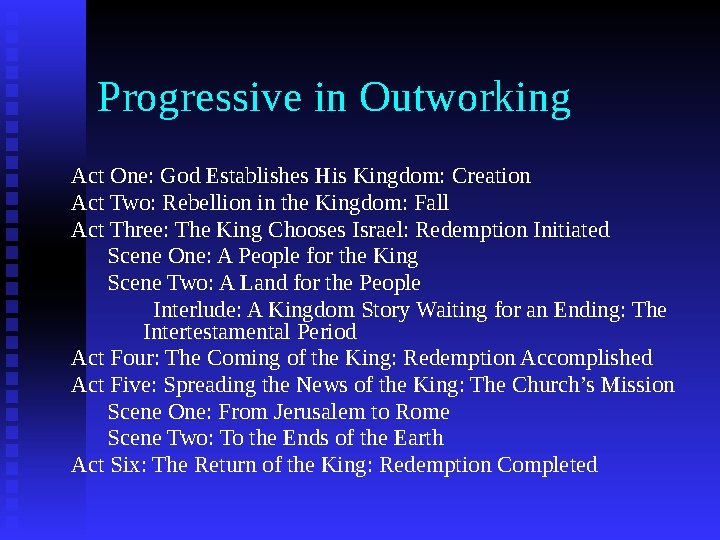
Progressive in Outworking Act One: God Establishes His Kingdom: Creation Act Two: Rebellion in the Kingdom: Fall Act Three: The King Chooses Israel: Redemption Initiated Scene One: A People for the King Scene Two: A Land for the People Interlude: A Kingdom Story Waiting for an Ending: The Intertestamental Period Act Four: The Coming of the King: Redemption Accomplished Act Five: Spreading the News of the King: The Church’s Mission Scene One: From Jerusalem to Rome Scene Two: To the Ends of the Earth Act Six: The Return of the King: Redemption Completed
ACT THREE The King Chooses Israel: Redemption Initiated Scene One: A People for the King
Bible: Story of Mission “Mission is a major key that unlocks the whole grand narrative of the canon of Scripture. ” “. . . the whole Bible renders to us the story of God’s mission through God’s people in their engagement with God’s world for the sake of God’s whole creation. ” (Chris Wright)
The Mission of God and His People God’s Mission: “While justly angry God did not turn his back on a world bent on destruction; he turned his face to it in love; with patience and tender care he set out on the long road of redemption to reclaim the lost as his people and the world as his kingdom. ” (CT, 19) Mission of God’s people: “God’s mission involves God’s people living in God’s way in the sight of the nations. ” (Chris Wright)
Israel’s mission and its context Exodus 19. 3 -6: Israel called to be a light to the nations Who is this God who called Israel? Why did He call Israel? Moses tells the story that makes sense of this incredible call Back to promise made to patriarchs Abraham, Isaac, Jacob (Genesis 12 -50: Patriarchal) First eleven chapters context of promise to Abraham (Genesis 3 -11: Primaeval)
Genesis 3 -11: Context for Abrahamic Promise Key text: Genesis 12. 1 -3 God promises to make Abraham into a great nation For the sake of all the nations Genesis 3 -11 provides context for this promise: Why did God choose Abraham?
“Certainly the primaeval history is set at the opening of the Hebrew Scriptures as the window through which the story of the patriarchs and the story of Israel are subsequently presented. ” (Jo Bailey Wells)
Gen 3 -11: Darkness of sin Sin: Author’s “great hamartiology” (Von Rad) Origin, spread, effects, judgment on sin Dark backdrop of sin: Good news to Abraham
Gen 3 -11: Universal period God is God of all humankind Concerned for restoration of all nations Promise given to all humankind From universal to particular: Narrows to one man, one nation One man, one nation: Means to restore all nations
God chooses Abraham Leave behind pagan culture New relationship with God Blessed to be a blessing For the sake of the nations
Genesis 12: 1 -3: Promise to Abraham (cf. Gen. 18: 18) I will make you a great nation I will bless all people on earth through you Five subordinate clauses One principle clause Channel of redemption to the world ‘. . . these few verses offer a theological blueprint for the redemptive history of the world’ (W. Dumbrell).
Abrahamic Covenant Content: Promise to Abraham Gen. 12 Promise takes form of covenant: Gen. 15 Covenant confirmed: Gen. 17
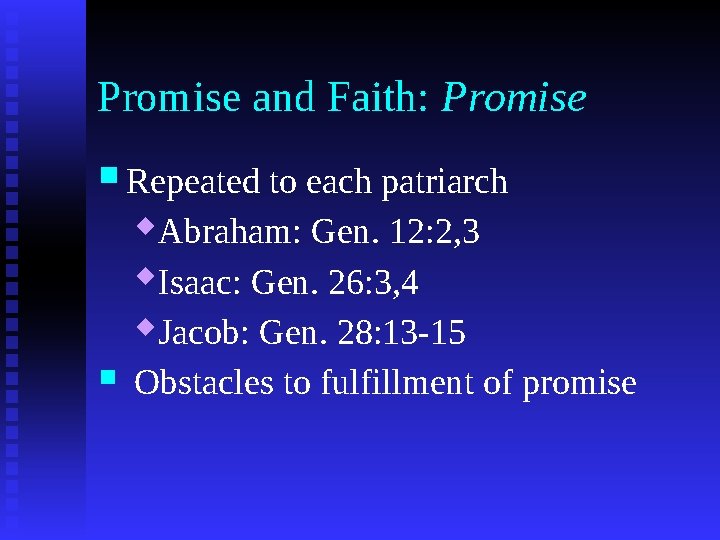
Promise and Faith: Promise Repeated to each patriarch Abraham: Gen. 12: 2, 3 Isaac: Gen. 26: 3, 4 Jacob: Gen. 28: 13 -15 Obstacles to fulfillment of promise
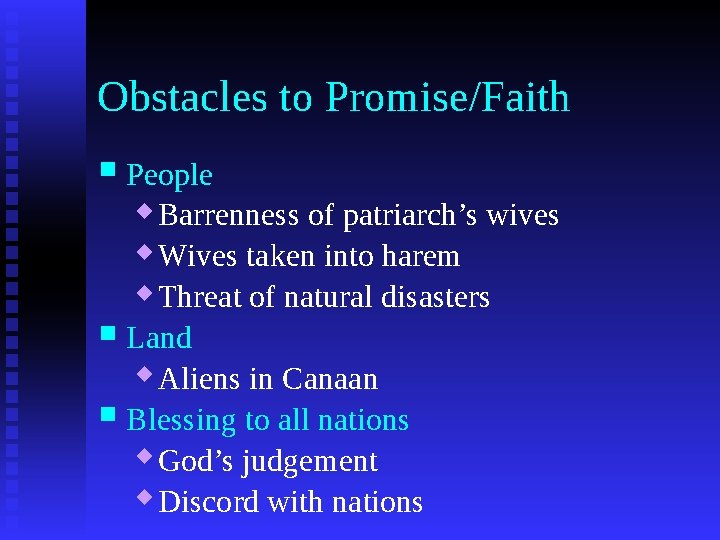
Obstacles to Promise/Faith People Barrenness of patriarch’s wives Wives taken into harem Threat of natural disasters Land Aliens in Canaan Blessing to all nations God’s judgement Discord with nations
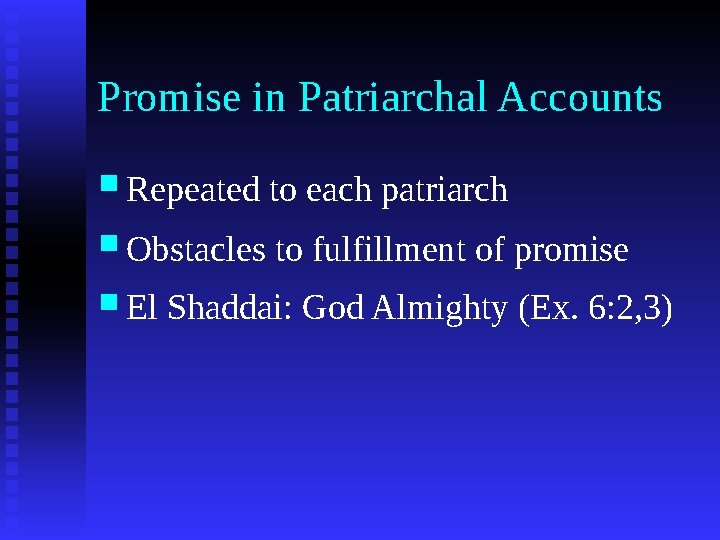
Promise in Patriarchal Accounts Repeated to each patriarch Obstacles to fulfillment of promise El Shaddai: God Almighty (Ex. 6: 2, 3)
End of Genesis ends with Abraham as small clan Joseph account: Abrahamic clan goes into Egypt
Exodus: Formation of a People By mighty act of redemption (1 -18) By covenant (19 -24) By His presence (25 -40) “Exodus is not a literary or theological goulash. It did not come together haphazardly or without a guiding purpose, or with no unified concept to hold it together. ” (Durham)
Redemption Redeemer is one who liberates family member who has fallen into bondage Israel bound to Pharaoh in covenant? Living under authority of Pharaoh was religious Liberation to serve God in all of life
Liberated to serve God alone ‘In the Exodus, the power of the suzerain is broken; the pharaoh, the god-king of Egypt, was defeated and therefore lost his right to be Israel’s suzerain lord; the Lord conquered the pharaoh and therefore ruled as King over Israel (Exod. 15: 18). As their deliverer, God had claimed the right to call for his people’s obedient commitment to him in the covenant’ (Craigie).
By a Mighty Act of Redemption By a mediator Yahweh
Meaning of Yahweh Covenant Presence “I faithfulness with Israel will be who I will be” (character known by future acts)
By a Mighty Act of Redemption By a mediator Yahweh • Through acts of judgement
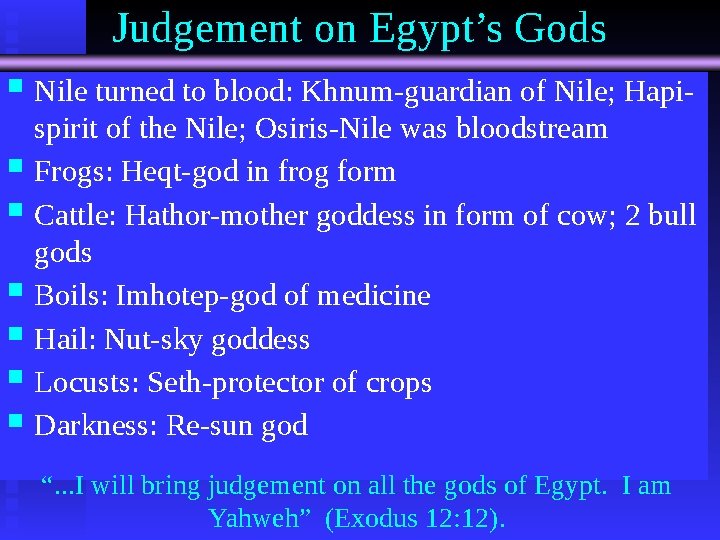
Judgement on Egypt’s Gods Nile turned to blood: Khnum-guardian of Nile; Hapispirit of the Nile; Osiris-Nile was bloodstream Frogs: Heqt-god in frog form Cattle: Hathor-mother goddess in form of cow; 2 bull gods Boils: Imhotep-god of medicine Hail: Nut-sky goddess Locusts: Seth-protector of crops Darkness: Re-sun god “. . . I will bring judgement on all the gods of Egypt. I am Yahweh” (Exodus 12: 12).
By Covenant (19 -24) Meaning of covenant Israel’s calling: treasured possession, holy nation, priestly kingdom Model of redeemed humanity
Treasured Possession, Holy Nation, Priestly Kingdom ‘. . . these terms are designed to show the way in which Israel will continue to exercise her Abrahamic role [be a blessing to the nations], and thus provide a commentary on the way in which the promises of Genesis 12: 1 -3 will find their fulfillment’ (Dumbrell).
Importance of Israel’s Calling for Redemptive History ‘The history of Israel from this point on is in reality merely a commentary upon the degree of fidelity with which Israel adhered to this Sinai-given vocation’ (Dumbrell).
By Covenant (19 -24) Meaning Israel’s of covenant calling: treasured possession, holy nation, priestly kingdom • Law
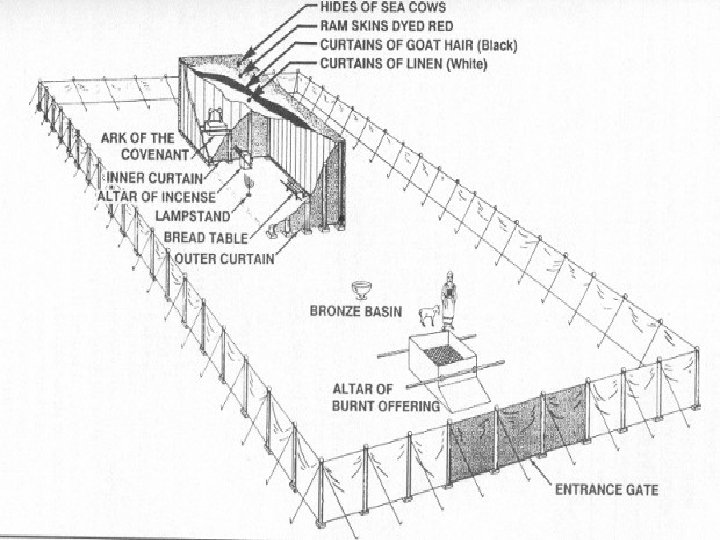
By Indwelling Presence (25 -40) Tabernacle
By Indwelling Presence (25 -40) • Tabernacle • Exodus 32 -34: Misplaced section?
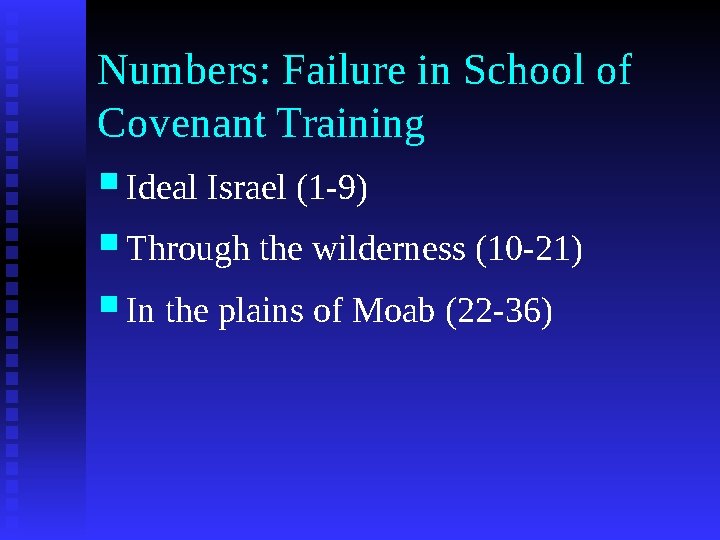
Numbers: Failure in School of Covenant Training Ideal Israel (1 -9)
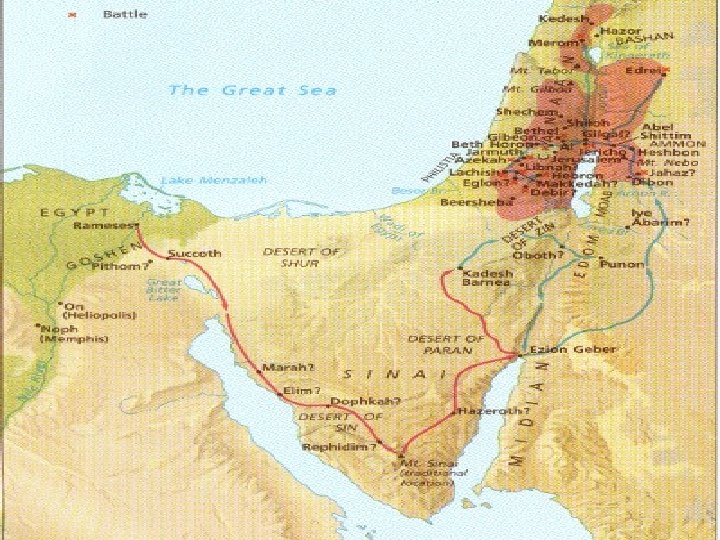
Numbers: Failure in School of Covenant Training Ideal Israel (1 -9) Through the wilderness (10 -21)
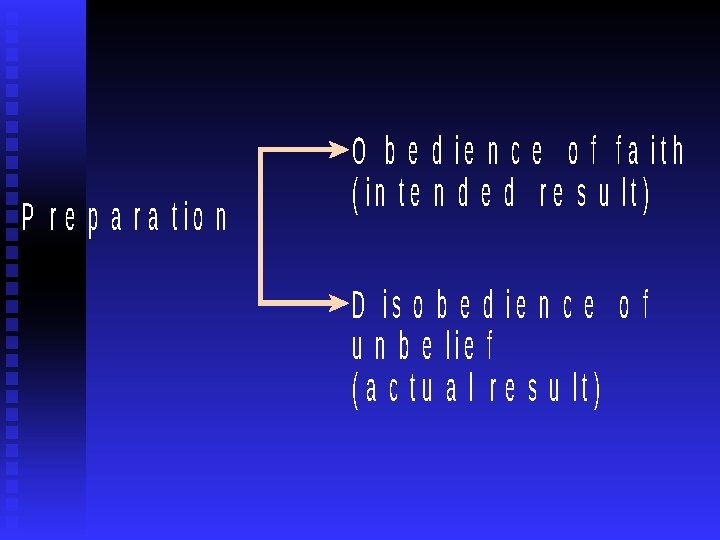
Preparation Obedience of faith
Schools in Wilderness: Lessons to be Learned Follow Lord’s appointed leader Trust Lord to provide necessities Trust Lord to defeat enemies
Israel Fails Course! Leadership squabbles (12, 16) Complaining (11, 20) Fear of enemies (12 -14)
P r e p a r a tio n O b e d ie n c e o f f a it h ( in te n d e d r e s u lt ) D is o b e d ie n c e o f u n b e lie f ( a c tu a l r e s u lt)
Numbers: Failure in School of Covenant Training Ideal Israel (1 -9) Through In the wilderness (10 -21) the plains of Moab (22 -36)
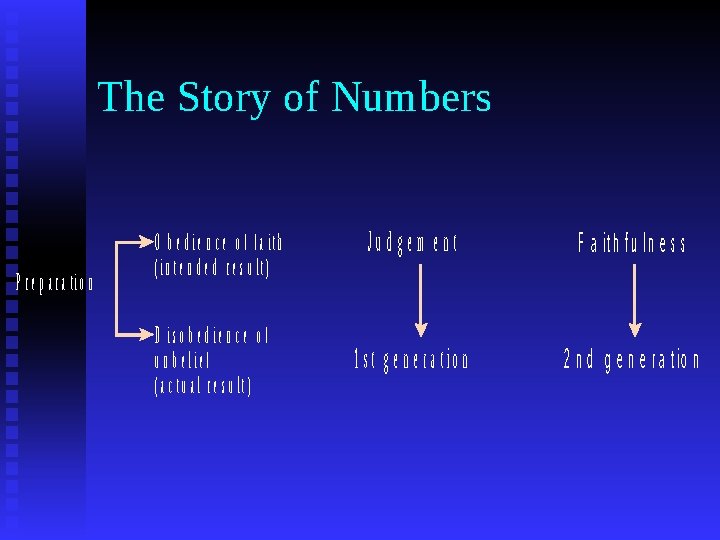
The Story of Numbers P r e p a r a tio n O b e d ie n c e o f fa ith ( in te n d e d r e s u lt) D iso b e d ie n c e o f u n b e lie f ( a c tu a l r e s u lt) Jud gem ent F a it h f u ln e s s 1 s t g e n e ra tio n 2 n d g e n e r a t io n
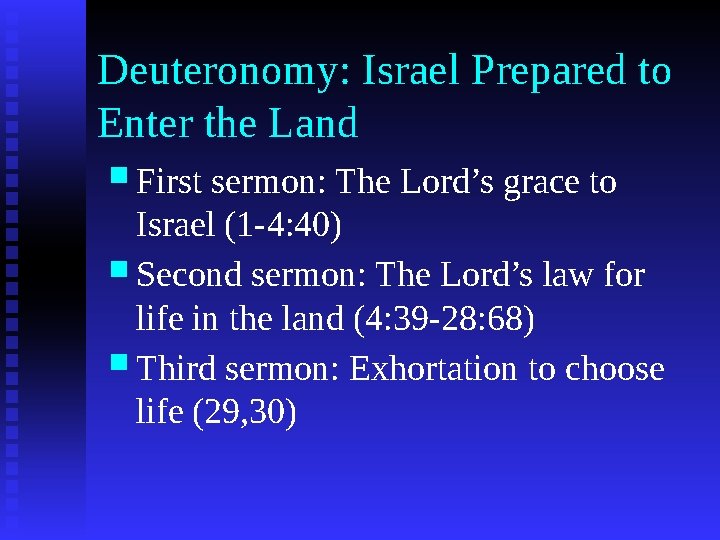
Deuteronomy: Israel Prepared to Enter the Land First sermon: The Lord’s grace to Israel (1 -4: 40) Second sermon: The Lord’s law for life in the land (4: 39 -28: 68) Third sermon: Exhortation to choose life (29, 30)
ACT THREE The King Chooses Israel: Redemption Initiated Scene Two: A Land for the People
Light on the land People formed to be light to the nations Set on the land to be light to the nations Land as “crossroads to the nations” and the “navel of the universe”
Joshua Theme: God keeps covenant promise to give Israel the land.
Joshua: Structure of the Book The Lord leads Israel into the land (1: 1 -5: 12) The Lord gives land to Israel (5: 1312: 24) The Lord distributes the land (13: 122: 34) The Lord consolidates rule over land (23, 24)
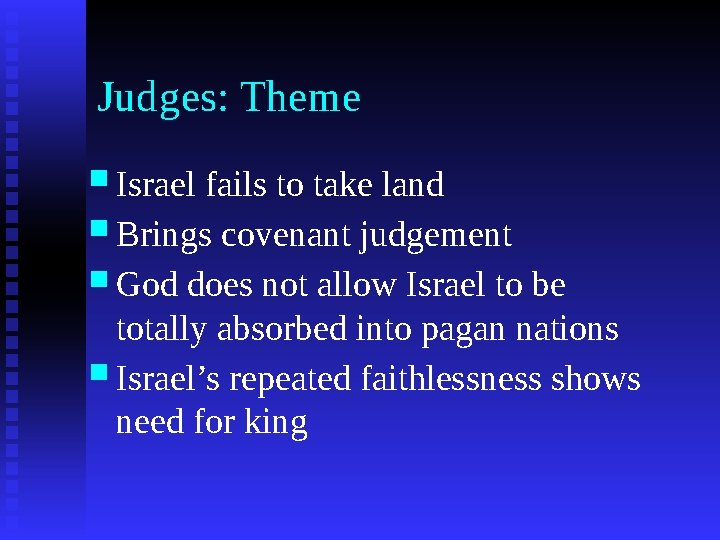
Judges: Theme Israel fails to take land Brings covenant judgement God does not allow Israel to be totally absorbed into pagan nations Israel’s repeated faithlessness shows need for king
Judges: Structure Israel fails to drive out Canaanites (1) The Lord’s covenant court case (2: 1 -5) Cycles (2: 11 -23)
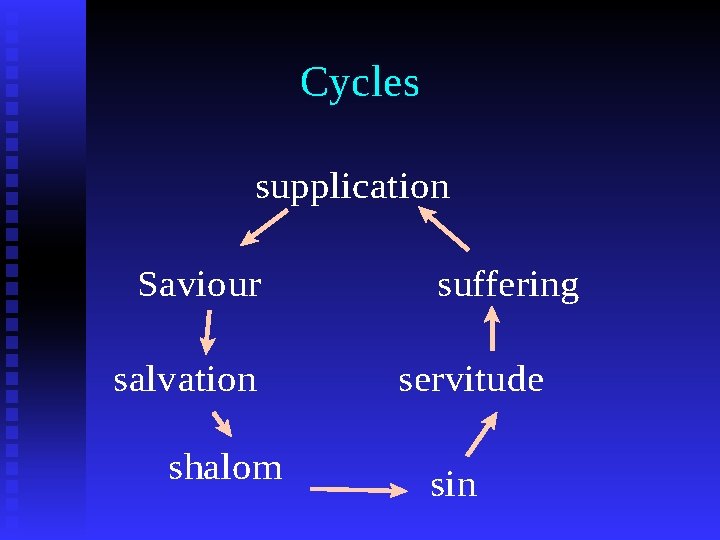
Cycles supplication Saviour salvation shalom suffering servitude sin
Judges: Structure Israel fails to drive out Canaanites (1) The Lord’s covenant court case (2: 1 -5) Cycles (2: 11 -23) Cycles elaborated historically (3 -16) Corruption illustrated (17 -21)
Cry of the Book of Judges In those days Israel had no king; everyone did as he saw fit (21: 25). Cry for better Deliverer David Jesus
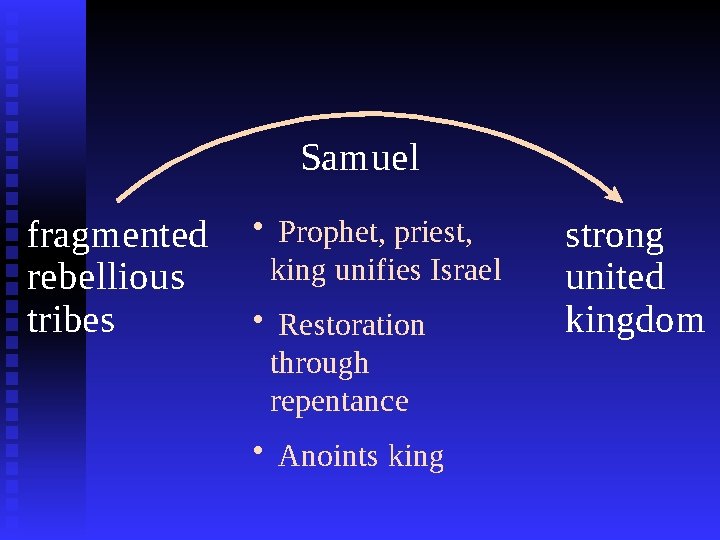
1 & 2 Samuel Theme: Under the leadership of the Lord’s anointed king, Israel is transformed from a group of fragmented, rebellious tribes into a strong, united kingdom.
1 & 2 Samuel: Structure Priestly leadership collapses and Samuel arises as transition figure (1 -6)
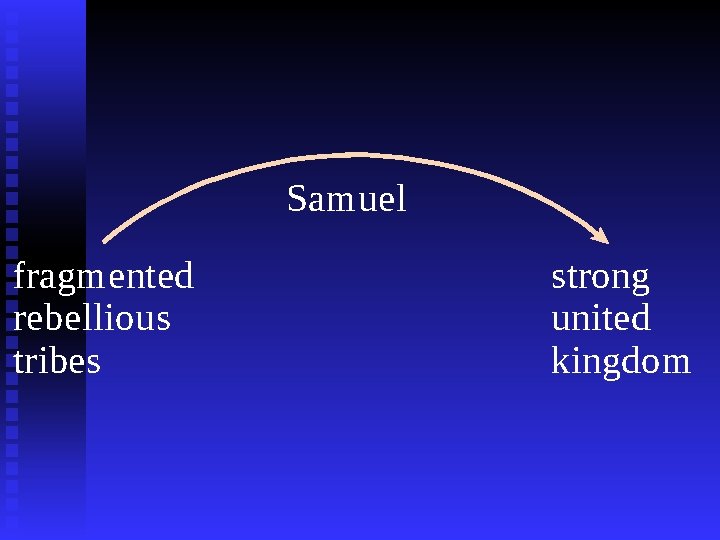
Samuel fragmented rebellious tribes strong united kingdom
1 & 2 Samuel Priestly leadership collapses and Samuel arises as transition figure (1 -6) Samuel’s role: From tribe to kingdom (7)
Samuel fragmented rebellious tribes • Prophet, priest, king unifies Israel • Restoration through repentance • Anoints king strong united kingdom
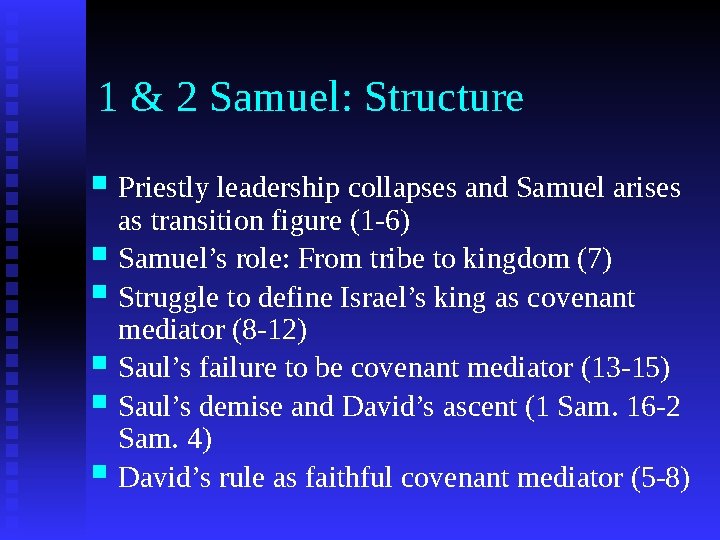
1 & 2 Samuel: Structure Priestly leadership collapses and Samuel arises as transition figure (1 -6) Samuel’s role: From tribe to kingdom (7) Struggle to define Israel’s king as covenant mediator (8 -12) Saul’s failure to be covenant mediator (13 -15) Saul’s demise and David’s ascent (1 Sam. 16 -2 Sam. 4) David’s rule as faithful covenant mediator (5 -8)
Faithful Covenant King Establishes temple life of Israel Defeats Israel’s enemies Enforces law
Davidic Covenant (2 Samuel 7: 11 -16) Descendant of David will rule over universal, everlasting kingdom Israel’s hope for redemption tied to David’s line
1 & 2 Samuel: Structure Priestly leadership collapses and Samuel arises as transition figure (1 -6) Samuel’s role: From tribe to kingdom (7) Struggle to define Israel’s king as covenant mediator (8 -12) Saul’s failure to be covenant mediator (13 -15) Saul’s demise and David’s ascent (1 Sam. 16 -2 Sam. 4) David’s rule as faithful covenant mediator (5 -8) David’s failure (9 -20) Hope for triumph in Davidic covenant (21 -24)
1 & 2 Kings Israel’s demise: 950: Israel world kingdom under Solomon 722: 10 of 12 tribes wiped out by Assyria 586: Jerusalem, temple destroyed 2 tribes exiled by Babylon
1 & 2 Kings Israel’s demise Exilic despair
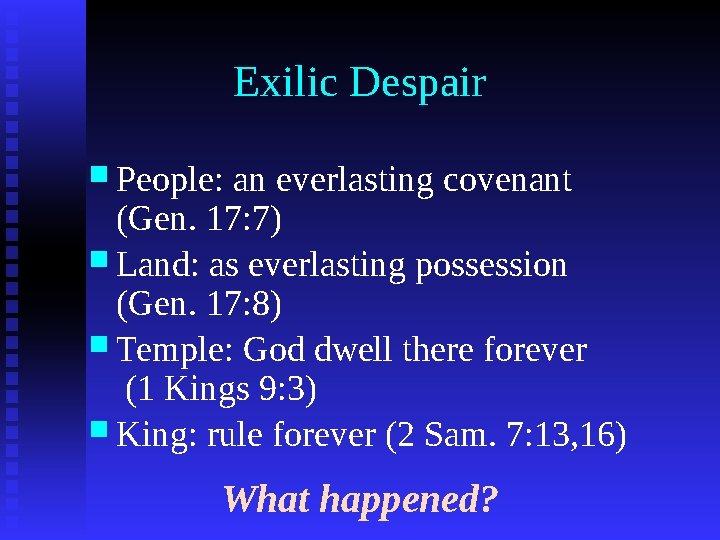
Exilic Despair People: an everlasting covenant (Gen. 17: 7) Land: as everlasting possession (Gen. 17: 8) Temple: God dwell there forever (1 Kings 9: 3) King: rule forever (2 Sam. 7: 13, 16) What happened?
1 & 2 Kings Israel’s demise Exilic despair Covenant perspective
Covenant Perspective G od death destruction curse life prosperity blessing (1 Kings 9: 2 -9; 2 Kings 17: 7 ff. )
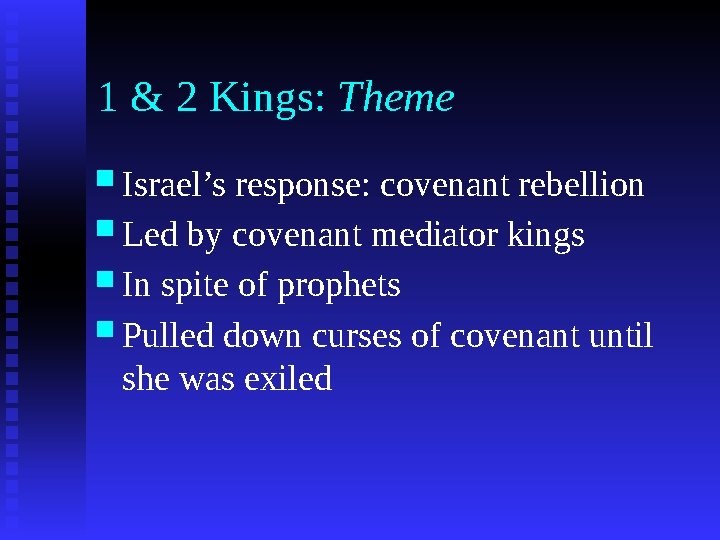
1 & 2 Kings: Theme Israel’s response: covenant rebellion Led by covenant mediator kings In spite of prophets Pulled down curses of covenant until she was exiled
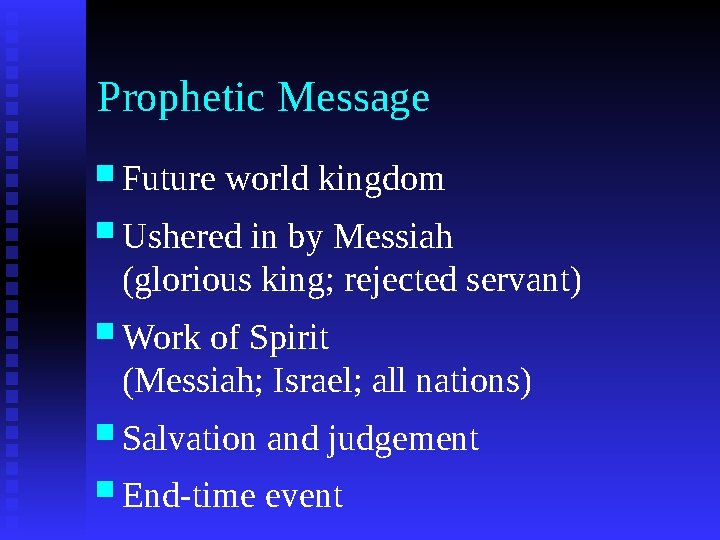
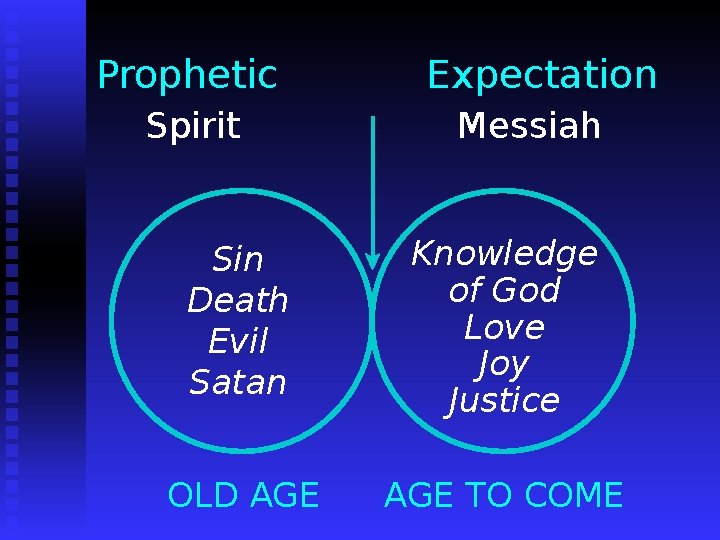
Prophetic Message Future world kingdom Ushered in by Messiah (glorious king; rejected servant) Work of Spirit (Messiah; Israel; all nations) Salvation and judgement End-time event
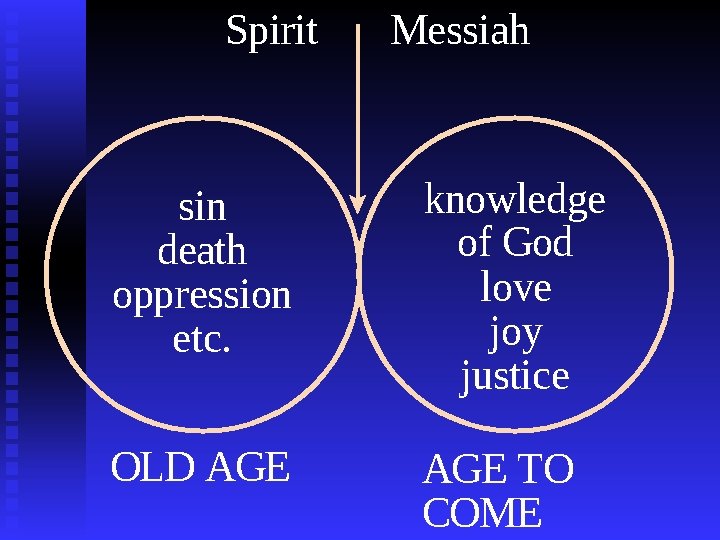
Spirit Messiah sin death oppression etc. knowledge of God love joy justice OLD AGE TO COME
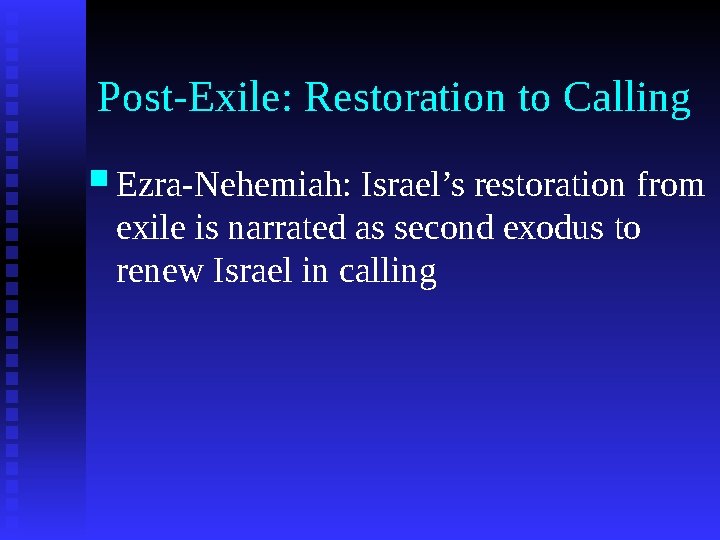
Post-Exile: Restoration to Calling Ezra-Nehemiah: Israel’s restoration from exile is narrated as second exodus to renew Israel in calling
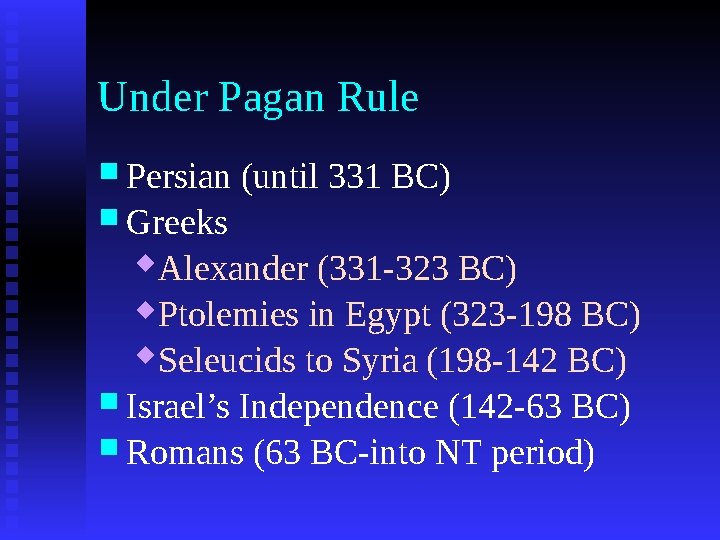
Under Pagan Rule Persian (until 331 BC) Greeks Alexander (331 -323 BC) Ptolemies in Egypt (323 -198 BC) Seleucids to Syria (198 -142 BC) Israel’s Independence (142 -63 BC) Romans (63 BC-into NT period)
Intertestamental Period Growing tension: Exile and faith/hope Growing hope: Coming of kingdom Growing concern: Faithfulness to Torah
Intertestamental Period Persian rule: Jewish identity Alexander the Great: Threat of Hellenism Antiochus Epiphanes and Maccabean revolt Compromised Jewish rule (Hasmoneans) and diversified response
Diversified Response Essenes: withdrawal Pharisees: boundary markers Zealots: violent revolt Sadducees: compromise
Intertestamental Period Persian rule: Jewish identity Alexander the Great: Threat of Hellenism Antiochus Epiphanes and Maccabean revolt Compromised Jewish rule (Hasmoneans) and diversified response Roman rule and revolt Israel ready for God’s kingdom: A story in search of an ending
ACT FOUR Kingdom Restored: Redemption Accomplished Jesus’ Mission
Kingdom: Dominating Centre of Jesus’ Mission The central theme of Jesus' message, as it comes down to us in the synoptic gospels, is the coming of the kingdom of God. . . It may be rightly said that the whole of the preaching of Jesus Christ and his apostles is concerned with the kingdom of God, and that in Jesus Christ's proclamation of the kingdom we are face to face with the specific form of expression of the whole of his revelation of God (Ridderbos).
Kingdom: Dominating Centre of Jesus’ Mission Jesus announces the kingdom (Mk. 1: 15 -17; Luke 4: 21) Jewish expectation What is the kingdom?
What is the Reign/Kingdom of God? Power of God in Christ by the Spirit to restore creation (especially humanity) to again live under the rule of God.
Kingdom: Dominating Centre of Jesus’ Mission Jesus announces the kingdom (Mk. 1: 1517; Luke 4: 21) Jewish expectation What is the kingdom? A new way
Jesus’ Kingdom Mission: A New Way Disagreement among Jews: who, how, when, how to live Violence and separation ‘Love of enemies instead of their destruction; unconditional forgiveness instead of retaliation; readiness to suffer instead of using force; blessing for peacemakers instead of hymns of hate and revenge' (Kung).
Jesus Launches His Kingdom Mission John the Baptizer: Repent for the kingdom of God is near Baptism of Jesus Descent of Spirit Temptation Stones to bread: Economic messiah Jump from temple: Wonderworker messiah Worship Satan: Political-military messiah
Jesus’ Kingdom Mission Announced reign of God with words
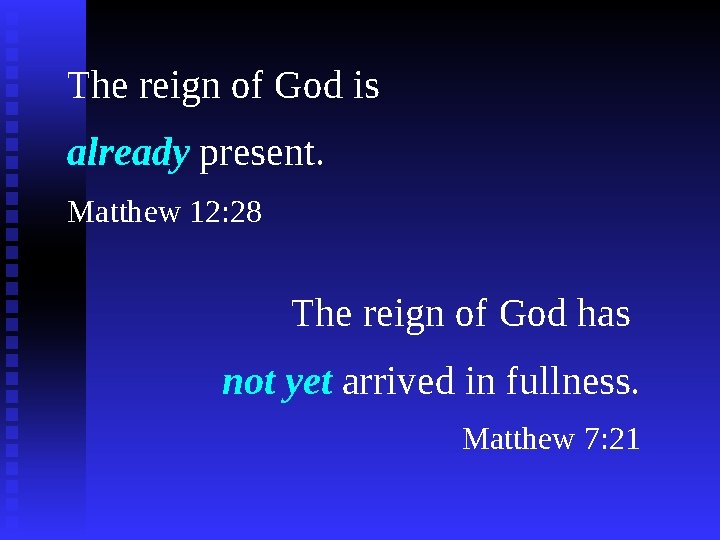
The reign of God is already present. Matthew 12: 28 The reign of God has not yet arrived in fullness. Matthew 7: 21
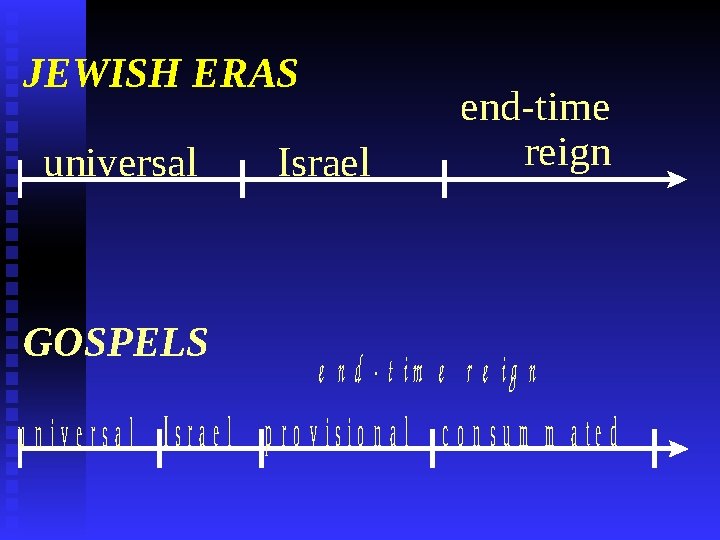
JEWISH ERAS universal GOSPELS Israel end-time reign e n d - t im e r e ig n u n iv e rs a l Is ra e l p ro v isio n a l c o n s u m m a te d
Prophetic Spirit Expectation Messiah Sin Death Evil Satan Knowledge of God Love Joy Justice OLD AGE TO COME
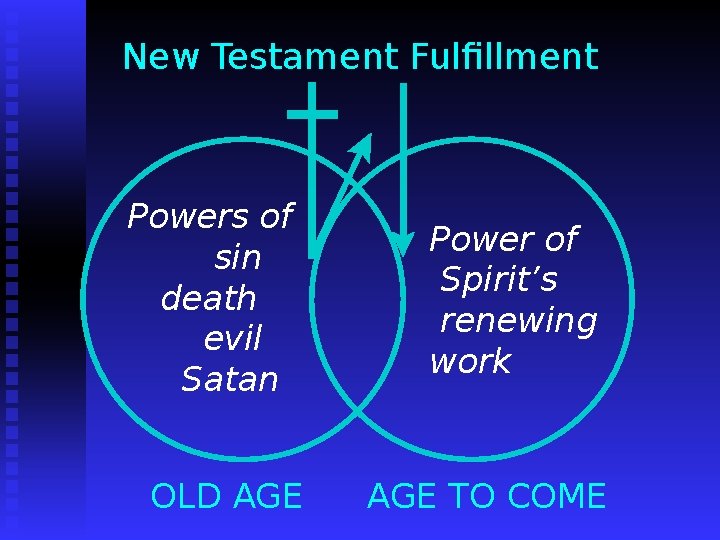
New Testament Fulfillment Powers of sin death evil Satan OLD AGE Power of Spirit’s renewing work AGE TO COME
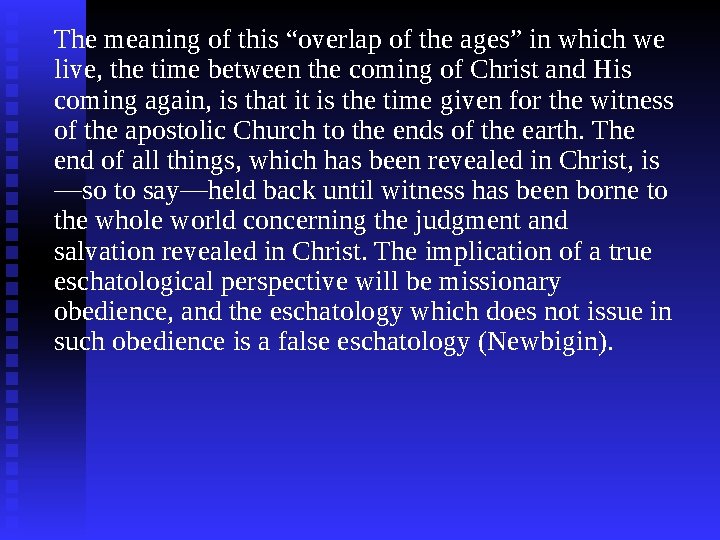
The meaning of this “overlap of the ages” in which we live, the time between the coming of Christ and His coming again, is that it is the time given for the witness of the apostolic Church to the ends of the earth. The end of all things, which has been revealed in Christ, is —so to say—held back until witness has been borne to the whole world concerning the judgment and salvation revealed in Christ. The implication of a true eschatological perspective will be missionary obedience, and the eschatology which does not issue in such obedience is a false eschatology (Newbigin).
Salvation and Judgement? Prophetic message Is. 63: 4, 5 Luke 4: 16 -30 John 3: 17 John the Baptizer’s confusion (Lk. 3: 7 -9; 17; 7: 18 -23)
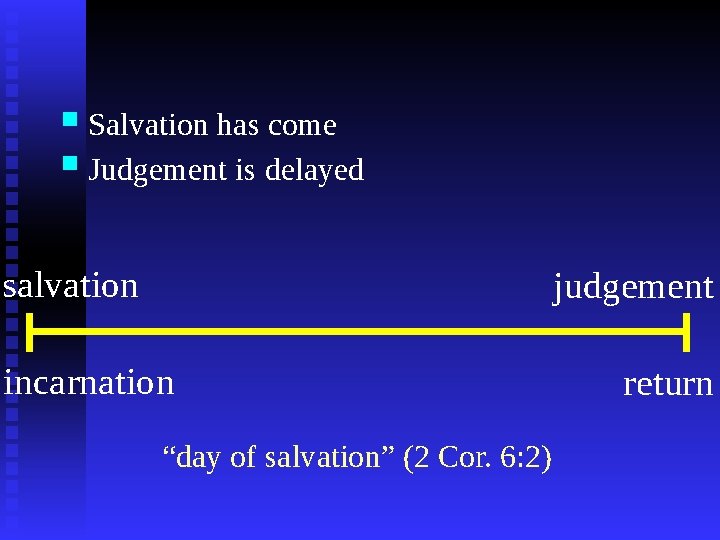
Salvation has come Judgement is delayed salvation judgement incarnation “day of salvation” (2 Cor. 6: 2) return
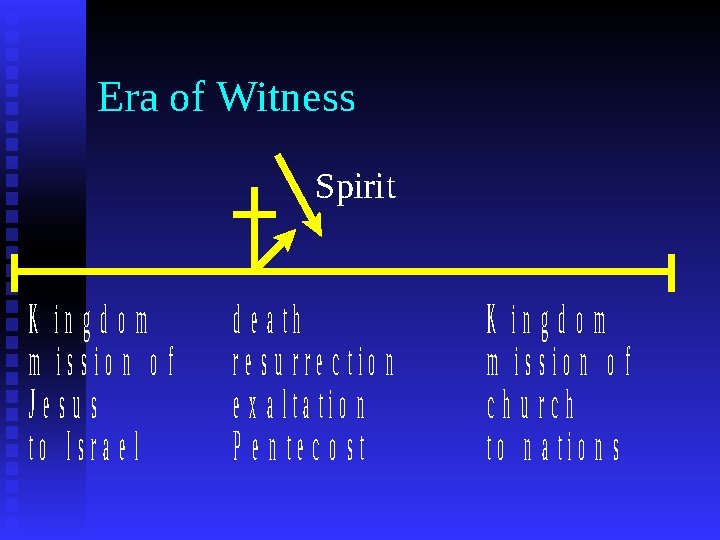
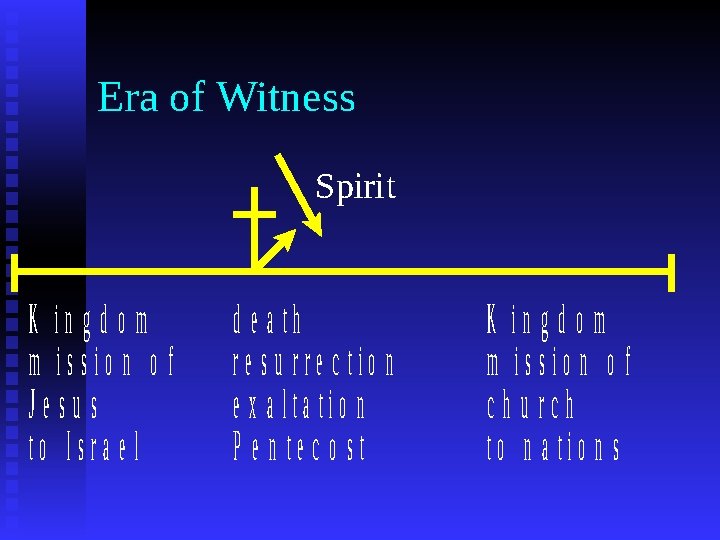
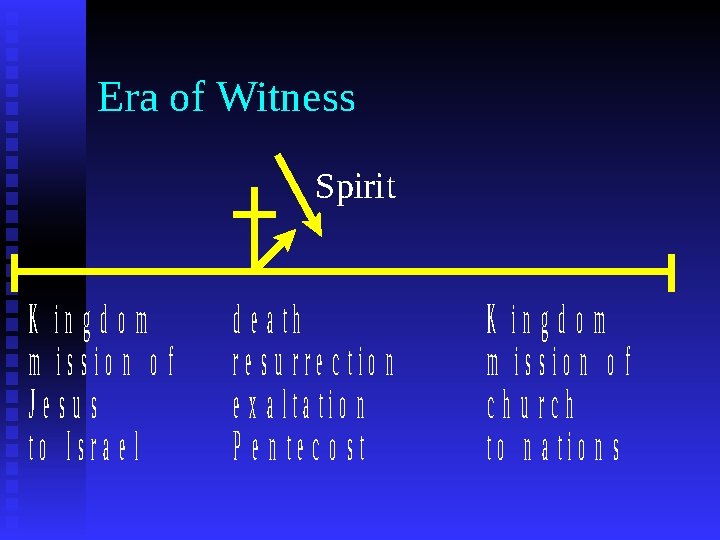
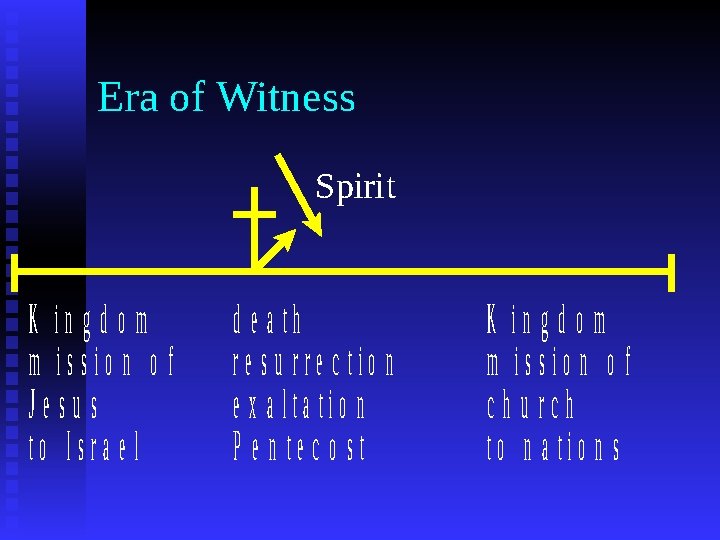
Era of Witness Spirit K in g d o m m is s io n o f Jesus to Is ra e l d e a th re s u rre c tio n e x a lta tio n P e n te c o s t K in g d o m m is s io n o f ch u rch to n a tio n s
Announcement of God’s Kingdom (Lk. 4: 43) Announcement of arrival of God’s power to restore rule Demand for decision: Repent and believe! Follow me! (Mark 1: 14 -18) Two metaphors: receive the gift of the kingdom; enter the realm of the kingdom Decision: resolute, urgent (Lk. 9: 57 -62); radical (Lk. 9: 23 ff. ; Lk. 13: 24); costly (Lk. 14: 25 -33; Matt. 19: 16 -24); eternal (Lk. 13: 25 -30) Receive blessing of kingdom: forgiveness, Abba relation to God, renewed life, joy, etc. Receive demands of kingdom: righteousness/justice, love, etc.
Jesus’ Kingdom Mission Announced reign of God with words Demonstrated reign of God with deeds
Demonstration of God’s Kingdom Blind see; lame walk; deaf hear; sick healed; dead raised; poor/lost received; sinners forgiven; cursed creation restored; demons cast out; lives changed (cf. Luke 7: 21 -23) Signs of God’s kingdom Inclusion in kingdom community of marginalized
Admittance to the Qumran Community Neither the blind nor the lame Nor the deaf nor the dumb Nor the lepers nor those whose flesh is blemished Shall be admitted to the council of the community
Jesus’ Kingdom Mission Announced reign of God with words Demonstrated reign of God with deeds Source of Jesus’ power: Abba, Holy Spirit, prayer
Jesus’ Kingdom Mission Announced reign of God with words Demonstrated reign of God with deeds Source of Jesus’ power: Abba, Holy Spirit, prayer Arouses opposition to kingdom mission
Opposition to Jesus’ Mission Temple, sabbath, food laws, tithing: symbols of separation and hatred Jesus challenges idolatrous status quo (John 15: 18 -20) Suffering for sake of kingdom
Jesus’ Kingdom Mission Announced reign of God with words Demonstrated reign of God with deeds Source of Jesus’ power: Abba, Holy Spirit, prayer Arouses opposition to kingdom mission Jesus gathers a kingdom community
Formation of Kingdom Community Gathering of scattered Israel (Ezek. 36. 24) Cleansing of idolatrous Israel and gift of Spirit (Ezek. 36. 24) Appointment of 12: Symbolic prophetic action of eschatological restoration of Israel (Matt. 5. 14 -16; cf. Is. 2. 2) Jew first, then Gentile Taught about life in the kingdom (e. g. Matt. 5 -7; Lk. 6; Jn. 13 etc. ) Participation in Jesus’ kingdom mission (Lk 9. 1 -6)
Jesus’ Kingdom Mission Announced reign of God with words Demonstrated reign of God with deeds Source of Jesus’ power: Abba, Holy Spirit, prayer Arouses opposition to kingdom mission Jesus gathers a kingdom community Jesus welcomes sinners and outcasts
Welcoming Socio-Religious Outcasts Friend of tax-collectors, sinners, prostitutes, lepers Doctor comes to sick Table fellowship Healings
Jesus’ Kingdom Mission Announced kingdom of God with words Demonstrated reign of God with deeds Source of Jesus’ power: Abba, Holy Spirit, prayer Arouses opposition to kingdom mission Jesus gathers a kingdom community Jesus welcomes sinners and outcasts Explained kingdom of God with parables
Parables: Correcting Wrong Notions Kingdom does not come all at once It is hidden; comes in weakness, can be rejected, humble, unobtrusive (Matt. 13: 1 ff. )
Parables: Correcting Wrong Notions Kingdom does not come in irresistible power or immediate, manifest glory Small, insignificant, tremendous conflict, suffering, antithesis (Matt. 13: 24 ff. ; 31 -33)
Parables: Correcting Wrong Notions Kingdom is not Jewish kingdom reserved for wealthy and righteous Gentiles, poor, sinners (Lk. 14: 15 ff. ; 15: 132)
Parables: Correcting Wrong Notions Final judgement does not come immediately Reserved for future (Matt. 13: 24 - 30; 13: 4752)
Parables: Correcting Wrong Notions Reason for delay: Give opportunity to gather people into kingdom (Luke 14: 1524).
Jesus’ Kingdom Mission Announced kingdom of God with words Demonstrated reign of God with deeds Source of Jesus’ power: Abba, Holy Spirit, prayer Arouses opposition to kingdom mission Jesus gathers a kingdom community Jesus welcomes sinners and outcasts Explained kingdom of God with parables Embodied kingdom with his life
Embodiment of God’s Kingdom Abba-relation to God (Jn. 17: 1 -3); Life in Spirit (Acts 10: 38); Love (Jn. 15: 9 ff. ); Joy (Jn. 15: 11); Peace (Jn. 14: 27); Obedience (Jn. 17: 4; Heb. 5: 8); Solidarity with excluded (Lk. 4: 18); Justice (Lk. 9: 58) etc.
Jesus Concludes His Kingdom Mission in Jerusalem Three prophetic-symbolic, Messianic actions Jesus enters Jerusalem on a donkey Jesus enacts judgement on temple Jesus symbolizes his death Arrest and trials Crucifixion Resurrection
Era of Witness Spirit K in g d o m m is s io n o f Jesus to Is ra e l d e a th re s u rre c tio n e x a lta tio n P e n te c o s t K in g d o m m is s io n o f ch u rch to n a tio n s
Significance of Jesus’ Ministry Jesus revealed the end Jesus accomplished the end
Summary: Jesus’ Kingdom Mission Announced kingdom of God with words Demonstrated reign of God with deeds Source of Jesus’ power: Abba, Holy Spirit, prayer Arouses opposition to kingdom mission Jesus gathers a kingdom community Jesus welcomes sinners and outcasts Explained kingdom of God with parables Embodied kingdom with his life
Jesus gave evidence of power of God to renew and restore. . . However, if his followers were to enjoy the same restoration. . . Then sin the enemy of God’s kingdom must be destroyed.
Death SIN Satanic power Forms of sin (hatred, greed, etc) Results of sin (sickness, suffering, etc) only accomplished through Jesus’ death and resurrection
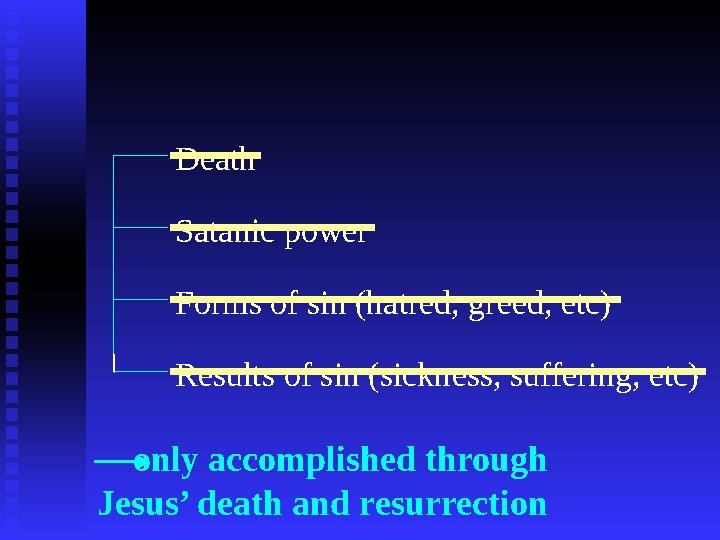
Death Satanic power Forms of sin (hatred, greed, etc) Results of sin (sickness, suffering, etc) only accomplished through Jesus’ death and resurrection
Era of Witness Spirit K in g d o m m is s io n o f Jesus to Is ra e l d e a th re s u rre c tio n e x a lta tio n P e n te c o s t K in g d o m m is s io n o f ch u rch to n a tio n s
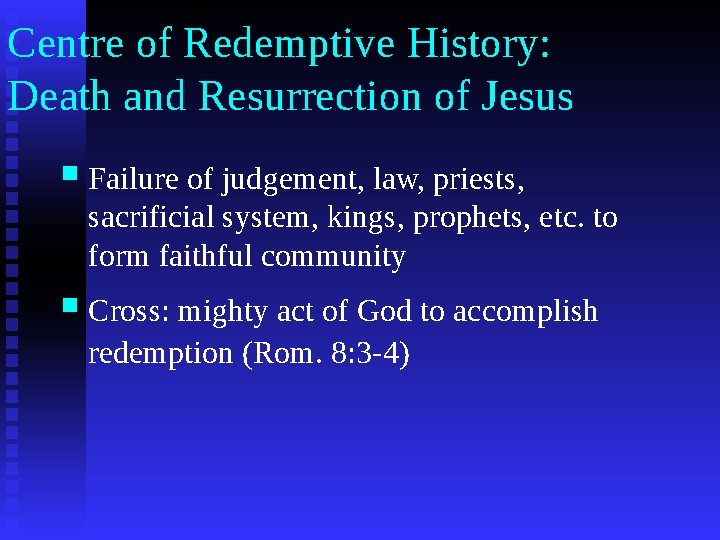
Centre of Redemptive History: Death and Resurrection of Jesus Failure of judgement, law, priests, sacrificial system, kings, prophets, etc. to form faithful community Cross: mighty act of God to accomplish redemption (Rom. 8: 3 -4)
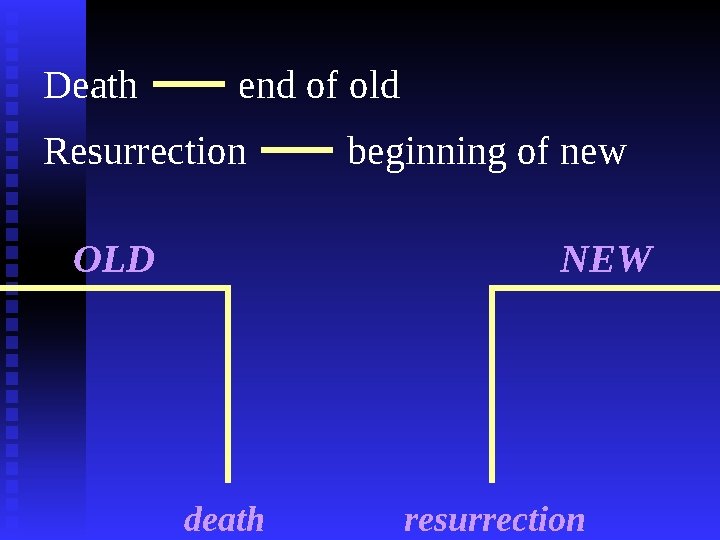
Death end of old Resurrection OLD beginning of new NEW death resurrection
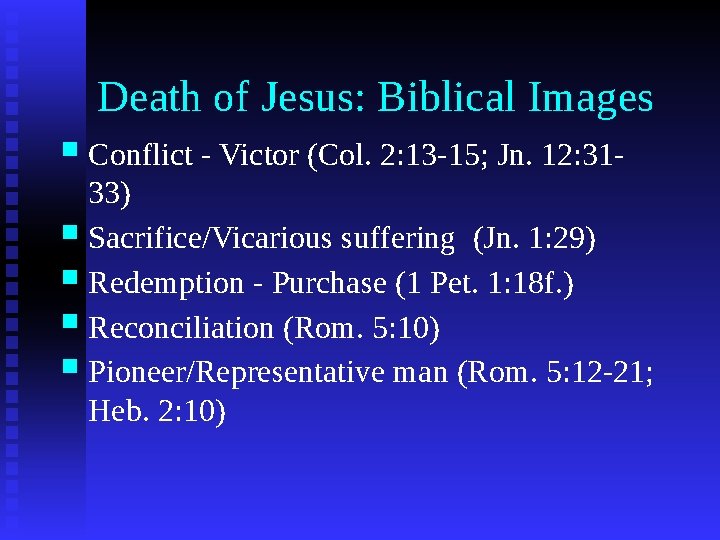
Death of Jesus: Biblical Images Conflict - Victor (Col. 2: 13 -15; Jn. 12: 3133) Sacrifice/Vicarious suffering (Jn. 1: 29) Redemption - Purchase (1 Pet. 1: 18 f. ) Reconciliation (Rom. 5: 10) Pioneer/Representative man (Rom. 5: 12 -21; Heb. 2: 10)
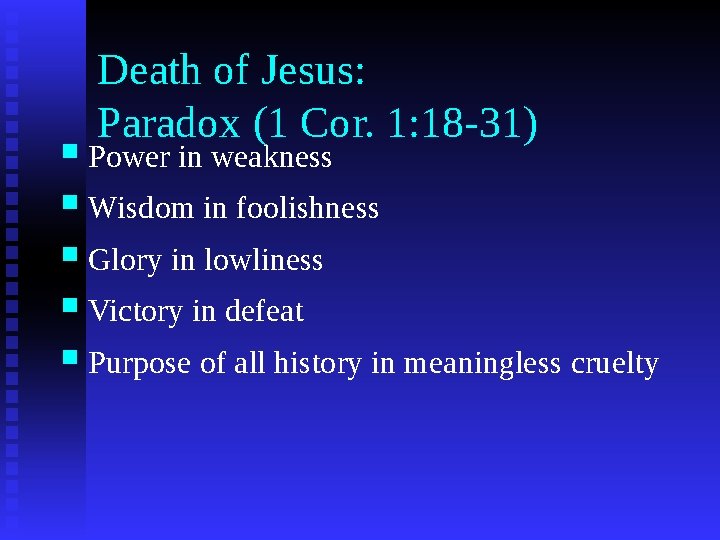
Death of Jesus: Paradox (1 Cor. 1: 18 -31) Power in weakness Wisdom in foolishness Glory in lowliness Victory in defeat Purpose of all history in meaningless cruelty
Jesus died to restore His creation. . . we participate in that new creation as we trust in Christ.
Resurrection of Jesus Resurrection in Jewish thought: Arrival of life of new creation Jesus: Dawning of new creation Firstborn from the dead (Rev. 1: 5) Firstfruits (I Cor. 15: 20) Pioneer Resurrection in three stages: Jesus Church: Resurrection life in foretaste Church and creation
Resurrection of Jesus: Significance Alive to give life of Kingdom (Lk. 24: 1335) Vindication, proclamation, demonstration of victory (Col. 2: 15)
Resurrection of Jesus Not victory that reverses defeat of cross. . . …but proclamation and demonstration of victory. Image: victory parade (Col. 2: 15)
The Risen Lord Commissions His Disciples Matt. 28: 16 -20: Make disciples Luke 24: 46 -49: Witness to salvation in Jesus John 20: 19 -23: Sent to continue the mission of Jesus
ACT FIVE Kingdom Tasted and Displayed Church’s Kingdom Mission
Era of Witness: Acts 1. 1 -11 Kingdom, Spirit, resurrection (1. 1 -5) Obvious question (1. 6): Now you’ll restore the kingdom, right? Jesus’ answer (1. 7 -8) Not yet Receive the Spirit Witness to ends of the earth
Exaltation of Jesus Coronation day: installation of rightful king Place: Right hand of God (Acts 2: 33) Name: Lord (Phil. 2: 9 -11) Hidden (Heb. 2: 8 f. )
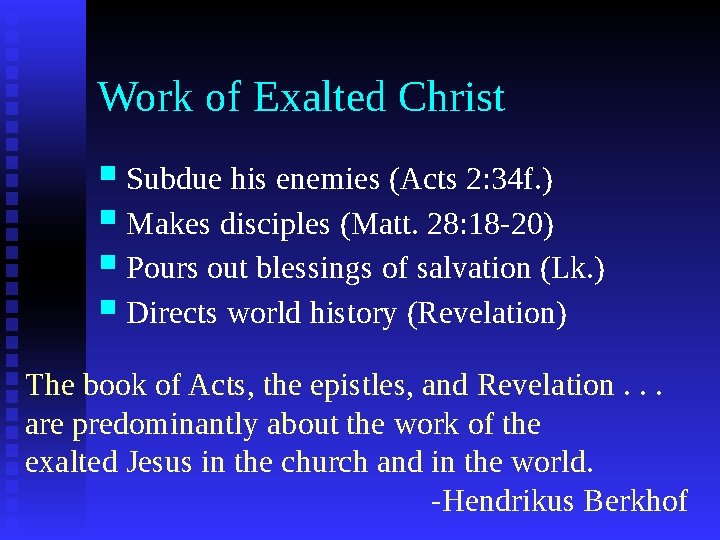
Work of Exalted Christ Subdue his enemies (Acts 2: 34 f. ) Makes disciples (Matt. 28: 18 -20) Pours out blessings of salvation (Lk. ) Directs world history (Revelation) The book of Acts, the epistles, and Revelation. . . are predominantly about the work of the exalted Jesus in the church and in the world. -Hendrikus Berkhof
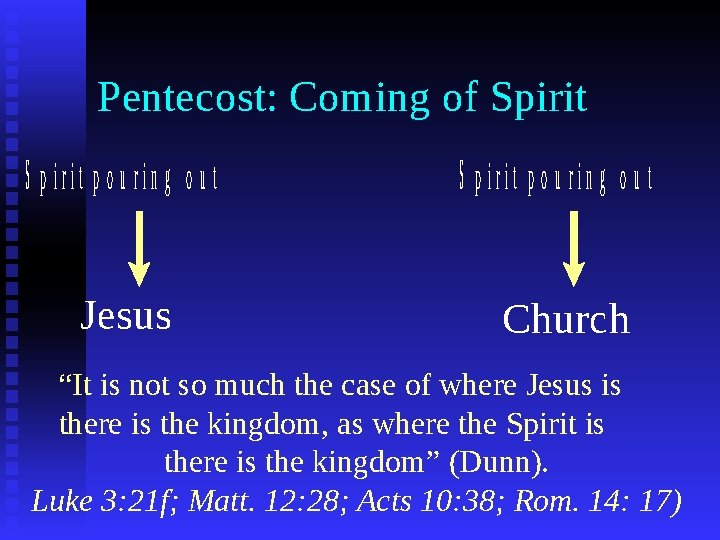
Pentecost: Coming of Spirit S p irit p o u rin g o u t Jesus Church “It is not so much the case of where Jesus is there is the kingdom, as where the Spirit is there is the kingdom” (Dunn). Luke 3: 21 f; Matt. 12: 28; Acts 10: 38; Rom. 14: 17)
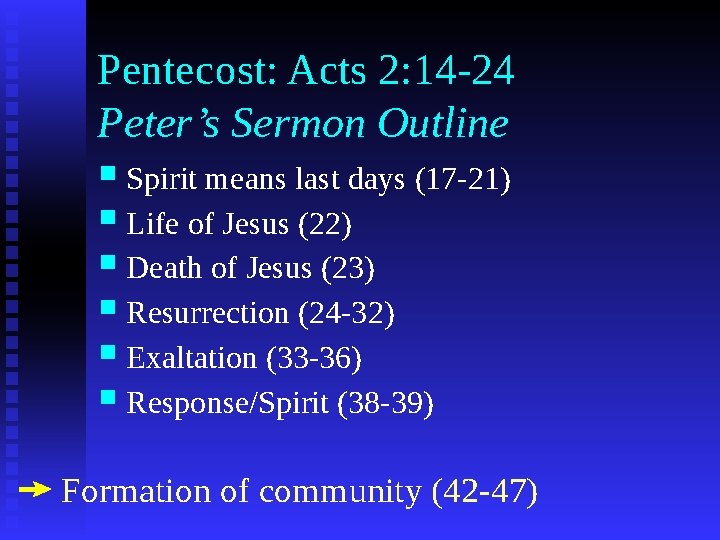
Pentecost: Acts 2: 14 -24 Peter’s Sermon Outline Spirit means last days (17 -21) Life of Jesus (22) Death of Jesus (23) Resurrection (24 -32) Exaltation (33 -36) Response/Spirit (38 -39) Formation of community (42 -47)
Era of Witness Spirit K in g d o m m is s io n o f Jesus to Is ra e l d e a th re s u rre c tio n e x a lta tio n P e n te c o s t K in g d o m m is s io n o f ch u rch to n a tio n s
Ideal Church: Acts 2: 42 -47 Devotion to apostles’ teaching, fellowship, breaking of bread, and prayer: Celebrating and nourishing kingdom life (v. 42) Life of kingdom manifested: Attractive ‘good news people’ (v. 43 - 47) Lord adds to number (v. 47)
Our place in the story. . . John 20: 21: “As the Father has sent me, I am sending you. ”. . . to continue the kingdom mission of Jesus
Story of Acts (1: 8) Witness in Jerusalem 3: 1 -6: 7 Witness in Samaria and Judea 6: 8 -12: 24 Witness to Ends of Earth 12: 25 -end
Acts narrates the progress of the gospel from a small gathering of Jewish disciples of the earthly Jesus in Jerusalem, across formidable cultic, ethnic, relational, and geographical boundaries, to Paul's bold and unhindered preaching of the risen and ascended Jesus to Gentiles in Rome. Acts is unmistakably a story of missionary expansion, which is announced in 1: 8 and confirmed along the way with the so-called progress reports (Rosner).
Witness in Jerusalem Word and deed (3: 1 -26) Suffering (4: 1 -22) Prayer (4: 23 -31) Work of God (6: 7) Attractive life of community (4: 32 -37; 6: 16)
Witness in Samaria and Judea Beyond Jerusalem Unplanned expansion by persecution (8: 1 -3) To Judea and Samaria Beyond Apostles Stephen, Phillip (6: 8 -8: 40) Common believers (8: 4; 11: 19 -21) Beyond Jews Gentiles (10, 11)
Witness to the Ends of the Earth Antioch: First Gentile church Paul’s missionary journeys Paul’s trials and witness To Rome
Church as a Missionary Community: Nearby and Faraway Pattern in Antioch (Acts 11, 13) Christians: ‘Evidence of grace of God’ in church at Antioch (11: 23) ‘Great number of people brought to the Lord’ (11: 24) Sent Saul and Barnabas (13: 1 -3)
Paul’s Pattern Pioneer church planting (Rom. 15: 23) Three missionary journeys Build them up for faithful witness Visits on journeys Letters
Spontaneous Expansion of the Church (Roland Allen) Spontaneous evangelism by common members of the church Attractive life of community Planting new churches
Ending of Acts Why so abrupt? Loose ends? Story of Acts has not ended Continues today until Christ returns . . . the ending of Acts is truly an opening to the continuing life of the messianic people, as it continues to preach the kingdom and teach the things concerning Jesus both boldly and without hindrance (Johnson).
ACT FIVE: Scene Two Tasting and Displaying the Kingdom The Church’s Witness Our Place in the Story
Our Place in the Story ‘What time is it? ’ Already/not yet era of kingdom Act five: Church continues the kingdom mission of Jesus
Summary: Jesus’ Kingdom Mission Announced reign of God with words Demonstrated reign of God with deeds Explained kingdom of God with teaching Embodied reign of God with life Prayed for reign of God to come Suffered for reign of God Formed community to live under rule of God ‘As the Father has sent me, I am sending you. ’
Jesus has not left us with a rigid model for action; rather he inspired his disciples to prolong the logic of his own action in a creative way amid the new and different historical circumstances in which the community would have to proclaim the gospel (Bosch).
Our Place in the Story ‘What time is it? ’ Already/not yet era of kingdom Act five: Church continues the Kingdom mission of Jesus Foretaste Preview
We have a foretaste of the Kingdom Actual taste now Complete meal in future We are previews of the Kingdom Actual footage of movie/kingdom Designed to interest viewer in future movie/kingdom so they will want to participate
Our Place in the Story ‘What time is it? ’ Already/not yet era of kingdom Act five: Church continues the kingdom mission of Jesus Foretaste Preview Witness to Christ’s rule over all of life
Following the apostles, the church is sent– Sent with the gospel of the kingdom to make disciples of all nations, to feed the hungry, to proclaim the assurance that in the name of Christ there is forgiveness of sin and new life for all who repent an believe– To tell the news that our world belongs to God. In a world estranged from God, where millions face confusing choices, this mission is central to our being, for we announce the one name that saves. The rule of Jesus Christ covers the whole world. To follow this Lord is to serve him everywhere, without fitting in, as lights in the darkness, as salt in a spoiling world. (CT, 44, 45)
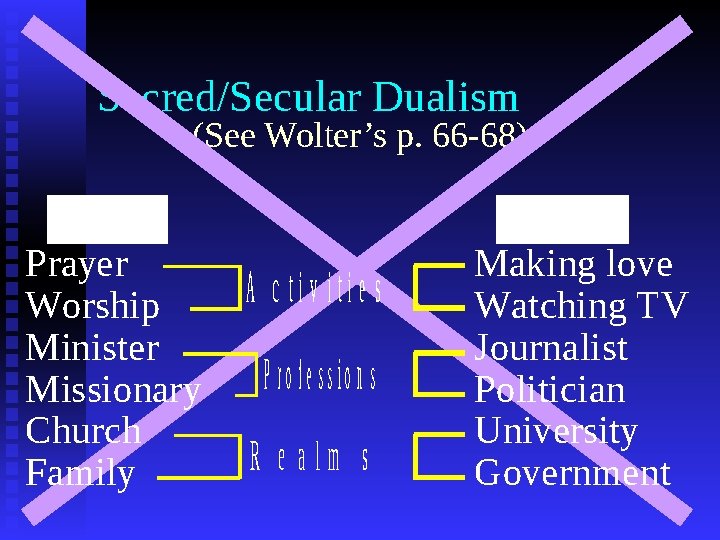
Embodying salvation means. . . living under Christ’s lordship in all of life.
Sacred/Secular Dualism (See Wolter’s p. 66 -68) Sacred Prayer Worship Minister Missionary Church Family Secular A c tiv itie s P ro fe ssio n s R e a lm s Making love Watching TV Journalist Politician University Government
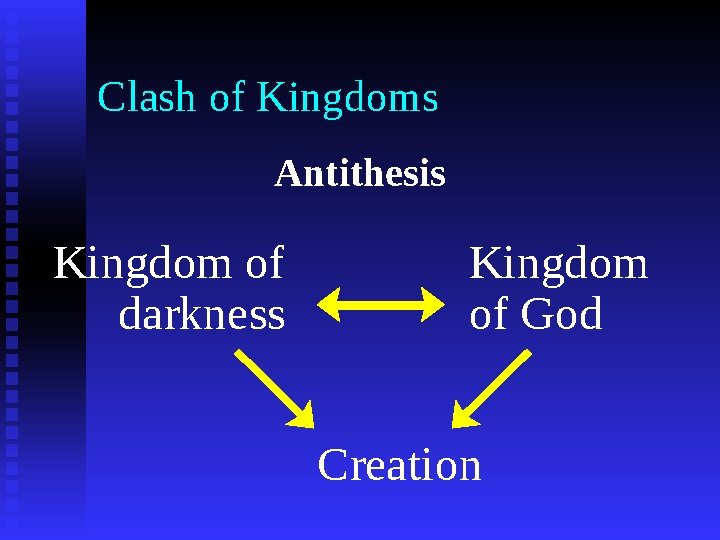
Clash of Kingdoms Antithesis Kingdom of darkness Kingdom of God Creation
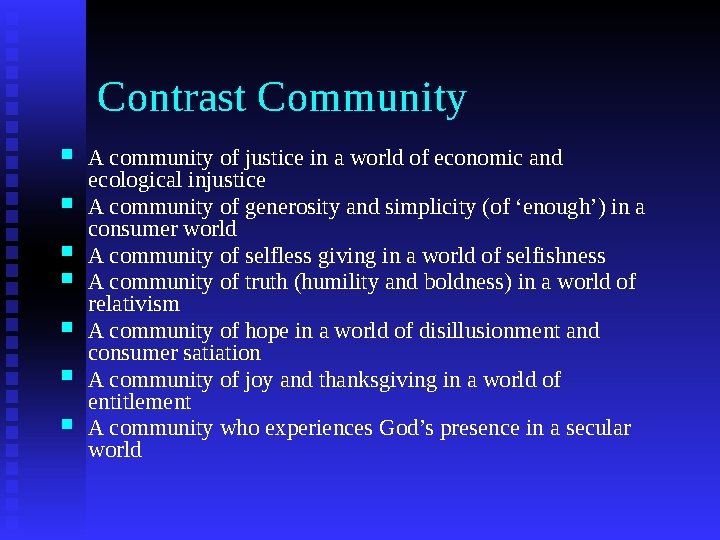
Contrast Community A community of justice in a world of economic and ecological injustice A community of generosity and simplicity (of ‘enough’) in a consumer world A community of selfless giving in a world of selfishness A community of truth (humility and boldness) in a world of relativism A community of hope in a world of disillusionment and consumer satiation A community of joy and thanksgiving in a world of entitlement A community who experiences God’s presence in a secular world
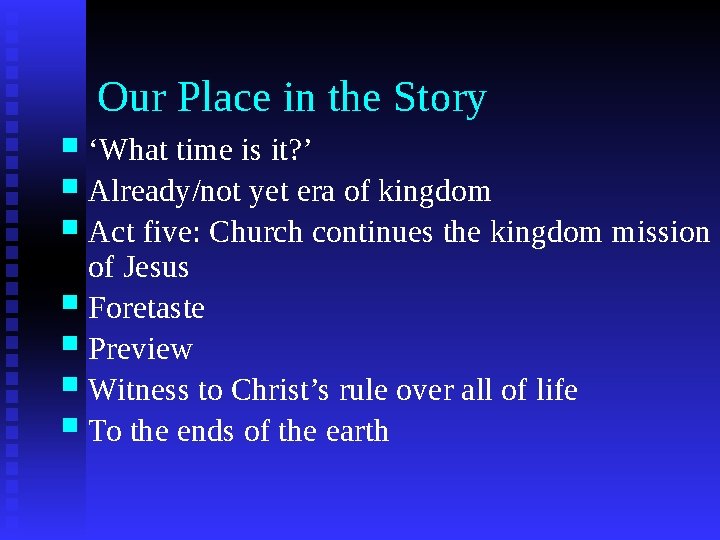
Our Place in the Story ‘What time is it? ’ Already/not yet era of kingdom Act five: Church continues the kingdom mission of Jesus Foretaste Preview Witness to Christ’s rule over all of life To the ends of the earth