
Living Ontologies with applications to Business Process Alignment
Living Ontologies: with applications to Business Process Alignment and Building Consensus Peter Weinstein, Ph. D Altarum Institute March 28, 2006
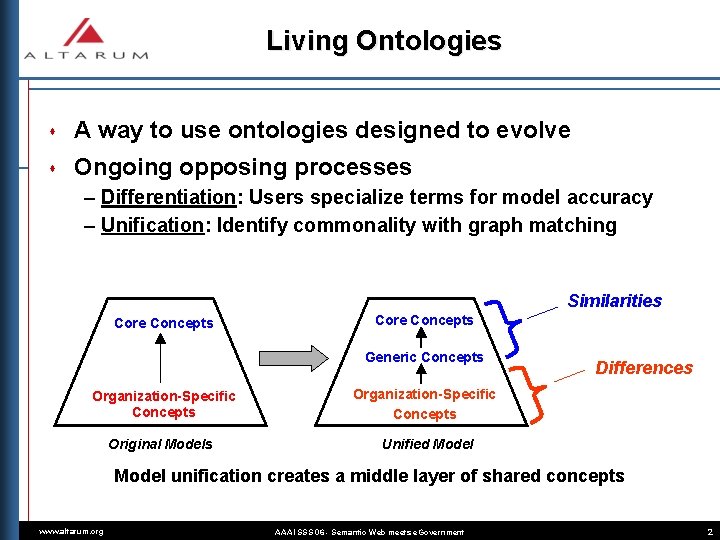
Living Ontologies s A way to use ontologies designed to evolve s Ongoing opposing processes – Differentiation: Users specialize terms for model accuracy – Unification: Identify commonality with graph matching Similarities Core Concepts Generic Concepts Organization-Specific Concepts Original Models Unified Model Differences Model unification creates a middle layer of shared concepts www. altarum. org AAAI SSS 06 - Semantic Web meets e. Government 2
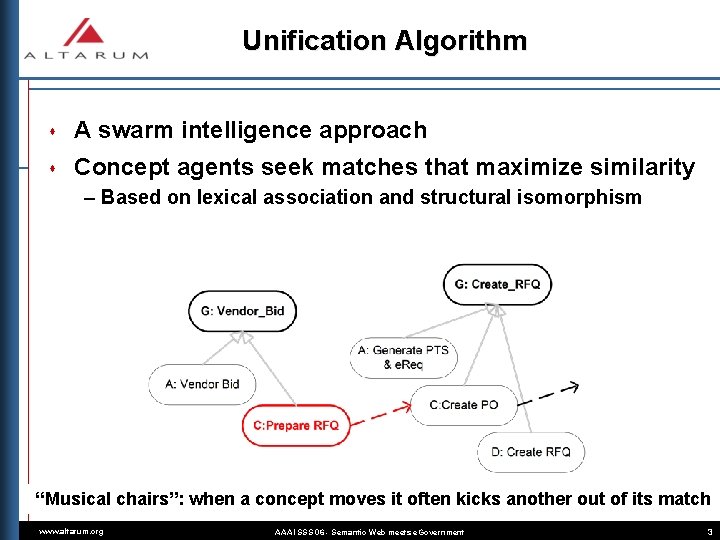
Unification Algorithm s A swarm intelligence approach s Concept agents seek matches that maximize similarity – Based on lexical association and structural isomorphism “Musical chairs”: when a concept moves it often kicks another out of its match www. altarum. org AAAI SSS 06 - Semantic Web meets e. Government 3

Problem 1 – Business Process Alignment s Want to analyze business processes for interoperability or reengineering, but … s Semantic heterogeneity impedes comparison Business process models can be hard to compare www. altarum. org AAAI SSS 06 - Semantic Web meets e. Government 4

Solution Overview Business Process Alignment s Model processes on two levels – Users work with familiar diagrams and other tools – Internal representation with formal ontology s Unify the models – An automatic process assisted by users (anytime, anywhere) s Compare processes Process Users interact with problem-specific models such as process flow diagrams www. altarum. org Swim lane AAAI SSS 06 - Semantic Web meets e. Government Flow 5
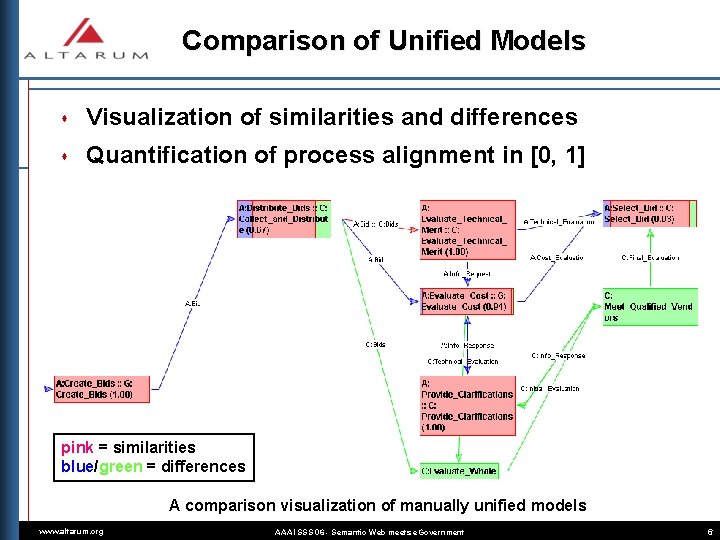
Comparison of Unified Models s Visualization of similarities and differences s Quantification of process alignment in [0, 1] pink = similarities blue/green = differences A comparison visualization of manually unified models www. altarum. org AAAI SSS 06 - Semantic Web meets e. Government 6
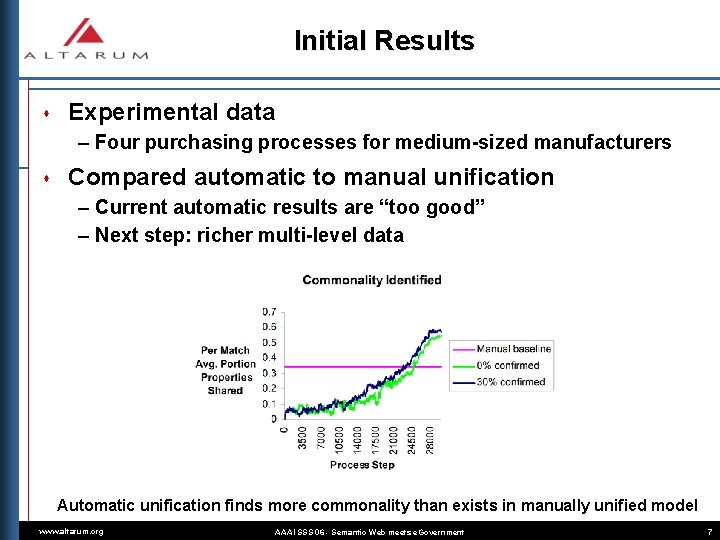
Initial Results s Experimental data – Four purchasing processes for medium-sized manufacturers s Compared automatic to manual unification – Current automatic results are “too good” – Next step: richer multi-level data Automatic unification finds more commonality than exists in manually unified model www. altarum. org AAAI SSS 06 - Semantic Web meets e. Government 7
Problem 2 – Political Discourse s Consensus Builder will be a place on the internet where people go to: – Speak about things they know and care about – Listen to others (if or when they are ready to listen) – Be counted by a system that aggregates and publishes beliefs www. altarum. org AAAI SSS 06 - Semantic Web meets e. Government 8
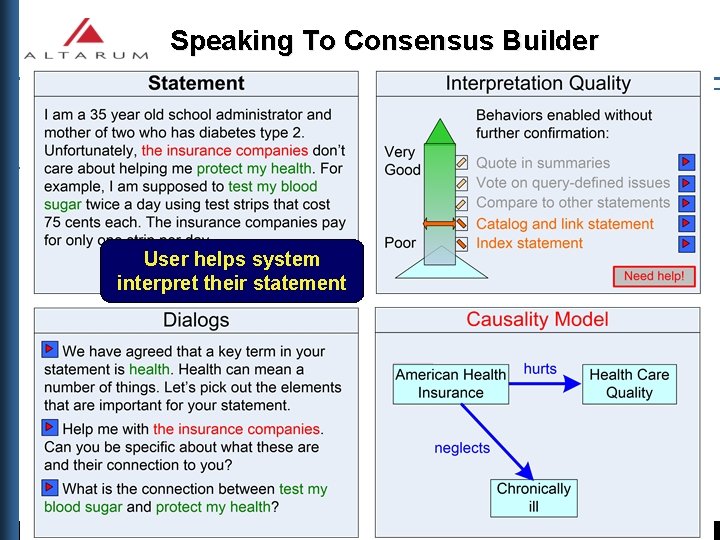
Speaking To Consensus Builder User helps system interpret their statement www. altarum. org AAAI SSS 06 - Semantic Web meets e. Government 9
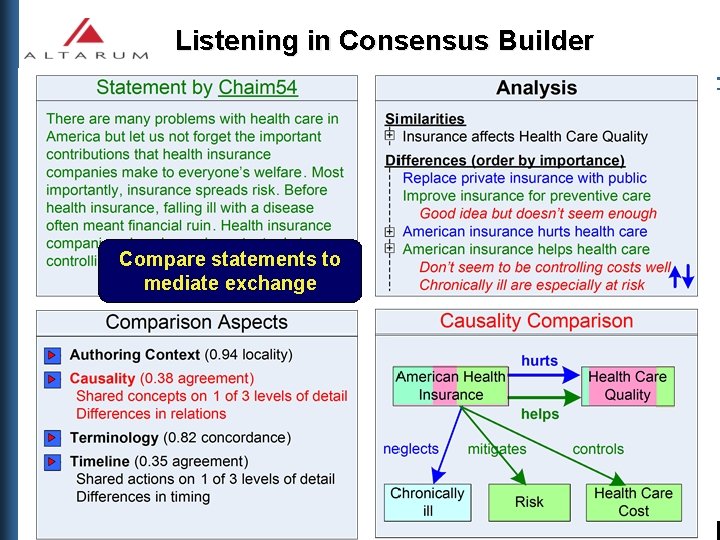
Listening in Consensus Builder Compare statements to mediate exchange www. altarum. org AAAI SSS 06 - Semantic Web meets e. Government 10
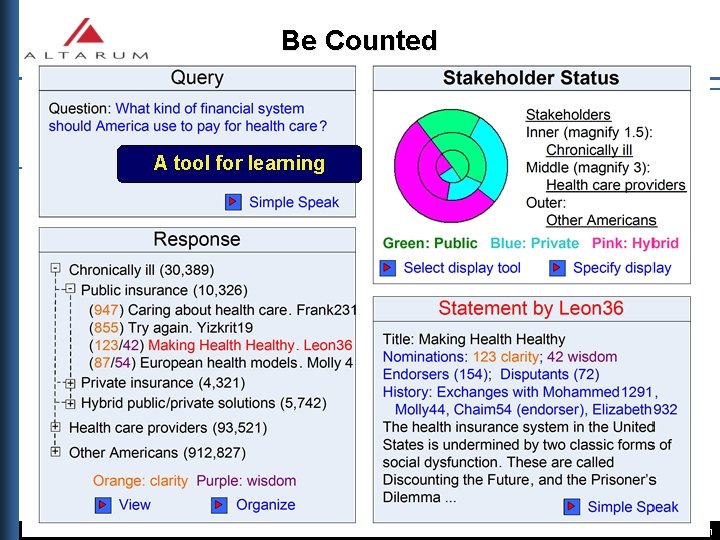
Be Counted A tool for learning www. altarum. org AAAI SSS 06 - Semantic Web meets e. Government 11
Conclusions s Living Ontologies evolve through use – Tolerate differences, maximize similarity – Wrap agents around concepts to self-organize s Applications meet users where they work – Ontologies belong under the hood s Benefits can include – New scientific rigor for Business Process Reengineering – Knowledge sharing to facilitate political discourse www. altarum. org AAAI SSS 06 - Semantic Web meets e. Government 12
- Slides: 12