
Living on Water Floating Structures in Singapore Outline








- Slides: 67
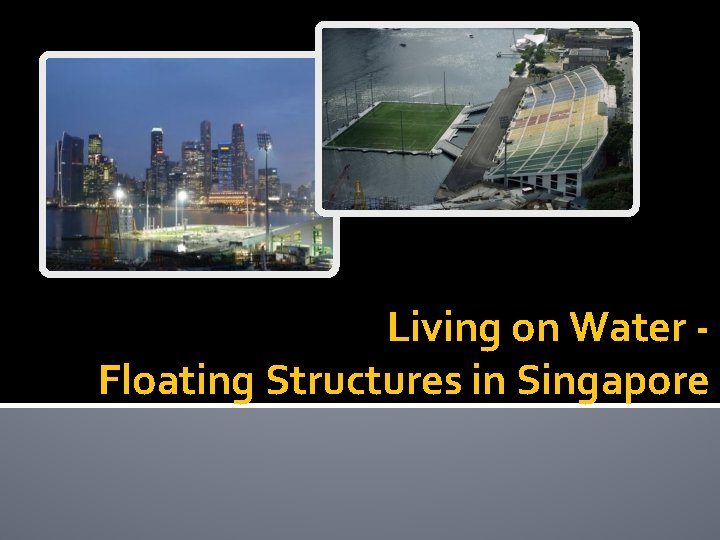
Living on Water - Floating Structures in Singapore
Outline Introduction &Objective Disadvantages of Land Reclamation Types of Floating Structures Advantages of Floating Structures Characteristics System Case of Pontoon Floating Study: The Float @ Marina Bay Our Improvised Floating Structure Advantages over existing system Installation procedure
Introduction The scarcity of land became a major problem in Singapore Land usages undergo threat, due to the increase in population and modern urbanization Singapore has to depend heavily on land reclamation, but it’s expensive
Disadvantages of Land Reclamation Damage to Marine Life Dumping sand Building a wall around the new shoreline Disrupt the habitat of marine life High cost Lack of resources (e. g. sand) Singapore forced to buy sand From Malaysia and Indonesia
Disadvantages of Land Reclamation (Cont’d) Flood threat from Singapore alleged The Straits Times March 21, 2002 JOHOR BARU - A Johor University academic has alleged Singapore's reclamation works on its islands in the north-east could turn settlements along several rivers in Johor into flood-prone areas. Prof Dr Ahmad Khairi Abdul Wahab, a coastal engineer, said settlements along Sungai Santi, Sungai Belungkor, Sungai Johor, Sungai Kim and Sungai Leban could come under threat when Singapore's Pulau Tekong and Pulau Ubin double their size and halve the capacity of the Johor Straits. Singapore soil works 'hurt JB fishing'. The Straits Times July 9, 2003 KUALA LUMPUR - The reclamation issue has cropped up again, with Berita Harian Malaysia saying Singapore's reclamation work on Pulau Tekong Besar and Pulau Tekong Kecil was affecting marine life habitats in Johor. Quoting a statement by local Umno politician Md Lazim Atan, the newspaper said the reclamation work was also destroying coral at the mouth of the Johor river.
Objective To find alternative methods to land reclamation To improve on the assembly method of the existing floating system
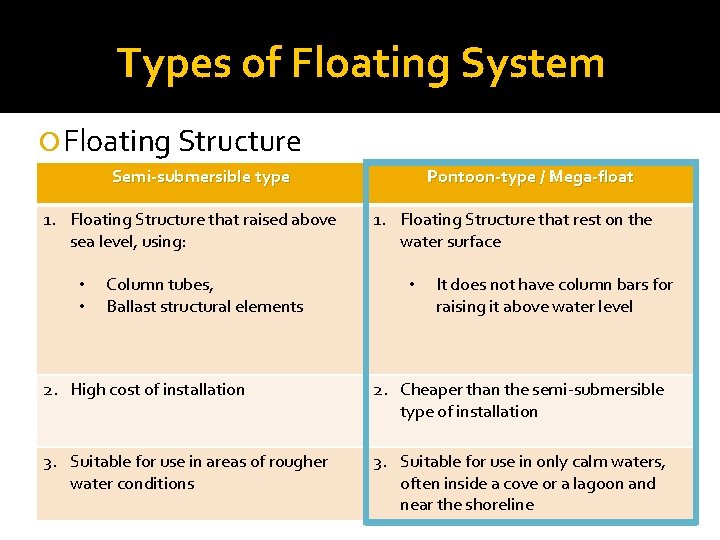
Types of Floating System Floating Structure Semi-submersible type 1. Floating Structure that raised above sea level, using: • • Column tubes, Ballast structural elements Pontoon-type / Mega-float 1. Floating Structure that rest on the water surface • It does not have column bars for raising it above water level 2. High cost of installation 2. Cheaper than the semi-submersible type of installation 3. Suitable for use in areas of rougher water conditions 3. Suitable for use in only calm waters, often inside a cove or a lagoon and near the shoreline
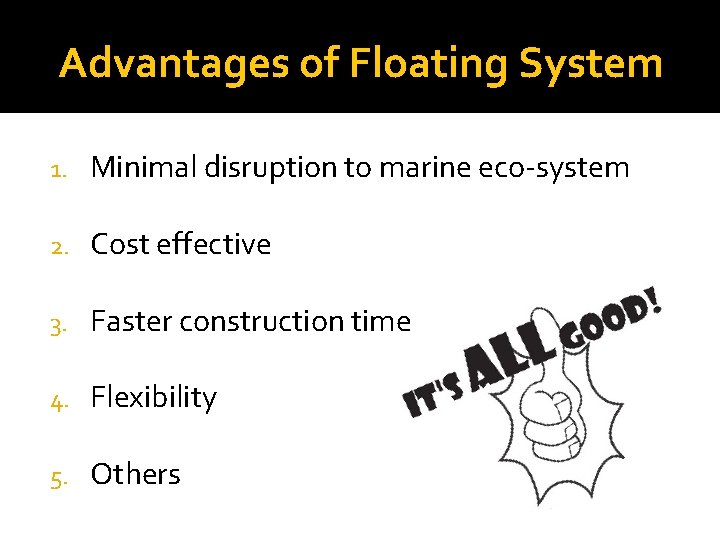
Advantages of Floating System 1. Minimal disruption to marine eco-system 2. Cost effective 3. Faster construction time 4. Flexibility 5. Others
Pontoon Floating Systems
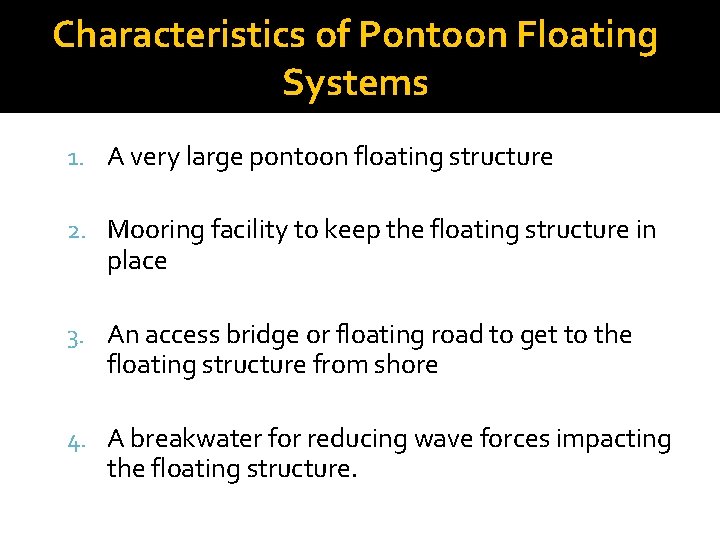
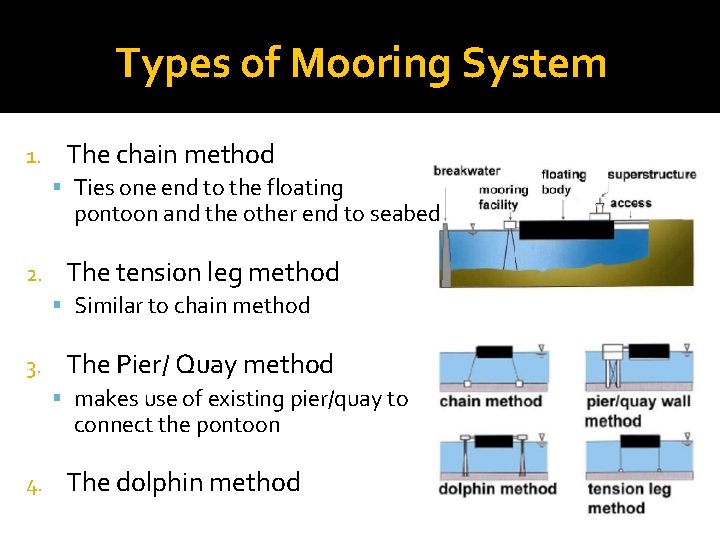
Characteristics of Pontoon Floating Systems 1. A very large pontoon floating structure 2. Mooring facility to keep the floating structure in place 3. An access bridge or floating road to get to the floating structure from shore 4. A breakwater for reducing wave forces impacting the floating structure.
Types of Mooring System 1. The chain method Ties one end to the floating pontoon and the other end to seabed 2. The tension leg method Similar to chain method 3. The Pier/ Quay method makes use of existing pier/quay to connect the pontoon 4. The dolphin method
Case Study: The Float at Marina Bay
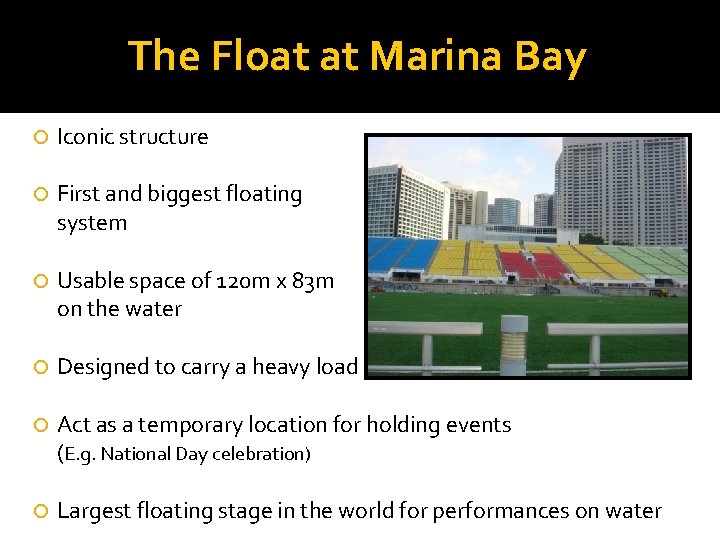
The Float at Marina Bay Iconic structure First and biggest floating system Usable space of 120 m x 83 m on the water Designed to carry a heavy load Act as a temporary location for holding events (E. g. National Day celebration) Largest floating stage in the world for performances on water
The Float at Marina Bay Methods of Assembly
Methods of Assembly Pontoon System 1. • Pontoon Connection System 2. Access Deck 3. Breakwater System 4. Detachable Dolphin Mooring System
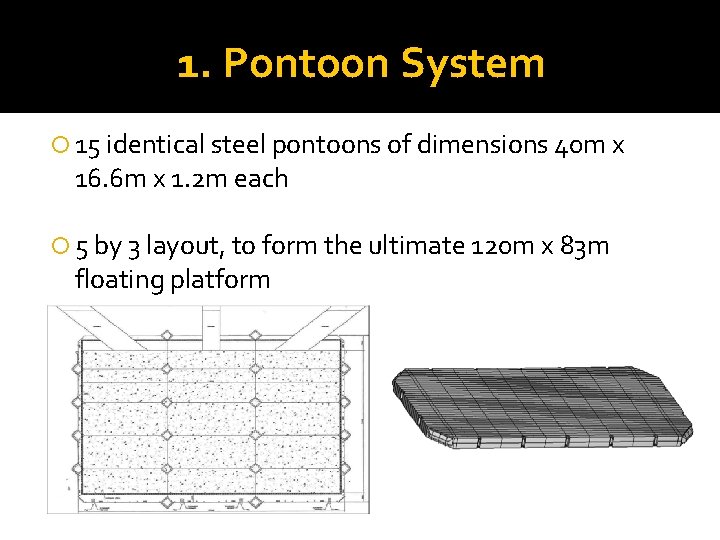
1. Pontoon System 15 identical steel pontoons of dimensions 40 m x 16. 6 m x 1. 2 m each 5 by 3 layout, to form the ultimate 120 m x 83 m floating platform
1. Pontoon System Made of welded mild steel construction Based on considerations of the shallow water depth and the need to carry heavy live loads Shallow water limits the platform depth to a height of approximate 1. 2 m Tests such as the Static Bending test and Hydro elastic Analysis were carried out
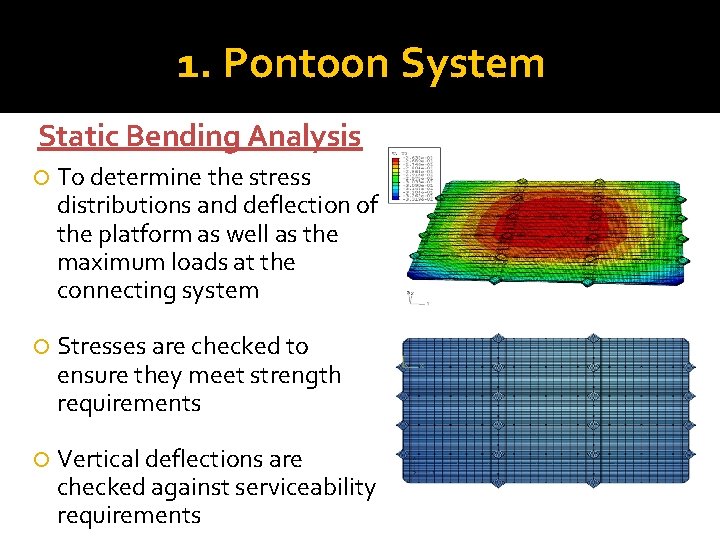
1. Pontoon System Static Bending Analysis To determine the stress distributions and deflection of the platform as well as the maximum loads at the connecting system Stresses are checked to ensure they meet strength requirements Vertical deflections are checked against serviceability requirements
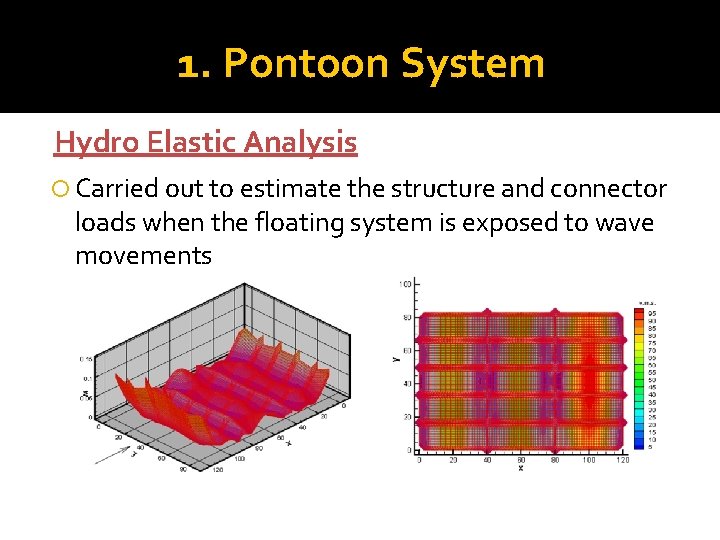
1. Pontoon System Hydro Elastic Analysis Carried out to estimate the structure and connector loads when the floating system is exposed to wave movements
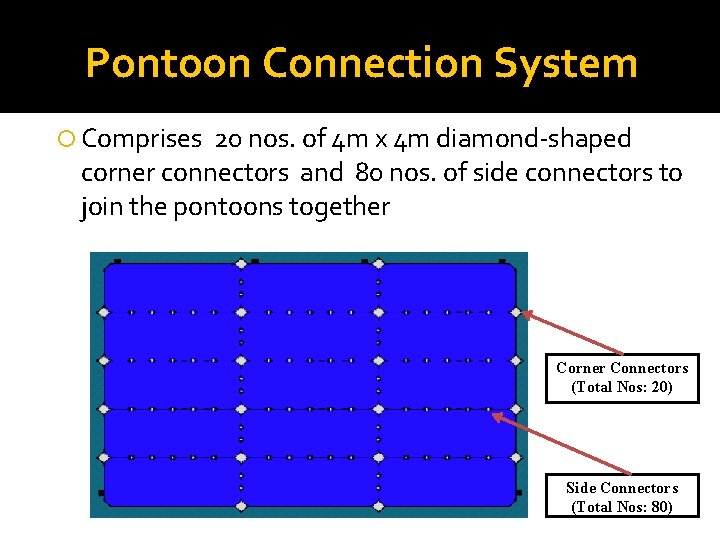
Pontoon Connection System Comprises 20 nos. of 4 m x 4 m diamond-shaped corner connectors and 80 nos. of side connectors to join the pontoons together Corner Connectors (Total Nos: 20) Side Connectors (Total Nos: 80)
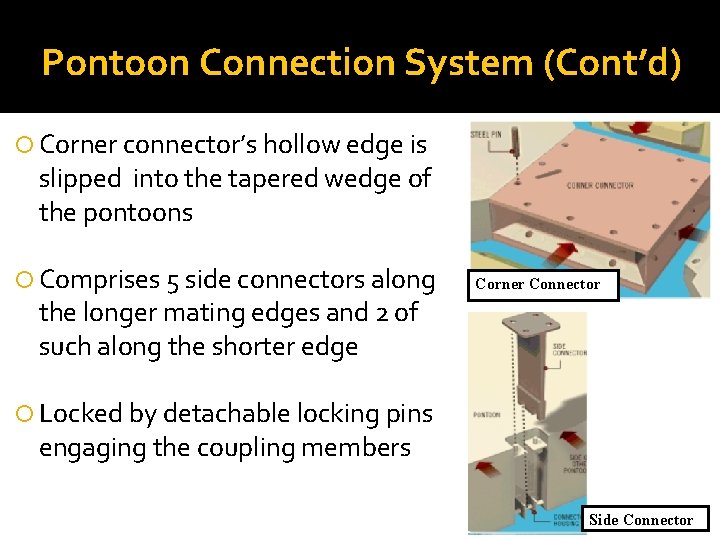
Pontoon Connection System (Cont’d) Corner connector’s hollow edge is slipped into the tapered wedge of the pontoons Comprises 5 side connectors along Corner Connector the longer mating edges and 2 of such along the shorter edge Locked by detachable locking pins engaging the coupling members Side Connector
Methods of Assembly Pontoon System 1. • Pontoon Connection System 2. Access Deck 3. Breakwater System 4. Detachable Dolphin Mooring System
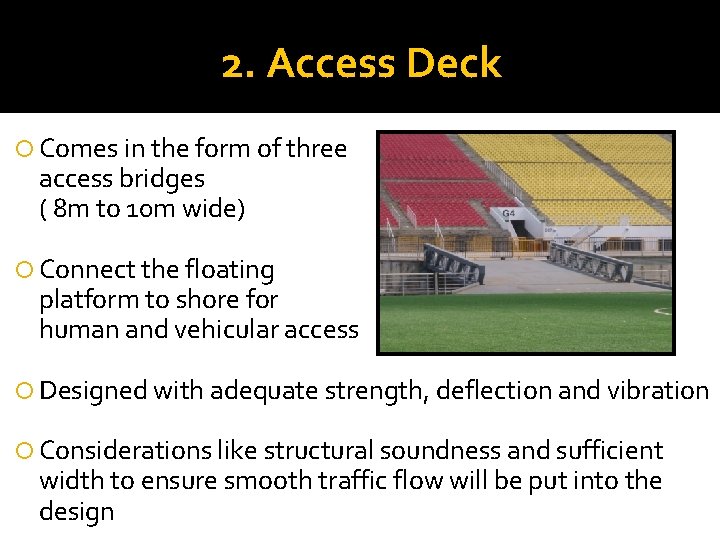
2. Access Deck Comes in the form of three access bridges ( 8 m to 10 m wide) Connect the floating platform to shore for human and vehicular access Designed with adequate strength, deflection and vibration Considerations like structural soundness and sufficient width to ensure smooth traffic flow will be put into the design
Methods of Assembly Pontoon System 1. • Pontoon Connection System 2. Access Deck 3. Breakwater System 4. Detachable Dolphin Mooring System
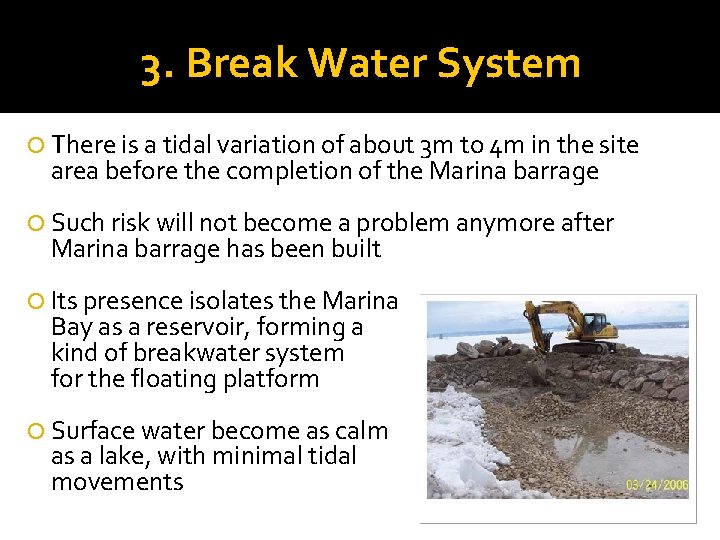
3. Break Water System There is a tidal variation of about 3 m to 4 m in the site area before the completion of the Marina barrage Such risk will not become a problem anymore after Marina barrage has been built Its presence isolates the Marina Bay as a reservoir, forming a kind of breakwater system for the floating platform Surface water become as calm as a lake, with minimal tidal movements
Methods of Assembly Pontoon System 1. • Pontoon Connection System 2. Access Deck 3. Breakwater System 4. Detachable Dolphin Mooring System
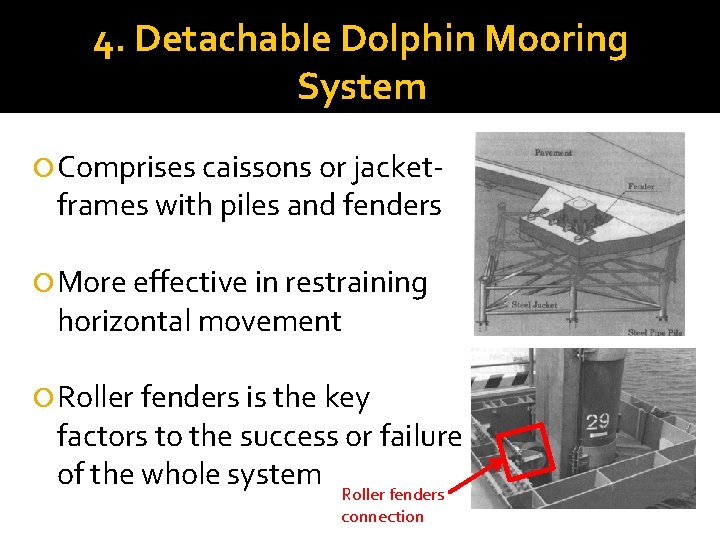
4. Detachable Dolphin Mooring System Comprises caissons or jacket- frames with piles and fenders More effective in restraining horizontal movement Roller fenders is the key factors to the success or failure of the whole system Roller fenders connection
4. Detachable Dolphin Mooring System (cont’d) The mooring columns consist of 2 section piles: Vertical upper pile column ▪ Being detachable above sea bed Vertical lower pile column ▪ Fixed and rammed 16 -20 mm into the seabed ▪ Leaving a protrusion of about 1/2 m above
Advantages of Detachable Dolphin Method 1. Involves simple installation process ▪ Kept the floating platform in position ▪ Minimise sea space usage 2. The components are detachable & reusable ▪ Stable connection to the seabed ▪ Allows disconnection when required so as to be transported away 3. It has a speedy construction
Disadvantages of Detachable Dolphin Method 1. Over design of system 2. Bolt and nuts connection of dolphin columns 3. Damaged by rollers fenders
Disadvantages of Detachable Dolphin Method Over design of system 1. Being the first & only marina floating system Additional tests & materials used contribute to the high construction cost. Over design features includes: ▪ ▪ ▪ The additional depth of the pontoons The extra thickness of dolphin columns The limitation to just 15 numbers of pontoons for the entire floating system
Disadvantages of Detachable Dolphin Method 1. Over design of system 2. Bolt and nuts connection of dolphin columns 3. Damaged by rollers fenders
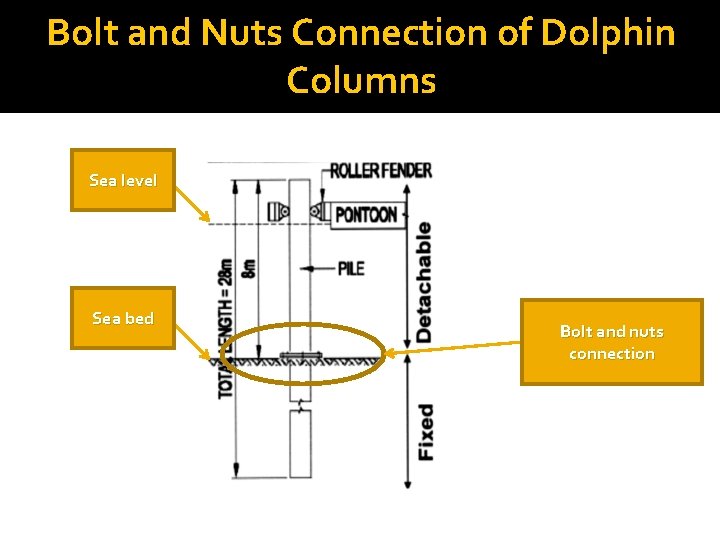
Disadvantages of Detachable Dolphin Method 2. Bolt and nuts connection of dolphin columns Bolts and nuts are meant for connection of the two sectional piles It’s located underwater for long period of time ▪ Subjected to risks of facing corrosion ▪ Break off over time
Bolt and Nuts Connection of Dolphin Columns Sea level Sea bed Bolt and nuts connection
Disadvantages of Detachable Dolphin Method 1. Over design of system 2. Bolt and nuts connection of dolphin columns 3. Damaged by rollers fenders
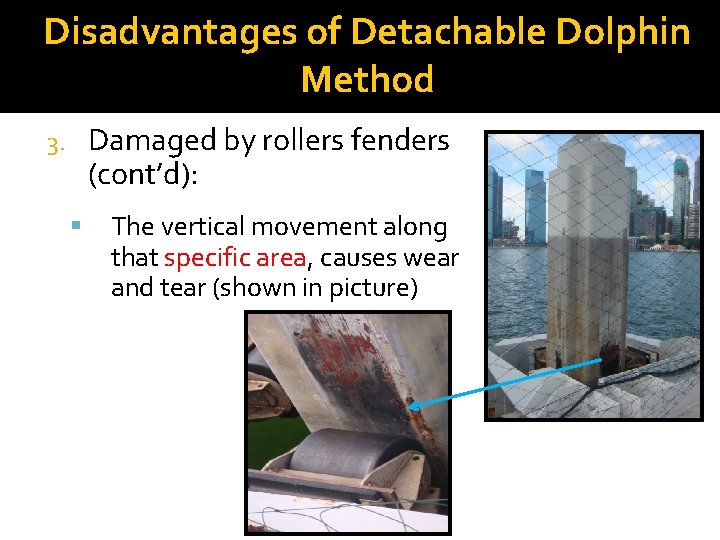
Disadvantages of Detachable Dolphin Method Damaged by rollers fenders: 3. Failure in the connection between roller fenders and dolphin columns The roller fenders allows pontoon to slide up and down the dolphin columns
Disadvantages of Detachable Dolphin Method Damaged by rollers fenders (cont’d): 3. The vertical movement along that specific area, causes wear and tear (shown in picture)
Improvised Floating System
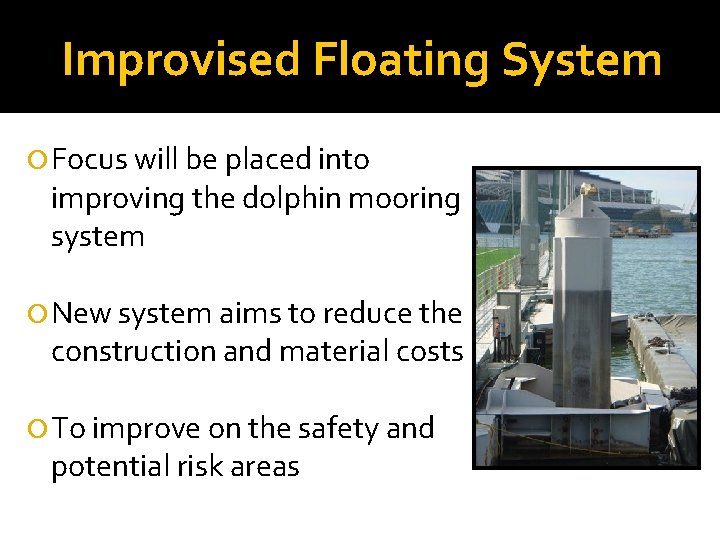
Improvised Floating System Focus will be placed into improving the dolphin mooring system New system aims to reduce the construction and material costs To improve on the safety and potential risk areas
Proposed Improvements 1. Decrease of depth of pontoon height 2. Spin fins piles for driving into seabed 3. Protection steel plate at rollers fenders 4. Recessed connection between dolphin section piles
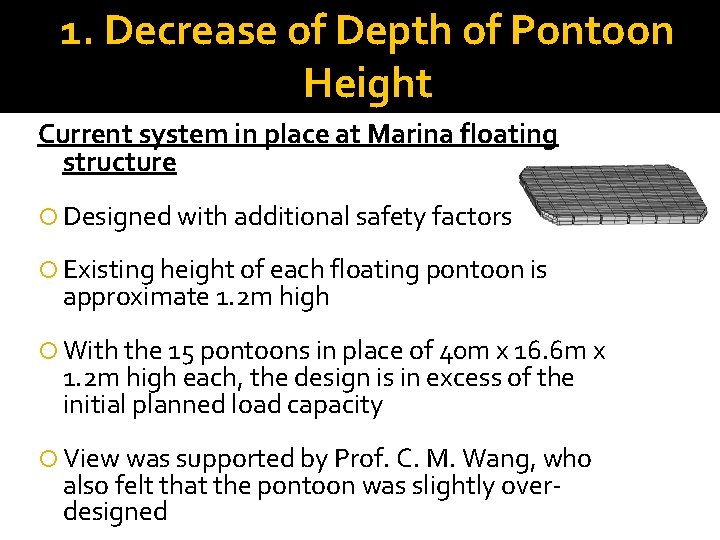
1. Decrease of Depth of Pontoon Height Current system in place at Marina floating structure Designed with additional safety factors Existing height of each floating pontoon is approximate 1. 2 m high With the 15 pontoons in place of 40 m x 16. 6 m x 1. 2 m high each, the design is in excess of the initial planned load capacity View was supported by Prof. C. M. Wang, who also felt that the pontoon was slightly overdesigned
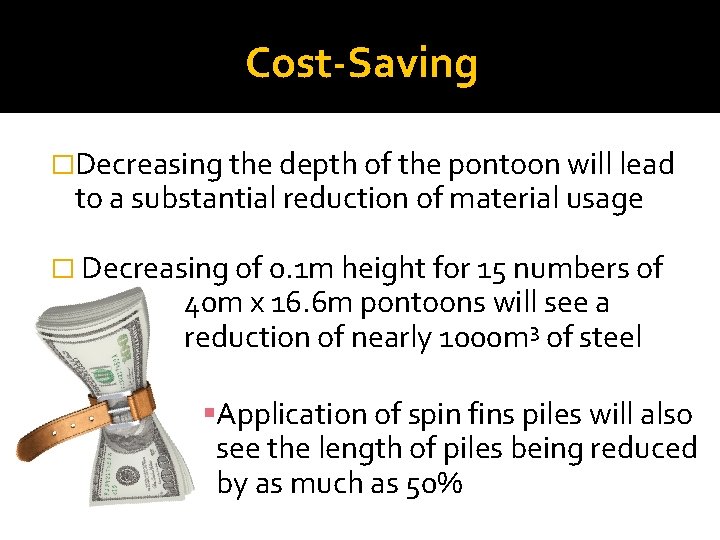
1. Decrease of Depth of Pontoon Height (Cont’d) Proposed system To decrease the depth of each pontoons from 1. 2 m high to 1. 1 m high The reduction will slightly decrease the load carrying capacity Despite being lower, is still capable of sustaining the maximum load limit Reduction in materials usage & construction cost Save up to 1000 m 3 of steel
Proposed Improvements 1. Decrease of depth of pontoon height 2. Spin fins piles for driving into seabed 3. Protection steel plate at rollers fenders 4. Recessed connection between dolphin section piles
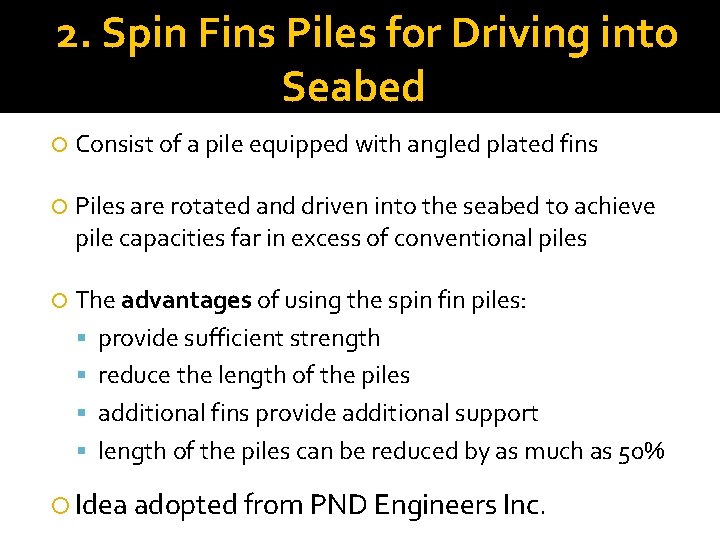
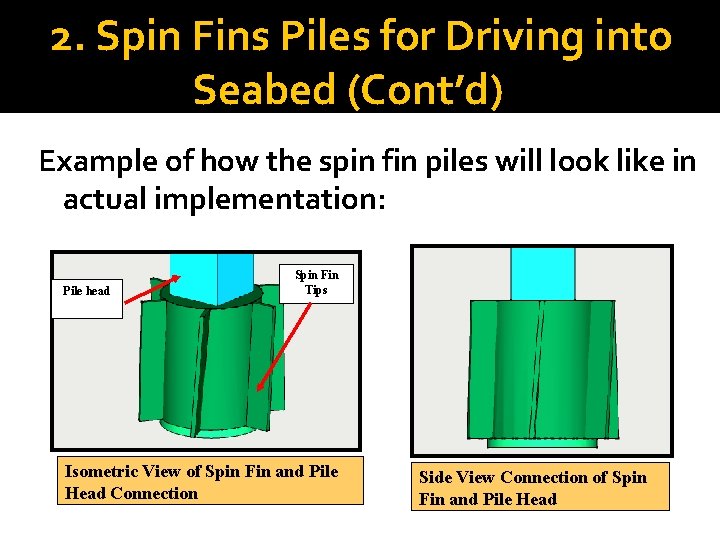
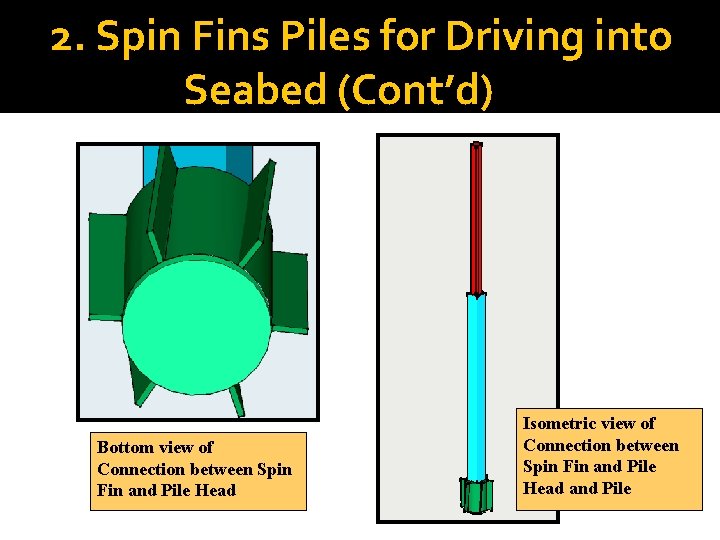
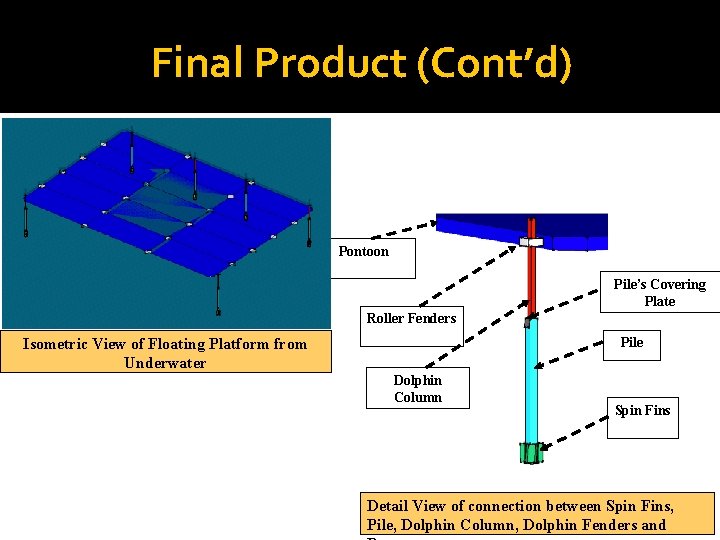
2. Spin Fins Piles for Driving into Seabed Consist of a pile equipped with angled plated fins Piles are rotated and driven into the seabed to achieve pile capacities far in excess of conventional piles The advantages of using the spin fin piles: provide sufficient strength reduce the length of the piles additional fins provide additional support length of the piles can be reduced by as much as 50% Idea adopted from PND Engineers Inc.
2. Spin Fins Piles for Driving into Seabed (Cont’d) Example of how the spin fin piles will look like in actual implementation: Pile head Spin Fin Tips Isometric View of Spin Fin and Pile Head Connection Pile head Spin Fin Tips Side View Connection of Spin Fin and Pile Head
2. Spin Fins Piles for Driving into Seabed (Cont’d) Bottom view of Connection between Spin Fin and Pile Head Isometric view of Connection between Spin Fin and Pile Head and Pile
Proposed Improvements 1. Decrease of depth of pontoon height 2. Spin fins piles for driving into seabed 3. Protection steel plate at rollers fenders 4. Recessed connection between dolphin section piles
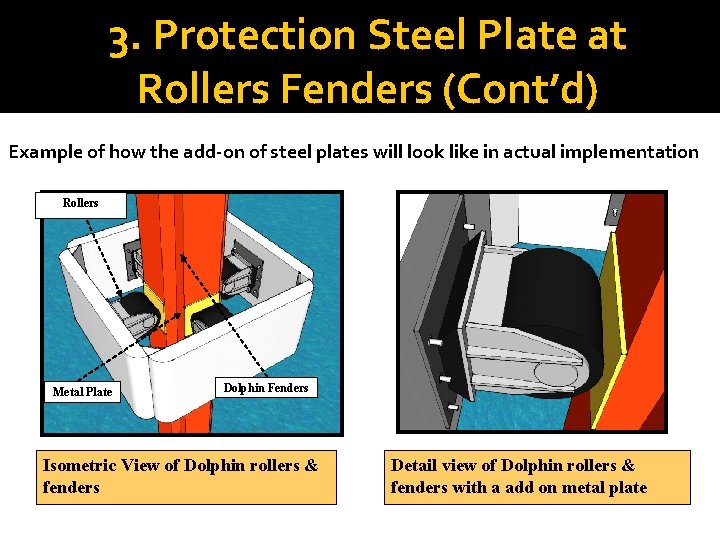
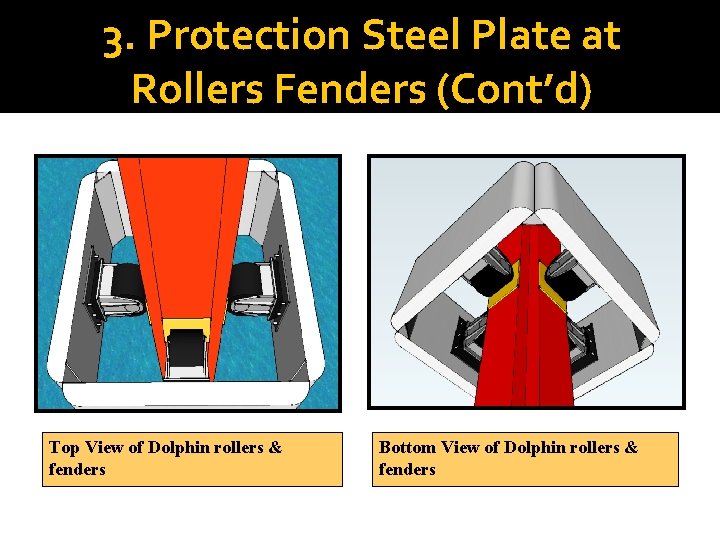
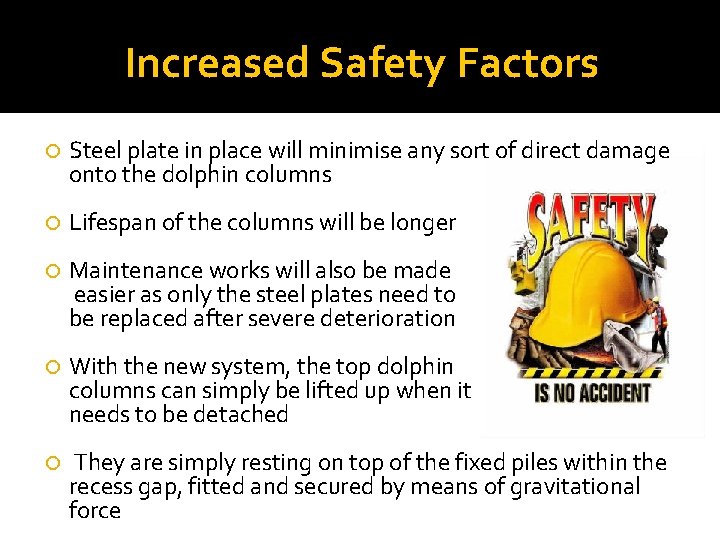
3. Protection Steel Plate at Rollers Fenders One of the risks was the wear and tear damage caused to the connection between the roller fenders and the dolphin columns To counter the risk we proposed to install steel plates to the area where roller fenders are in contact with the dolphin columns Proposed size of the steel plates shall be 300 x 300 x 10 mm thick
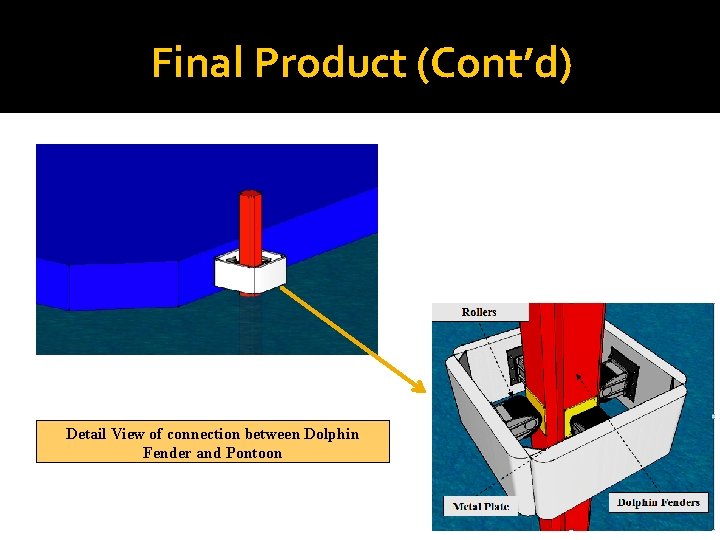
3. Protection Steel Plate at Rollers Fenders (Cont’d) Example of how the add-on of steel plates will look like in actual implementation Rollers Metal Plate Dolphin Fenders Isometric View of Dolphin rollers & fenders Detail view of Dolphin rollers & fenders with a add on metal plate
3. Protection Steel Plate at Rollers Fenders (Cont’d) Top View of Dolphin rollers & fenders Bottom View of Dolphin rollers & fenders
Proposed Improvements 1. Decrease of depth of pontoon height 2. Spin fins piles for driving into seabed 3. Protection steel plate at rollers fenders 4. Recessed connection between dolphin section piles
4. Recessed Connection between Dolphin Section Piles Improvement made to the connection between the detachable and fixed dolphin section piles Current system makes use of the bolt and nuts connection Possibility of the connection wearing off over time
4. Recessed Connection between Dolphin Section Piles (Cont’d) Bottom fixed pile will come with a recess that allows the detachable pile to slot in that rest on top of the pile With the piles resting on the bottom piles, risks of broken connections is eliminated Bottom pile comprise of a covering cap situated just beside the recess gap Covering cap will be used to cover up the recess gap whenever the detachable pile is removed for relocation of platform With the cap will prevent the accumulation of debris inside the recess gap
Video of Recessed Connection between Dolphin Section Piles
Our Final Product
Final Product Isometric View of the Floating Platform on water
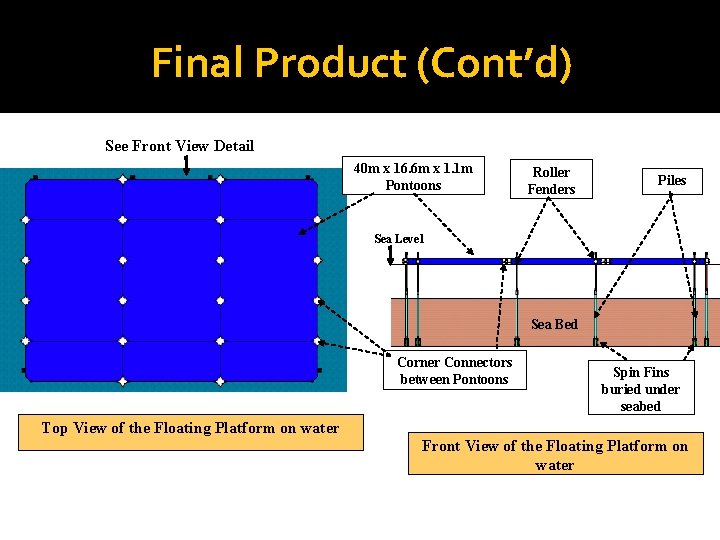
Final Product (Cont’d) See Front View Detail 40 m x 16. 6 m x 1. 1 m Pontoons Roller Fenders Piles Sea Level Sea Bed Corner Connectors between Pontoons Spin Fins buried under seabed Top View of the Floating Platform on water Front View of the Floating Platform on water
Final Product (Cont’d) Detail View of connection between Dolphin Fender and Pontoon
Final Product (Cont’d) Pontoon Pile’s Covering Plate Roller Fenders Pile Isometric View of Floating Platform from Underwater Dolphin Column Spin Fins Detail View of connection between Spin Fins, Pile, Dolphin Column, Dolphin Fenders and
Advantages over Original System
Cost-Saving �Decreasing the depth of the pontoon will lead to a substantial reduction of material usage � Decreasing of 0. 1 m height for 15 numbers of 40 m x 16. 6 m pontoons will see a reduction of nearly 1000 m 3 of steel Application of spin fins piles will also see the length of piles being reduced by as much as 50%
Increased Safety Factors Steel plate in place will minimise any sort of direct damage onto the dolphin columns Lifespan of the columns will be longer Maintenance works will also be made easier as only the steel plates need to be replaced after severe deterioration With the new system, the top dolphin columns can simply be lifted up when it needs to be detached They are simply resting on top of the fixed piles within the recess gap, fitted and secured by means of gravitational force
Installation Method
Installation Method 1. Most of the individual elements will be first prefabricated off-site 2. A separate breakwater system can first be constructed 3. Designated sea site will be free from rough currents and any major tidal movements 4. After the breakwater has been constructed, the access decks can be installed on site 5. Fixed spin fins dolphin piles with recessed opening can also be brought to site and driven in place
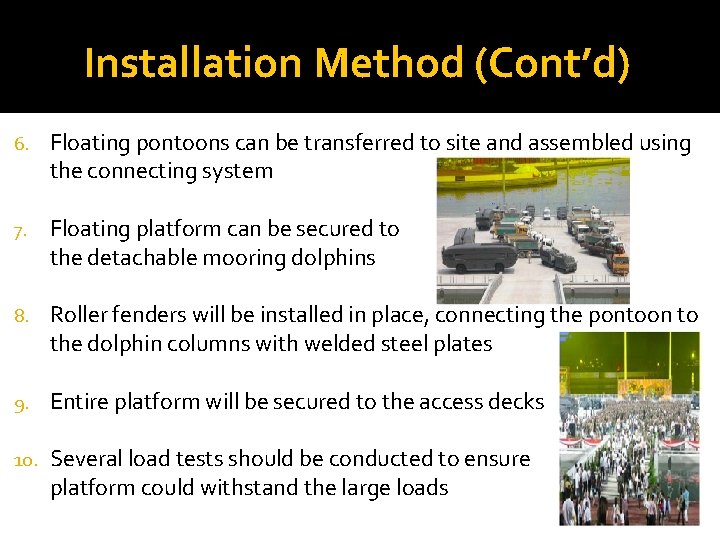
Installation Method (Cont’d) 6. Floating pontoons can be transferred to site and assembled using the connecting system 7. Floating platform can be secured to the detachable mooring dolphins 8. Roller fenders will be installed in place, connecting the pontoon to the dolphin columns with welded steel plates 9. Entire platform will be secured to the access decks 10. Several load tests should be conducted to ensure platform could withstand the large loads
Conclusion �In the near future, we hope to see the increased of developments expanding out from our shores towards to the surrounding waters Floating system is a possible alternative to land reclamation The proposed design will be more cost-effective and safe
Q& A Done by: Chia Kuo Wai: Kam Huei Woon : Lin Yi. Ting : Ng Yan Ling : Ong Jing Yi Deniel : Suwati : Tan Ying Jie: U 086722 B U 077860 H U 097965 J U 097994 L U 086719 L U 086746 N U 086788 X