
Living in the Stone Age Lithos stone Paleolithic
![Caves at Lascaux [lass co] l l l Lascaux Caves (south central France) art](https://slidetodoc.com/presentation_image_h2/afb2c732891191d8b023aa7ea3014053/image-9.jpg "Caves at Lascaux [lass co] l l l Lascaux Caves (south central France) art")

- Slides: 13
Living in the Stone Age
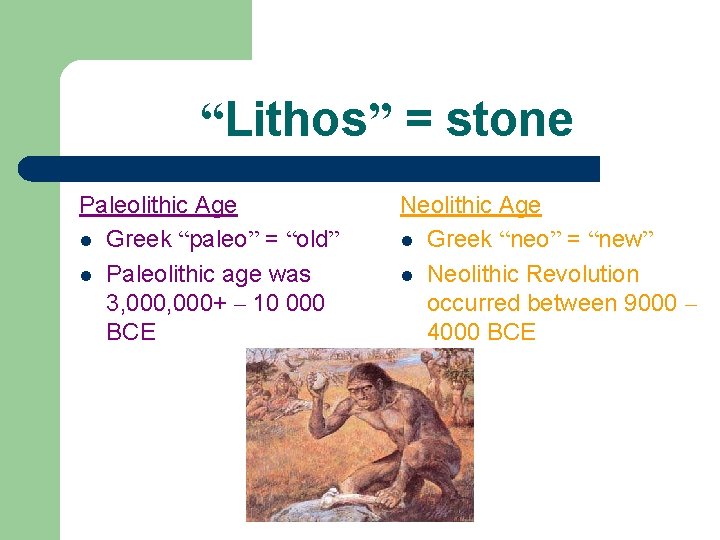
“Lithos” = stone Paleolithic Age l Greek “paleo” = “old” l Paleolithic age was 3, 000+ – 10 000 BCE Neolithic Age l Greek “neo” = “new” l Neolithic Revolution occurred between 9000 – 4000 BCE
Comparing the Stone Ages PALEOLITHIC l People lived in small groups of 5 -10 families l Nomadic to seminomadic (hunting & gathering) l Close relationships between bands of people l ie. Cro-Magnon society NEOLITHIC l People abandoned seminomadic life & began farming – Agricultural revolution was a progression of the “Great Leap Forward” l l l planting of crops domesticating of animals Better tools & weapons
Social Structure: Paleolithic Age l l Beginning: – closer social relationships arranged marriages with other bands bartering for raw materials – Stratification = leadership & social classes l age, gender, experiences Roles: MEN big game hunters WOMEN small game gatherers (approx. 60 -70% of diet ~ roots, potatoes, fruits, berries) made clothing from animal hides nurtured children
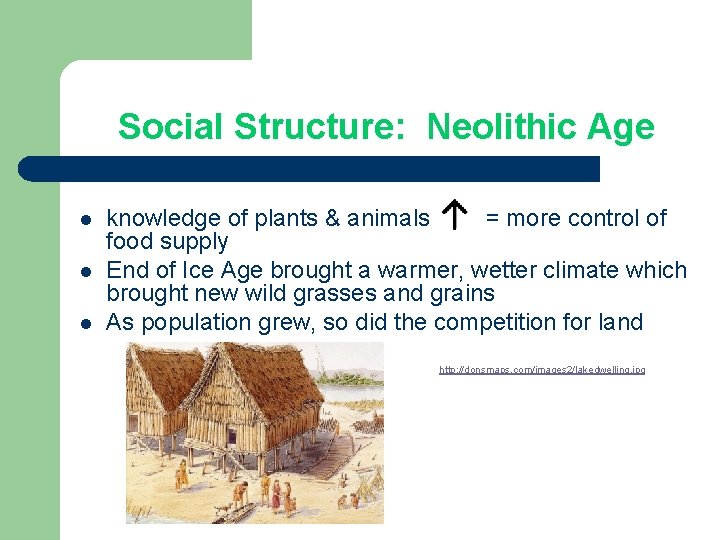
Social Structure: Neolithic Age l l l knowledge of plants & animals = more control of food supply End of Ice Age brought a warmer, wetter climate which brought new wild grasses and grains As population grew, so did the competition for land http: //donsmaps. com/images 2/lakedwelling. jpg
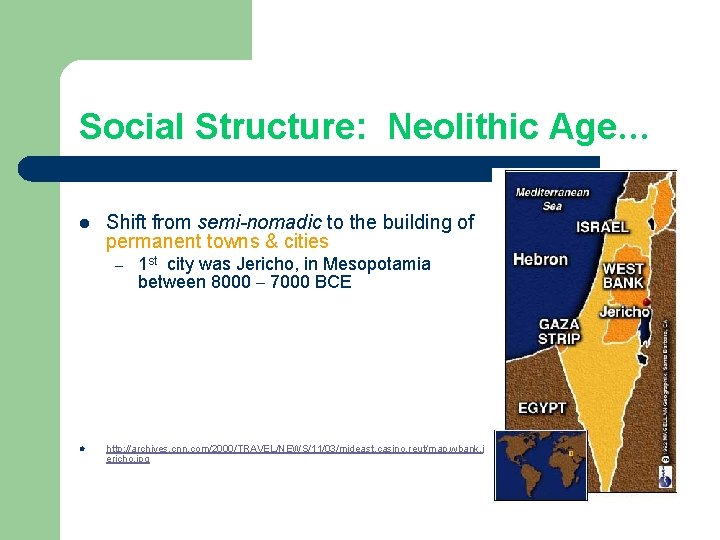
Social Structure: Neolithic Age… l Shift from semi-nomadic to the building of permanent towns & cities – l 1 st city was Jericho, in Mesopotamia between 8000 – 7000 BCE http: //archives. cnn. com/2000/TRAVEL/NEWS/11/03/mideast. casino. reut/map. wbank. j ericho. jpg
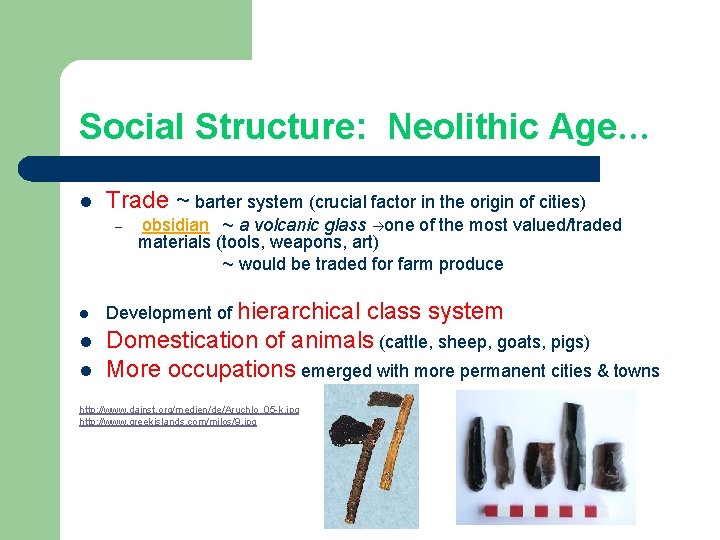
Social Structure: Neolithic Age… l Trade ~ barter system (crucial factor in the origin of cities) – l l l obsidian ~ a volcanic glass one of the most valued/traded materials (tools, weapons, art) ~ would be traded for farm produce Development of hierarchical class system Domestication of animals (cattle, sheep, goats, pigs) More occupations emerged with more permanent cities & towns http: //www. dainst. org/medien/de/Aruchlo_05 -k. jpg http: //www. greekislands. com/milos/9. jpg
Religion & Art in Paleolithic Age l l 1 st to develop fine art as drawings Over 100 European caves showcase CAVE PAINTINGS – l Beginnings of cultural explosion in art – l deer, horses & animals which are now extinct tools, pendants, jewellery & sculptures/ figurines of clay, ivory & stone More advanced spiritual practices emerged – graves were found containing beads, ivory jewellery & spears made of mammoth tusks buried with bodies = this suggests a ritual burial with a view of an afterlife
Caves at Lascaux [lass co] l l l Lascaux Caves (south central France) art circa 15 000 BCE used irregularities in cave walls to add a 3 -D effect to figures Paintings portray an awe & reverence towards animals which shows that for the 1 st time people were expressing religious beliefs (rituals related to hunting magic; sacrifices of animals)
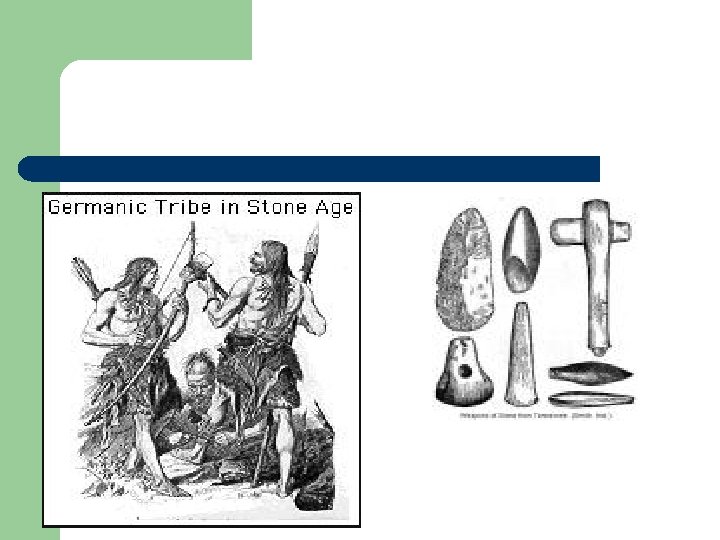
Weapons & Technology PALEOLITHIC l Better hunting strategies due to co-operation & more lethal weapons l Better tools for skinning game, preparing food, sewing clothes l Cro-Magnons stored food over winter showing more planning l Invention of the bow & arrow around 20 000 BCE made hunting more easy NEOLITHIC l More efficient farming tools & weapons (sickle made of flint blades & antler; axes, hoe, copper use) l Domestication of animals to do manual work & the planting of crops freed people from the pursuit of food l New time for leisure activities (art, music, sports, religion)
Major Innovations of the Stone Age l l l l More complex human societies (from semi-nomadic to permanent cities; domestication of animals; leisure time) Development of social hierarchies Development of alliances & cooperation Marriage customs Development of trade goods & routes Religious rituals Refined sense of artistic beauty
ALL LEAD TO THE FIRST “CIVILIZATION”