
Living in a fragmenting world A tenpoint users
- Slides: 13
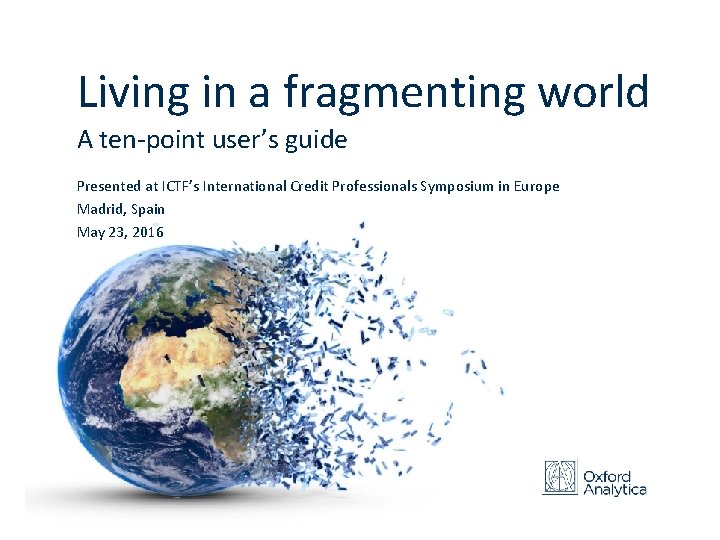
Living in a fragmenting world A ten-point user’s guide Presented at ICTF’s International Credit Professionals Symposium in Europe Madrid, Spain May 23, 2016
Living in a fragmenting world Profound changes are underway in the global landscape in which business is conducted. We call it living in a ‘fragmenting world’ -- one in which global power is increasingly being broken up and congregating around new nodes, countries and entities. In a fragmenting world, power, influence and social demand are hostage to powerful new forces, such as environmental change and technology; deep drivers such as demography; and, in many parts of the world, the reassertion of nationalist ‘visions’. www. oxan. com These developments pose fundamental challenges for global corporations. This ten-point user’s guide provides some signposts to help navigation.
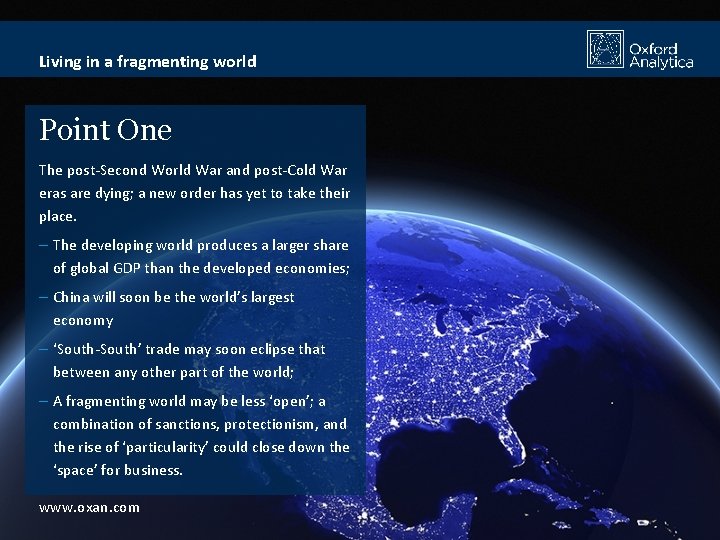
Living in a fragmenting world Point One The post-Second World War and post-Cold War eras are dying; a new order has yet to take their place. – The developing world produces a larger share of global GDP than the developed economies; – China will soon be the world’s largest economy – ‘South-South’ trade may soon eclipse that between any other part of the world; – A fragmenting world may be less ‘open’; a combination of sanctions, protectionism, and the rise of ‘particularity’ could close down the ‘space’ for business. www. oxan. com
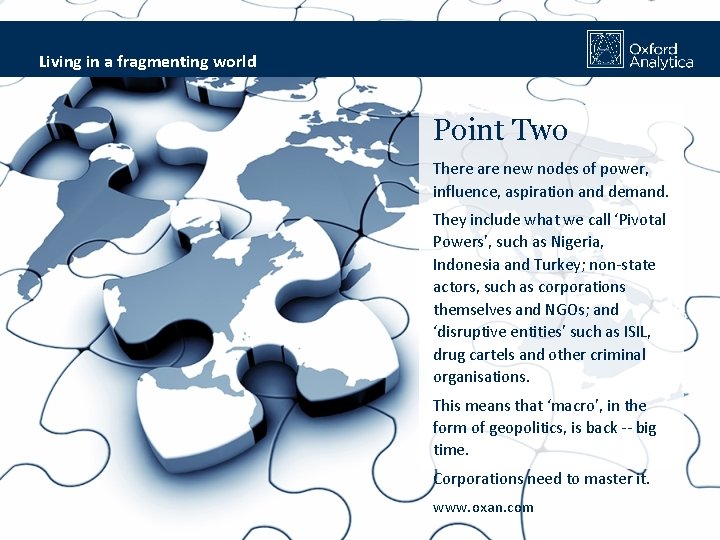
Living in a fragmenting world Point Two There are new nodes of power, influence, aspiration and demand. They include what we call ‘Pivotal Powers’, such as Nigeria, Indonesia and Turkey; non-state actors, such as corporations themselves and NGOs; and ‘disruptive entities’ such as ISIL, drug cartels and other criminal organisations. This means that ‘macro’, in the form of geopolitics, is back -- big time. Corporations need to master it. www. oxan. com
Living in a fragmenting world Point Three Sub-national entities matter more than ever in a fragmenting world. Welcome to the world of mega cities. Welcome to human beings as an urban species. Will they be ‘smart cities’ or ‘shanty towns’? The homes of ‘intelligent’ buildings, and the rational use of transport and energy or new arenas for crime corruption, congestions – and anomie? Global corporations can help decide. www. oxan. com
Living in a fragmenting world Point Four Making poverty history. There is a huge - and growing - global ‘middle class’. It constitutes a ‘market’, but also a dynamic source of critical scrutiny and articulation of views about a whole range of topics – from clean air to clean government. Imagine a world where the majority are not impoverished but are prosperous – or at least can reasonably expect to become so. By 2030 the population will be 8. 3 billion and close to 50% might be middle class. www. oxan. com
Living in a fragmenting world Point Five We are growing more numerous. There are 7 billion of us now; we may add a further billion in the next ten years. Many of us are ageing, and many of those who are not, can’t find jobs. Welcome to the complex dynamics of demography. Demographic ‘time bombs’ are ticking away in the developed and developing worlds that will restructure entire societies and the balance of national power. ‘Young’, ‘mature’ and ‘post-mature’ societies are emerging, each posing acute policy challenges as well as market opportunities. www. oxan. com
Living in a fragmenting world Point Six The global triumph of democracy (as understood in the West) is a myth; global digital empowerment is not – even if the empowerment is a matter of degree. Welcome to the world of the empowered individual, which poses unique challenges for government and business. The individual, as well as small groups, has the capacity to do harm and do good - on the scale once reserved for states – or corporations. Welcome to the wars of information and disinformation. Welcome to cyber war. We live in a fragmenting world – but also a connected one, in which risks can cascade alarmingly but where opportunities are also multiplied. www. oxan. com
Living in a fragmenting world Point Seven Technological change is accelerating. We can see some of what is coming: – Automated production; – 3 D printing; – personalised medicine; – the ‘internet of things’; – synthetic biology. The real surprises will arise from what we cannot yet see. www. oxan. com
Living in a fragmenting world Point Eight – Power and inequality form a powerful axis in a fragmenting world. – Their offspring include corruption, lack of respect for the rule of law, absence of transparency and other violations of human rights. – The best defence corporations can mount against these trends is a combination of transparency and collaboration, gender and ethnic diversity, rule-setting and effective communication of goals and purpose. www. oxan. com
Living in a fragmenting world Point Nine There will be a growing sense – indeed, an expectation and demand that every policy and business plan – and certainly every business plan has sustainability at or close to its centre. Business behaviour and performance will increasingly be judged, not by its contribution to shareholder or ‘stakeholder’ value, but by its impact on the energy, water and food matrix… the stuff we eat, drink, breathe, touch, and treasure. www. oxan. com
Living in a fragmenting world Point Ten A fragmenting world is not a disaster; we must not overdo the gloom. We must never overlook the power of agency, of policy, of will and the innovatory capacity of women and men to ‘make their own future’. But it requires leadership, insight, knowledge and guts. That’s what global corporations have to provide in a fragmenting world. www. oxan. com
Living in a fragmenting world Graham Hutchings, Principal ghutchings@oxford-analytica. com Oxford Analytica 5 Alfred Street Oxford OX 1 4 EH United Kingdom T +44 (0)1865 261600 F +44 (0)1865 242018 www. oxan. com