
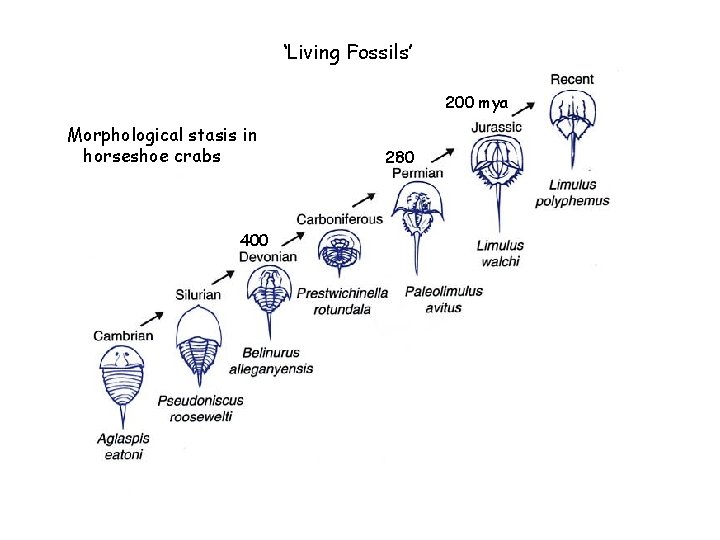
Living Fossils 200 mya Morphological stasis in horseshoe
- Slides: 34
‘Living Fossils’ 200 mya Morphological stasis in horseshoe crabs 400 280
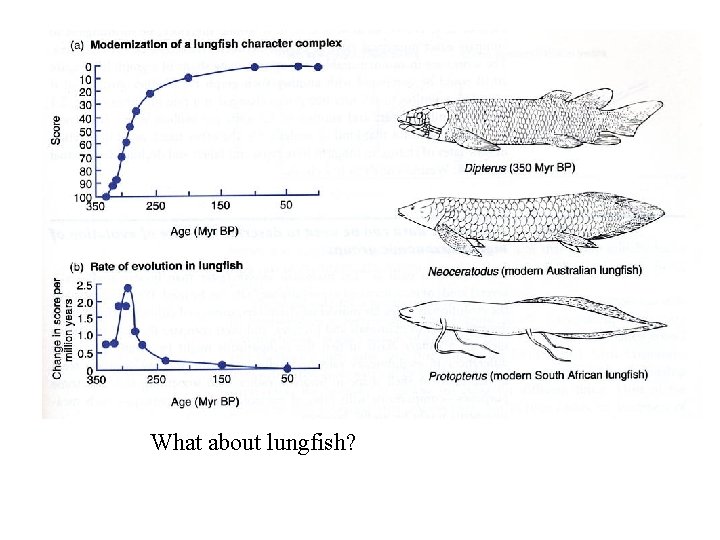
What about lungfish?
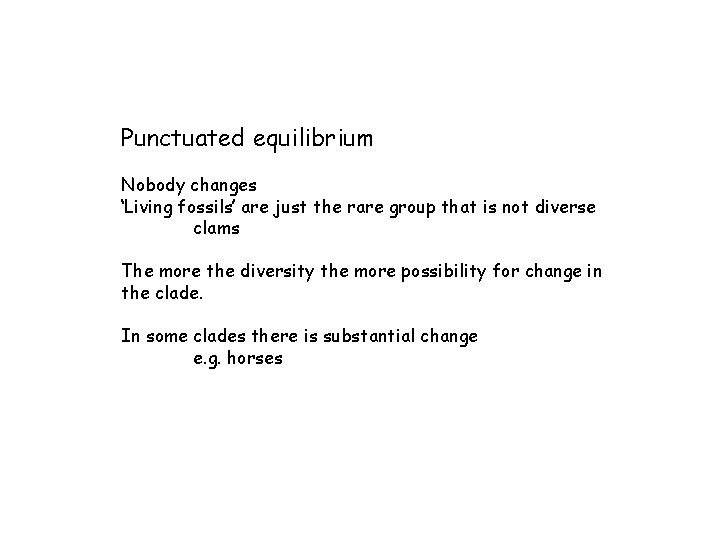
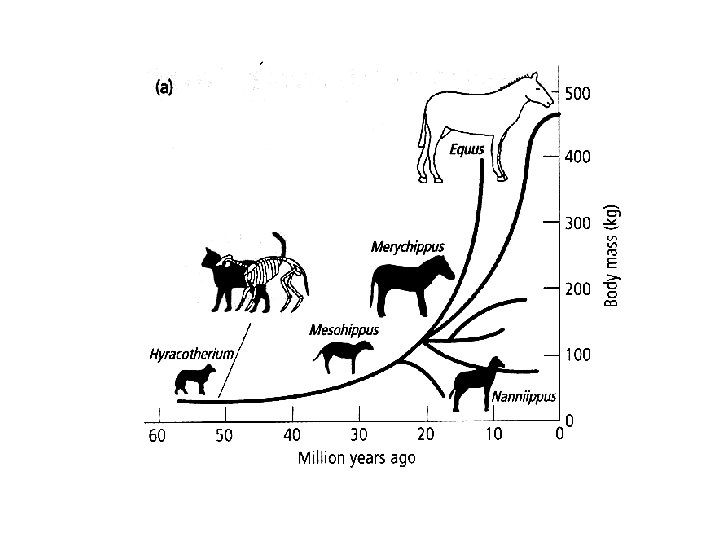
Punctuated equilibrium Nobody changes ‘Living fossils’ are just the rare group that is not diverse clams The more the diversity the more possibility for change in the clade. In some clades there is substantial change e. g. horses
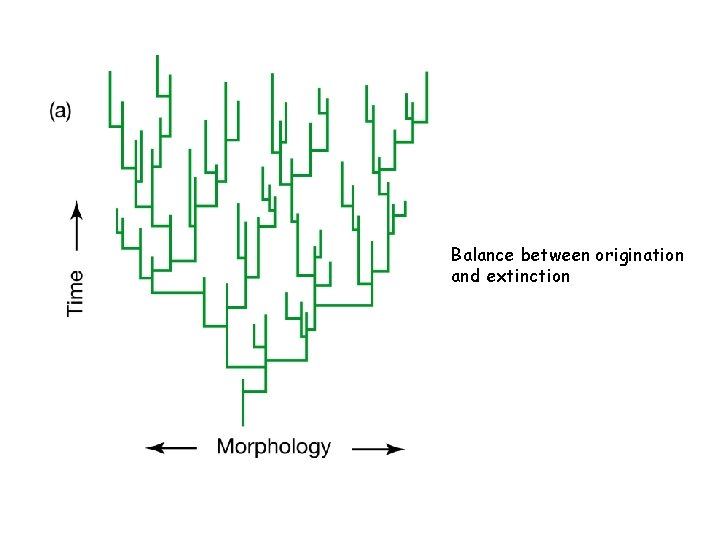
Balance between origination and extinction
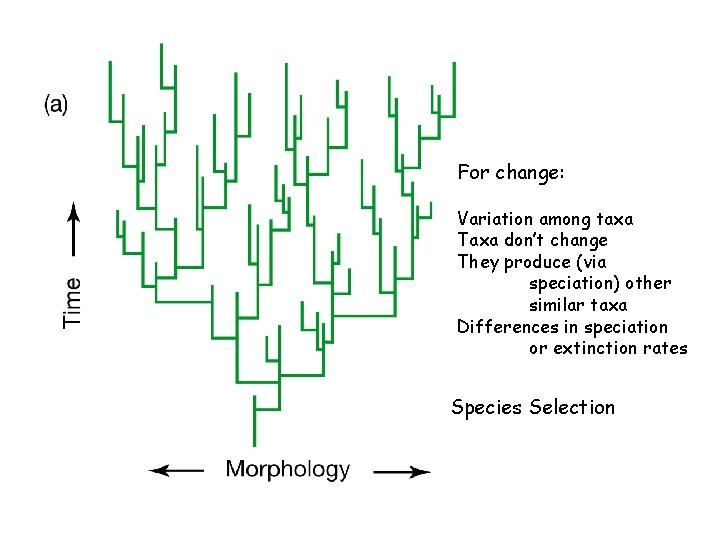
For change: Variation among taxa Taxa don’t change They produce (via speciation) other similar taxa Differences in speciation or extinction rates Species Selection
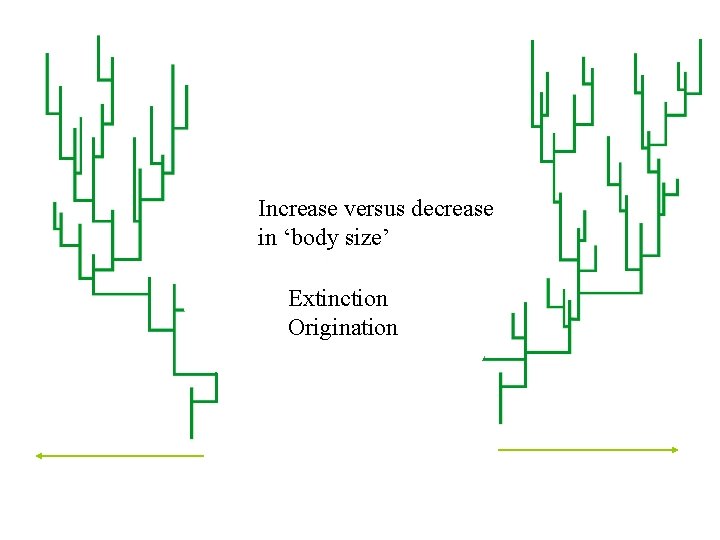
Increase versus decrease in ‘body size’ Extinction Origination
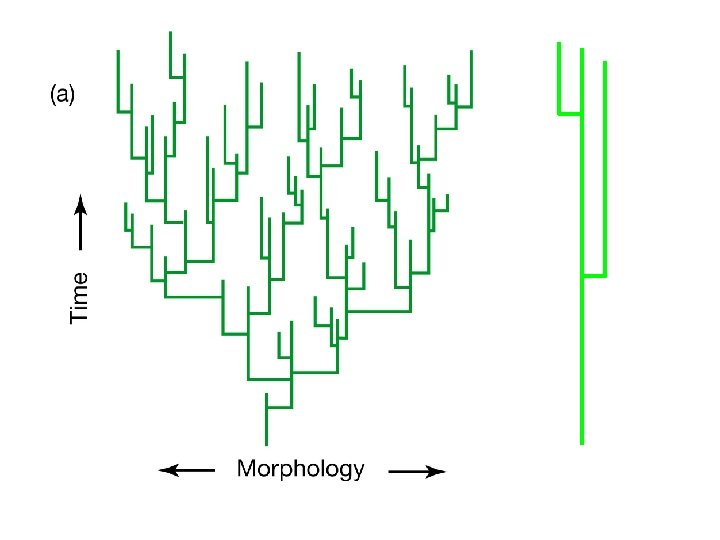
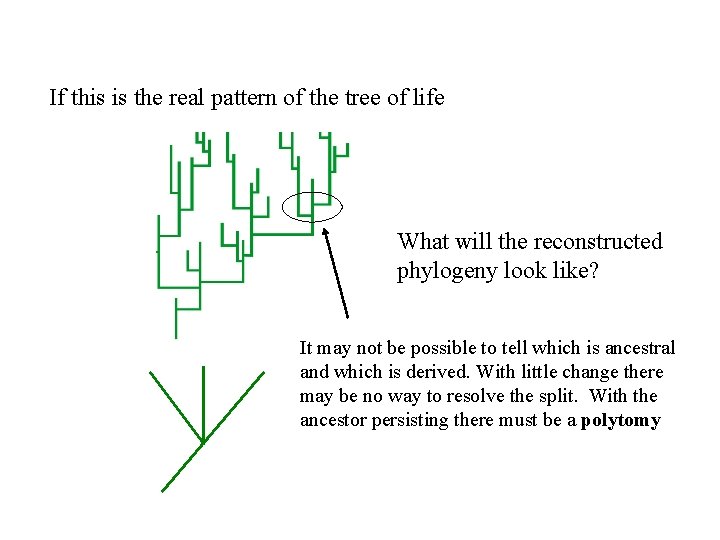
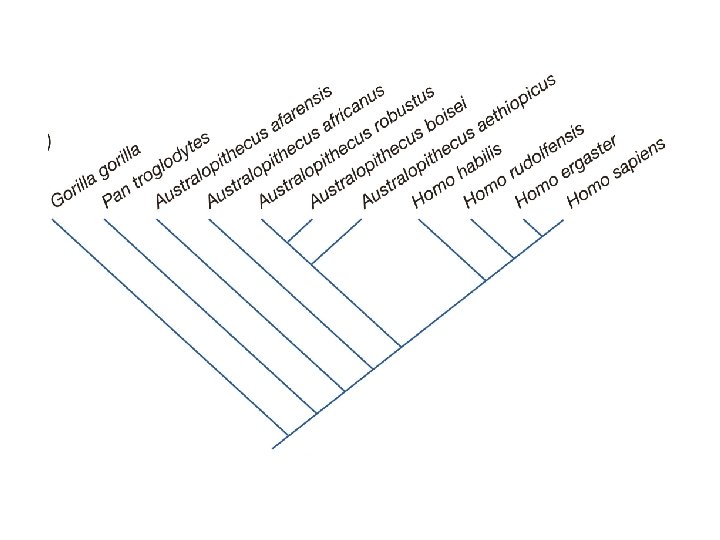
If this is the real pattern of the tree of life What will the reconstructed phylogeny look like? It may not be possible to tell which is ancestral and which is derived. With little change there may be no way to resolve the split. With the ancestor persisting there must be a polytomy
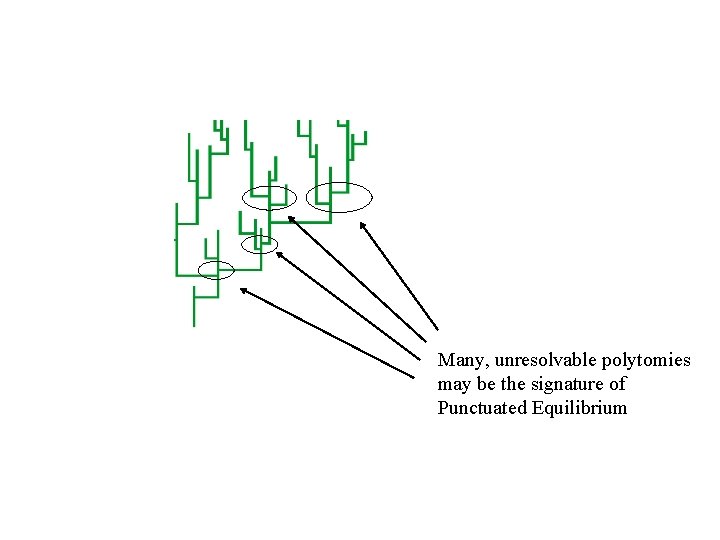
Many, unresolvable polytomies may be the signature of Punctuated Equilibrium
History/Origins of Mammals Humans The Cambrian Explosion All Animal Phyla Common threads? Evolution and Complexity
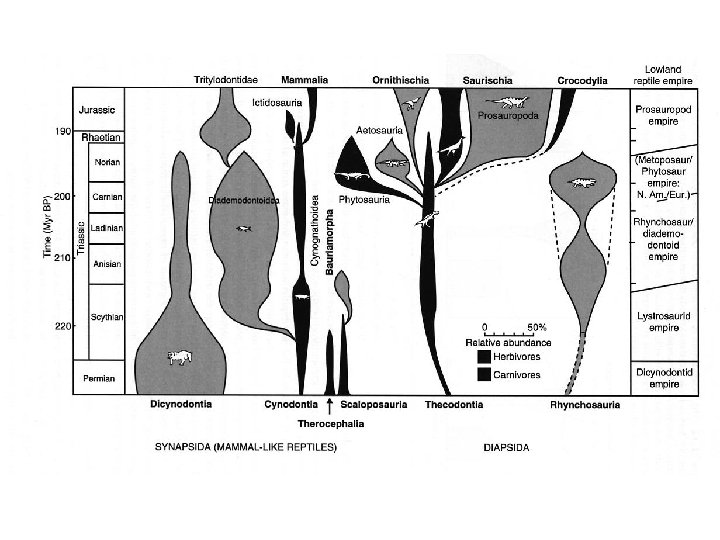
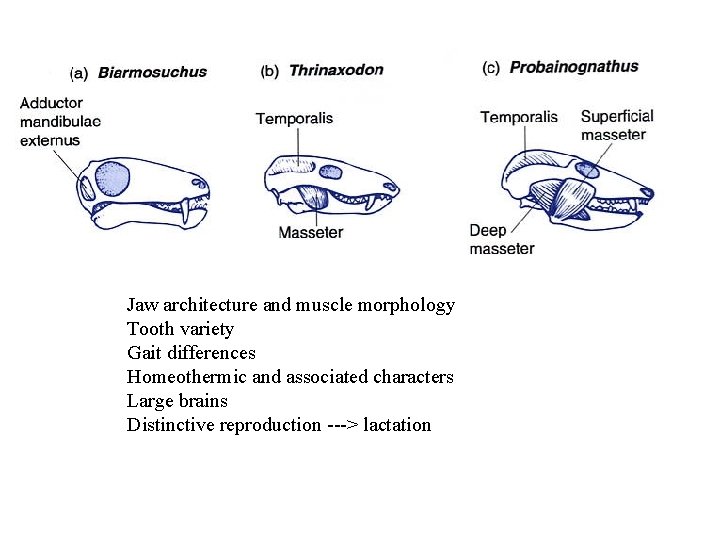
Jaw architecture and muscle morphology Tooth variety Gait differences Homeothermic and associated characters Large brains Distinctive reproduction ---> lactation
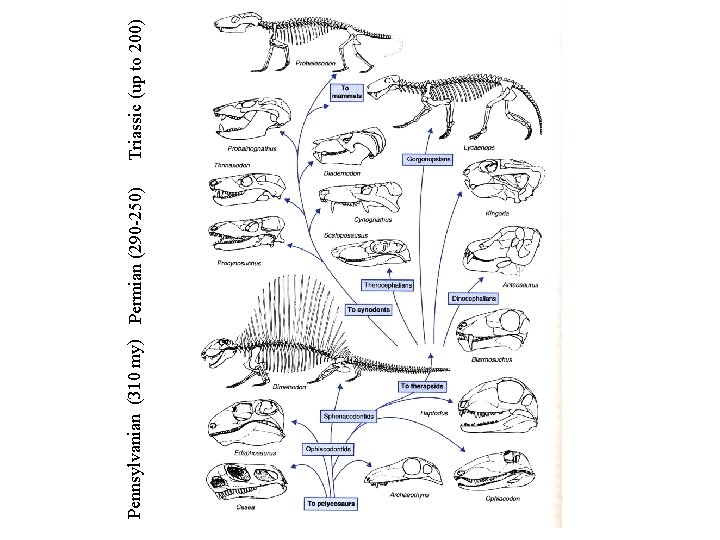
Pennsylvanian (310 my) Permian (290 -250) Triassic (up to 200)
Large diversity Major extinctions Survival of few lineages
Human evolution Who are our relatives? What makes us unique? What makes us human?
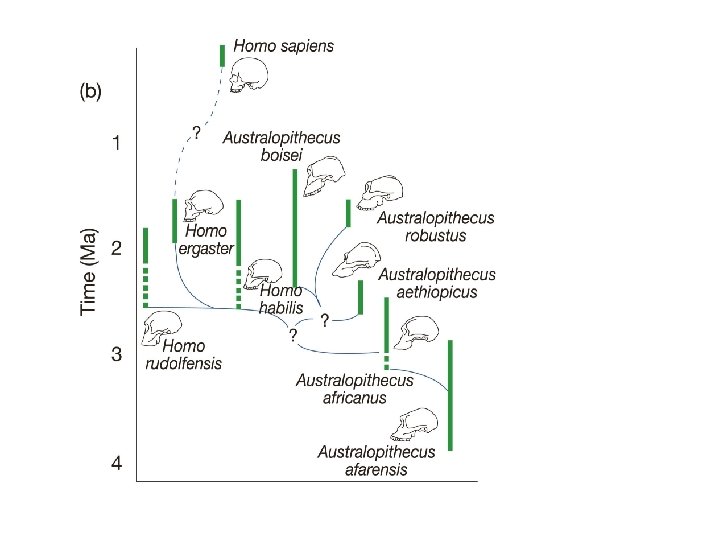
Evidence of a bushy hominid lineage Times when multiple species Numerous extinctions Some survive Contingency -- Future events are shaped by small, chance events. Replaying the tape
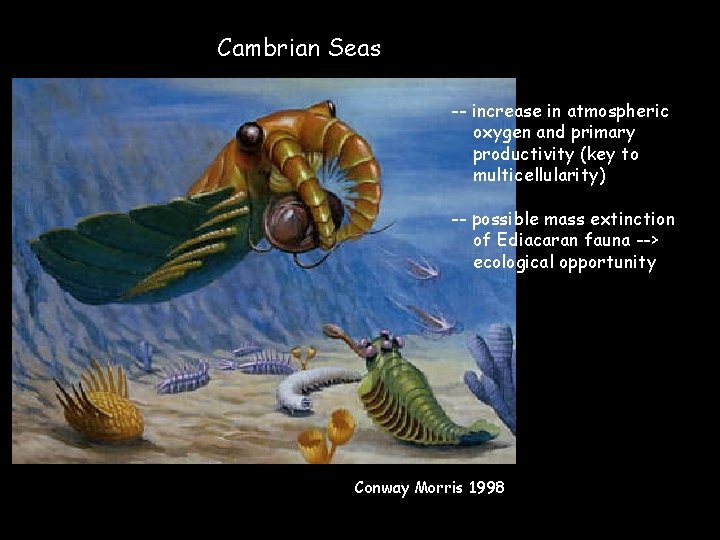
Cambrian Seas -- increase in atmospheric oxygen and primary productivity (key to multicellularity) -- possible mass extinction of Ediacaran fauna --> ecological opportunity Conway Morris 1998
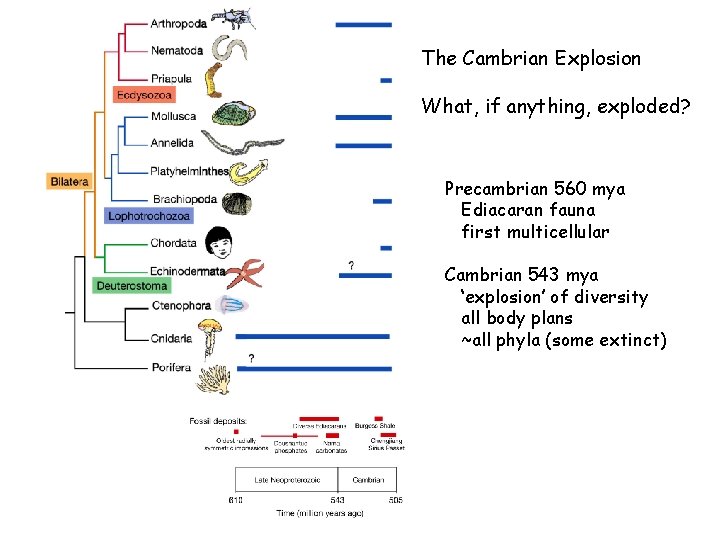
The Cambrian Explosion What, if anything, exploded? Precambrian 560 mya Ediacaran fauna first multicellular Cambrian 543 mya ‘explosion’ of diversity all body plans ~all phyla (some extinct)
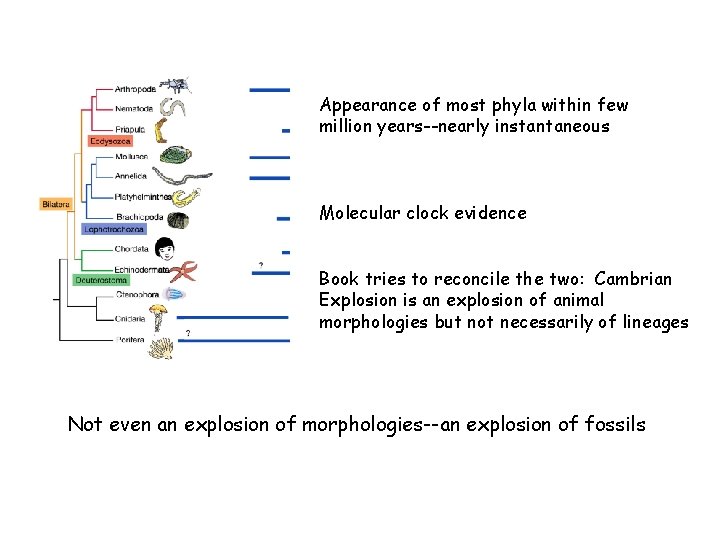
Appearance of most phyla within few million years--nearly instantaneous Molecular clock evidence Book tries to reconcile the two: Cambrian Explosion is an explosion of animal morphologies but not necessarily of lineages Not even an explosion of morphologies--an explosion of fossils
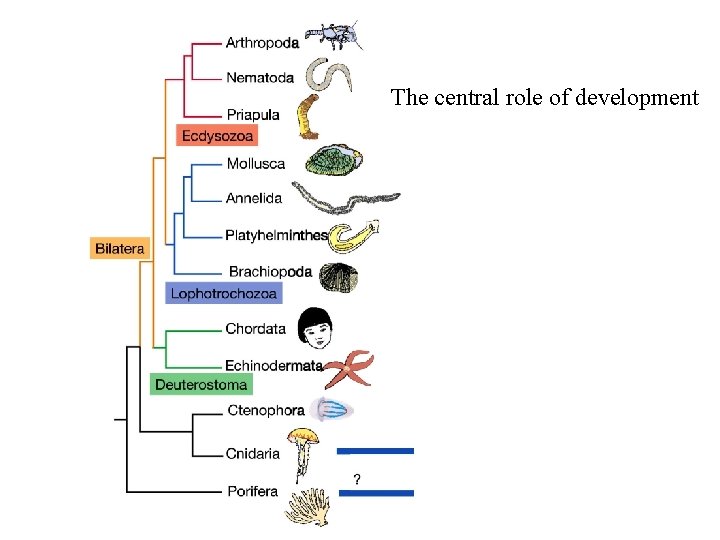
The central role of development
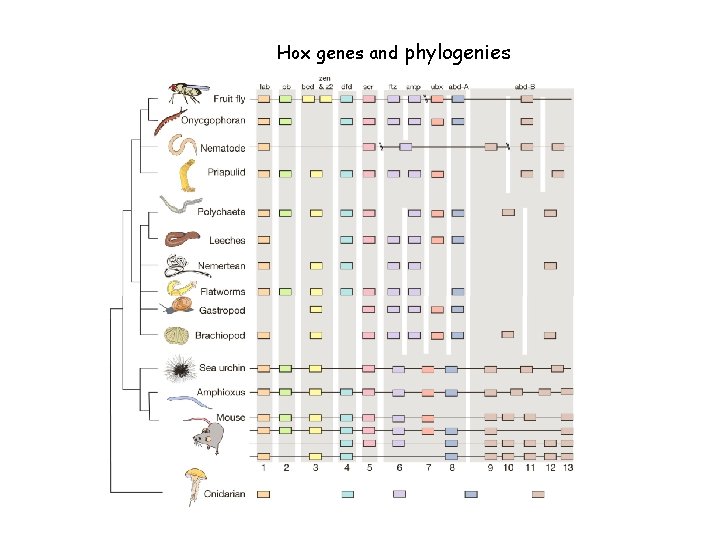
Hox genes and phylogenies
Pushing back still further --Key Innovations associated with the development of multicellularity --cell adhesion molecules --epithelial sheets of cells --hierarchical gene action --Key Innovations for Eukaryota --organelles --mitosis --nucleus
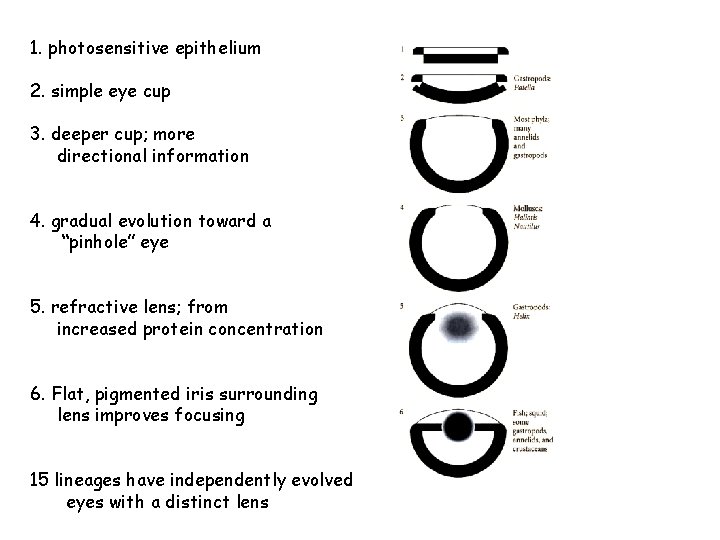
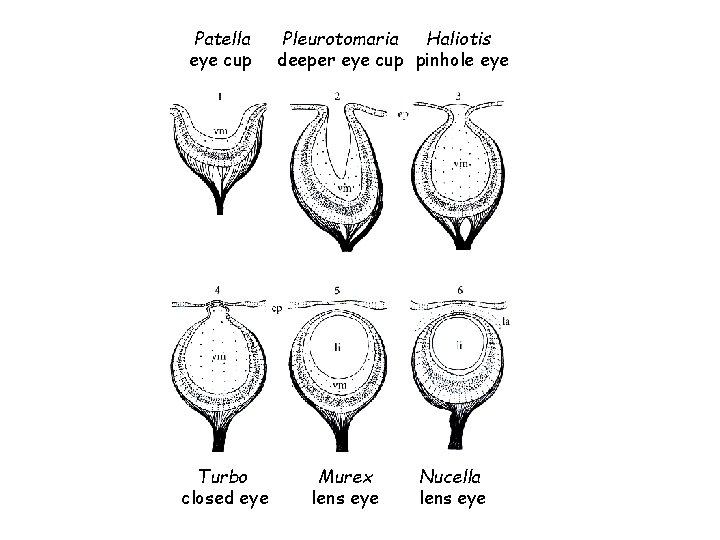
Complex traits evolution vs. intelligent design complex eyes of vertebrates and squid; wings -- incipient evolution of new features -- evolution of highly complex adaptations
Hypotheses for the Incipient Evolution of Complex Adaptations 1. In its initial form, the feature is sufficiently well-developed to provide an advantage (e. g. , Mimicry genes) 2. The new feature is not initially adaptive, but is a developmental by-product of other adaptive features (e. g. , Pierine wing color)
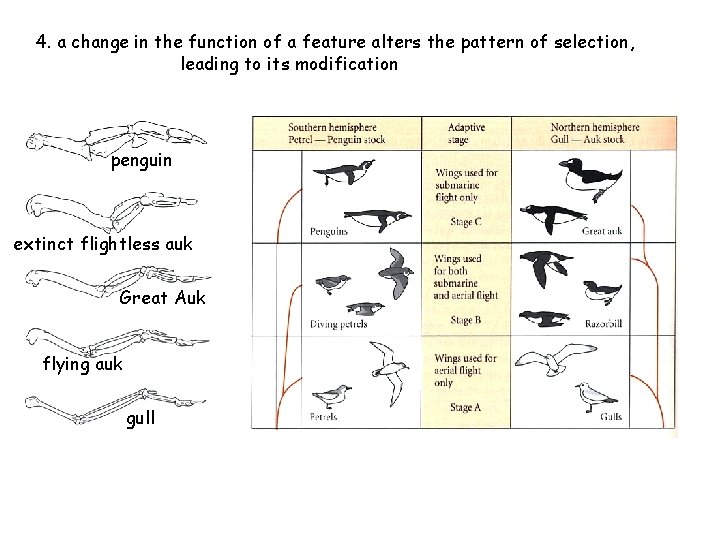
3. 4. 5. 6. 7. 8. 9. 10. 4. 5. One ancestral function of a feature becomes accentuated “With malleus Aforethought Mammals Got an earful Of their ancestors’ Jaw” the mammalian ear evolved from two bones from the lower jaw, the articular and the quadrate --J. M. Burns A change in the function of a feature alters the pattern of selection, leading to its modification
4. a change in the function of a feature alters the pattern of selection, leading to its modification penguin extinct flightless auk Great Auk flying auk gull
1. photosensitive epithelium 2. simple eye cup 3. deeper cup; more directional information 4. gradual evolution toward a “pinhole” eye 5. refractive lens; from increased protein concentration 6. Flat, pigmented iris surrounding lens improves focusing 15 lineages have independently evolved eyes with a distinct lens
Patella eye cup Turbo closed eye Pleurotomaria Haliotis deeper eye cup pinhole eye Murex lens eye Nucella lens eye
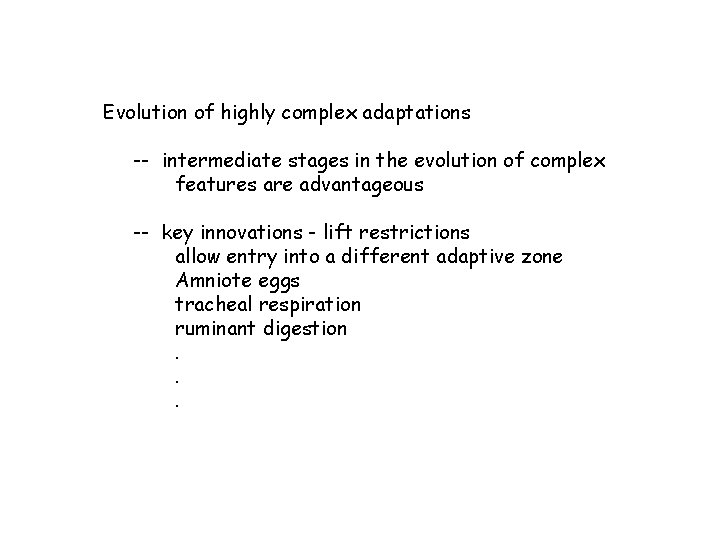
Evolution of highly complex adaptations -- intermediate stages in the evolution of complex features are advantageous -- key innovations - lift restrictions allow entry into a different adaptive zone Amniote eggs tracheal respiration ruminant digestion. . .
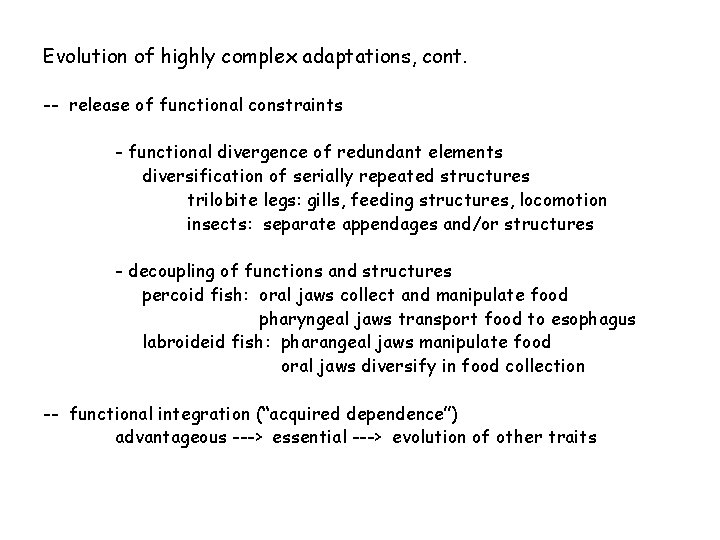
Evolution of highly complex adaptations, cont. -- release of functional constraints - functional divergence of redundant elements diversification of serially repeated structures trilobite legs: gills, feeding structures, locomotion insects: separate appendages and/or structures - decoupling of functions and structures percoid fish: oral jaws collect and manipulate food pharyngeal jaws transport food to esophagus labroideid fish: pharangeal jaws manipulate food oral jaws diversify in food collection -- functional integration (“acquired dependence”) advantageous ---> essential ---> evolution of other traits
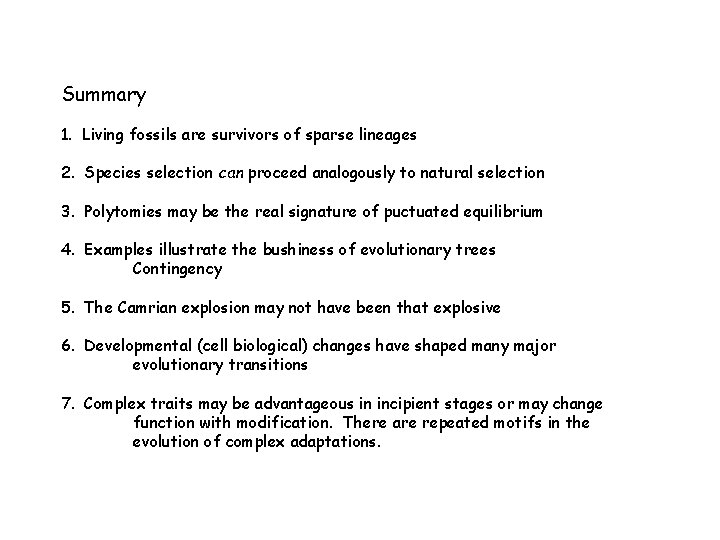
Summary 1. Living fossils are survivors of sparse lineages 2. Species selection can proceed analogously to natural selection 3. Polytomies may be the real signature of puctuated equilibrium 4. Examples illustrate the bushiness of evolutionary trees Contingency 5. The Camrian explosion may not have been that explosive 6. Developmental (cell biological) changes have shaped many major evolutionary transitions 7. Complex traits may be advantageous in incipient stages or may change function with modification. There are repeated motifs in the evolution of complex adaptations.