
Living and working in Sweden Elena Tornberg EURES
Living and working in Sweden Elena Tornberg, EURES Adviser
Some facts about Sweden -EU-member state since 1995 -Sweden is the third largest country in the EU -9, 7 million inhabitants - 85% live in the south and 85% live in cities -Population density: 21 people/km 2 (Italy 198 p/km 2) -Currency: Svenska kronor (Swedish Crown) SEK 100 = EUR 10, 90 -95. 700 lakes -8, 000 Italian citizens live in Sweden
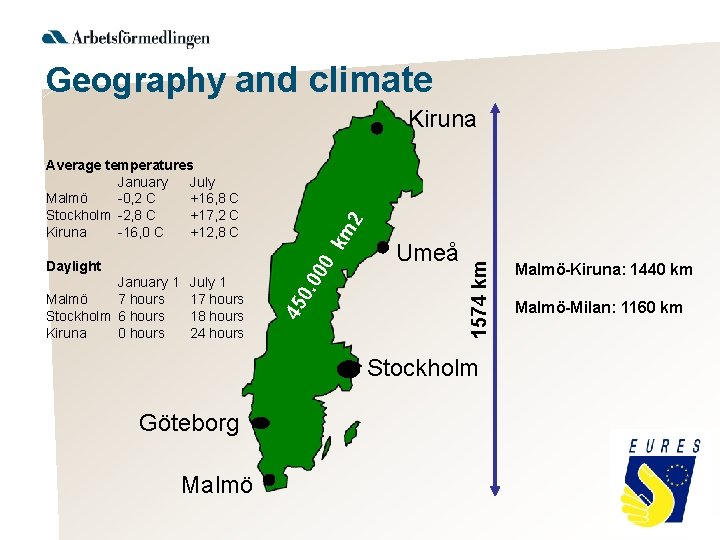
Geography and climate Kiruna Umeå 1574 km km 00 July 1 17 hours 18 hours 24 hours 0. 0 January 1 Malmö 7 hours Stockholm 6 hours Kiruna 0 hours 45 Daylight 2 Average temperatures January July Malmö -0, 2 C +16, 8 C Stockholm -2, 8 C +17, 2 C Kiruna -16, 0 C +12, 8 C Stockholm Göteborg Malmö-Kiruna: 1440 km Malmö-Milan: 1160 km
Language skills • Most jobs require good level of Swedish • In some highly skilled jobs you can use English (still expected that you learn Swedish) ü Engineers ü IT-specialists ü Medical doctors, specialist nurses • Few jobs for low skilled workers with no Swedish. • Free basic swedish web course on www. si. se
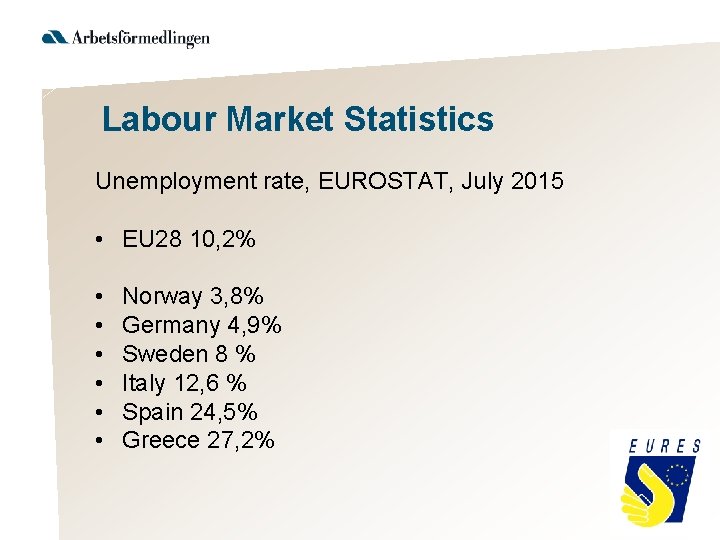
Labour Market Statistics Unemployment rate, EUROSTAT, July 2015 • EU 28 10, 2% • • • Norway 3, 8% Germany 4, 9% Sweden 8 % Italy 12, 6 % Spain 24, 5% Greece 27, 2%
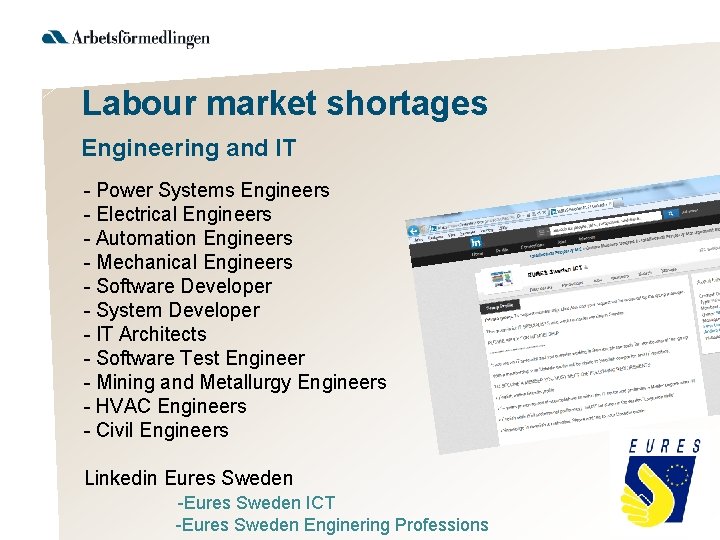
Labour market shortages Engineering and IT - Power Systems Engineers - Electrical Engineers - Automation Engineers - Mechanical Engineers - Software Developer - System Developer - IT Architects - Software Test Engineer - Mining and Metallurgy Engineers - HVAC Engineers - Civil Engineers Linkedin Eures Sweden -Eures Sweden ICT -Eures Sweden Enginering Professions
Labour market shortages Other professions • • Physicians Surgical Nurses, psychiatric care Nurses in emergency care Geriatric Nurses Chefs Preschool teachers Car Mechanics, heavy vehicles
Working in Sweden • Full time, 40 hours per week • Minimum 25 days vacation per year • No national minimum wage • Collective agreements between trade unions and employers
Working in Sweden • All EU/EEA or Swiss citizens have the right to work in Sweden • Citizens of a non-EU country - need a work permit • www. migrationsverket. se
Recognition of foreign diplomas • Universitets- och Högskolerådet The Swedish Higher Education Authority www. uhr. se The National Board for Health and Welfare www. sos. se licences for regulated health care professions
Finding a job • Public Employment Services www. arbetsformedlingen. se Many links to other major job websites • EURES http: //www. eures. europa. eu/ • Swedish newspapers www. onlinenewspapers. com/sweden. htm • Jobs in English www. jobsinstockholm. com www. thelocal. se/jobs
Applying for a job in Sweden • Applying via web site, online or e-mail • Applications should be typewritten in Swedish or English. • An application consists of: Cover letter (1 page) CV (1 -2 pages)
Cover Letter • Should be a ”bridge” that shows employer how your CV meets his or her vacancy ad’s requirements • Don’t repeat information that’s in your CV - explain what you’ve learned, what you can offer them, give an example showing how you work or deal with customers
Cover Letter • The first paragraph of your letter should include information on why you are writing. Mention the position you are applying for and where you found the job listing. Include the name of a mutual contact, if you have one. • Middle Paragraph(s); The next section should describe what you have to offer the employer. Mention specifically how your qualifications match the job you are applying for. Remember, you are interpreting your resume, not repeating it. • Conclude your cover letter by thanking the employer for considering you for the position. Include information on how you will follow-up.
Letters of Interest - also known as prospecting letters should contain information on: • why the company interests you; • why your skills and experience would be an asset to the company; • also provide information on how you can be contacted if the company is interested in following up with you.
CV • Simple, attractive layout—think about how it looks! • You can start with either your education or work experience • Reverse time order—the latest is first • We write dates: YY-MM-DD • Don’t go back too far in time (except certain education) • Skip short courses, apprenticeships if they’re not relevant
After sending the application… • Positive with telephone contact • Have some intelligent questions ; -) • An extra chance to market yourself and stand out!
Job interview • Be on time! • Adaped your dress to your position • Be prepared 3 most common interview questions: - Tell us a little bit about yourself. - Tell us about your strengths and limitations. - Where do you see yourself in five years?
Swedish work place culture • Flat organisations • Team work and consensus -Swedes tend to avoid conflicts • ”Du” – first name basis – informality! • Gender equality • Strong trade unions
Housing • Rent an apartment or house (cooker, fridge and freezer included) • 1 bedroom apartment, average rent 500 EURO/month, 68 m 2 (heating included) • Buy a condominium • Buy a house • Accommodation costs vary greatly
Your first EURES job financial assistance for young people Your first EURES job can make it easier for you to come to Sweden for a job interview or to start working here. You should be: • aged 18 -35 • citizen of an EU country • legally resident in an EU country Information and application www. yourfirsteuresjob. eu
Want to know more…. . ? www. sweden. se www. work. sweden. se www. swedenabroad. com/it-IT www. arbetsformedlingen. se www. eures. se www. facebook. com/Eures. Sweden Mailbox EURES Sweden: eures@arbetsformedlingen. se Chat with EURES Sweden - Fridays, 10 -15: eures. europa. eu
Grazie!
- Slides: 23