
Living Agnathans Lamprey Dissections Agnathans The vertebrate story
Living Agnathans Lamprey Dissections
Agnathans • The vertebrate story begins with the Agnathans • Agnathans lack jaws, a biting apparatus derived from pharyngeal bars. • Today, hagfishes and lamprey carry the history of the jawless fish. • These two groups, together, form the Cyclostomes and are used to represent primitive vertebrates. – However, they are modified and adapted to specialized lifestyles, and therefore depart in several ways from primitive agnathans.
Myxinoidea • The hagfishes- deep sea, mud burrowing, eellike scavengers. • The use tooth-like processes on a muscular tongue to rasp the flesh from prey. • Slime glands beneath the skin release mucus through surface pores. – Hagfishes have a unique ability t tie themselves into a know and use the slime to slip through his know.

• Hagfishes have no trace of vertebrae on or around the notochord. • Their osmotic concentration is unique. – Their internal osmotic concentration is roughly that of seawater, so there is no net flow of water into or out of their tissues. – Due to this it is believed that hagfishes are the only extant fishes to have a saltwater ancestor.
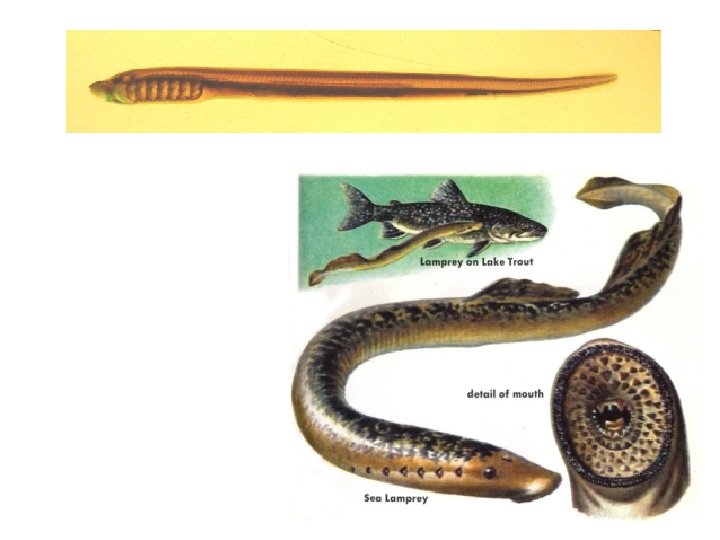
Petromyzontida • Lampreys are a mostly parasitic, freshwater agnathan. • Lampreys use the “teeth” around their mouth to grasp onto prey, and a rasping tongue to pierce the flesh of their host. • Larval lamprey are referred to as ammocetes, and undergo metamorphosis into the adult form. • As larvae they possess all five chordate features and life as suspension feeding individuals. • Lamprey lack bones and surface scales. • Adults possess: – medial fins, but no paired fins – Vertebrae, represented as individual blocks of cartilage that sit atop the notochord.
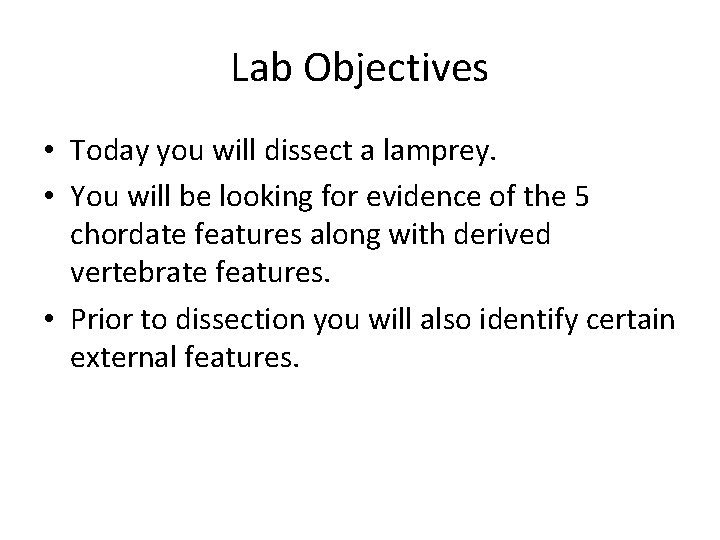
Lab Objectives • Today you will dissect a lamprey. • You will be looking for evidence of the 5 chordate features along with derived vertebrate features. • Prior to dissection you will also identify certain external features.
Dissection • Externally: – Dorsal Fins (Anterior and posterior) – External Gillss – Eye – Oral Funnel • Internally Transverse and Sagittal Sections) – – – – Notochord Pharyngeal Gills Ovary/Testis Heart (ventricle) Myomeres Liver Kidney
- Slides: 9