
LIVIA DEA YULIANI 1401144487 Uber Chicago study case
LIVIA DEA YULIANI 1401144487 Uber Chicago study case
“sharing economy” generally refers to the phenomenon of turning unused or under-used assets owned by individuals into productive resources.
CHICAGO BEFORE UBER Riders Received Low-Quality Service from an Unaccountable Taxi Industry Drivers Suffered Under an Exploitative, Inefficient, and Unsafe System
CHICAGO BEFORE UBER • Taxi passengers led nearly 36, 000 complaints with the city’s Department of Business Affairs and Consumer Protection, which regulates Chicago’s taxi industry. • Reckless driving and rude driver behavior accounted for over 20, 000 of those complaints, while thousands more cited fare overcharges or refusals to pick up, and complaints of verbal or physical assaults by taxi drivers averaged 1. 5 a day, every day, over this period. • More than 2, 700 riders went to the trouble of lodging formal complaints specifically about credit card readers in taxis between 2011 and February 2014. • The lack of any meaningful accountability in the taxi industry is unfortunately far more harmful. • Chicago residents have long reported taxi drivers discriminating on the grounds of disability or race, or simply refusing to pick up or drop off in low-income neighborhoods.
ENTER UBER In 2011, Uber arrived in Chicago and set about fundamentally changing how both riders and drivers moved around the city. Uber is a technology company that provides a smartphone application connecting driver-partners with people who need a ride. With Uber, there’s no need to call a dispatcher or hail a car on the street: getting a ride on the platform is literally as easy as tapping a button. Uber enables driver-partners to use their personal car to provide rides and earn income whenever they want.
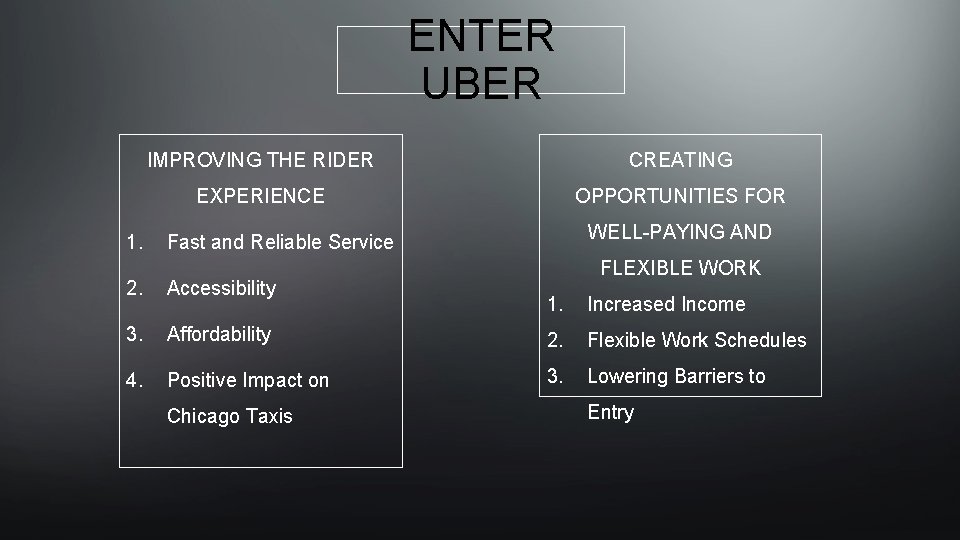
ENTER UBER 1. IMPROVING THE RIDER CREATING EXPERIENCE OPPORTUNITIES FOR WELL-PAYING AND Fast and Reliable Service 2. Accessibility 3. 4. FLEXIBLE WORK 1. Increased Income Affordability 2. Flexible Work Schedules Positive Impact on 3. Lowering Barriers to Chicago Taxis Entry
ENTER UBER To providing fast, reliable, and affordable rides on its platform, Uber may be responsible for improving taxi service levels by introducing healthy competition to the for-hire transportation market. Uber’s arrival in Chicago coincided with a noticeable drop in taxi complaints led through the city’s 311 non-emergency hotline. Uber debuted uber. X in Chicago in April 2013 and a direct comparison between the first nine months of 2013 and of 2014 reveals that overall taxi complaints fell 18%, reports of reckless driving dropped 20%, credit card refusals were down 37%, and complaints over taxi drivers’ rudeness fell 25%.
OPINI This article explain, Uber has significantly improved how both residents and tourists alike move throughout Chicago, helping to bring people, businesses, and neighborhoods closer together only download the application of uber. Removing technological and practical barriers that once stymied willing drivers from connecting with people who needed rides, Uber has had a dramatic impact on the lives of riders, driver-partners, and the city as a whole. Sharing Economy concept in uber which makes consumers more efficiently towards time and costs. Driver uber also feel advantaged because of the management provided by uber the motorcycle/car driver had, they could get a lot of revenue and dividing the result with uber company. I think this article is very useful to know the uber’s life and uber’s growth in chicago. This article explain before and after uber arrived in chicago and also the growth of uber in chicago itself time by time. Also this case have related with sharing economy.
REFERENCE https: //uber-static. s 3. amazonaws. com/webfresh/legal/Uber_Chicago_Case. Study. pdf
- Slides: 9