
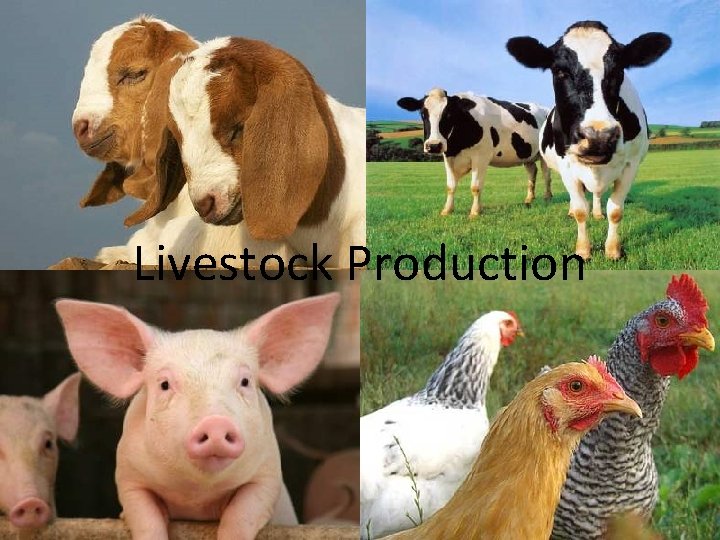
Livestock Production Livestock Production Cattle ranching and farming
- Slides: 35
Livestock Production
Livestock Production ü Cattle ranching and farming ü Dairy farming • Hog and pig farming • Sheep and goat farming • Poultry and egg production • Animal aquaculture
Hog and Pig Farming • • • Swine production systems Types of swine operations Management practices Diseases Importance of the swine industry in the U. S.
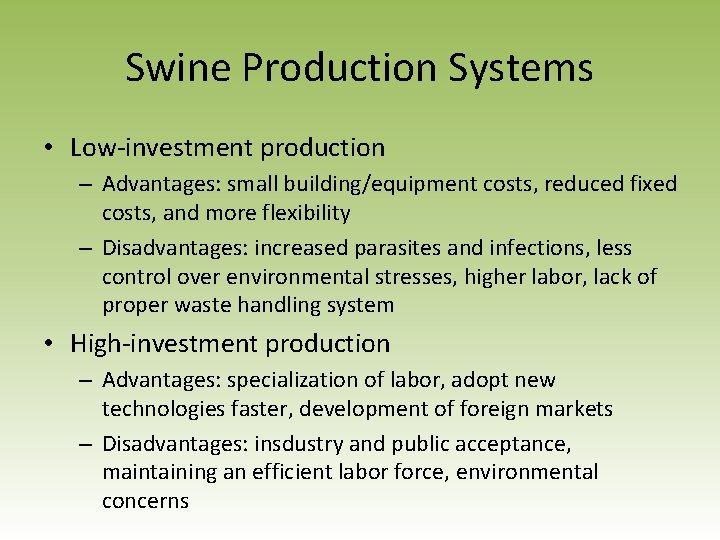
Swine Production Systems • Low-investment production – Advantages: small building/equipment costs, reduced fixed costs, and more flexibility – Disadvantages: increased parasites and infections, less control over environmental stresses, higher labor, lack of proper waste handling system • High-investment production – Advantages: specialization of labor, adopt new technologies faster, development of foreign markets – Disadvantages: insdustry and public acceptance, maintaining an efficient labor force, environmental concerns
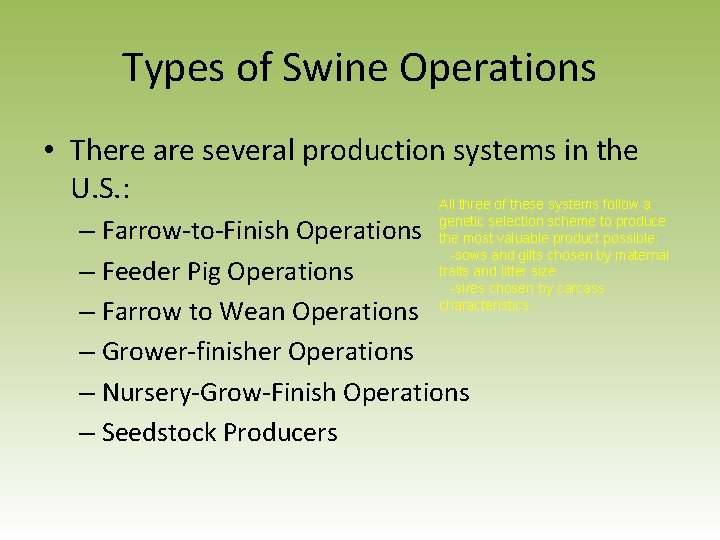
Types of Swine Operations • There are several production systems in the U. S. : All three of these systems follow a selection scheme to produce – Farrow-to-Finish Operations genetic the most valuable product possible: -sows and gilts chosen by maternal traits and litter size – Feeder Pig Operations -sires chosen by carcass – Farrow to Wean Operations characteristics – Grower-finisher Operations – Nursery-Grow-Finish Operations – Seedstock Producers
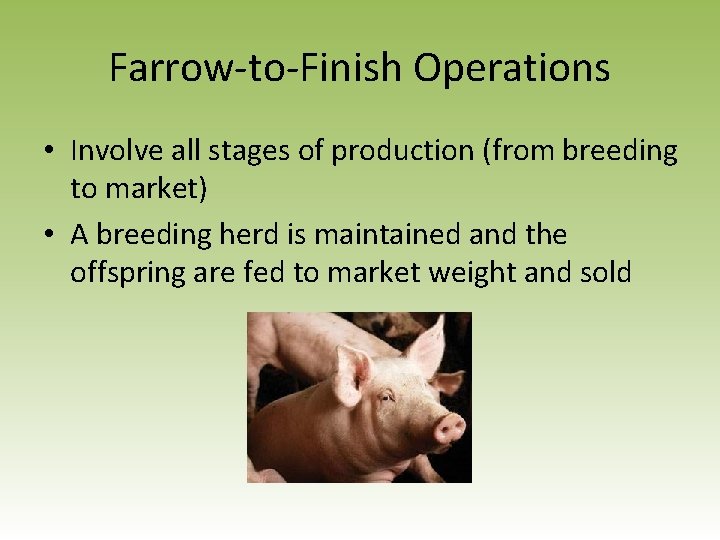
Farrow-to-Finish Operations • Involve all stages of production (from breeding to market) • A breeding herd is maintained and the offspring are fed to market weight and sold
Feeder Pig Operations • Also called Farrowing-to-Nursery Operations • A breeding herd is maintained and offspring are marketed at 40 -60 lbs • High labor requirements • Minimizes feed inputs necessary to raise market animals as pigs are sold before feed demands become great
Farrow-to-Wean Operations • Breeding herd is maintained and offspring are sold at 10 -15 lbs after weaning to nurserygrow-finish farms • High labor requirements
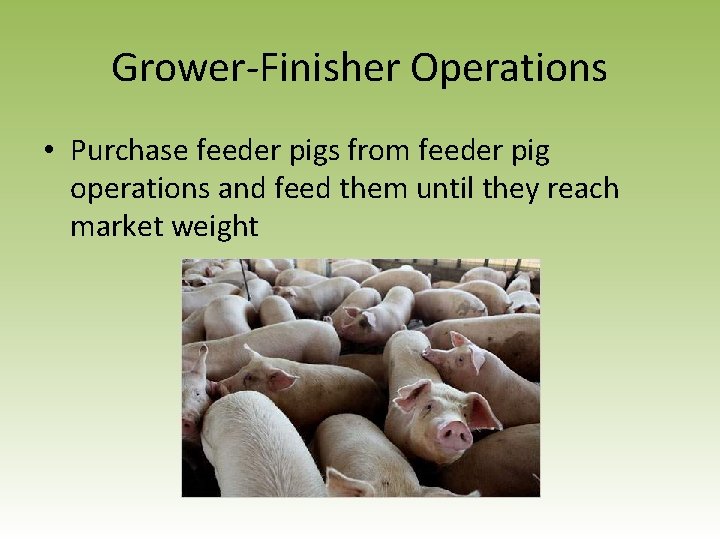
Grower-Finisher Operations • Purchase feeder pigs from feeder pig operations and feed them until they reach market weight
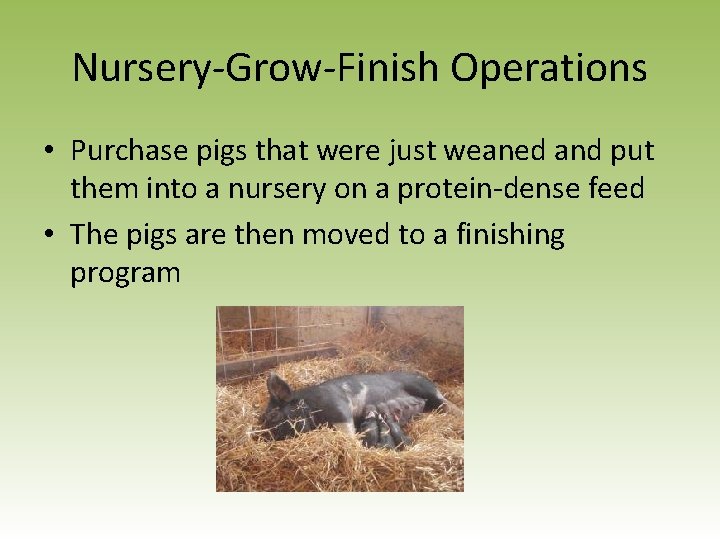
Nursery-Grow-Finish Operations • Purchase pigs that were just weaned and put them into a nursery on a protein-dense feed • The pigs are then moved to a finishing program
Seedstock Producers • Seedstock producers provide foundation hogs and pigs for Farrow-to-Finish and Farrow-to. Feeder programs • Objective of seedstock producers is to provide genetically superior, healthy breeding stock – Emphasizes reproduction, growth performance, and carcass characteristics
Swine Management Practices • • Crossbreeding Farrowing Processing Nutrition and feeding
Crossbreeding • Crossbreeding systems take advantage of the complementarity between breeds – Incorporates the strengths of both parental breeds into a hybrid offspring • Important to commercial swine production – Approximately 95% of hogs marketed annually in the U. S. are crossbred
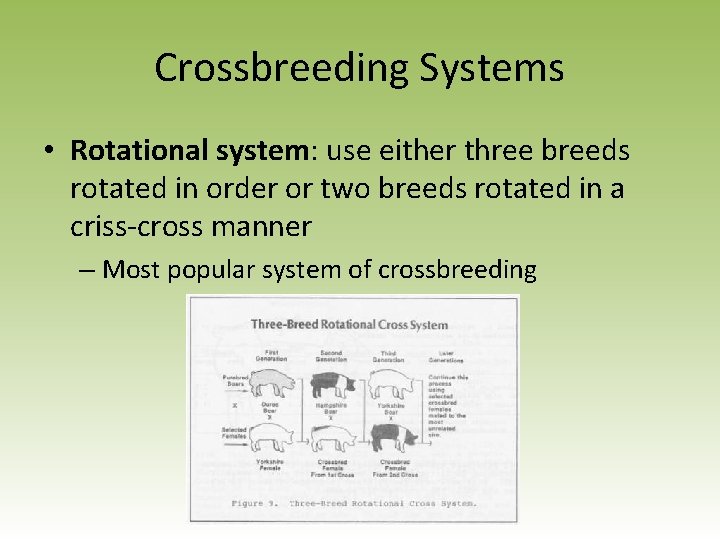
Crossbreeding Systems • Rotational system: use either three breeds rotated in order or two breeds rotated in a criss-cross manner – Most popular system of crossbreeding
Crossbreeding Systems • Terminal crossbreeding: all offspring from the terminal mating are marketed (no replacement gilts kept) • Two types – Simple terminal: two purebred animals mated together – Complex terminal: crossbred sire mated to a crossbred female
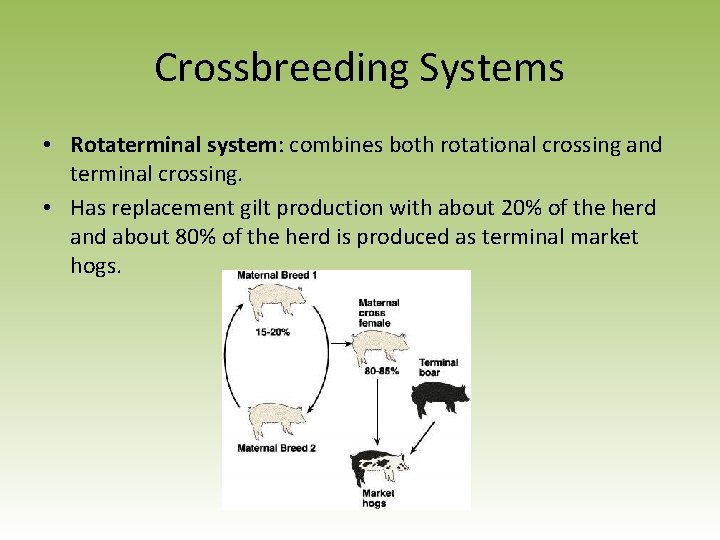
Crossbreeding Systems • Rotaterminal system: combines both rotational crossing and terminal crossing. • Has replacement gilt production with about 20% of the herd and about 80% of the herd is produced as terminal market hogs.
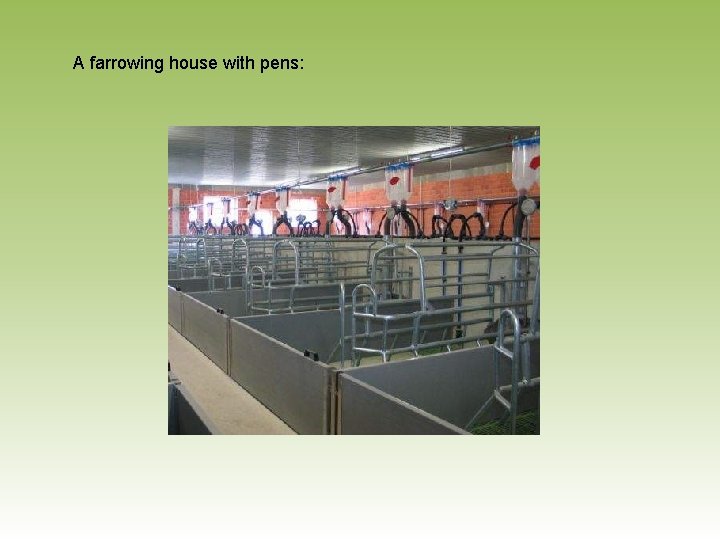
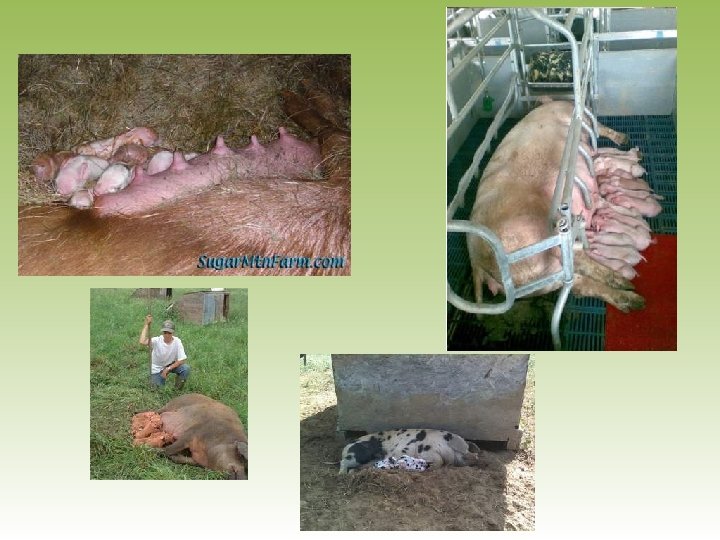
Farrowing • Farrowing: to produce a litter of pigs • Sows are generally moved into farrowing crates or pens in a farrowing house about one week before their projected farrowing date • Farrowing house: confinement building that house sows during parturition.
Farrowing • “All-in, all-out” is a concept that is commonly followed by swine producers. • Sows with similar farrowing dates are moved into the farrowing house at the same time and removed about a month later when litters are weaned and moved into the nursery. – Allows producers to completely clean and disinfect the farrowing house for better disease control.
A farrowing house with pens:
Farrowing • Indications of farrowing: – Restlessness – Swelling of vulva – Fullness of udder – Milk letdown – Fluid presence from vulva
Farrowing • Once the sow starts giving birth, pigs should be born at about 15 -20 minute intervals – If birth interval exceeds 45 -60 minutes, the birth canal should be checked for obstructions and oxytocin administered to induce labor • Normal labor lasts between 30 minutes to 5 hours • It takes approximately 2. 5 hours to deliver a litter of 12 piglets
Farrowing • Temperature is important to maintain comfort of both sow and piglets: – Sows are comfortable at 60 -65 degrees – Newborn piglets require temperatures of about 85 -90 degrees for the first 3 days of life (maintained by heat lamp and/or heat pad)
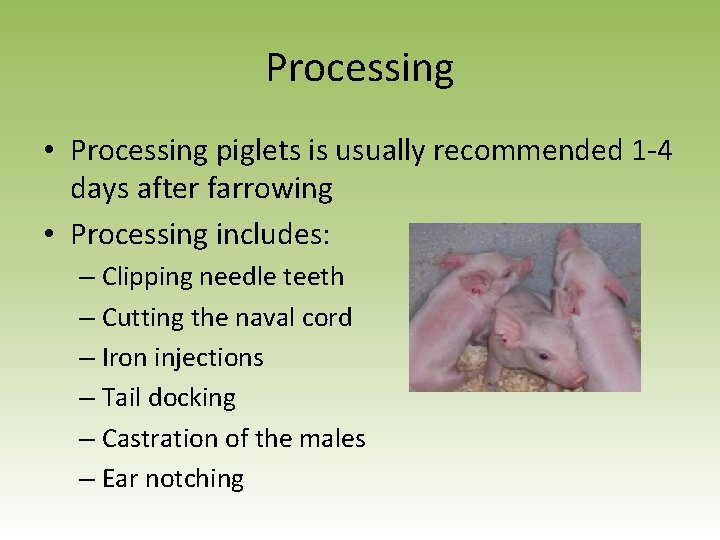
Processing • Processing piglets is usually recommended 1 -4 days after farrowing • Processing includes: – Clipping needle teeth – Cutting the naval cord – Iron injections – Tail docking – Castration of the males – Ear notching
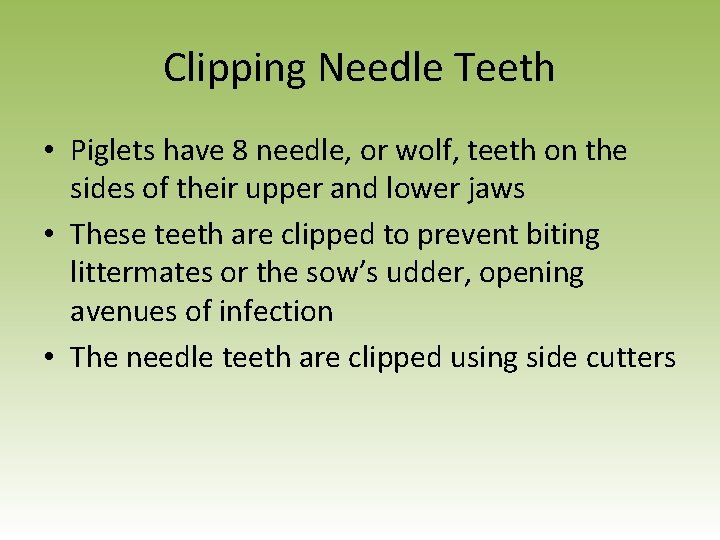
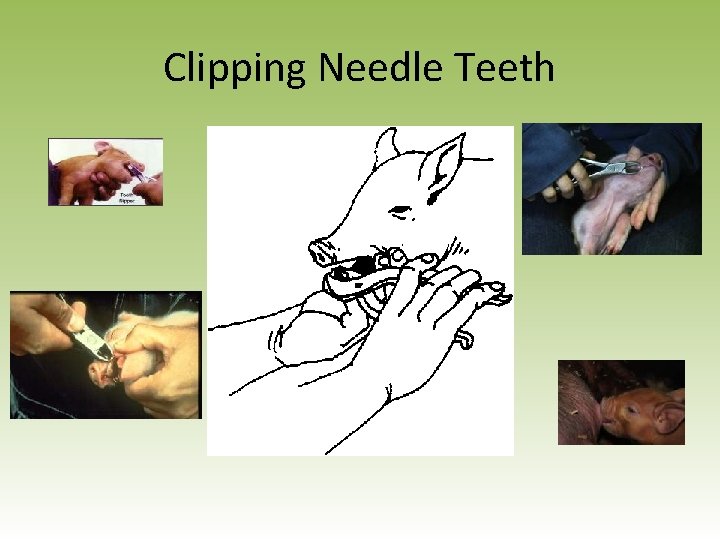
Clipping Needle Teeth • Piglets have 8 needle, or wolf, teeth on the sides of their upper and lower jaws • These teeth are clipped to prevent biting littermates or the sow’s udder, opening avenues of infection • The needle teeth are clipped using side cutters
Clipping Needle Teeth
Cutting the Naval Cord • The naval cord is cut to approximately 1 to 1. 5 inches in length to prevent catching and pulling • After the cord is cut, it is dipped in Betadine or iodine solution to prevent infection
Iron Injections • Iron injections are given to prevent anemia, which can result from iron content in milk • Confinement in the farrowing house prevents contact with the soil, which is nature’s way of replenishing piglets’ iron needs
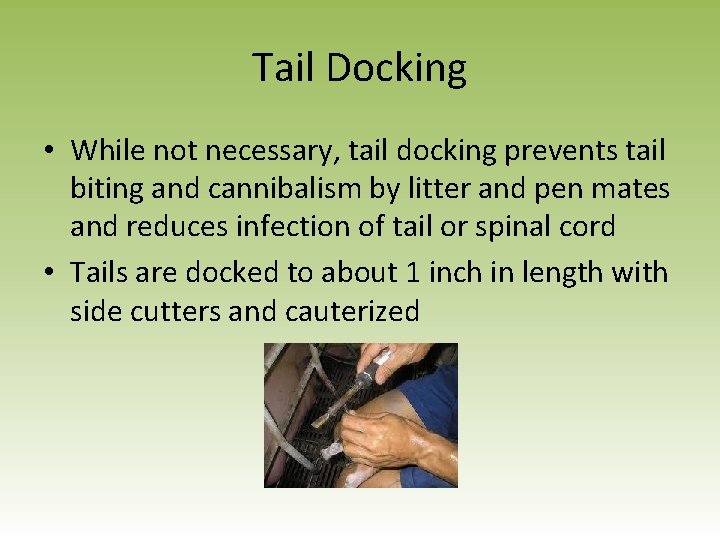
Tail Docking • While not necessary, tail docking prevents tail biting and cannibalism by litter and pen mates and reduces infection of tail or spinal cord • Tails are docked to about 1 inch in length with side cutters and cauterized
Castration • Castration in hogs prevents undesirable boar odor or taint associated with cooked pork from males
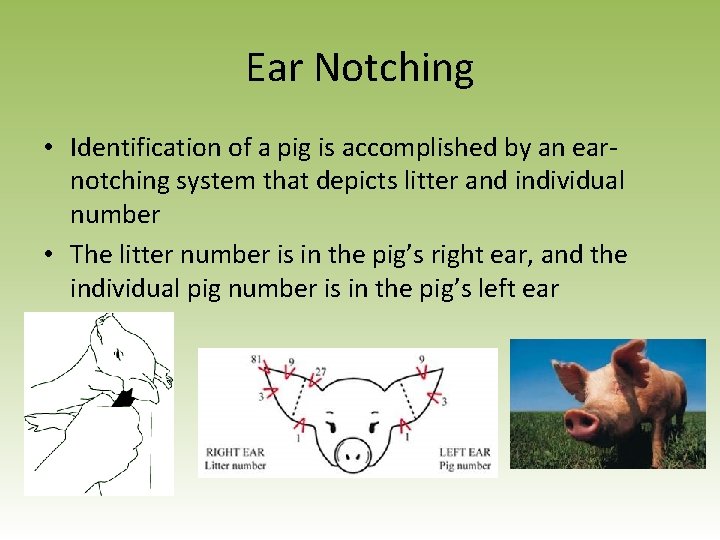
Ear Notching • Identification of a pig is accomplished by an earnotching system that depicts litter and individual number • The litter number is in the pig’s right ear, and the individual pig number is in the pig’s left ear
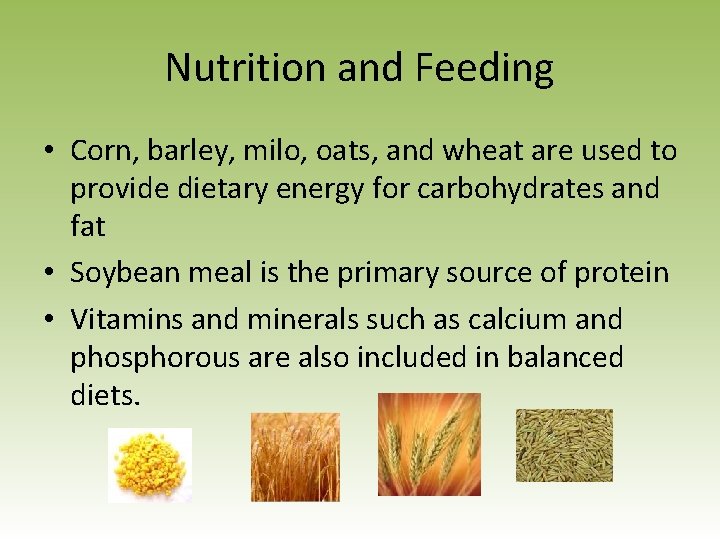
Nutrition and Feeding • Corn, barley, milo, oats, and wheat are used to provide dietary energy for carbohydrates and fat • Soybean meal is the primary source of protein • Vitamins and minerals such as calcium and phosphorous are also included in balanced diets.
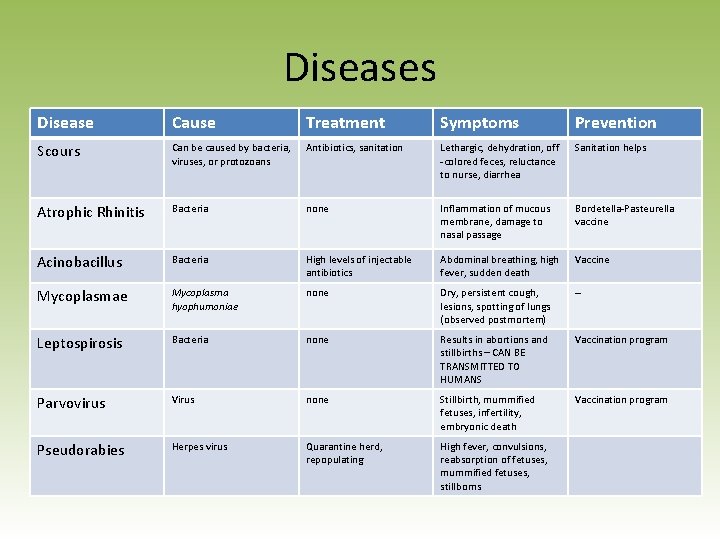
Diseases Disease Cause Treatment Symptoms Prevention Scours Can be caused by bacteria, viruses, or protozoans Antibiotics, sanitation Lethargic, dehydration, off -colored feces, reluctance to nurse, diarrhea Sanitation helps Atrophic Rhinitis Bacteria none Inflammation of mucous membrane, damage to nasal passage Bordetella-Pasteurella vaccine Acinobacillus Bacteria High levels of injectable antibiotics Abdominal breathing, high fever, sudden death Vaccine Mycoplasma hyophumoniae none Dry, persistent cough, lesions, spotting of lungs (observed postmortem) -- Leptospirosis Bacteria none Results in abortions and stillbirths – CAN BE TRANSMITTED TO HUMANS Vaccination program Parvovirus Virus none Stillbirth, mummified fetuses, infertility, embryonic death Vaccination program Pseudorabies Herpes virus Quarantine herd, repopulating High fever, convulsions, reabsorption of fetuses, mummified fetuses, stillborns
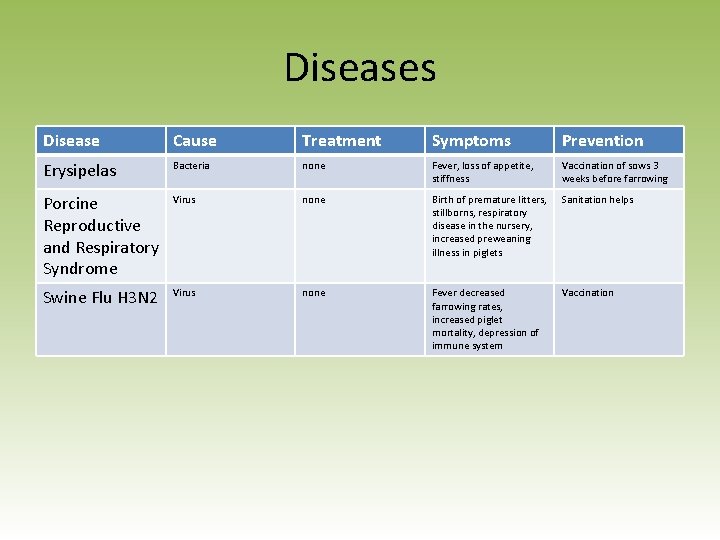
Diseases Disease Cause Treatment Symptoms Prevention Erysipelas Bacteria none Fever, loss of appetite, stiffness Vaccination of sows 3 weeks before farrowing Porcine Reproductive and Respiratory Syndrome Virus none Birth of premature litters, stillborns, respiratory disease in the nursery, increased preweaning illness in piglets Sanitation helps Swine Flu H 3 N 2 Virus none Fever decreased farrowing rates, increased piglet mortality, depression of immune system Vaccination
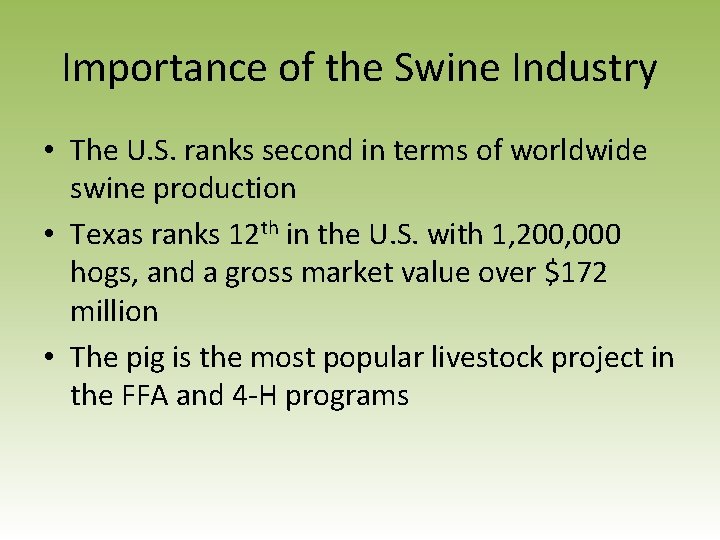
Importance of the Swine Industry • The U. S. ranks second in terms of worldwide swine production • Texas ranks 12 th in the U. S. with 1, 200, 000 hogs, and a gross market value over $172 million • The pig is the most popular livestock project in the FFA and 4 -H programs