
LIVER SPLEEN Color index Slides Important Notes Extra
- Slides: 10
LIVER & SPLEEN Color index: Slides. . Important. . Notes. . Extra. .
Objectives: By the end of this lecture, the student should be able to describe: 1. The histological structure of liver with special emphasis on: § Classical hepatic (liver) lobule. § Hepatocytes. § Portal tract (portal area). § Hepatic (liver) blood sinusoids. § Space of Disse (perisinusoidal space of Disse) § Bile canalculi. 2. The histological structure of spleen with special emphasis on: § White pulp. § Red Pulp.
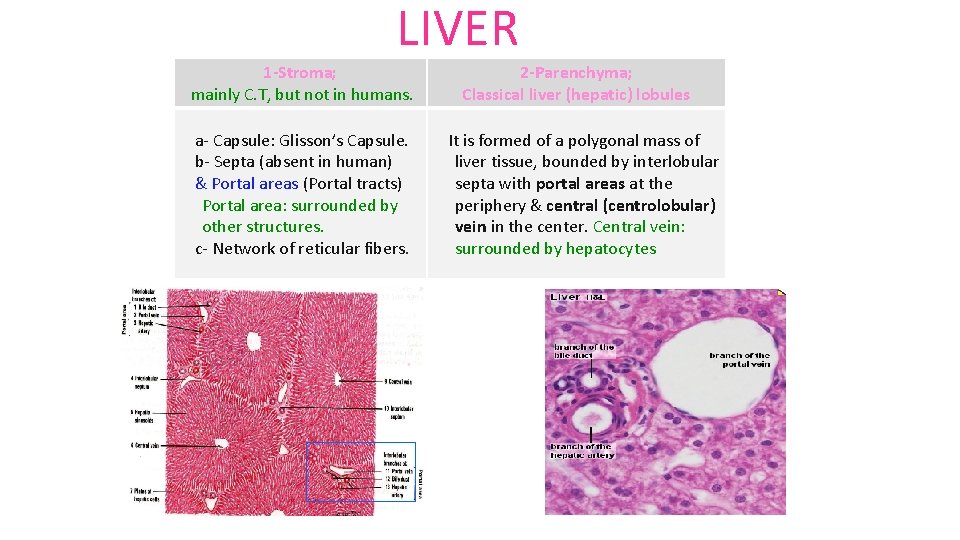
LIVER 1 -Stroma; mainly C. T, but not in humans. a- Capsule: Glisson’s Capsule. b- Septa (absent in human) & Portal areas (Portal tracts) Portal area: surrounded by other structures. c- Network of reticular fibers. 2 -Parenchyma; Classical liver (hepatic) lobules It is formed of a polygonal mass of liver tissue, bounded by interlobular septa with portal areas at the periphery & central (centrolobular) vein in the center. Central vein: surrounded by hepatocytes
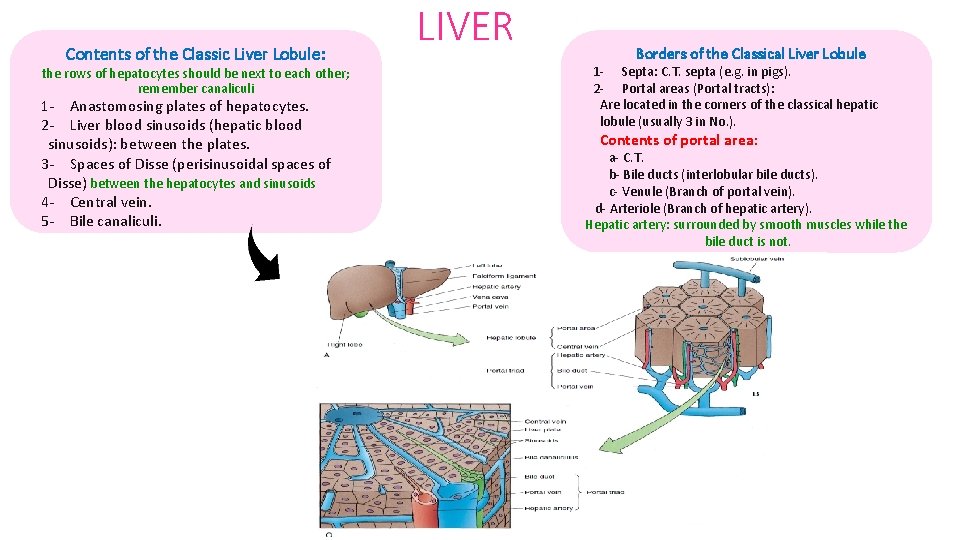
Contents of the Classic Liver Lobule: the rows of hepatocytes should be next to each other; remember canaliculi 1 - Anastomosing plates of hepatocytes. 2 - Liver blood sinusoids (hepatic blood sinusoids): between the plates. 3 - Spaces of Disse (perisinusoidal spaces of Disse) between the hepatocytes and sinusoids 4 - Central vein. 5 - Bile canaliculi. LIVER Borders of the Classical Liver Lobule 1 - Septa: C. T. septa (e. g. in pigs). 2 - Portal areas (Portal tracts): Are located in the corners of the classical hepatic lobule (usually 3 in No. ). Contents of portal area: a- C. T. b- Bile ducts (interlobular bile ducts). c- Venule (Branch of portal vein). d- Arteriole (Branch of hepatic artery). Hepatic artery: surrounded by smooth muscles while the bile duct is not.
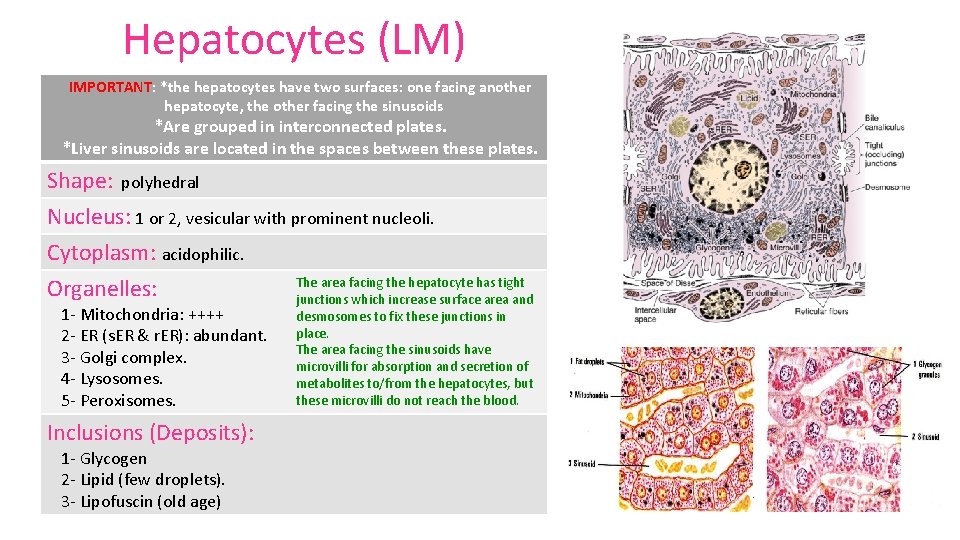
Hepatocytes (LM) IMPORTANT: *the hepatocytes have two surfaces: one facing another hepatocyte, the other facing the sinusoids *Are grouped in interconnected plates. *Liver sinusoids are located in the spaces between these plates. Shape: polyhedral Nucleus: 1 or 2, vesicular with prominent nucleoli. Cytoplasm: acidophilic. Organelles: 1 - Mitochondria: ++++ 2 - ER (s. ER & r. ER): abundant. 3 - Golgi complex. 4 - Lysosomes. 5 - Peroxisomes. Inclusions (Deposits): 1 - Glycogen 2 - Lipid (few droplets). 3 - Lipofuscin (old age) The area facing the hepatocyte has tight junctions which increase surface area and desmosomes to fix these junctions in place. The area facing the sinusoids have microvilli for absorption and secretion of metabolites to/from the hepatocytes, but these microvilli do not reach the blood.
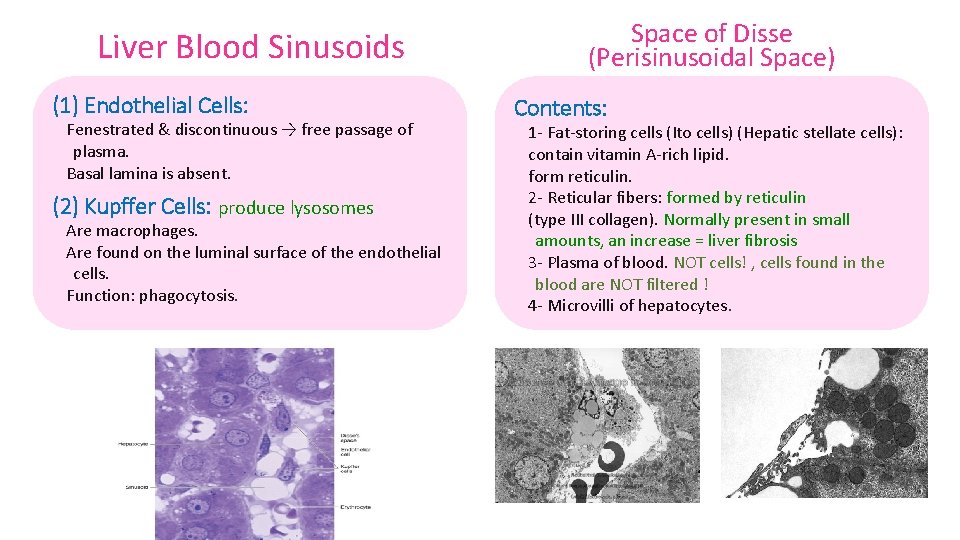
Liver Blood Sinusoids (1) Endothelial Cells: Fenestrated & discontinuous → free passage of plasma. Basal lamina is absent. (2) Kupffer Cells: produce lysosomes Are macrophages. Are found on the luminal surface of the endothelial cells. Function: phagocytosis. Space of Disse (Perisinusoidal Space) Contents: 1 - Fat-storing cells (Ito cells) (Hepatic stellate cells): contain vitamin A-rich lipid. form reticulin. 2 - Reticular fibers: formed by reticulin (type III collagen). Normally present in small amounts, an increase = liver fibrosis 3 - Plasma of blood. NOT cells! , cells found in the blood are NOT filtered ! 4 - Microvilli of hepatocytes.
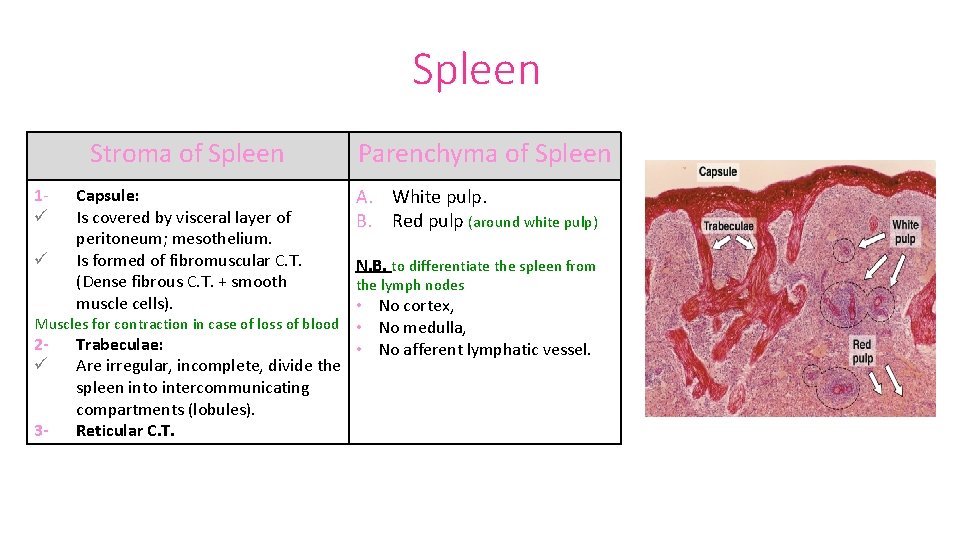
Spleen Stroma of Spleen 1ü ü Capsule: Is covered by visceral layer of peritoneum; mesothelium. Is formed of fibromuscular C. T. (Dense fibrous C. T. + smooth muscle cells). Parenchyma of Spleen A. White pulp. B. Red pulp (around white pulp) N. B. to differentiate the spleen from the lymph nodes • No cortex, Muscles for contraction in case of loss of blood • No medulla, 2 Trabeculae: • No afferent lymphatic vessel. ü Are irregular, incomplete, divide the spleen into intercommunicating compartments (lobules). 3 Reticular C. T.
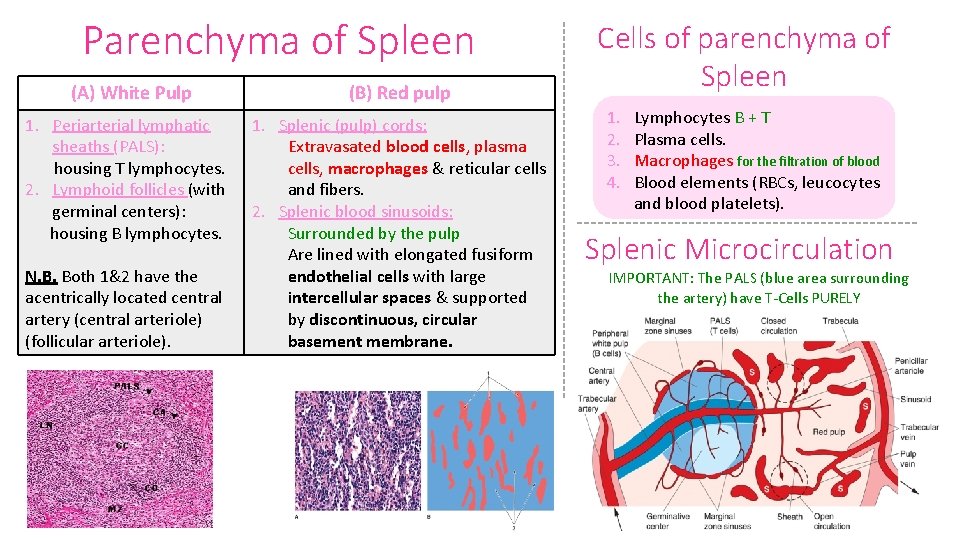
Parenchyma of Spleen (A) White Pulp 1. Periarterial lymphatic sheaths (PALS): housing T lymphocytes. 2. Lymphoid follicles (with germinal centers): housing B lymphocytes. N. B. Both 1&2 have the acentrically located central artery (central arteriole) (follicular arteriole). (B) Red pulp 1. Splenic (pulp) cords: Extravasated blood cells, plasma cells, macrophages & reticular cells and fibers. 2. Splenic blood sinusoids: Surrounded by the pulp Are lined with elongated fusiform endothelial cells with large intercellular spaces & supported by discontinuous, circular basement membrane. Cells of parenchyma of Spleen 1. 2. 3. 4. Lymphocytes B + T Plasma cells. Macrophages for the filtration of blood Blood elements (RBCs, leucocytes and blood platelets). Splenic Microcirculation IMPORTANT: The PALS (blue area surrounding the artery) have T-Cells PURELY
1 Glisson’s Capsules are found in: A-parenchyma. B-stroma. C-Both A&B. MCQs 2 the shape of hepatocyte is: a. polyhedral. b. spherical. c. spiral. 3 What is the space between the liver sinusoids and the hepatocytes called? a. Space of Disse. b. Space of Mall. c. Vacuole. 4what is the function of Kupffer Cells: a. Regeneration. b. Phagocytosis. c. nutrtion. 5Fat-storing cells in liver are called: a. Endothelial cells. b. kupffer cells c. Ito cells. 6 Which of the following is part of the spleen’s Parenchyma? a. Cortex. b. Red Pulp. c. Medulla. 7one of The differences between the spleen and the lymph nodes is: a. spleen has no white pulp. b. Spleen has cortex. c. Spleen has No medulla. 1 -b 2 -a 3 -a 4 -b 5 -c 6 -b 7 -c
Thank you & good luck - Histology team Done by: ü Amal Al. Qarni ü Do’aa Al. Walid ü Heba Al. Nasser ü Shahad Al. Anzan ü We’am Babaier References: ü ü Females’ and Males’ slides. Doctors’ notes Team leaders: ü Rana Barasain ü Faisal Alrabaii