
LIVELIHOODS IN THE CAMPS Nabi Khan Livelihood Coordinator
LIVELIHOODS IN THE CAMPS Nabi Khan Livelihood Coordinator Food and Agriculture Organization-UN Cox’s Bazar Sub Office Date: 28 th August, 2019 Venue: Hotel Cox’s Today, Cox’s Bazar
LIVELIHOODS (LH) Means and ways of living A livelihood is sustainable when it can cope with and recover from the stresses and shocks LH Needs: • Income and source of income/assets • Skill and Knowledge • Improved Technologies • Input support • Scopes and opportunities Desired change - Self-reliance and socio-economic empowerment
LIVELIHOOD ASSETS 1. Human capital: household members, active labor, education, knowledge and skills 2. Physical capital: livestock, equipment, roads, houses, irrigation pumps, 3. Natural capital: access to land, forests, water, grazing, fishing, etc 4. Financial capital: savings/debt, income, credit, insurance 5. Social capital: kin networks, group membership, socio-political voice and influence
WHAT DO YOU NEED TO KNOW 1. The vulnerability context 2. Livelihood assets 3. Institutions 4. Livelihood strategies 5. Livelihood outcomes
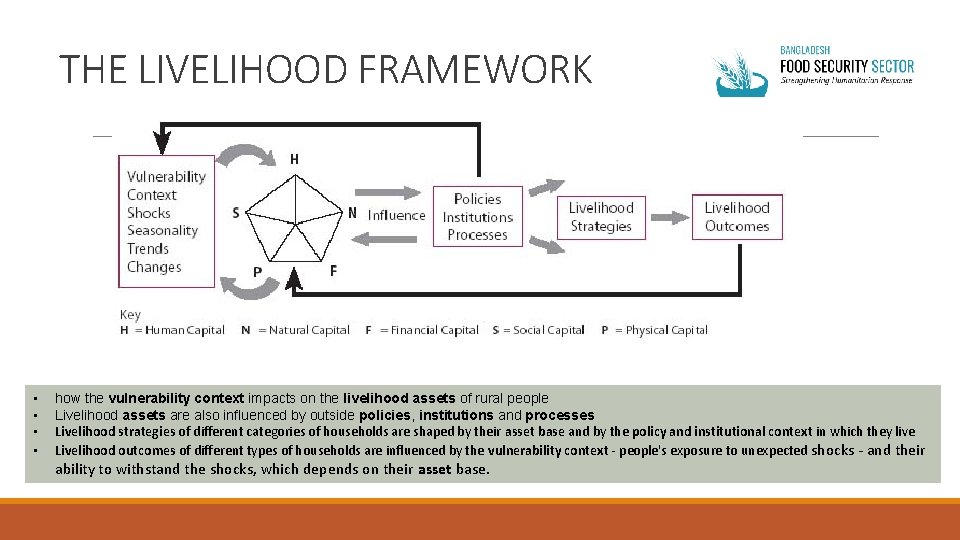
THE LIVELIHOOD FRAMEWORK • • how the vulnerability context impacts on the livelihood assets of rural people Livelihood assets are also influenced by outside policies, institutions and processes Livelihood strategies of different categories of households are shaped by their asset base and by the policy and institutional context in which they live Livelihood outcomes of different types of households are influenced by the vulnerability context - people's exposure to unexpected shocks - and their ability to withstand the shocks, which depends on their asset base.
LETS LOOK AT THE CAMP
CONSTRAINT AND LIMITATION OF LH INTERVENTIONS IN THE CAMPS 1. Skill & knowledge 2. Space 3. Behavior 4. Inputs 5. Scope and options 6. External linkages Can you identify which assets/s are not available in the camps?
TYPES OF LH SUPPORTS 1. Cash for work 2. Income generating activities-AIGAs 3. Technical trainings 4. Seeds and agriculture tools distributions
BENEFICIARY SELECTION CRITERIA FOR REFUGEE: • Minimum space for micr o-gar dening -2/ 3 inch of land adjacent to his/her shelter. • Pr oper sunlight, moist ure, and wat er sources for gardening • Large size families and w it h under t wo children and with adolescent B/G • Female- headed household • HHs wit h PLW, el derly people, di sabled/ challenged people, widow and tr an sgender • HHs wit h other vulnerable for m- no incom e-earning members, natural shocked, etc.
LH SUPPORT PACKAGE - DESIGNED FOR CAMPS AREAS WHERE CONDITIONS ARE SUITABLE – SPACE, LIGHT, WATER ACCESS. 1. Silos/food safety drum/storage-1 Seeds: 2. Watering Can-1 1. Indian spinach-20 gm 3. Spade-1 2. Sweet gourd- 5 gm 4. Vermi-compost-2 kg 3. Red amaranth- 20 gm 5. Vegetable Seeds-45 gm
LH SUPPORT PACKAGE DISTRIBUTION PROCESS 1. Coordination and planning with RRRC, Ci. Cs, Majhi, Volunteers, Site management and CPP; 2. Prepare family and block wise lists; 3. CICs (Camp in charge) and Site Management Team identify the venue for the distribution. 4. Male and Female separate row to increase protection of women. 5. Volunteers are assigned for trouble free distribution 6. Cards with unique number are used to verify individual household to avoid duplications. 7. Facilities at distribution center has a Breastfeeding corner, Female Toilets facilities, Shed system, and a Complain Box.
TREND OF LH IN THE CAMP Since beginning of 2018 1. livelihoods activities have increased in the camps 2. UN agencies such WFP, FAO, UNHCR, IOM, UNWOMEN, UNDP are planning for increasing their efforts. 3. International and National NGOs have been deeply involved in Livelihoods initiatives as UN implementing partners or with other source of funds.
LIVELIHOODS COORDINATION The Food Security Sector (FSS) established in September 2017 coordinating food security agencies Livelihoods WG was established in November 2017 under the FSS - to ensure a coordinated and harmonized approach of livelihoods initiatives Lead Agency: The United Nations World Food Programme & Food & Agriculture Organisation
? THANKS
- Slides: 14