
Livelihoods Assessment and Analysis Livelihoods Indicators Learning objectives
Livelihoods Assessment and Analysis Livelihoods Indicators Learning objectives At the end of this lesson you will be able to: • identify indicators for each aspect of the livelihood framework; • understand the criteria for selecting and collecting livelihoods indicators; • be aware of the skills and knowledge required to select, collect and interpret livelihood indicators. Screen 1 of 22
Livelihoods Assessment and Analysis Livelihoods Indicators Screen 2 of 22 Introduction In order to analyze the livelihood status of a group it is necessary to choose and interpret indicators. Let’s see how. . .
Livelihoods Assessment and Analysis Livelihoods Indicators Screen 3 of 22 Aspects of livelihoods A livelihood group is “homogenous”: the main livelihood strategies will be similar amongst households. The mix of indicators should cover all aspects of livelihoods of a livelihood group: Vulnerability context Livelihoods resources or assets Policies, institutions and processes Livelihood strategies Livelihood outcomes or goals
Livelihoods Assessment and Analysis Livelihoods Indicators Screen 4 of 22 Aspects of livelihoods Therefore, we should select indicators which reflect: main risk and vulnerability; key assets; livelihood strategies; key policies/institutions and processes which may impact livelihoods, livelihood outcomes. Example CONTEXT EXAMPLE OF INDICATORS Vulnerability context Drought proneness or High levels of HIV Livelihood resources or assets Education or Membership of a large extended family Key policies, institutions and processes. Land tenure system or Subsidies on main staple crop Livelihood sustainable strategies Petty trading and Agro-pastoralism
Livelihoods Assessment and Analysis Livelihoods Indicators Screen 5 of 22 Selecting livelihood indicators Information should not be collected on too many indicators, but mainly on key indicators. Indicators should be prioritised on the basis that they provide as much information about a livelihood as possible. Example Suppose the livelihood strategy of a population group is predominantly wage labour. Key information: wages, e. g. daily rates, seasonal fluctuations, relationship to labour availability.

Livelihoods Assessment and Analysis Livelihoods Indicators Screen 6 of 22 Selecting livelihood indicators It may not be worthwhile collecting data on: Practices not important for an understanding of food security. Strategies which only contribute a small amount towards food security. Phenomena which may have an impact on livelihoods and food security but there is no framework for determining what this impact might be.
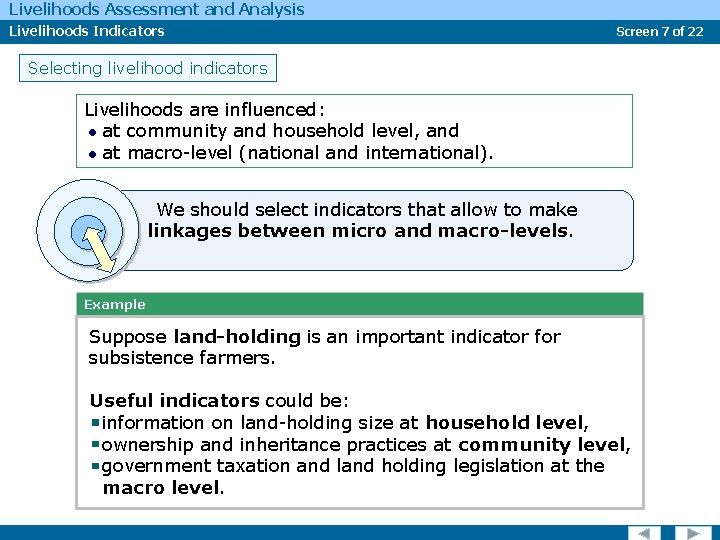
Livelihoods Assessment and Analysis Livelihoods Indicators Screen 7 of 22 Selecting livelihood indicators Livelihoods are influenced: at community and household level, and at macro-level (national and international). We should select indicators that allow to make linkages between micro and macro-levels. Example Suppose land-holding is an important indicator for subsistence farmers. Useful indicators could be: information on land-holding size at household level, ownership and inheritance practices at community level, government taxation and land holding legislation at the macro level.
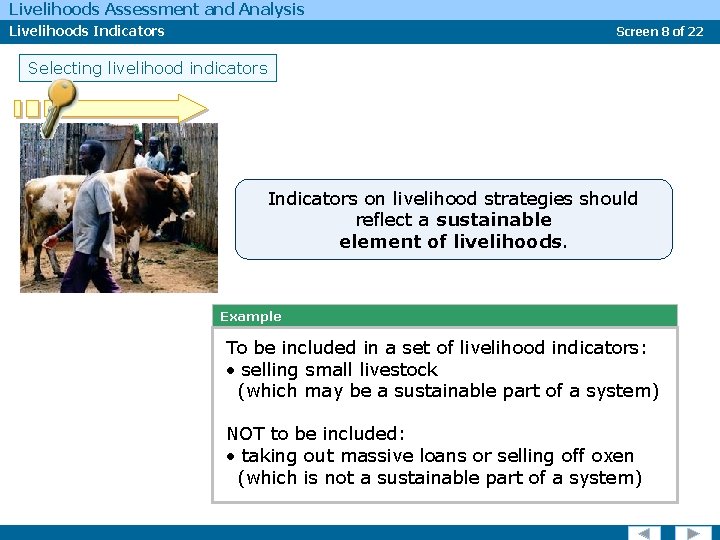
Livelihoods Assessment and Analysis Livelihoods Indicators Screen 8 of 22 Selecting livelihood indicators Indicators on livelihood strategies should reflect a sustainable element of livelihoods. Example To be included in a set of livelihood indicators: • selling small livestock (which may be a sustainable part of a system) NOT to be included: • taking out massive loans or selling off oxen (which is not a sustainable part of a system)
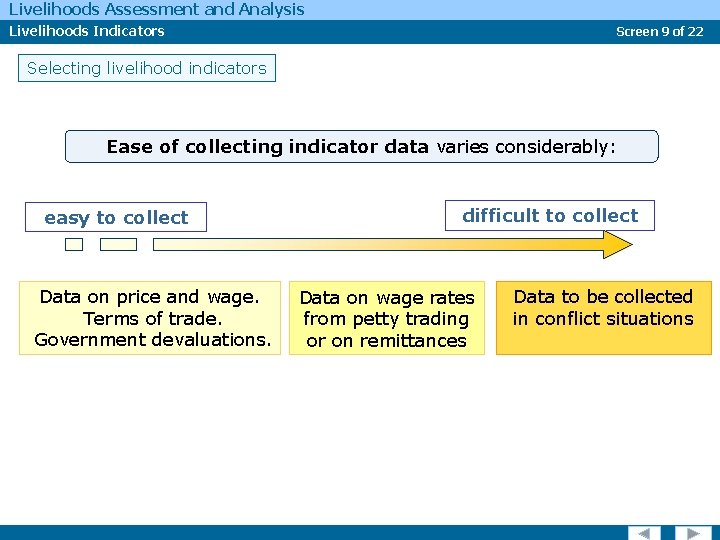
Livelihoods Assessment and Analysis Livelihoods Indicators Screen 9 of 22 Selecting livelihood indicators Ease of collecting indicator data varies considerably: easy to collect Data on price and wage. Terms of trade. Government devaluations. difficult to collect Data on wage rates from petty trading or on remittances Data to be collected in conflict situations
Livelihoods Assessment and Analysis Livelihoods Indicators Screen 10 of 22 Selecting livelihood indicators Information may need to be contextualised within normal seasonal variations. It is important to collect data at key seasonal points. Especially for indicators like: prices, migration and grazing patterns, malnutrition, and mortality.

Livelihoods Assessment and Analysis Livelihoods Indicators Screen 11 of 22 Selecting livelihood indicators Data on outcomes, e. g. stunting, anaemia and mortality, require carrying out surveys. Consequences: substantial investment of resources; it may be difficult to collect data at the level of a livelihood zone.
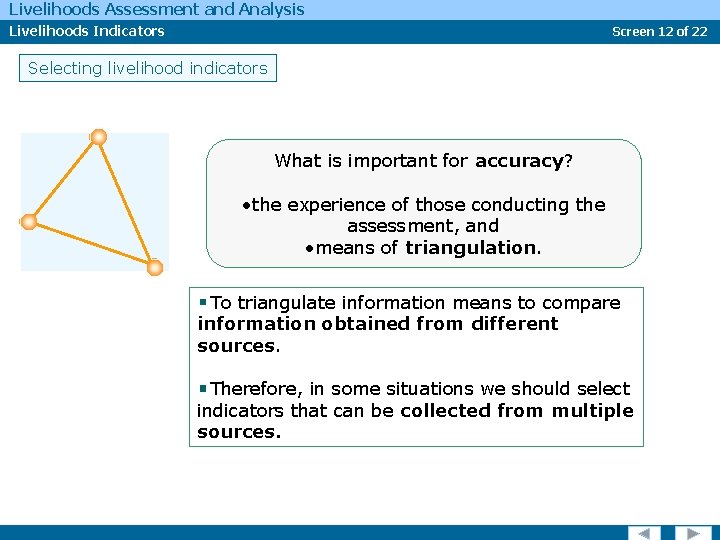
Livelihoods Assessment and Analysis Livelihoods Indicators Screen 12 of 22 Selecting livelihood indicators What is important for accuracy? • the experience of those conducting the assessment, and • means of triangulation. To triangulate information means to compare information obtained from different sources. Therefore, in some situations we should select indicators that can be collected from multiple sources.
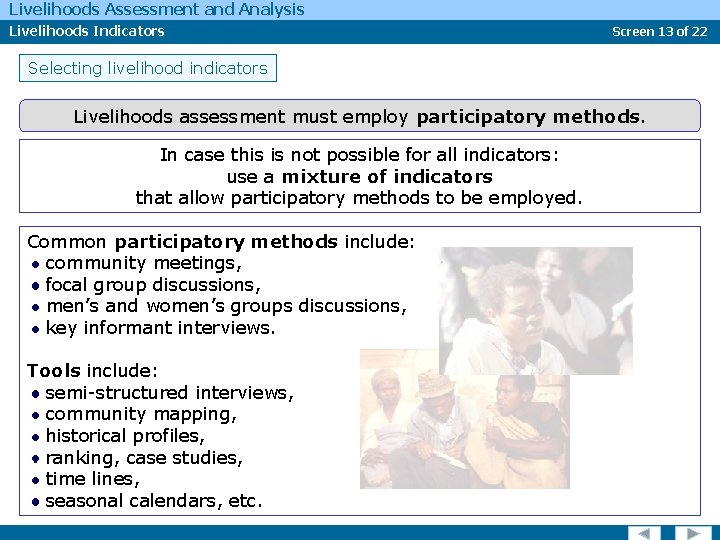
Livelihoods Assessment and Analysis Livelihoods Indicators Screen 13 of 22 Selecting livelihood indicators Livelihoods assessment must employ participatory methods. In case this is not possible for all indicators: use a mixture of indicators that allow participatory methods to be employed. Common participatory methods include: community meetings, focal group discussions, men’s and women’s groups discussions, key informant interviews. Tools include: semi-structured interviews, community mapping, historical profiles, ranking, case studies, time lines, seasonal calendars, etc.
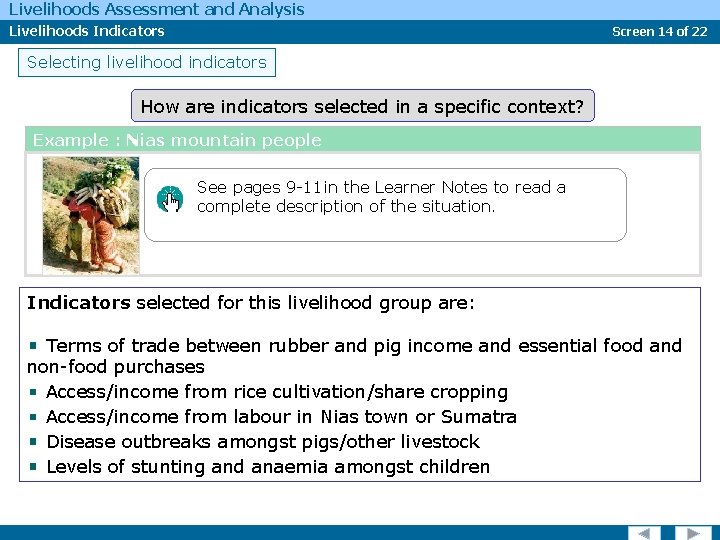
Livelihoods Assessment and Analysis Livelihoods Indicators Screen 14 of 22 Selecting livelihood indicators How are indicators selected in a specific context? Example : Nias mountain people See pages 9 -11 in the Learner Notes to read a complete description of the situation. Indicators selected for this livelihood group are: Terms of trade between rubber and pig income and essential food and non-food purchases Access/income from rice cultivation/share cropping Access/income from labour in Nias town or Sumatra Disease outbreaks amongst pigs/other livestock Levels of stunting and anaemia amongst children
Livelihoods Assessment and Analysis Livelihoods Indicators Screen 15 of 22 Selecting livelihood indicators Why have these indicators been selected? 1. The mix of indicators covers most aspects of livelihoods, i. e. vulnerability, livelihood strategies, processes and outcomes. 2. They reflect sustainable livelihood strategies. 3. They provide the maximum amount of information on livelihood status. 4. They are generally easy to measure. 5. They can easily be incorporated into a framework to assess livelihood and food security status.
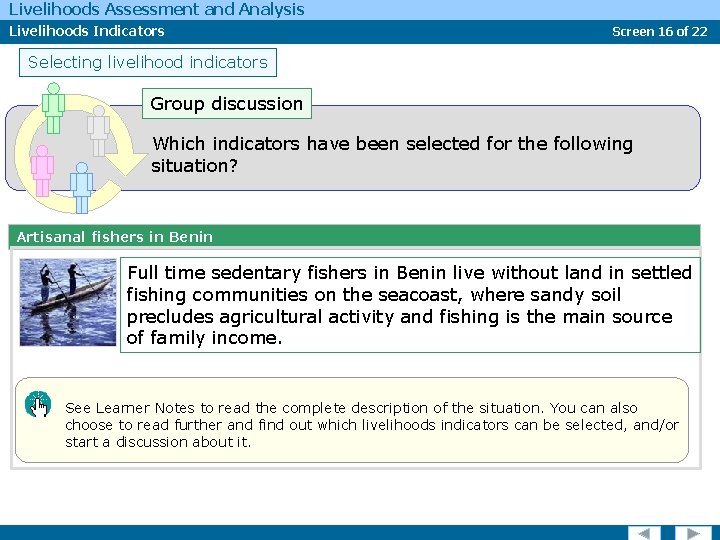
Livelihoods Assessment and Analysis Livelihoods Indicators Screen 16 of 22 Selecting livelihood indicators Group discussion Which indicators have been selected for the following situation? Artisanal fishers in Benin Full time sedentary fishers in Benin live without land in settled fishing communities on the seacoast, where sandy soil precludes agricultural activity and fishing is the main source of family income. See Learner Notes to read the complete description of the situation. You can also choose to read further and find out which livelihoods indicators can be selected, and/or start a discussion about it.
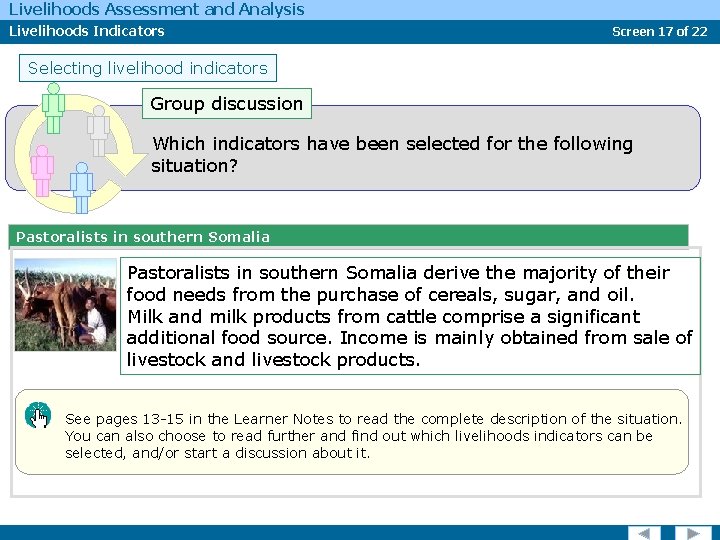
Livelihoods Assessment and Analysis Livelihoods Indicators Screen 17 of 22 Selecting livelihood indicators Group discussion Which indicators have been selected for the following situation? Pastoralists in southern Somalia derive the majority of their food needs from the purchase of cereals, sugar, and oil. Milk and milk products from cattle comprise a significant additional food source. Income is mainly obtained from sale of livestock and livestock products. See pages 13 -15 in the Learner Notes to read the complete description of the situation. You can also choose to read further and find out which livelihoods indicators can be selected, and/or start a discussion about it.
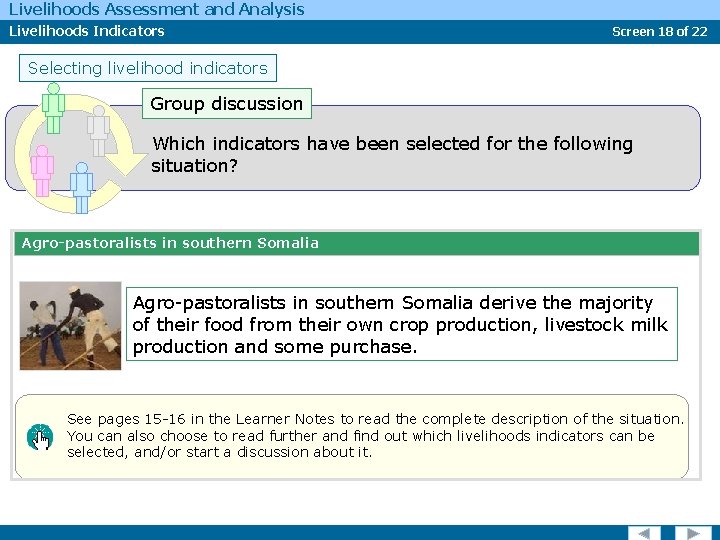
Livelihoods Assessment and Analysis Livelihoods Indicators Screen 18 of 22 Selecting livelihood indicators Group discussion Which indicators have been selected for the following situation? Agro-pastoralists in southern Somalia derive the majority of their food from their own crop production, livestock milk production and some purchase. See pages 15 -16 in the Learner Notes to read the complete description of the situation. You can also choose to read further and find out which livelihoods indicators can be selected, and/or start a discussion about it.
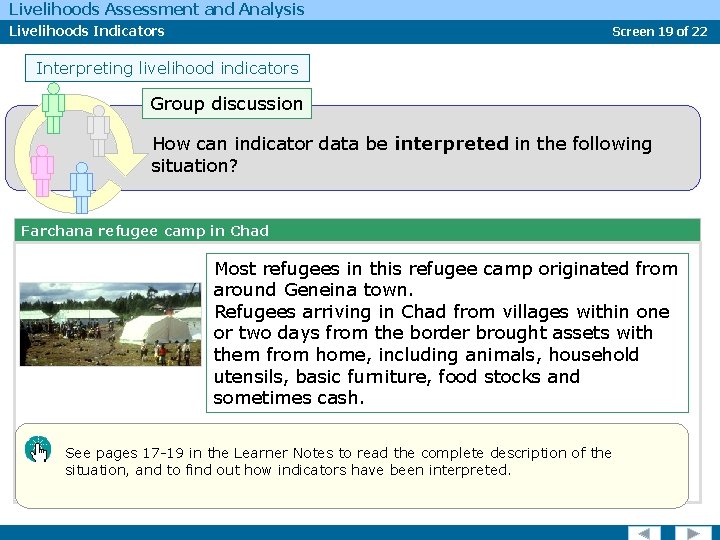
Livelihoods Assessment and Analysis Livelihoods Indicators Screen 19 of 22 Interpreting livelihood indicators Group discussion How can indicator data be interpreted in the following situation? Farchana refugee camp in Chad Most refugees in this refugee camp originated from around Geneina town. Refugees arriving in Chad from villages within one or two days from the border brought assets with them from home, including animals, household utensils, basic furniture, food stocks and sometimes cash. See pages 17 -19 in the Learner Notes to read the complete description of the situation, and to find out how indicators have been interpreted.
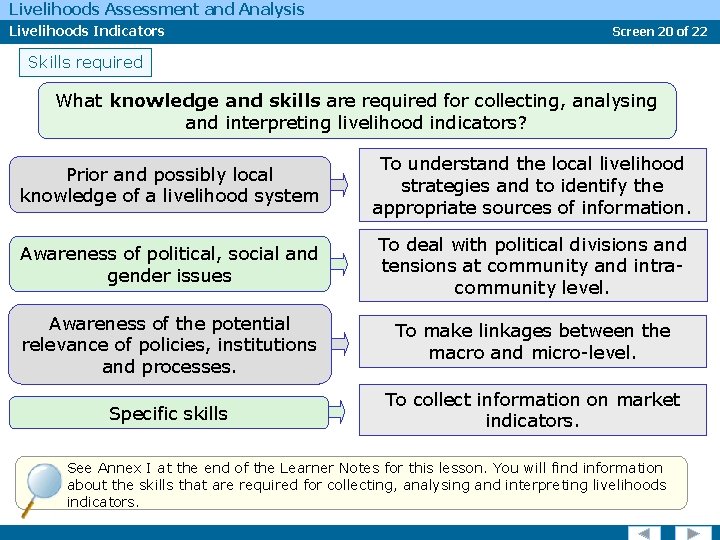
Livelihoods Assessment and Analysis Livelihoods Indicators Screen 20 of 22 Skills required What knowledge and skills are required for collecting, analysing and interpreting livelihood indicators? Prior and possibly local knowledge of a livelihood system To understand the local livelihood strategies and to identify the appropriate sources of information. Awareness of political, social and gender issues To deal with political divisions and tensions at community and intracommunity level. Awareness of the potential relevance of policies, institutions and processes. To make linkages between the macro and micro-level. Specific skills To collect information on market indicators. See Annex I at the end of the Learner Notes for this lesson. You will find information about the skills that are required for collecting, analysing and interpreting livelihoods indicators.
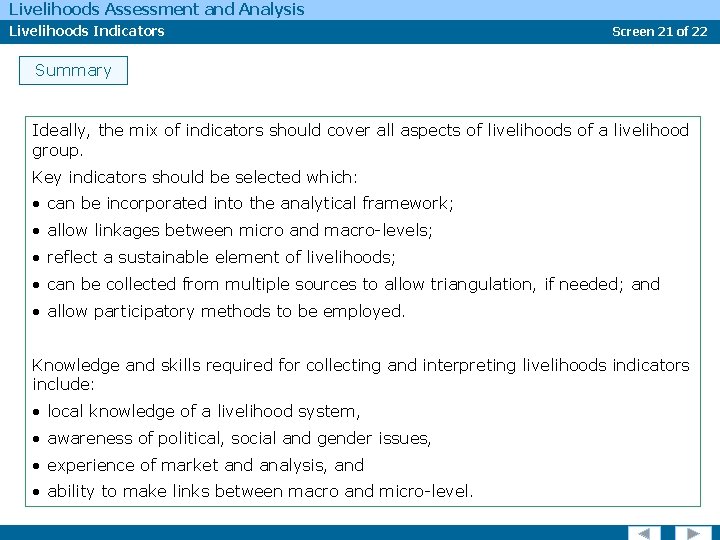
Livelihoods Assessment and Analysis Livelihoods Indicators Screen 21 of 22 Summary Ideally, the mix of indicators should cover all aspects of livelihoods of a livelihood group. Key indicators should be selected which: • can be incorporated into the analytical framework; • allow linkages between micro and macro-levels; • reflect a sustainable element of livelihoods; • can be collected from multiple sources to allow triangulation, if needed; and • allow participatory methods to be employed. Knowledge and skills required for collecting and interpreting livelihoods indicators include: • local knowledge of a livelihood system, • awareness of political, social and gender issues, • experience of market and analysis, and • ability to make links between macro and micro-level.
Livelihoods Assessment and Analysis Livelihoods Indicators Screen 22 of 22 If you want to know more. . . Suggested references: • Corbett. J (1988): Famine and household coping strategies. World Development 16 (9) • Hastie (undated). Using indicators to monitor protective impact. Oxfam G. B. • Jaspars. S and Shoham. J (2002): A critical review of approaches to assessing and monitoring livelihoods in situations of chronic conflict and political instability. ODI Working Paper 191. • WFP (2005): Emergency Food Security Assessment Handbook • Young. H et al (2001): Food security assessment in emergencies: A livelihoods approach. ODI HPN Network Papers 36. ODI, London • Jaspars. S (2006): From food crisis to fair trade. Livelihoods analysis, protection and support in emergencies. ENN Special Supplement No 3 • Westley. K and Michalev. V (2002): The use of participatory methods for livelihood assessment in situations of political instability: A case study from Kosovo. ODI Working paper 190 • Narbeth. S and Mc. Lean. C (2003): Livelihoods and protection. Displacement and vulnerable communities in Kismaayo, southern Somalia. HPN Network paper No 44, December 2003 • Pain. A (2002): Understanding and monitoring livelihoods under conditions of chronic conflict: Lessons from Afghanistan. ODI working paper 187 • Boudreau. T and Coutts. P (2002): Food economy in situations of chronic political instability. ODI working paper 188 • WFP (2003): Key issues in emergency needs assessment. Volume 1: Report of the Technical Meeting. 28 -30 October 2003, Rome, Italy. • Montania. A and Majid. N (2002): Conducive conditions: Livelihood interventions in southern Somalia. ODI working paper 193 • F. Pittaluga, E. Corcoran, and J. Senahoun: Poverty profiles of artisanal fishers: methods based on the SLA model.
- Slides: 22