
Live your life Create your destiny Teaching Strategies
- Slides: 19
Live your life. Create your destiny. Teaching Strategies Critical Thinking and Problem Solving Skills
Faculty: Humanities. Department: Educational Studies Lesson outcome: Use teaching practice information to apply critical thinking skills in problem solving situations
Faculty: Humanities. Department: Educational Studies Critical Thinking and Problem Solving Skills Give a man a fish, and he eats for a day Give a man the skills to catch a fish and he will never go hungry
Faculty: Humanities. Department: Educational Studies State true or false 1. Critical thinking(CT) is the active systematic process of understanding and evaluating arguments 2. Blooms’ taxonomy: analysis, synthesis and evaluation forms part of critical thinking 3. CT is a complex activity and one method of instruction will be sufficient
Faculty: Humanities. Department: Educational Studies State true and false continue 4. Creative thinking is finding the best possible solution for a problem 5. Non- critical thinking is not habitual thinking and is based on future practices with considering current data 6. CT and Creative thinking should be combined to solve problems
Faculty: Humanities. Department: Educational Studies Higher Order Skills: Critical Thinking Primary Photograph or Graph
Faculty/Department name here 18 pt Arial What are critical thinking skills? q. Critical thinking skills are problem solving skills q. Different approaches to solve a problem q. Ways of thinking creatively
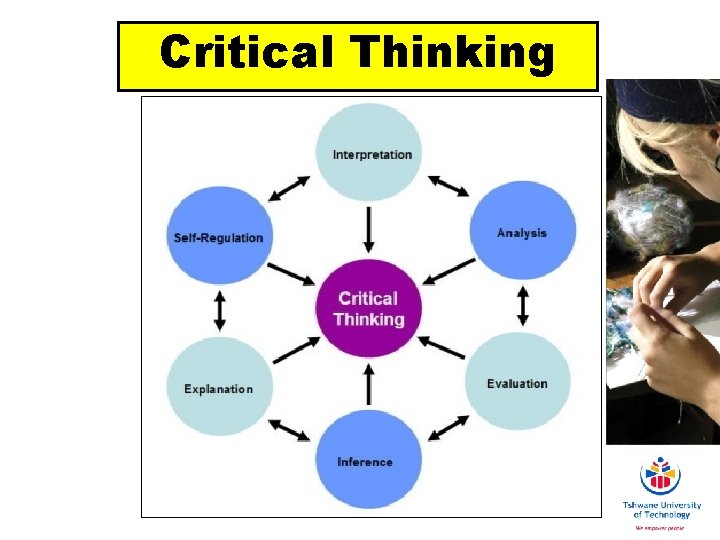
Critical Thinking
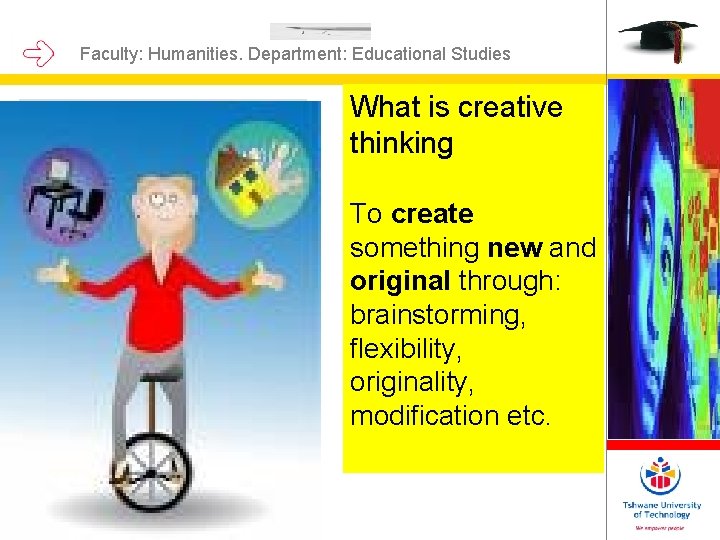
Faculty: Humanities. Department: Educational Studies What is creative thinking Photograph or graph To create something new and original through: brainstorming, flexibility, originality, modification etc.
Faculty: Humanities. Department: Educational Studies Characteristics of critical thinkers • Raise and formulates a problem • Gather, analyse and assess info • Formulates conclusions • Curiosity • Open minded • Communicates effectively with others
Faculty: Humanities. Department: Educational Studies Characteristics of non- critical thinkers • Unwilling to listen • Reluctant to question • Rush conclusions • Indicates intellectual laziness • Lack of respect for evidence • Lack reasoning skills • Use invalid evidence to solve problems
Faculty: Humanities. Department: Educational Studies Primary Photograph or Graph
Faculty: Humanities. Department: Educational Studies
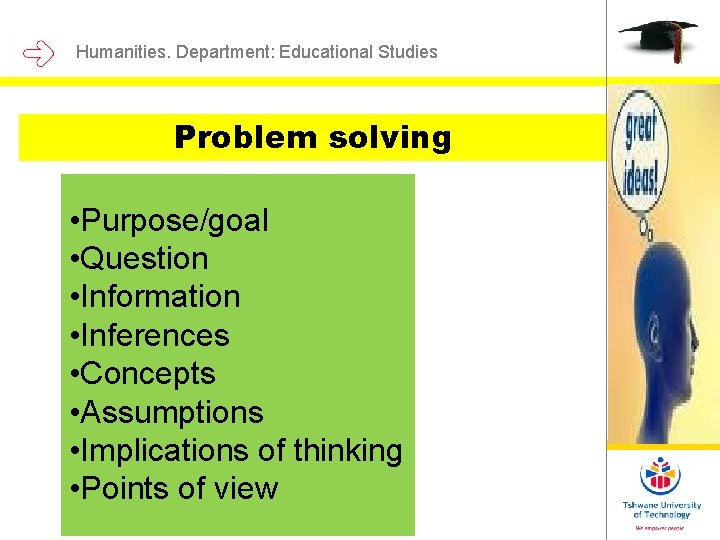
Humanities. Department: Educational Studies Problem solving • Purpose/goal • Question • Information • Inferences • Concepts • Assumptions • Implications of thinking • Points of view
Humanities. Department: Educational Studies Group Activity • Divide in groups of six. • Use your teaching practice journal • What is the most urgent problem in the school? What should be done to solve the problem (p 65) • Identify one frequent problem in your group. Brainstorm, use your info and the problem solving steps to find a solution to the problem (20 minutes) • Group leaders give feed back on possible
Humanities. Department: Educational Studies Individual feedback In not more than two paragraphs answer the following two questions: • Which concepts are still not clear to you in this lesson? • What new concepts did you learn from the lesson?
Faculty: Humanities. Department: Educational Studies Summary • Thinking, analysing, comparing, questioning and evaluating allows one to learn new content. • Critical thinking is a problem solving skill. • Non-critical thinkers rely on info from the teacher and internet. • Critical thinkers analyse info before making a decision.
Faculty: Humanities. Department: Educational Studies Individual activity (Homework) Use your teaching practice observations And complete the following question. 1. Do teachers develop learners’ critical thinking skills? • If the answer is “yes”. Give examples of activities that teachers use in the classroom. • If the answer is “no”. Why do you say so? What methods do they use?
Faculty: Humanities. Department: Educational Studies References • Bloom, B. , Englehart, M. , Furst, E. , Hill, W. , & Krathwohl, D. 1956. Taxonomy of educational objectives: The classification of educational goals. Handbook: Cognitive Domain. New York: Longmans Green. • Ennis, R. 1992. Critical thinking: What is it? Proceedings of the forty. Eighth Annual meeting of the Philosophy of Education Society Denver, Colorado, March 27 -30. Retrieved 16/10/2010, from http: //www. ed. uiuc. edu/PES/92 docs/Ennis. HTM • Gallagher, J. J. 1975. Teaching the Gifted Child. Boston: Allyn and Bacon. • Huitt, W. 1992. Problem solving and decision making: Consideration of individual differences using the Myers-Briggs Type Indicator. Journal of Psychological Type, 24, 33 -44. • Thomas, R. & Smoot, G. 1994. Critical thinking: A vital work skill. Trust for Educational Leadership, 23, 34 -38. • Raths, L. E. , Jonas, A. , Rothstein, A. & Wassermann, S. 1967. Teaching for Thinking, Theory and Application. Columbus, OH: Charles E. Merrill.