
Live Deduplication Storage of Virtual Machine Images in

- Slides: 30
Live Deduplication Storage of Virtual Machine Images in an Open-Source Cloud Chun-Ho Ng, Mingcao Ma, Tsz-Yeung Wong, Patrick P. C. Lee, John C. S. Lui The Chinese University of Hong Kong Middleware’ 11 1
Using Cloud Computing Ø Cloud computing is real… Ø But many companies still hesitate to use public clouds • e. g. , security concerns Ø Open-source cloud platforms • • Self-manageable with cloud-centric features Extensible with new functionalities Deployable with low-cost commodity hardware Examples: • Eucalyptus, Open. Stack 2
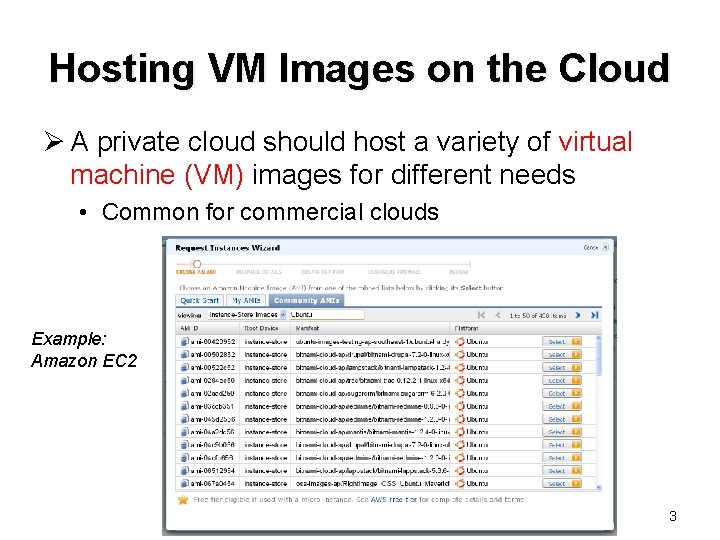
Hosting VM Images on the Cloud Ø A private cloud should host a variety of virtual machine (VM) images for different needs • Common for commercial clouds Example: Amazon EC 2 3
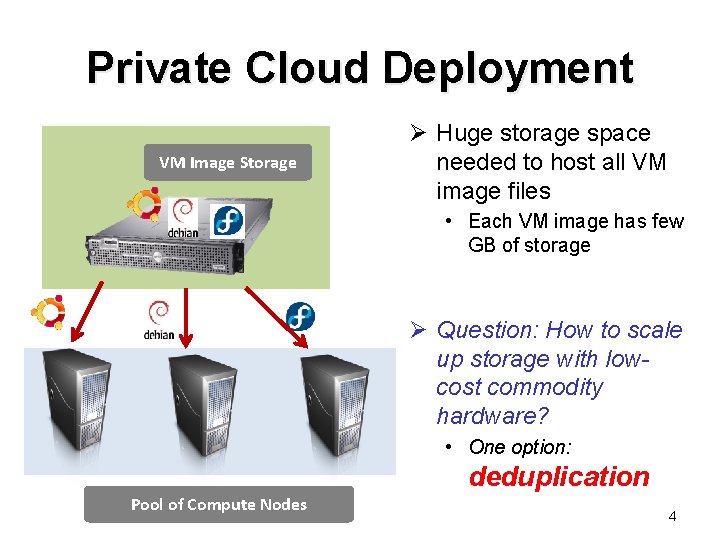
Private Cloud Deployment VM Image Storage Ø Huge storage space needed to host all VM image files • Each VM image has few GB of storage Ø Question: How to scale up storage with lowcost commodity hardware? • One option: deduplication Pool of Compute Nodes 4
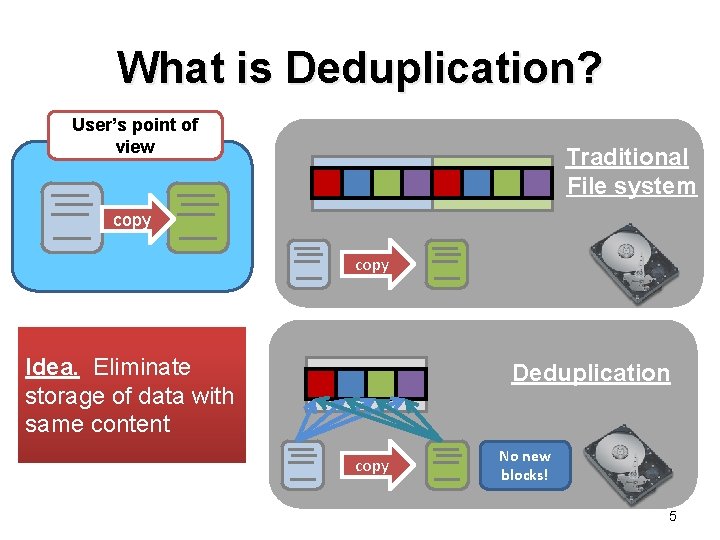
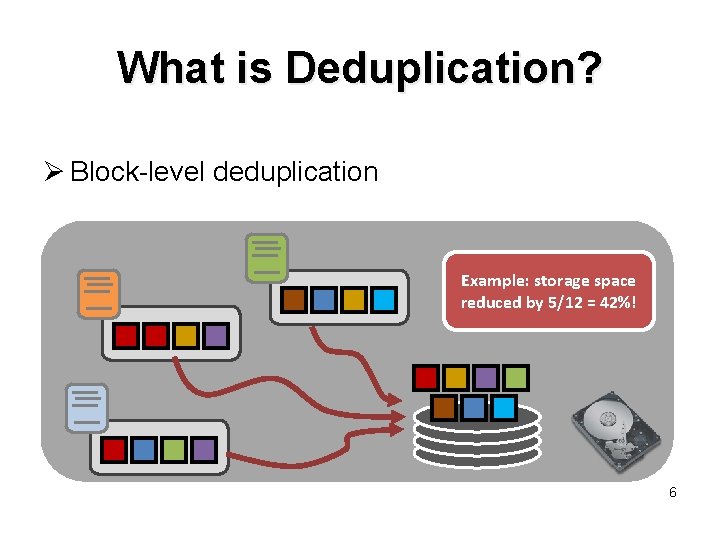
What is Deduplication? User’s point of view Traditional File system copy Idea. Eliminate storage of data with same content Deduplication copy No new blocks! 5
What is Deduplication? Ø Block-level deduplication Example: storage space reduced by 5/12 = 42%! 6
Challenges Ø Deployment issues of deduplication in VM image storage in an open-source cloud: • Can we preserve the performance of VM operations? • e. g. , inserting VM images, VM startup • Can we support general file system operations? • e. g. , read, write, modify, delete • Can we deploy deduplication on low-cost commodity systems? • e. g. , a few GB of RAM, 32/64 -bit CPU, standard OS 7
Related Work Ø Deduplication backup systems • e. g. , Venti [Quinlan & Dorward ’ 02], Data Domain [Zhu et al. ’ 08], Foundation [Rhea et al. ’ 08] • Assume data is not modified or deleted Ø Deduplication file systems • e. g. , Open. Solaris ZFS, Open. Dedup SDFS • Consume significant memory space, not for commodity systems Ø VM image storage • e. g. , Lithium [Hansen & Jul ’ 10], mainly on fault tolerance, but not on deduplication 8
Our Work Live. DFS: a live deduplication file system tailored for VM image storage Ø Design goals of Live. DFS: • Target open-source clouds deployed on low-cost commodity hardware and OSs • Support basic file system operations, while allowing inline (on-the-fly) deduplication while data being written 9
Our Work Ø Design features of Live. DFS: • Spatial locality: store partial metadata in memory, while storing full metadata on disk with respect to file system layout • Prefetching metadata: store metadata of same block group into page cache • Journaling: enable crash recovery and combine block writes in batch • Kernel-space design: built on Ext 3, and follow Linux file system layout 10
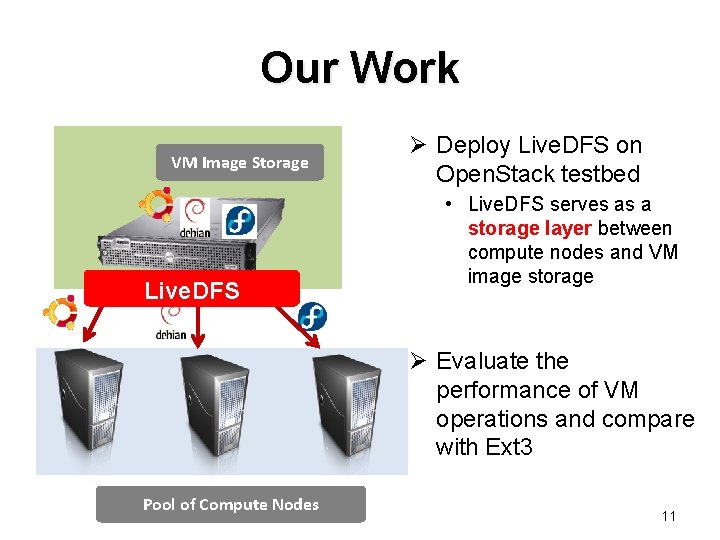
Our Work VM Image Storage Live. DFS Ø Deploy Live. DFS on Open. Stack testbed • Live. DFS serves as a storage layer between compute nodes and VM image storage Ø Evaluate the performance of VM operations and compare with Ext 3 Pool of Compute Nodes 11
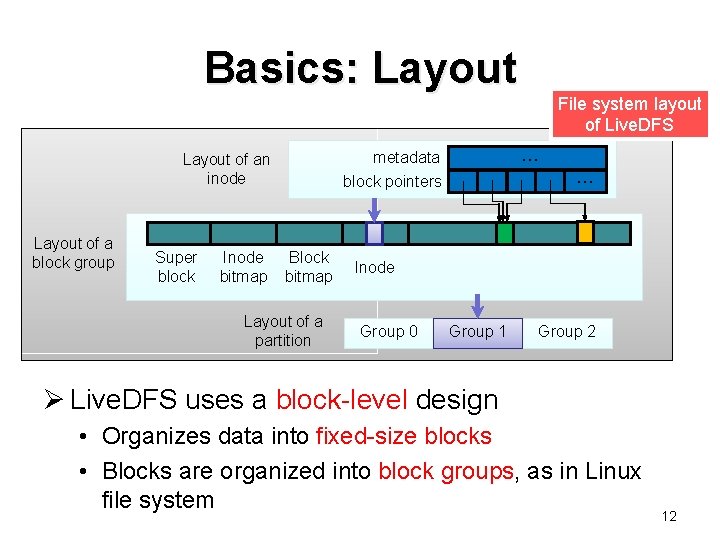
Basics: Layout of a block group Super block Inode bitmap … metadata block pointers Layout of an inode Block bitmap Layout of a partition File system layout of Live. DFS … Inode Group 0 Group 1 Group 2 Ø Live. DFS uses a block-level design • Organizes data into fixed-size blocks • Blocks are organized into block groups, as in Linux file system 12
Basics: Layout Ø Deduplication operates on fixed-size blocks • Saves one copy if two fixed-size blocks have the same content Ø For VM image storage, deduplication efficiencies similar for fixed-size blocks and variable-size blocks [Jin & Miller, ’ 09] 13
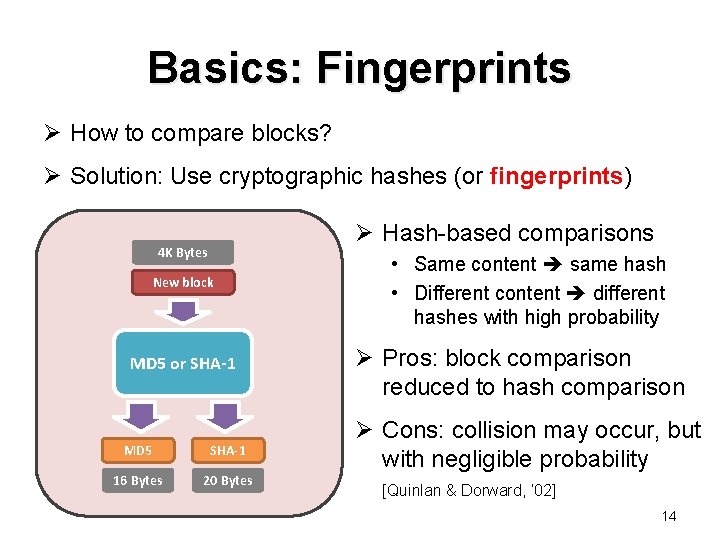
Basics: Fingerprints Ø How to compare blocks? Ø Solution: Use cryptographic hashes (or fingerprints) Ø Hash-based comparisons 4 K Bytes New block MD 5 or SHA-1 MD 5 SHA-1 16 Bytes 20 Bytes • Same content same hash • Different content different hashes with high probability Ø Pros: block comparison reduced to hash comparison Ø Cons: collision may occur, but with negligible probability [Quinlan & Dorward, ’ 02] 14
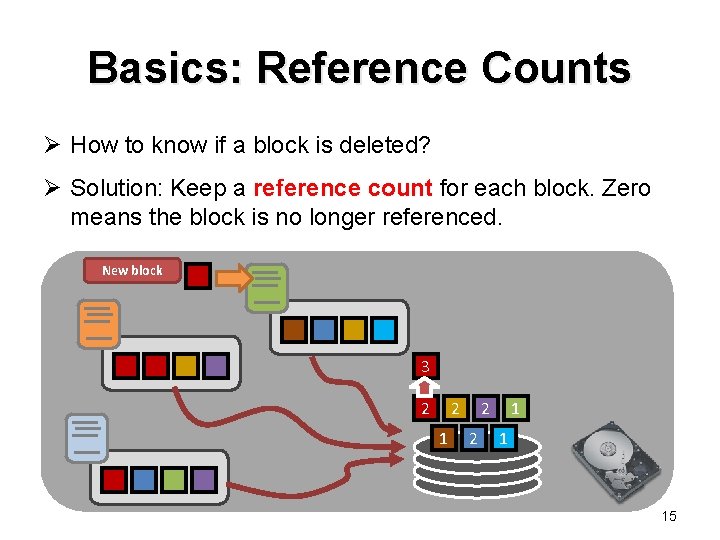
Basics: Reference Counts Ø How to know if a block is deleted? Ø Solution: Keep a reference count for each block. Zero means the block is no longer referenced. New block 3 2 2 1 1 15
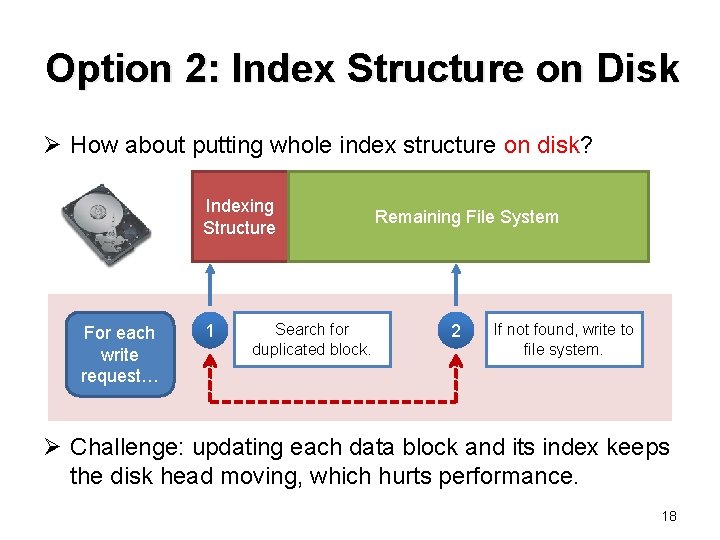
Inline Deduplication Ø How to check if a block being written and can be deduplicated with existing blocks? Ø Solution: maintain an index structure • Keep track of fingerprints of existing blocks Ø Goal: design of index structure must be efficient in space and speed Ø Two options of keeping an index structure: • Putting whole index structure in RAM • Putting whole index structure on disk 16
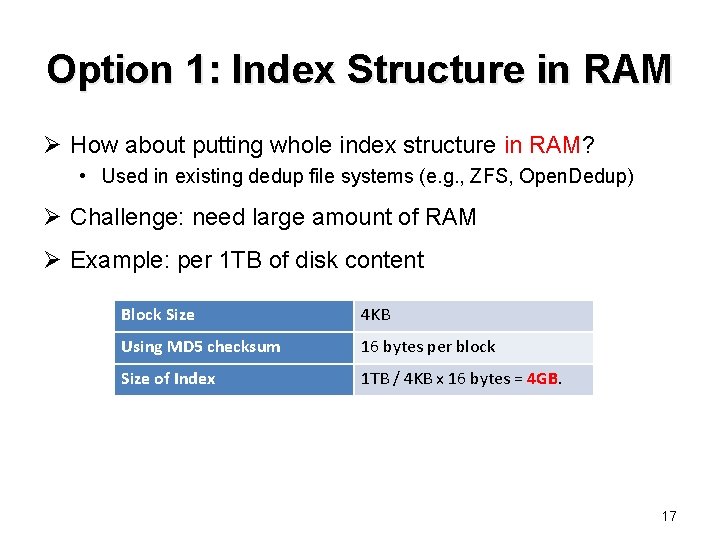
Option 1: Index Structure in RAM Ø How about putting whole index structure in RAM? • Used in existing dedup file systems (e. g. , ZFS, Open. Dedup) Ø Challenge: need large amount of RAM Ø Example: per 1 TB of disk content Block Size 4 KB Using MD 5 checksum 16 bytes per block Size of Index 1 TB / 4 KB x 16 bytes = 4 GB. 17
Option 2: Index Structure on Disk Ø How about putting whole index structure on disk? Indexing Structure For each write request… 1 Search for duplicated block. Remaining File System 2 If not found, write to file system. Ø Challenge: updating each data block and its index keeps the disk head moving, which hurts performance. 18
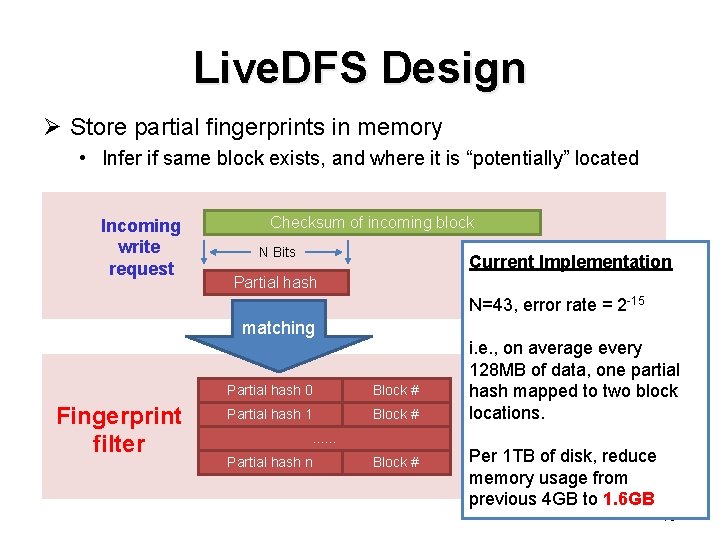
Live. DFS Design Ø Store partial fingerprints in memory • Infer if same block exists, and where it is “potentially” located Incoming write request Checksum of incoming block N Bits Current Implementation Partial hash N=43, error rate = 2 -15 matching Fingerprint filter Partial hash 0 Block # Partial hash 1 Block # . . . Partial hash n Block # i. e. , on average every 128 MB of data, one partial hash mapped to two block locations. Per 1 TB of disk, reduce memory usage from previous 4 GB to 1. 6 GB 19
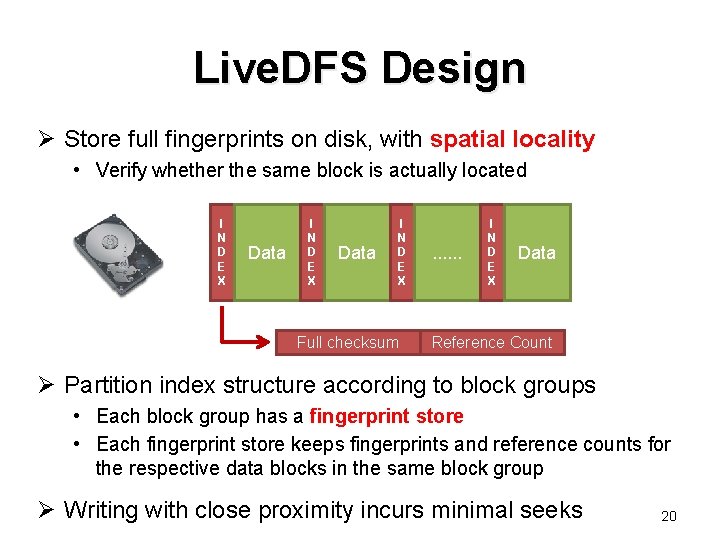
Live. DFS Design Ø Store full fingerprints on disk, with spatial locality • Verify whether the same block is actually located I N D E X Data I N D E X Full checksum . . . I N D E X Data Reference Count Ø Partition index structure according to block groups • Each block group has a fingerprint store • Each fingerprint store keeps fingerprints and reference counts for the respective data blocks in the same block group Ø Writing with close proximity incurs minimal seeks 20
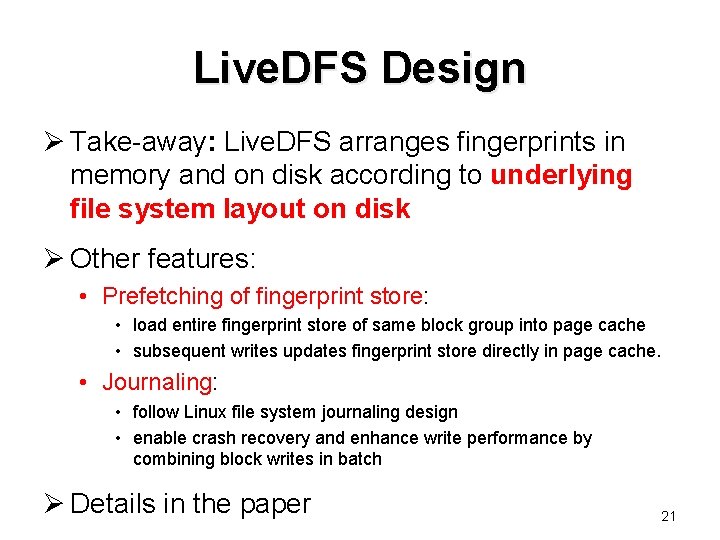
Live. DFS Design Ø Take-away: Live. DFS arranges fingerprints in memory and on disk according to underlying file system layout on disk Ø Other features: • Prefetching of fingerprint store: • load entire fingerprint store of same block group into page cache • subsequent writes updates fingerprint store directly in page cache. • Journaling: • follow Linux file system journaling design • enable crash recovery and enhance write performance by combining block writes in batch Ø Details in the paper 21
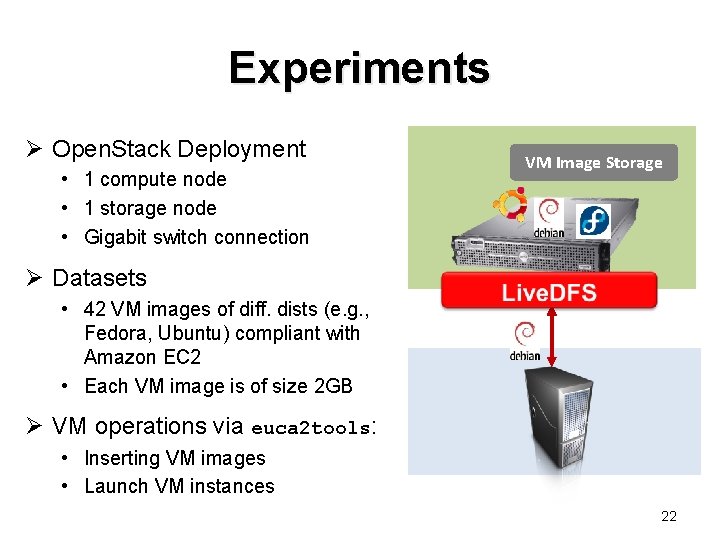
Experiments Ø Open. Stack Deployment • 1 compute node • 1 storage node • Gigabit switch connection VM Image Storage Ø Datasets • 42 VM images of diff. dists (e. g. , Fedora, Ubuntu) compliant with Amazon EC 2 • Each VM image is of size 2 GB Ø VM operations via euca 2 tools: • Inserting VM images • Launch VM instances 22
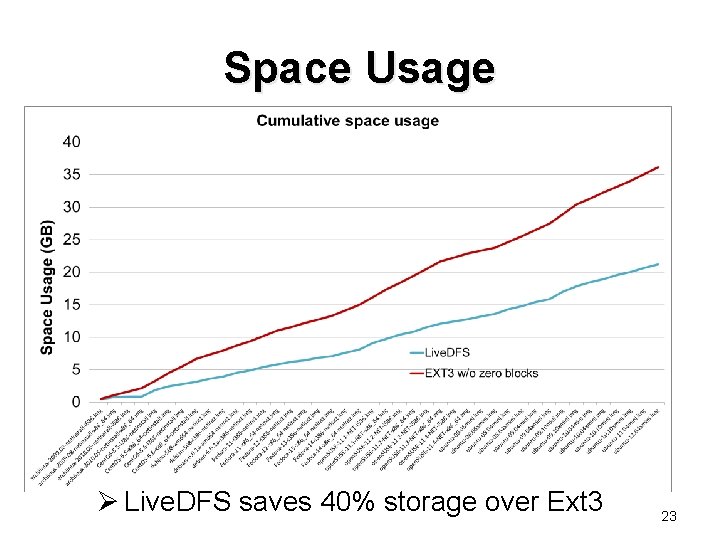
Space Usage Ø Live. DFS saves 40% storage over Ext 3 23
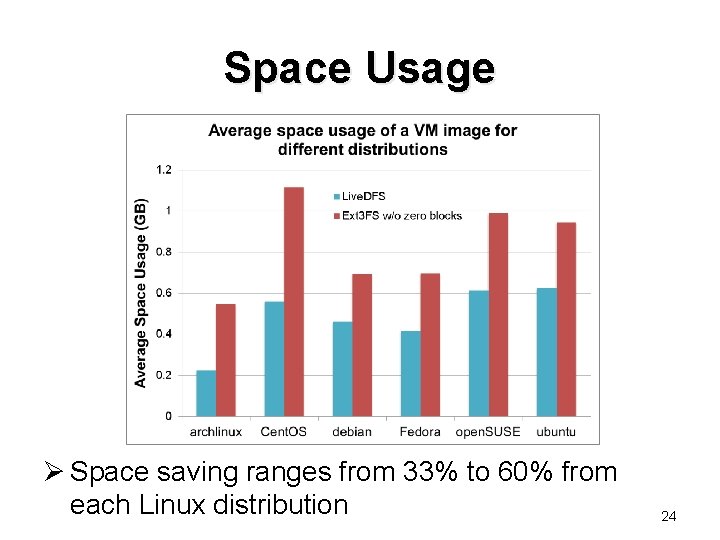
Space Usage Ø Space saving ranges from 33% to 60% from each Linux distribution 24
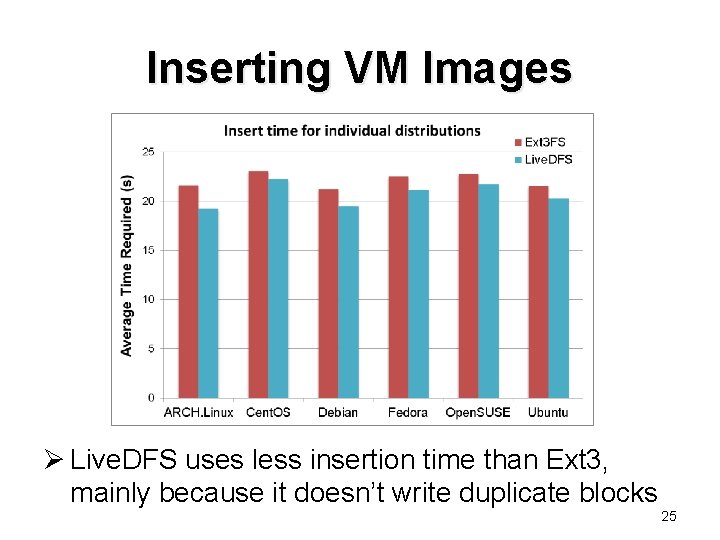
Inserting VM Images Ø Live. DFS uses less insertion time than Ext 3, mainly because it doesn’t write duplicate blocks 25
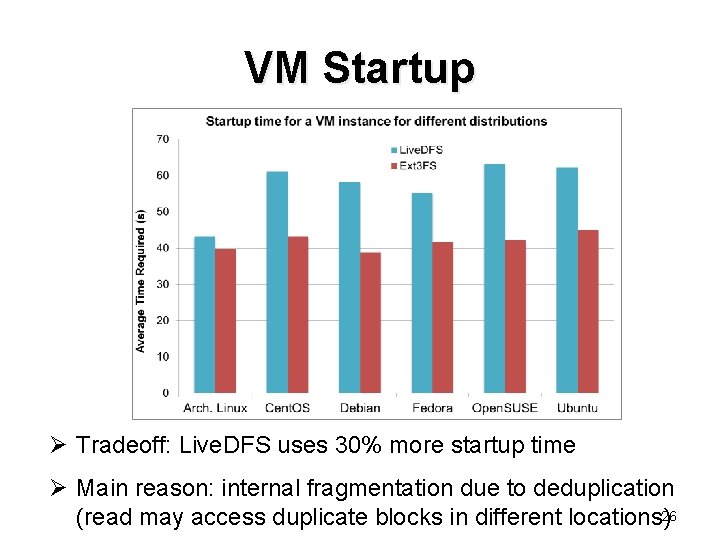
VM Startup Ø Tradeoff: Live. DFS uses 30% more startup time Ø Main reason: internal fragmentation due to deduplication (read may access duplicate blocks in different locations)26
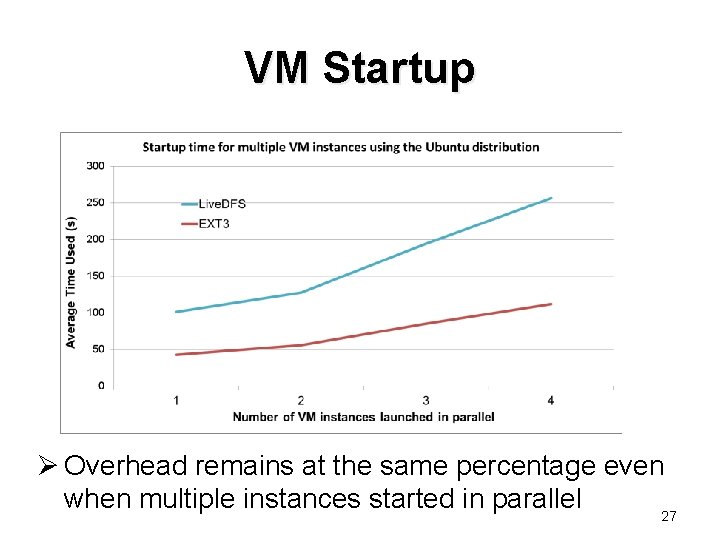
VM Startup Ø Overhead remains at the same percentage even when multiple instances started in parallel 27
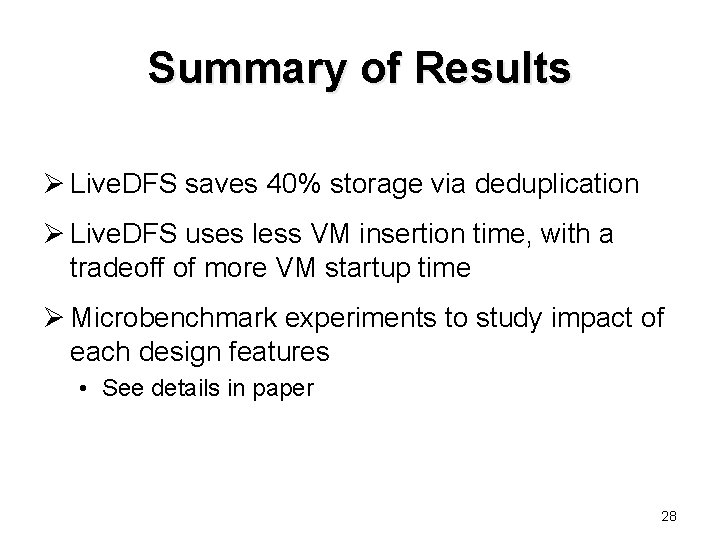
Summary of Results Ø Live. DFS saves 40% storage via deduplication Ø Live. DFS uses less VM insertion time, with a tradeoff of more VM startup time Ø Microbenchmark experiments to study impact of each design features • See details in paper 28
Future Work Ø Reduce read time due to fragmentation introduced by deduplication? • e. g. , read cache to cache duplicate blocks Ø Compare Live. DFS with other deduplication file systems (e. g. , ZFS, Open. Dedup SDFS)? Ø Explore other storage applications 29
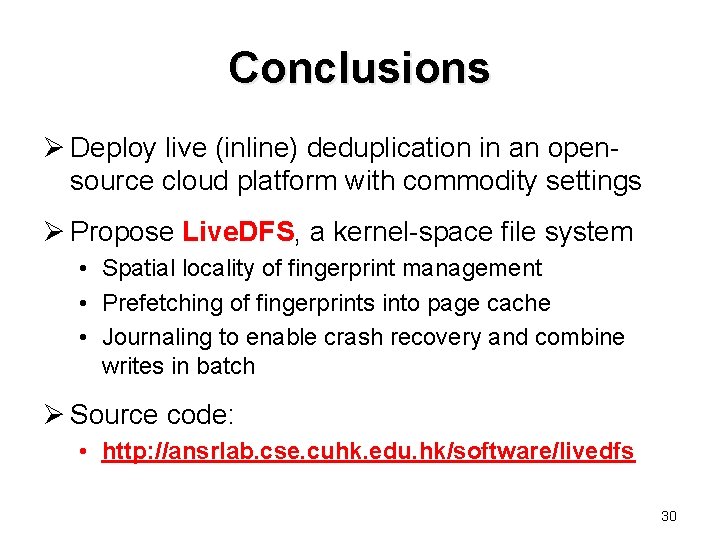
Conclusions Ø Deploy live (inline) deduplication in an opensource cloud platform with commodity settings Ø Propose Live. DFS, a kernel-space file system • Spatial locality of fingerprint management • Prefetching of fingerprints into page cache • Journaling to enable crash recovery and combine writes in batch Ø Source code: • http: //ansrlab. cse. cuhk. edu. hk/software/livedfs 30