
Lithuanian Military Academy NATO Non Article 5 Crisis
- Slides: 79
Lithuanian Military Academy NATO Non Article 5 Crisis Response Operations and PSO concept 2020 -11 -29 MAJ. MINDAUGAS STACKEVICIUS
CONTENT Introduction United Nations NATO Article V Non Article V Crisis Response Operations Pease Support Operations Bosnia and Herzegovina Quiz Questions
REFERENCES - AJP-3. 4 Non Article 5 Crisis Response Operations. AJP-3. 4. 1 Peace Support Operations. FM 3 -07 Stability Operations. FM 3 -07. 31 Peace Operations. JWP 3 -50 The Military Contribution to PSO.
INTRO “Peace-keeping is not a job for soldiers, but only soldiers can do it” Dag Hammarskjöld
INTRO Non Article V Crisis Response Operations “NA 5 CROs can be described as multifunctional operations which encompass those political, military and civil activities, initiated and executed in accordance with international law, including international humanitarian law, contributing to conflict prevention and resolution, and crisis management in the pursuit of declared Alliance objectives. ” AJP-3. 4 No. 0005
INTRO PEACE SUPPORT OPERATIONS “PSOs are multi-functional operations, conducted impartially, normally in support of an internationally recognised organisation such as the UN or Organisation for Security and Co-operation in Europe (OSCE), involving military forces and diplomatic and humanitarian agencies. PSO are designed to achieve a long-term political settlement or other specified conditions. AJP-3. 4. 1 No. 0202
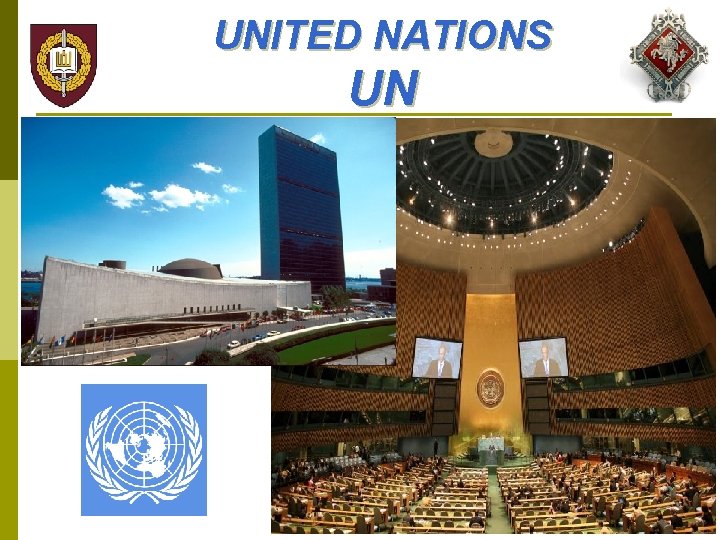
UNITED NATIONS UN
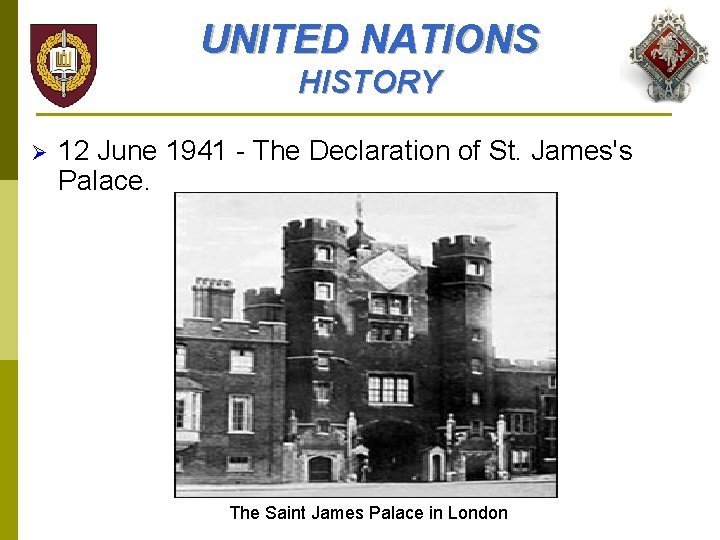
UNITED NATIONS HISTORY Ø 12 June 1941 - The Declaration of St. James's Palace. The Saint James Palace in London
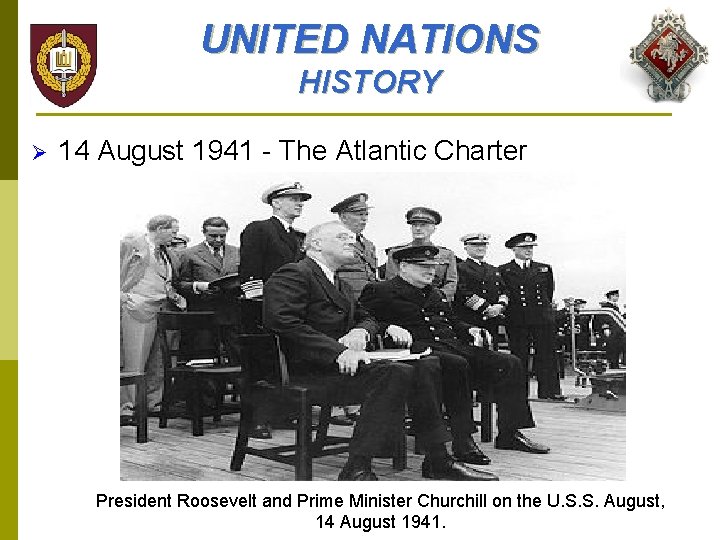
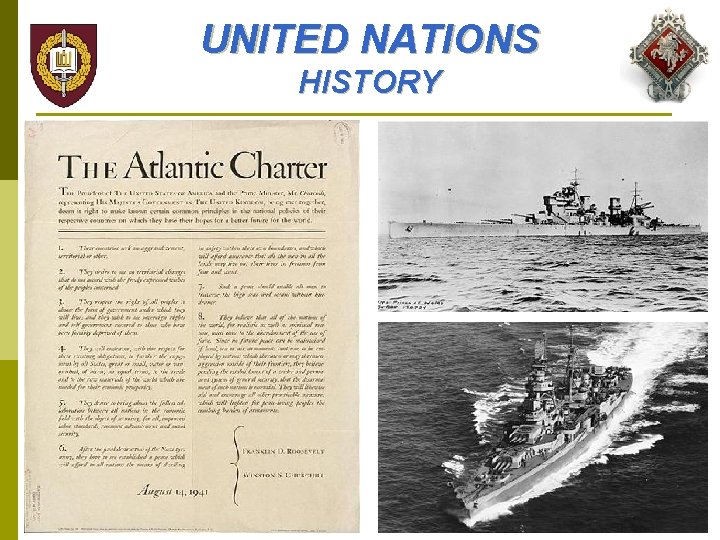
UNITED NATIONS HISTORY Ø 14 August 1941 - The Atlantic Charter President Roosevelt and Prime Minister Churchill on the U. S. S. August, 14 August 1941.
UNITED NATIONS HISTORY
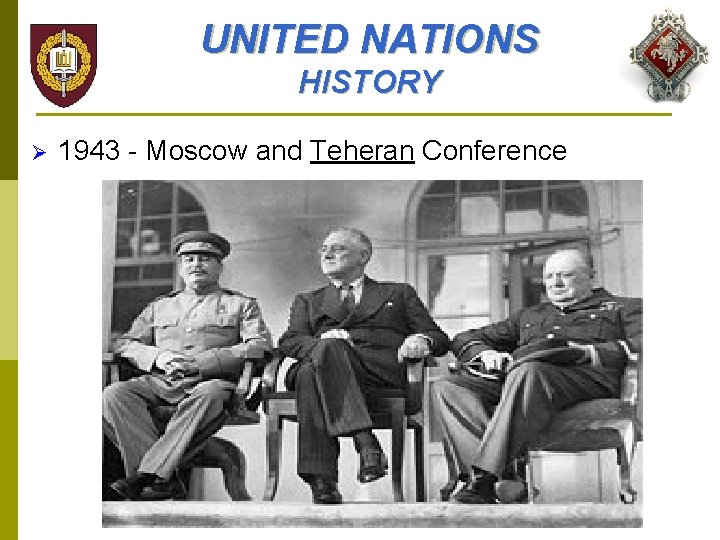
UNITED NATIONS HISTORY Ø 1943 - Moscow and Teheran Conference
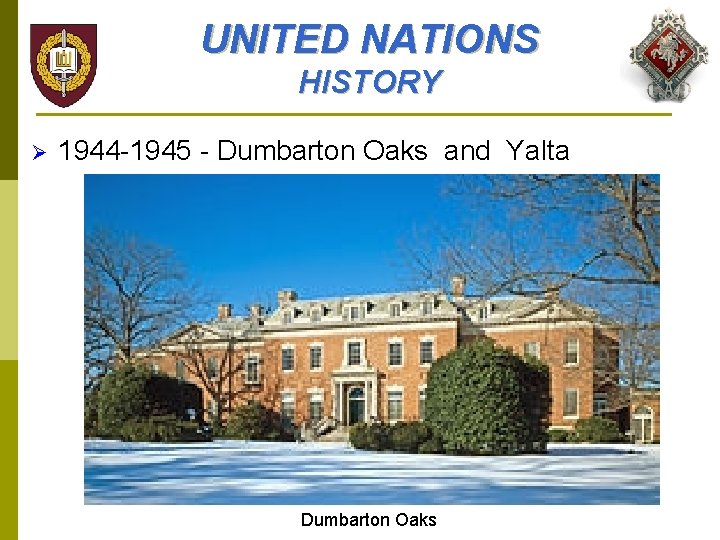
UNITED NATIONS HISTORY Ø 1944 -1945 - Dumbarton Oaks and Yalta Dumbarton Oaks
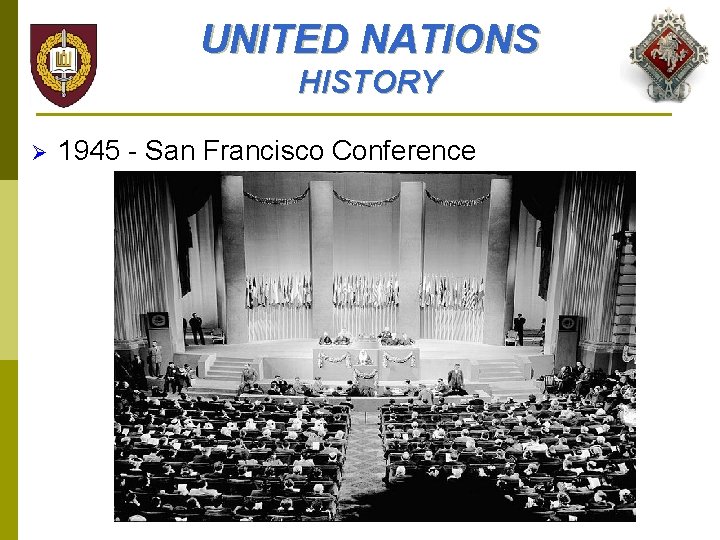
UNITED NATIONS HISTORY Ø 1945 - San Francisco Conference
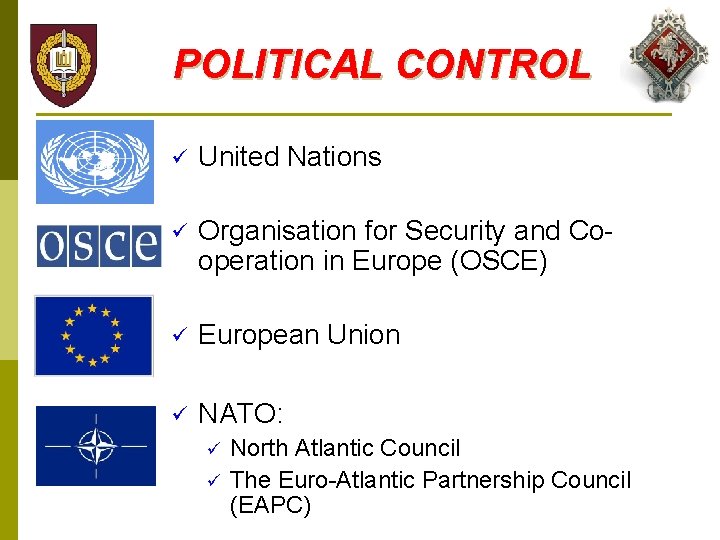
POLITICAL CONTROL ü United Nations ü Organisation for Security and Cooperation in Europe (OSCE) ü European Union ü NATO: ü ü North Atlantic Council The Euro-Atlantic Partnership Council (EAPC)
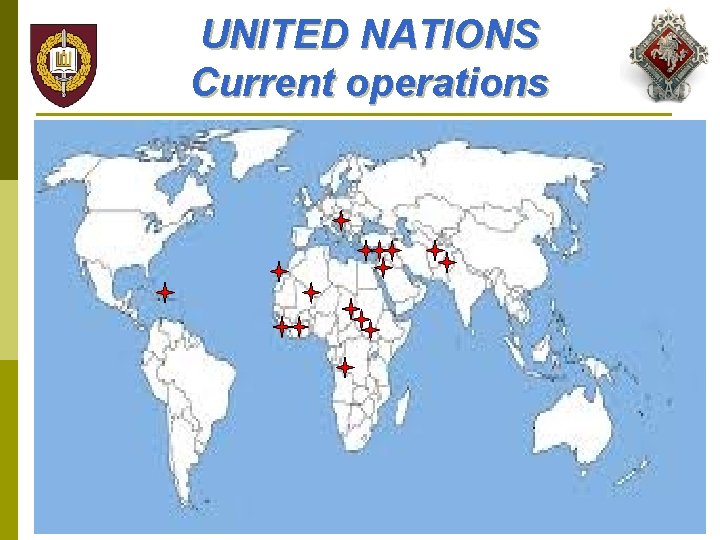
UNITED NATIONS Current operations
NATO North Atlantic Treaty Organization
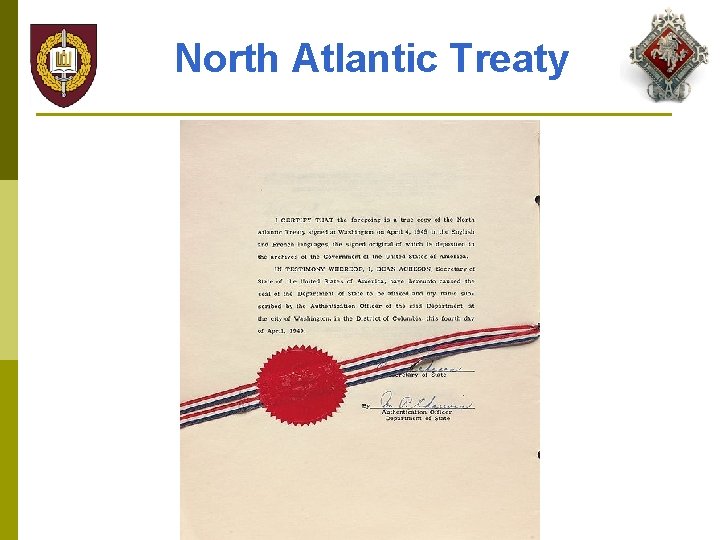
NATO Ø North Atlantic Treaty was signed on 4 April 1949. Ø The organization constitutes a system of collective defence. Ø 28 member states. Ø 22 countries participate in NATO's “Partnership for Peace”. Ø 15 other countries involved in institutionalized dialogue programs.
North Atlantic Treaty
NATO Political and Military Alliance Ø NATO’s essential purpose is to safeguard the freedom and security of its members through political and military means. ü ü POLITICAL - NATO promotes democratic values and encourages consultation and cooperation on defence and security issues to build trust and, in the long run, prevent conflict. MILITARY - NATO is committed to the peaceful resolution of disputes. If diplomatic efforts fail, it has the military capacity needed to undertake crisis-management operations. These are carried out under Article 5 of the Washington Treaty - NATO’s founding treaty - or under a UN mandate, alone or in cooperation with other countries and international organizations.
NATO Decisions and consultations ü NATO provides a unique opportunity for member countries to consult and take decisions on security issues at all levels and in a variety of fields. ü A “NATO decision” is the expression of the collective will of all 28 member countries since all decisions are taken by consensus. ü Each day, hundreds of civilian and military experts and officials come to NATO HQs to exchange information, share ideas and help prepare decisions when needed, in cooperation with national delegations and the staff at NATO HQs.
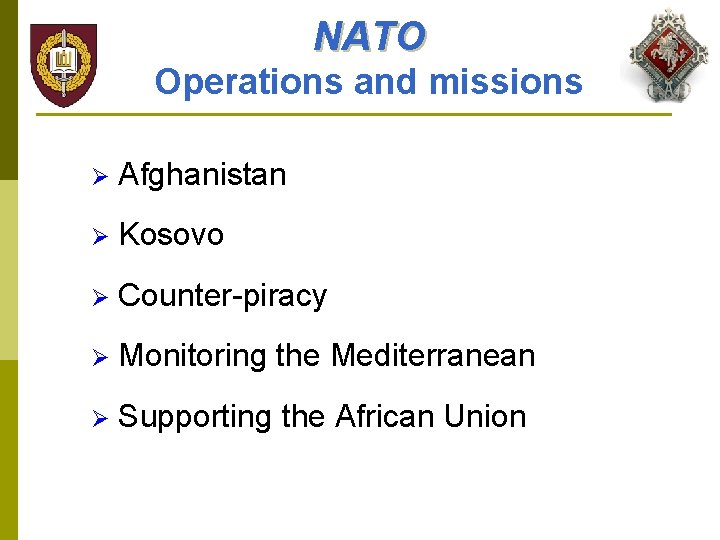
NATO Operations and missions Ø Afghanistan Ø Kosovo Ø Counter-piracy Ø Monitoring the Mediterranean Ø Supporting the African Union
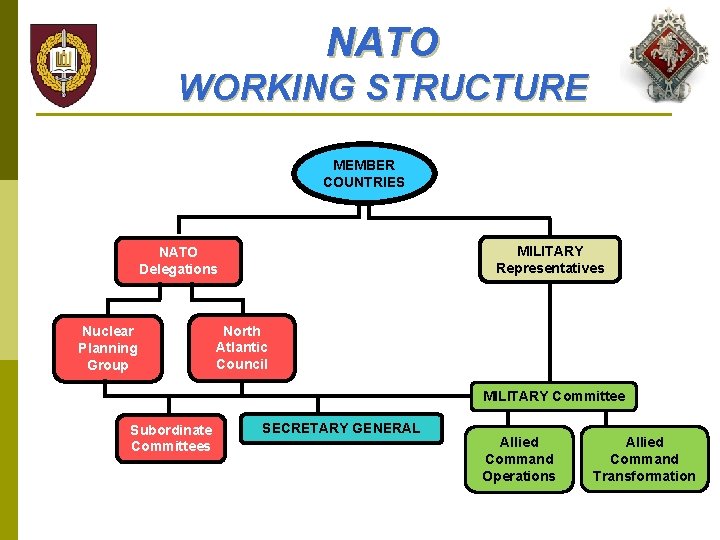
NATO WORKING STRUCTURE MEMBER COUNTRIES MILITARY Representatives NATO Delegations Nuclear Planning Group North Atlantic Council MILITARY Committee Subordinate Committees SECRETARY GENERAL Allied Command Operations Allied Command Transformation
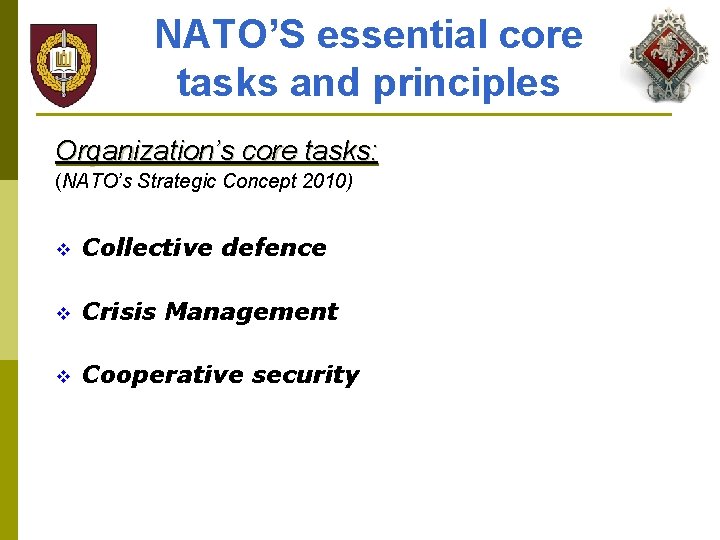
NATO’S essential core tasks and principles Organization’s core tasks: (NATO’s Strategic Concept 2010) v Collective defence v Crisis Management v Cooperative security
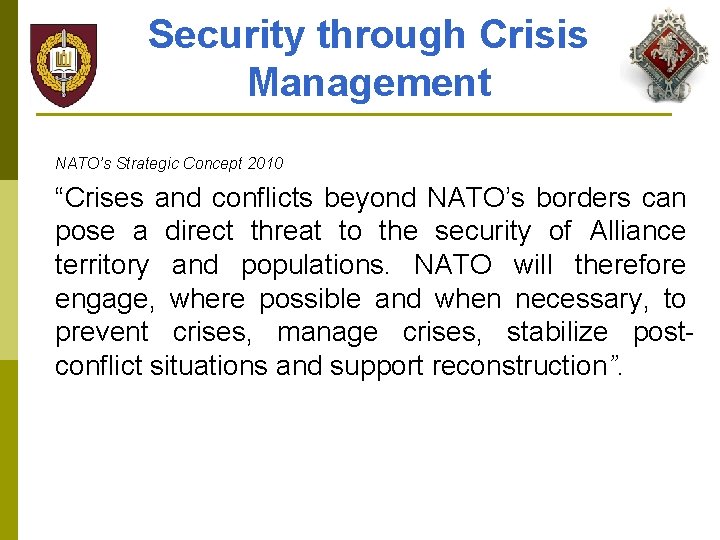
Security through Crisis Management NATO’s Strategic Concept 2010 “Crises and conflicts beyond NATO’s borders can pose a direct threat to the security of Alliance territory and populations. NATO will therefore engage, where possible and when necessary, to prevent crises, manage crises, stabilize postconflict situations and support reconstruction”.
MILITARY IMPLEMENTATION The Alliance’s Military Operations: Ø Article 5 Collective Defence Ø Non-Article 5 Crisis Response
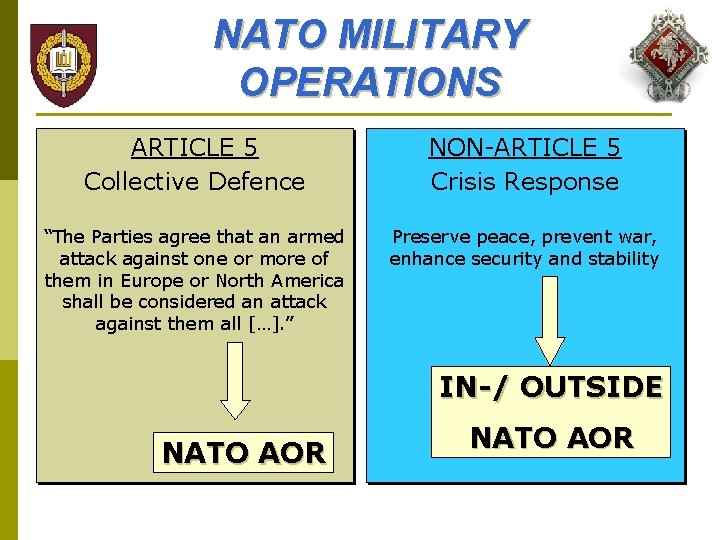
NATO MILITARY OPERATIONS ARTICLE 5 Collective Defence NON-ARTICLE 5 Crisis Response “The Parties agree that an armed attack against one or more of them in Europe or North America shall be considered an attack against them all […]. ” Preserve peace, prevent war, enhance security and stability IN-/ OUTSIDE NATO AOR
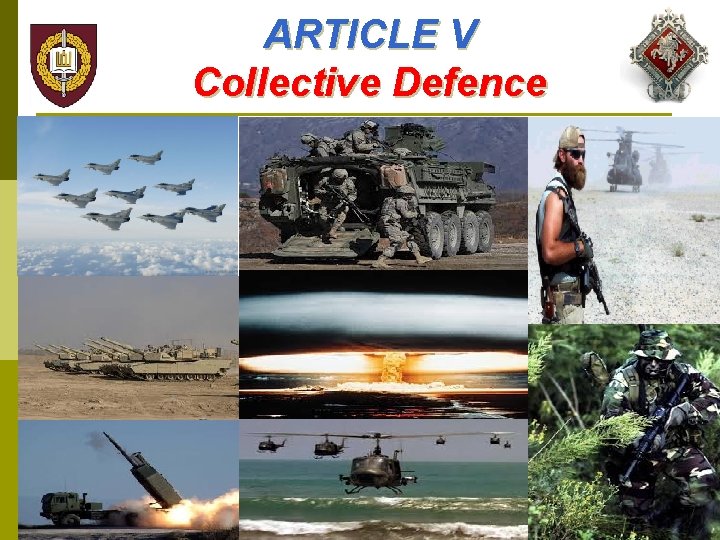
ARTICLE V Collective Defence
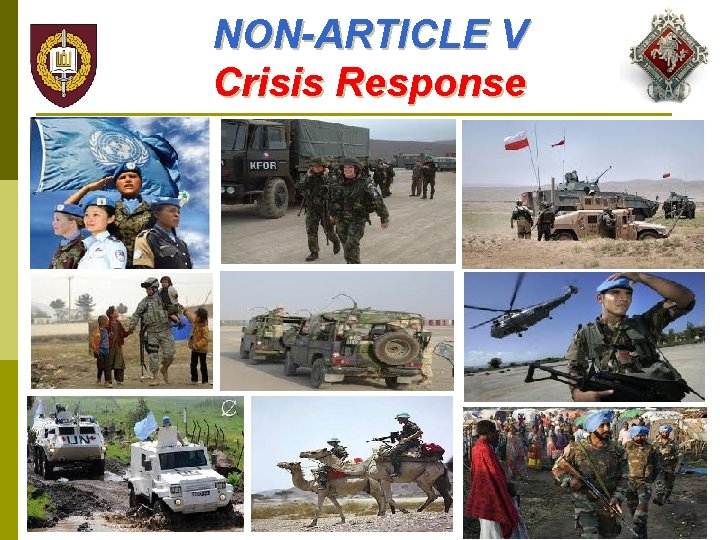
NON-ARTICLE V Crisis Response
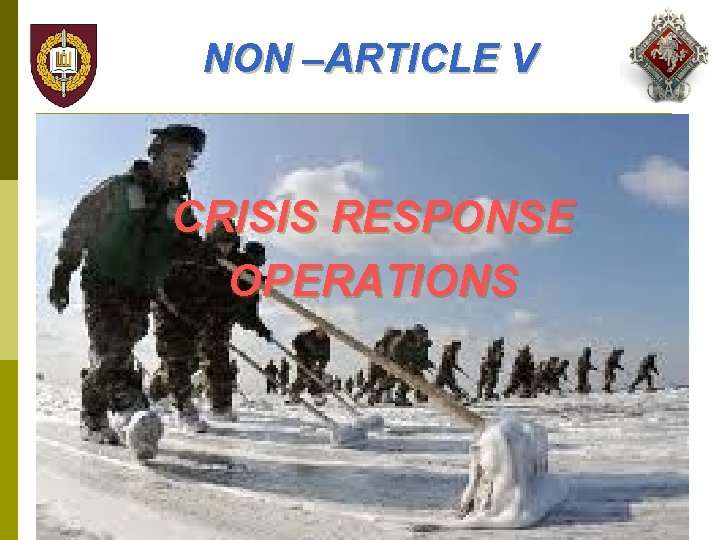
NON –ARTICLE V CRISIS RESPONSE OPERATIONS
NA 5 CRO Description “NA 5 CROs can be described as multifunctional operations which encompass those political, military and civil activities, initiated and executed in accordance with international law, including international humanitarian law, contributing to conflict prevention and resolution, and crisis management in the pursuit of declared Alliance objectives. ” AJP-3. 4 No. 0005
NA 5 CRO Principles ü ü ü ü Objective Perseverance Unity of Command Unity of Effort Credibility Transparency of Operations Protection Flexibility ü ü ü Promotion of Cooperation and Consent Impartiality Use of Force Mutual Respect Freedom of Military Movement Legitimacy
NA 5 CRO Principles Ø Objective: ü Ø Perseverance: ü Ø Require a patient, resolute, persistent and protracted pursuit of objectives; Unity of Command: ü Ø Direct towards clearly defined, decisive, and achievable objectives and the desired end state. Clearly defined authorities, roles, and relationships. Unity of Effort: ü ü Need for a coherent approach that all means are directed to a common purpose between all agencies and parties (IOs, NGOs military and local authorities, ); Effective liaison, regular conferences and meetings is essential.
NA 5 CRO Principles Ø Ø Ø Credibility: ü Is essential to ensure mission accomplishment; ü Reflects the belligerents’ assessment of the capability of the force to accomplish its mission; ü Forces has to respond with professional bearing and swift. Transparency of Operations: ü Mandate, mission, political/military end states readily understood and obvious to all; ü Information should be gathered and communicated through open sources, but balanced against the need to ensure the security. Protection: ü Force protection is a command responsibility in all operations.
NA 5 CRO Principles Ø Flexibility: ü ü ü Ø Ability to adapt and move from one activity to another at short notice and with the minimum of outside assistance; The eventual transition to a stable environment; Forces balanced and independent in terms of skills, capabilities, equipment, and logistics. Promotion of Co-operation and Consent: ü ü ü Amongst the parties are pre-requisites; Any activity, which may result in a loss of consent, should be carefully balanced against the long-term objectives; There may be consent at the strategic level but not necessarily at the tactical level.
NA 5 CRO Principles Ø Ø Impartiality: ü Requires the force to act on behalf of the peace process and mandate, and not show favour or prejudice to any party; ü Applies to the parties to the dispute, not to possible spoilers (e. g. , terrorists or criminals); ü Key: Effective communications and Transparency of Ops. Use of Force: ü Force must apply military force prudently, judiciously, and with discipline; ü IAW the provisions of International Law & ROE; ü ROE do not limit the inherent right of self-defence; ü Limited to the degree, intensity, and duration necessary; ü A single act could cause significant military and political consequences.
NA 5 CRO Principles Ø Ø Mutual Respect: ü The respect - a consequence of its professional conduct & how it treats the local population authorities; ü Respect the laws and customs of the host-nation and must be seen to be doing so; ü Same principles implemented amongst the different national, cultural and ethnic elements within the formations; ü Demonstrate the highest standards of discipline on and off duty. Freedom of Military Movement: ü Essential to remain free at all times to perform its duties without interference; ü Restrictions firmly and swiftly resolved initially through negotiation, but if necessary, the use of force.
NA 5 CRO Principles Ø Legitimacy: ü Legitimacy is perceived by interested audiences as the legality, morality, or fairness of a set of actions; ü Such audiences may include the home public, foreign nations, HN’s civil populations, and the participating forces; ü If an operation is perceived as legitimate by interested audiences it will have a better chance of long-term success; ü The participation of Partners broaden the basis of international support.
NA 5 CRO Political Primacy All NATO non-article 5 CRO will be under the political control and strategic direction of the NAC.
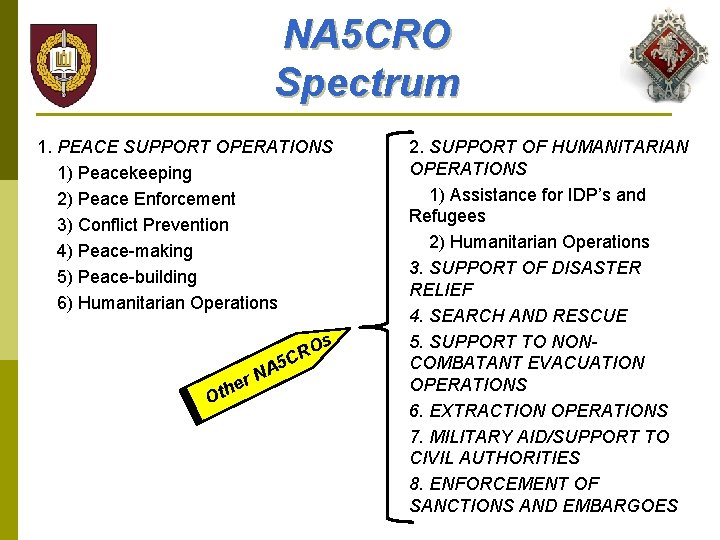
NA 5 CRO Spectrum 1. PEACE SUPPORT OPERATIONS 1) Peacekeeping 2) Peace Enforcement 3) Conflict Prevention 4) Peace-making 5) Peace-building 6) Humanitarian Operations s 5 O CR e h t O A r. N 2. SUPPORT OF HUMANITARIAN OPERATIONS 1) Assistance for IDP’s and Refugees 2) Humanitarian Operations 3. SUPPORT OF DISASTER RELIEF 4. SEARCH AND RESCUE 5. SUPPORT TO NONCOMBATANT EVACUATION OPERATIONS 6. EXTRACTION OPERATIONS 7. MILITARY AID/SUPPORT TO CIVIL AUTHORITIES 8. ENFORCEMENT OF SANCTIONS AND EMBARGOES
NA 5 CRO Operational Consideration Ø A nation’s level of participation in an NA 5 CRO may vary in relation to its national strategic interest in the operation and resources available; therefore, national commitment to provide forces will vary accordingly and will affect the force generation process. Ø When planning NA 5 CROs, initially only forces under the purview of NATO will be considered as the basis force generation. Ø The Political Military Framework (PMF) for NATO-led Pf. P operations was established in light of important Partner contributions and participation to NA 5 CROs.
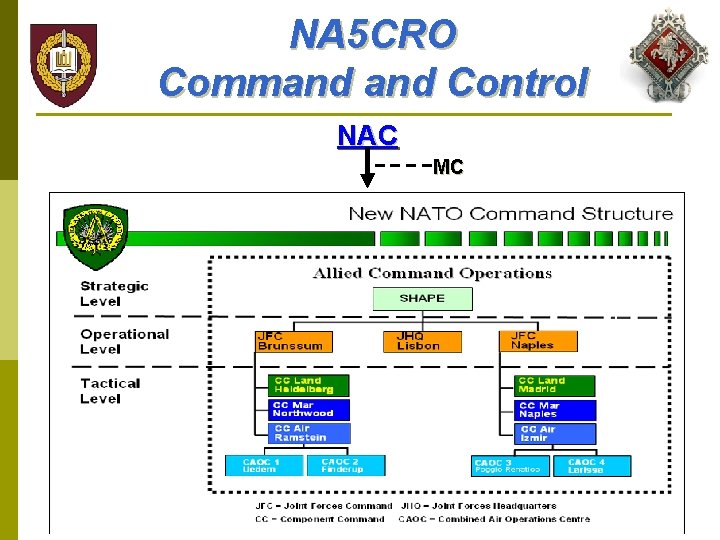
NA 5 CRO Command Control NAC MC
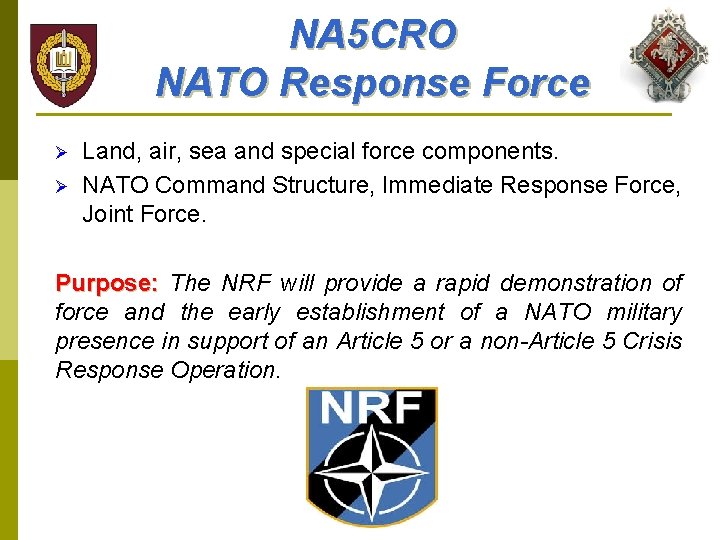
NA 5 CRO NATO Response Force Ø Ø Land, air, sea and special force components. NATO Command Structure, Immediate Response Force, Joint Force. Purpose: The NRF will provide a rapid demonstration of force and the early establishment of a NATO military presence in support of an Article 5 or a non-Article 5 Crisis Response Operation.
NA 5 CRO NATO Response Force List of tasks Contribute to the Preservation of Territorial Integrity ü Demonstrative Force Package ü Peace Support Operations ü Embargo Operations ü Disaster Relief ü Protection of critical Infrastructure ü Security Operations ü As part of a larger Force, the NRF could also be used to conduct Initial Entry Operations ü Priority tasks for NRF ü Peace Support Operations ü Collective Defence ü Disaster Relief
NA 5 CRO NATO Response Force The Immediate Response Force has: a brigade-sized land component based on three Battle Groups and their supporting elements; ü a maritime component based on NATO’s Standing Naval Maritime Groups and Standing Naval Mine Counter Measures Groups; ü a combat air and air support component; ü special forces; ü a CBRN (chemical, biological, radiological and nuclear) defence task force. ü
PEACE SUPPORT OPERATIONS
PEACE SUPPORT OPERATIONS PSO - an operation that impartially makes use diplomatic, civil and military means, normally pursuit of UN Charter purposes and principles, restore or maintain peace. of in to
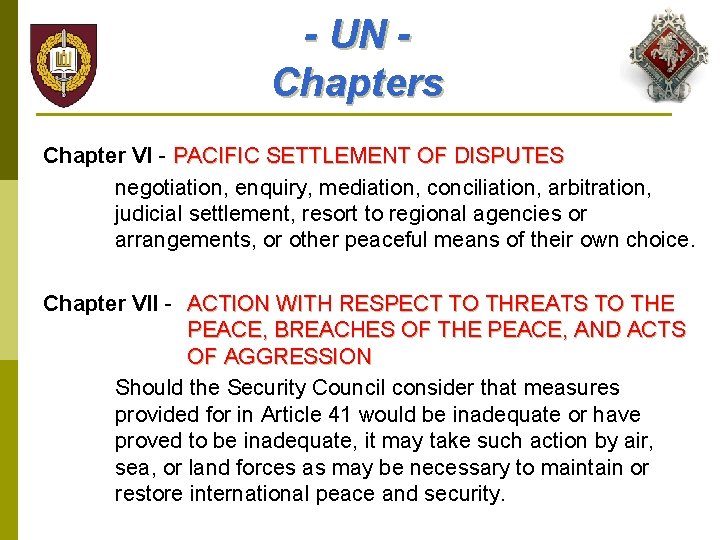
- UN Chapters Chapter VI - PACIFIC SETTLEMENT OF DISPUTES negotiation, enquiry, mediation, conciliation, arbitration, judicial settlement, resort to regional agencies or arrangements, or other peaceful means of their own choice. Chapter VII - ACTION WITH RESPECT TO THREATS TO THE PEACE, BREACHES OF THE PEACE, AND ACTS OF AGGRESSION Should the Security Council consider that measures provided for in Article 41 would be inadequate or have proved to be inadequate, it may take such action by air, sea, or land forces as may be necessary to maintain or restore international peace and security.
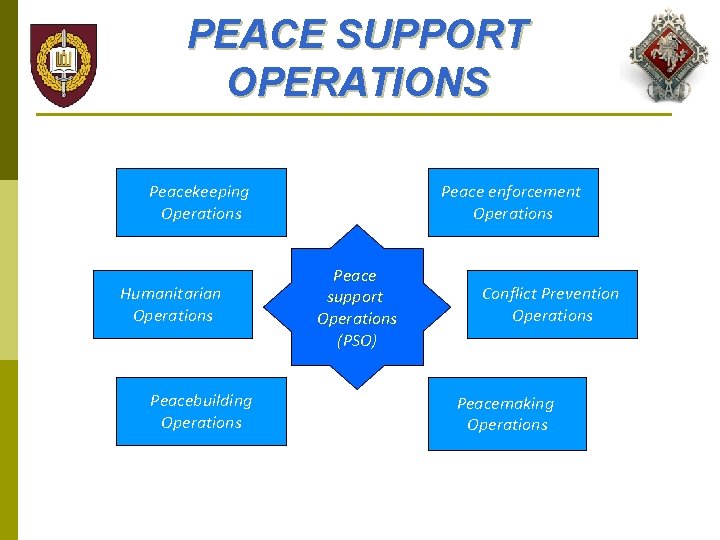
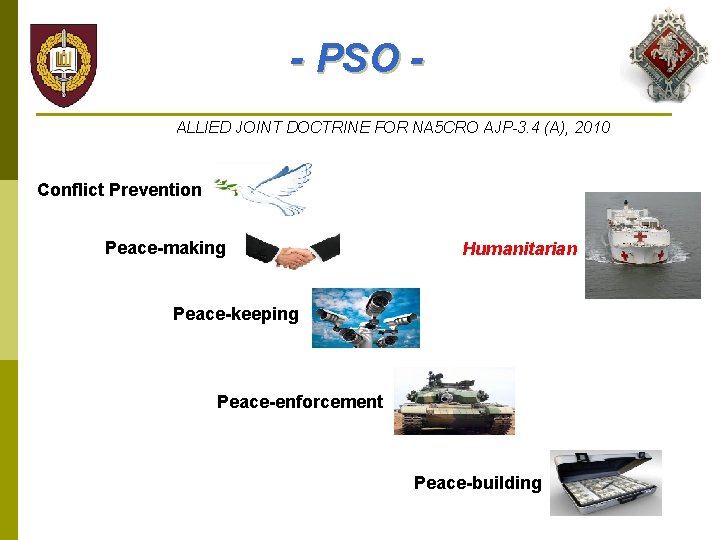
PEACE SUPPORT OPERATIONS Peacekeeping Operations Humanitarian Operations Peacebuilding Operations Peace enforcement Operations Peace support Operations (PSO) Conflict Prevention Operations Peacemaking Operations
- PSO ALLIED JOINT DOCTRINE FOR NA 5 CRO AJP-3. 4 (A), 2010 Conflict Prevention Peace-making Humanitarian Peace-keeping Peace-enforcement Peace-building
- PSO I - Conflict Prevention 1. Conflict prevention activities are normally conducted in accordance with the Chapter VI of the UN Charter. They may include: diplomatic, economic, or information initiatives; actions designed to reform a country’s security sector and make it more accountable to democratic control; or deployment of forces designed to prevent or contain disputes from escalating to armed conflict. 2. Military assets used for conflict prevention should generally be focused on the support they provide to the political and developmental efforts to mitigate the causes of tensions and unrest. This can be before the commencement of intervention, or during or after intervention in order to protect and consolidate the reform. Military activities will be tailored to meet political and developmental demands but include: early warning, surveillance, and preventative deployment.
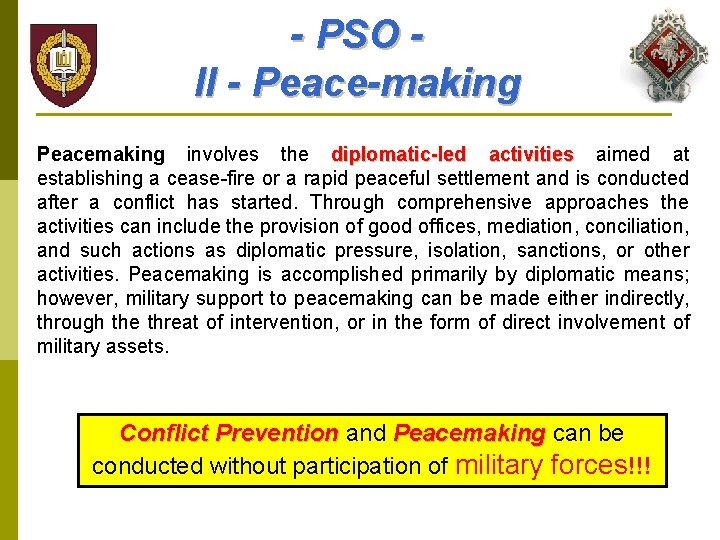
- PSO II - Peace-making Peacemaking involves the diplomatic-led activities aimed at establishing a cease-fire or a rapid peaceful settlement and is conducted after a conflict has started. Through comprehensive approaches the activities can include the provision of good offices, mediation, conciliation, and such actions as diplomatic pressure, isolation, sanctions, or other activities. Peacemaking is accomplished primarily by diplomatic means; however, military support to peacemaking can be made either indirectly, through the threat of intervention, or in the form of direct involvement of military assets. Conflict Prevention and Peacemaking can be conducted without participation of military forces!!!
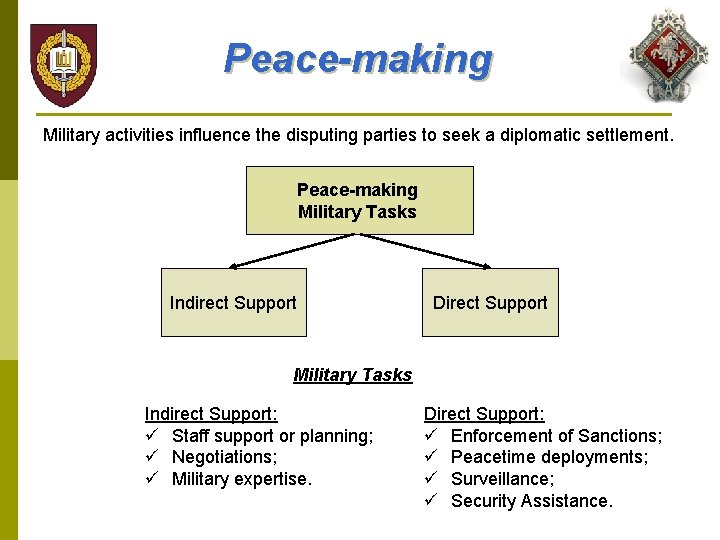
Peace-making Military activities influence the disputing parties to seek a diplomatic settlement. Peace-making Military Tasks Indirect Support Direct Support Military Tasks Indirect Support: ü Staff support or planning; ü Negotiations; ü Military expertise. Direct Support: ü Enforcement of Sanctions; ü Peacetime deployments; ü Surveillance; ü Security Assistance.
- PSO III - Peace-keeping Peacekeeping operations are generally undertaken in accordance with the principles of Chapter VI of the UN Charter in order to monitor and facilitate the implementation of a peace agreement The loss of consent or the development of a noncompliant party may limit the freedom of action of the PK force and even threaten the continuation of the mission or cause it to evolve into a PE operation. Thus, the conduct of PK is driven by the requirement to build and retain perceived legitimacy.
- PSO IV - Peace enforcement Peace Enforcement operations normally take place under the principles of Chapter VII of the UN Charter. The difference between Peace Enforcement and other PSOs is that the Chapter VII mandate allows more freedom of action for the commander concerning the use of force without losing legitimacy. These operations are coercive in nature and are conducted when the consent of all parties to the conflict has not been achieved or might be uncertain. They are designed to maintain or re-establish peace or enforce the terms specified in the mandate. In the conduct of PE, the link between political and military objectives must be extremely close. It is important to emphasize that the aim of the PE operation will not be the defeat or destruction of an adversary, but rather to compel, coerce, and persuade the parties to comply with a particular desired outcome and the established rules and regulations.
- PSO V - Peace building involves actions that support political, economic, military, and social measures through comprehensive approaches and that are aimed at strengthening political settlements of a conflict. Thus, for a society to regenerate and become self-sustaining, it must address the constituents of a functioning society. Peace building includes mechanisms to identify and support structures that will consolidate peace, foster a sense of confidence and well-being, and support economic reconstruction. Peace building therefore requires the commitment of political, humanitarian and development resources to a long-term political process. Peace building establishes infrastructures of society - socio-political and material, physical.
- PSO VI - Humanitarian A humanitarian operation, operation within the context of or in support of a PSO, aims to alleviate human suffering where responsible authorities in an area are unable, or unwilling, to fully support a population. It may be conducted in the broader context of a PSO, or as an independent task, which may precede or accompany the humanitarian activities of specialized civilian organizations. Forces are assigned for a specific task in support of the coordinating humanitarian agency, and adopt a benign posture, except for FP measures.
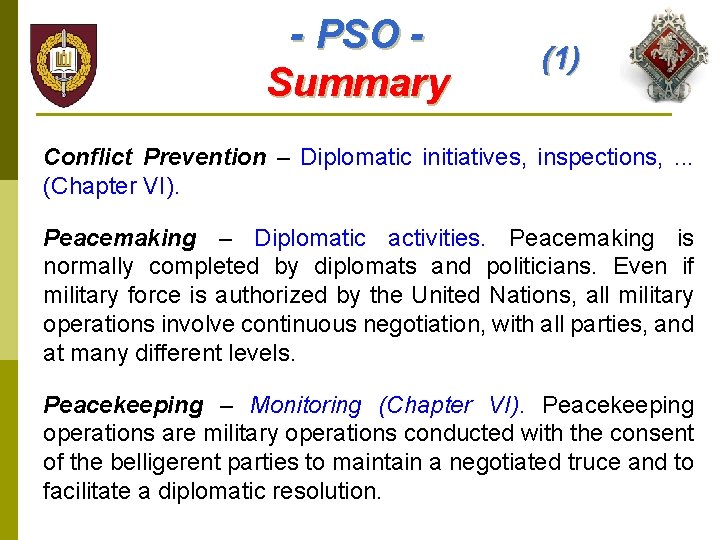
- PSO Summary (1) Conflict Prevention – Diplomatic initiatives, inspections, . . . (Chapter VI). Peacemaking – Diplomatic activities. Peacemaking is normally completed by diplomats and politicians. Even if military force is authorized by the United Nations, all military operations involve continuous negotiation, with all parties, and at many different levels. Peacekeeping – Monitoring (Chapter VI). Peacekeeping operations are military operations conducted with the consent of the belligerent parties to maintain a negotiated truce and to facilitate a diplomatic resolution.
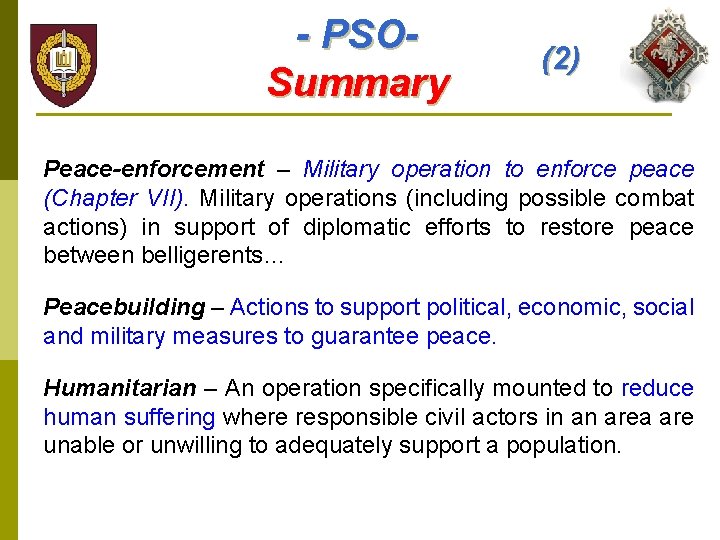
- PSOSummary (2) Peace-enforcement – Military operation to enforce peace (Chapter VII). Military operations (including possible combat actions) in support of diplomatic efforts to restore peace between belligerents… Peacebuilding – Actions to support political, economic, social and military measures to guarantee peace. Humanitarian – An operation specifically mounted to reduce human suffering where responsible civil actors in an area are unable or unwilling to adequately support a population.
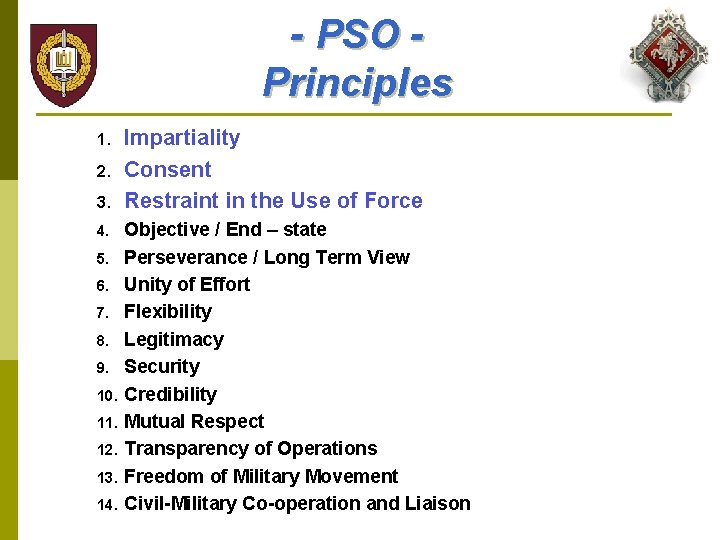
- PSO Principles 1. 2. 3. 4. 5. 6. 7. 8. 9. 10. 11. 12. 13. 14. Impartiality Consent Restraint in the Use of Force Objective / End – state Perseverance / Long Term View Unity of Effort Flexibility Legitimacy Security Credibility Mutual Respect Transparency of Operations Freedom of Military Movement Civil-Military Co-operation and Liaison
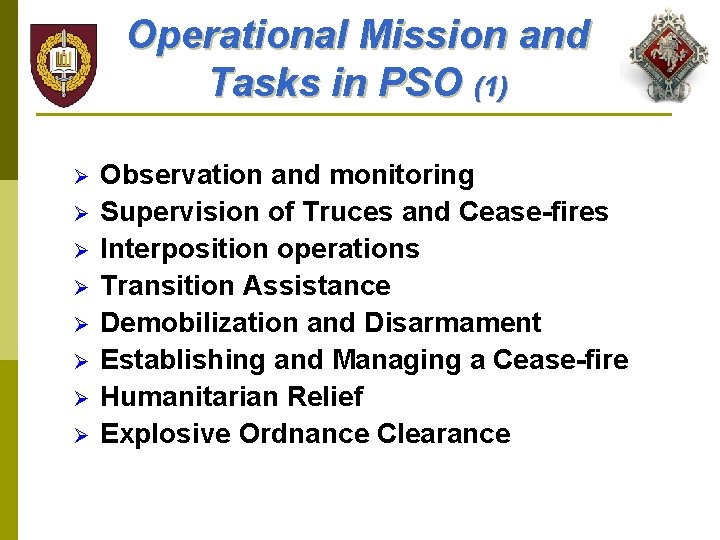
Operational Mission and Tasks in PSO (1) Ø Ø Ø Ø Observation and monitoring Supervision of Truces and Cease-fires Interposition operations Transition Assistance Demobilization and Disarmament Establishing and Managing a Cease-fire Humanitarian Relief Explosive Ordnance Clearance
Operational Mission and Tasks in PSO (2) Ø Ø Ø Ø Restoration of Law and Order Protection of Humanitarian Operations and Human Rights (. . . create a stable and secure environment) Conflict Containment Forcible Separation of Belligerents Establishment of Protected or Safe Areas Guarantee & Denial of Movement Operations Enforcement of Sanctions
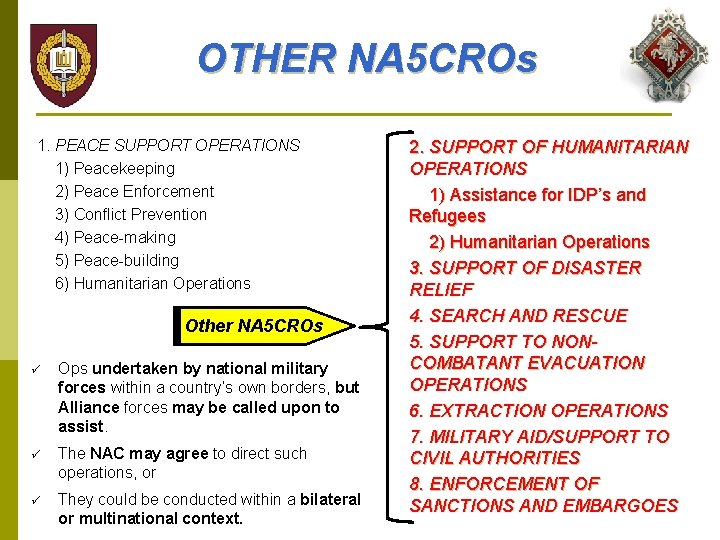
OTHER NA 5 CROs 1. PEACE SUPPORT OPERATIONS 1) Peacekeeping 2) Peace Enforcement 3) Conflict Prevention 4) Peace-making 5) Peace-building 6) Humanitarian Operations Other NA 5 CROs ü Ops undertaken by national military forces within a country’s own borders, but Alliance forces may be called upon to assist. ü The NAC may agree to direct such operations, or ü They could be conducted within a bilateral or multinational context. 2. SUPPORT OF HUMANITARIAN OPERATIONS 1) Assistance for IDP’s and Refugees 2) Humanitarian Operations 3. SUPPORT OF DISASTER RELIEF 4. SEARCH AND RESCUE 5. SUPPORT TO NONCOMBATANT EVACUATION OPERATIONS 6. EXTRACTION OPERATIONS 7. MILITARY AID/SUPPORT TO CIVIL AUTHORITIES 8. ENFORCEMENT OF SANCTIONS AND EMBARGOES
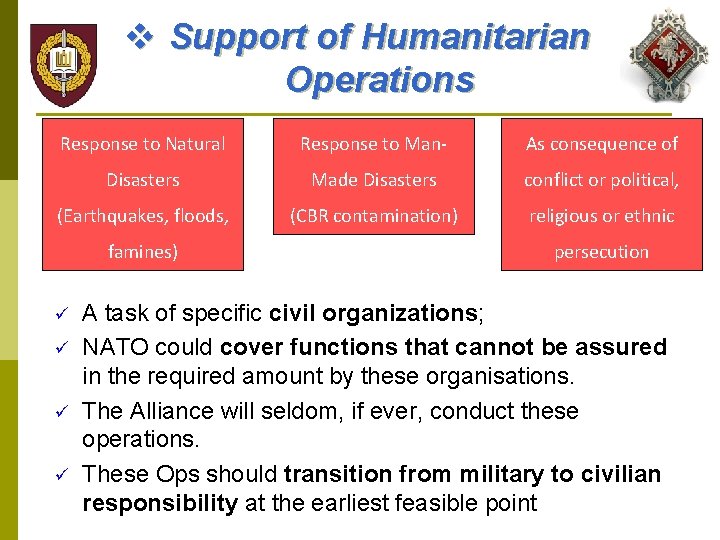
v Support of Humanitarian Operations Response to Natural Response to Man- As consequence of Disasters Made Disasters conflict or political, (Earthquakes, floods, (CBR contamination) religious or ethnic famines) ü ü persecution A task of specific civil organizations; NATO could cover functions that cannot be assured in the required amount by these organisations. The Alliance will seldom, if ever, conduct these operations. These Ops should transition from military to civilian responsibility at the earliest feasible point
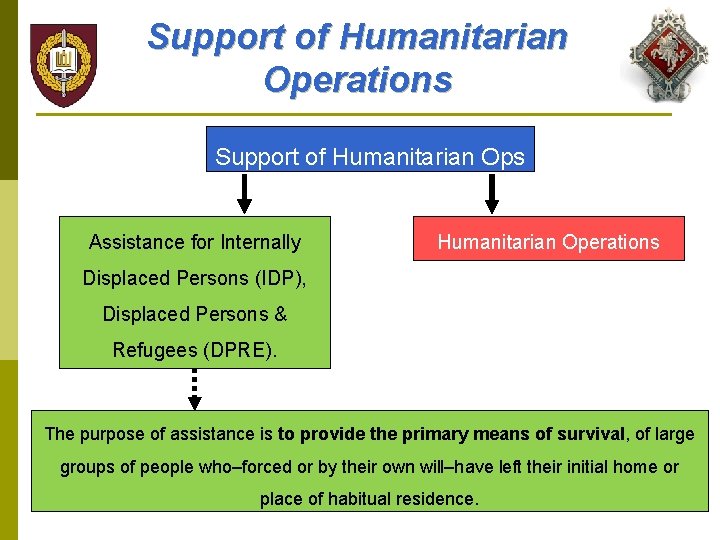
Support of Humanitarian Operations Support of Humanitarian Ops Assistance for Internally Humanitarian Operations Displaced Persons (IDP), Displaced Persons & Refugees (DPRE). The purpose of assistance is to provide the primary means of survival, of large groups of people who–forced or by their own will–have left their initial home or place of habitual residence.
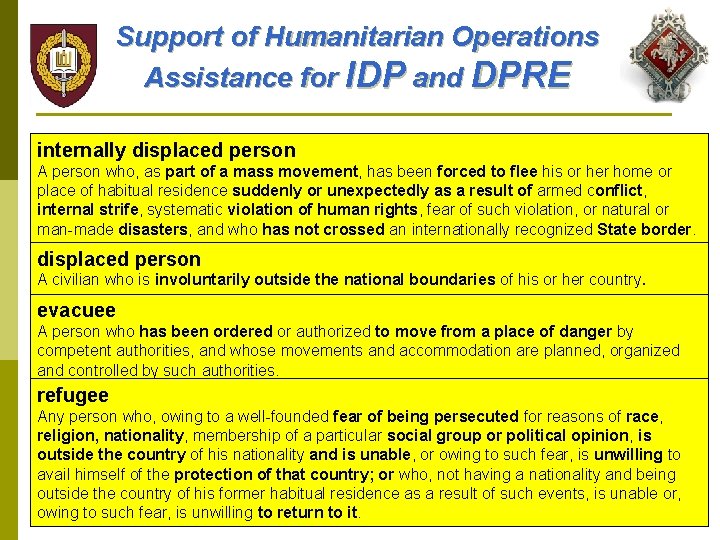
Support of Humanitarian Operations Assistance for IDP and DPRE internally displaced person A person who, as part of a mass movement, has been forced to flee his or her home or place of habitual residence suddenly or unexpectedly as a result of armed conflict, internal strife, systematic violation of human rights, fear of such violation, or natural or man-made disasters, and who has not crossed an internationally recognized State border. displaced person A civilian who is involuntarily outside the national boundaries of his or her country. evacuee A person who has been ordered or authorized to move from a place of danger by competent authorities, and whose movements and accommodation are planned, organized and controlled by such authorities. refugee Any person who, owing to a well-founded fear of being persecuted for reasons of race, religion, nationality, membership of a particular social group or political opinion, is outside the country of his nationality and is unable, or owing to such fear, is unwilling to avail himself of the protection of that country; or who, not having a nationality and being outside the country of his former habitual residence as a result of such events, is unable or, owing to such fear, is unwilling to return to it.
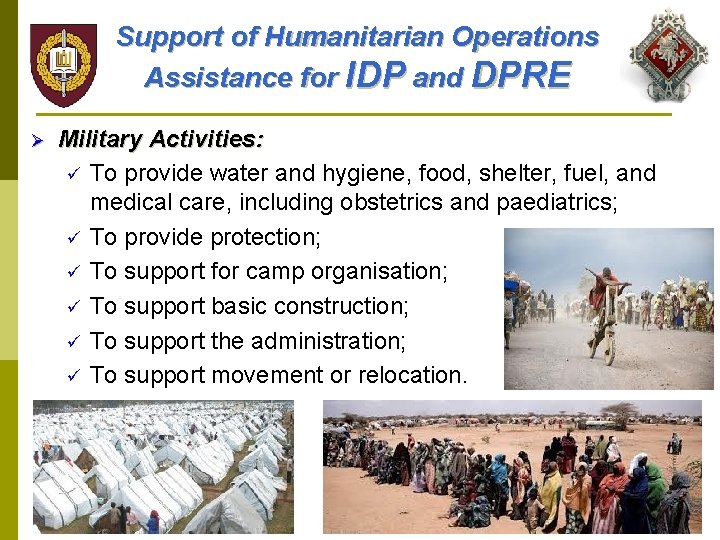
Support of Humanitarian Operations Assistance for IDP and DPRE Ø Military Activities: ü To provide water and hygiene, food, shelter, fuel, and medical care, including obstetrics and paediatrics; ü To provide protection; ü To support for camp organisation; ü To support basic construction; ü To support the administration; ü To support movement or relocation.
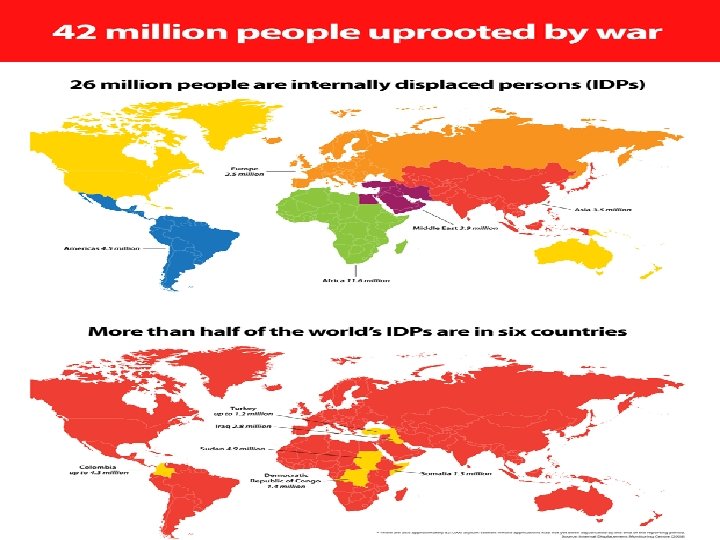
IDP
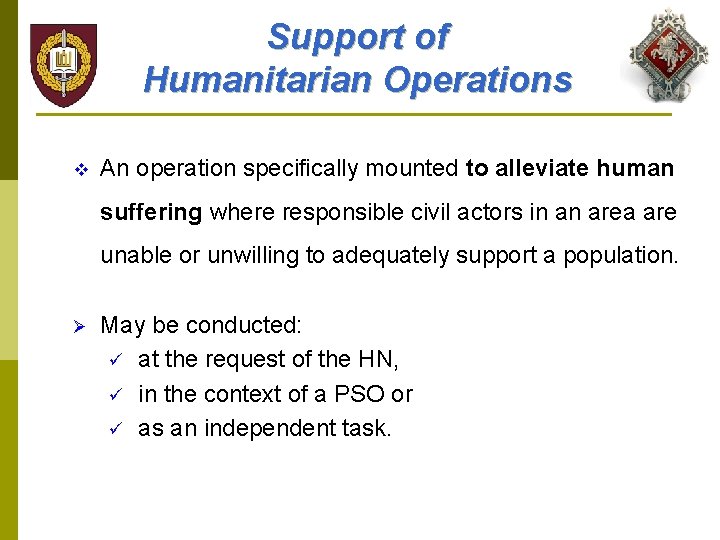
Support of Humanitarian Operations v An operation specifically mounted to alleviate human suffering where responsible civil actors in an area are unable or unwilling to adequately support a population. Ø May be conducted: ü at the request of the HN, ü in the context of a PSO or ü as an independent task.
Support of Humanitarian Operations Military Activities: Ø Support to short-term tasks: ü Communications restoration; ü Relief supply management; ü Providing emergency medical care; ü Humanitarian demining; ü High priority relief supply delivery. Ø Advice, selected training & assessments; Ø Provision of manpower and equipment. Ø Longer-term reconstruction assistance: ü Digging wells; ü Reconnecting water and electricity grid systems; ü Rebuilding schools, hospitals, and communications networks. Ø Protection of convoys, depots, equipment, and workers.
v Support for Disaster Relief v v v Disaster relief is closely linked with humanitarian operations: response to natural or man-made disasters; Conducting disaster relief is primarily a responsibility of local civil authorities, possibly supported by IOs and NGOs; Disaster relief is more likely to take place within the context of an on going NA 5 CROs, because of the requisite response times. Military Activities: Ø C 2, logistics, and communications, and the planning; Ø Immediate response to prevent loss of life and destruction of property; Ø Assistance in the distribution of relief supplies (IAW “Oslo Guidelines”); Ø Constructing basic sanitation facilities and shelters; Ø Providing food and medical care.
v Search & Rescue v The use of aircraft, surface craft, submarines, specialised rescue teams, and equipment to search for and rescue personnel in distress on land or at sea. Ø All NATO nations - signatories to the Chicago Conventions of 1947 on International Civil Aviation and International Convention on Maritime SAR of 1979. Each nation being responsible for SAR within an area in which SAR operations are controlled by Rescue Co-ordination Centres (RCCs). In time of conflict, NATO commanders are responsible for the planning and conduct of local SAR forces under their command. Ø Ø
v Support to Non-Combatant Evacuation Ops v Operations conducted to relocate (to a place of safety) non-combatants threatened in a foreign country. Ø NEOs are diplomatic initiatives – with Alliance forces participating in a supporting role; Ø NEOs remains a national responsibility.
v Extraction Operations v Missions where a NATO-led force covers or assists in the withdrawal of a UN or other military mission from a crisis region. Ø Forces with similar capabilities as for NEO; Ø In an Uncertain or Hostile environment; Ø NATO: planning of potential NATO extraction force to enhance safety of international missions.
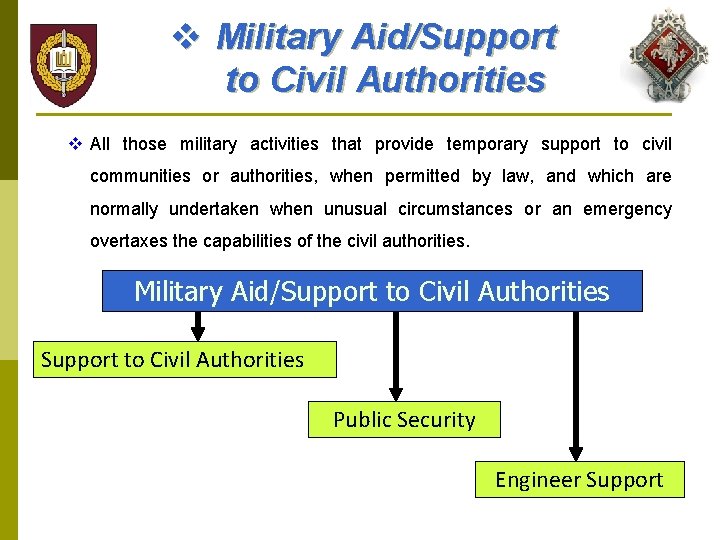
v Military Aid/Support to Civil Authorities v All those military activities that provide temporary support to civil communities or authorities, when permitted by law, and which are normally undertaken when unusual circumstances or an emergency overtaxes the capabilities of the civil authorities. Military Aid/Support to Civil Authorities Public Security Engineer Support
Support to Civil Authorities Activities: Ø Provide a stable and secure environment; Ø Provide security assistance to an election process; Ø Supervise the transition to a democratically elected public administration; Ø Train local police and security forces; Ø Mine and UXO clearing and training of the local population; Ø Assist in public administration; Ø Maintain public services; Ø Support public administration in co-ordinating a humanitarian operation; Ø Provide security for individuals, populations, or installations.
Public Security Ø In exception, within a mandate for a larger mission; Ø Military support will depend entirely on the mission and the residual local policing and judicial capability: ü Maintain local law and order ü Provided by Multinational Specialised Units.
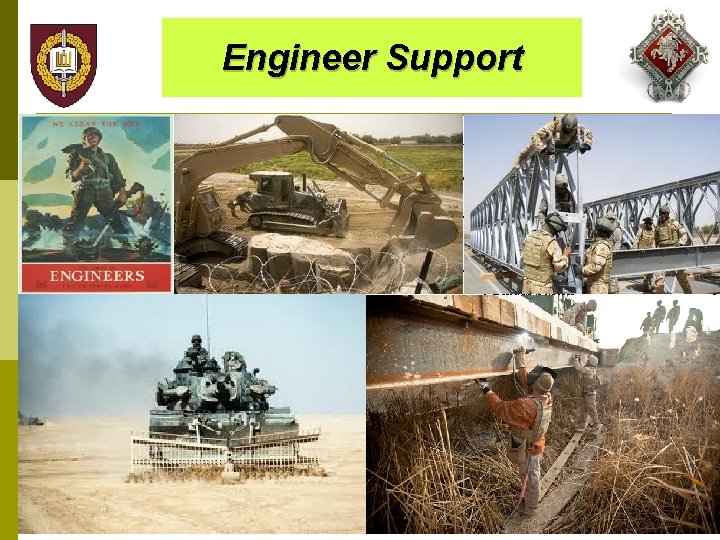
Engineer Support Engineer units provide essential civil, electrical, and mechanical support: Mine clearance and counter obstacle operations Camp construction FP measures Explosive ordnance disposal Structural repair Baseline and final environmental assessments, environmental protection and remediation Debris clearance Heating, ventilation, and air conditioning systems Basic response to WMD and hazardous materials incidents Bridging POL infrastructure Support to CBRN decontamination and recovery operations Route maintenance and repair Power generation Fire protection and crash rescue Quarry operations Facility construction Water treatment Runway construction and repair Underwater construction and salvage Geodetic survey control Railway construction and repair Emergency repairs to restore utilities Terrain analysis Pavement evaluation and analysis Water well drilling Asphalt and concrete plant operations Port openings
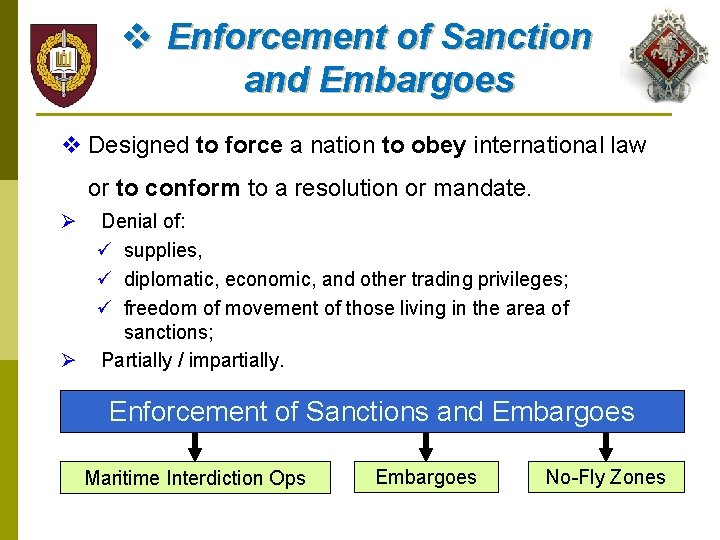
v Enforcement of Sanction and Embargoes v Designed to force a nation to obey international law or to conform to a resolution or mandate. Ø Denial of: ü supplies, ü diplomatic, economic, and other trading privileges; ü freedom of movement of those living in the area of sanctions; Ø Partially / impartially. Enforcement of Sanctions and Embargoes Maritime Interdiction Ops Embargoes No-Fly Zones
QUESTIONS 2020 -11 -29 MAJ. MINDAUGAS STACKEVICIUS 80