
Lithography Advanced Key parameters resolution alignment or misalignment
- Slides: 31
Lithography: Advanced + Key parameters: + resolution + alignment (or misalignment) + depth of focus + Resolution: + indicates the smallest feature (or space) that can be produced + One of the limiting factors is wavelength of the light used 22 -Nov-20 2
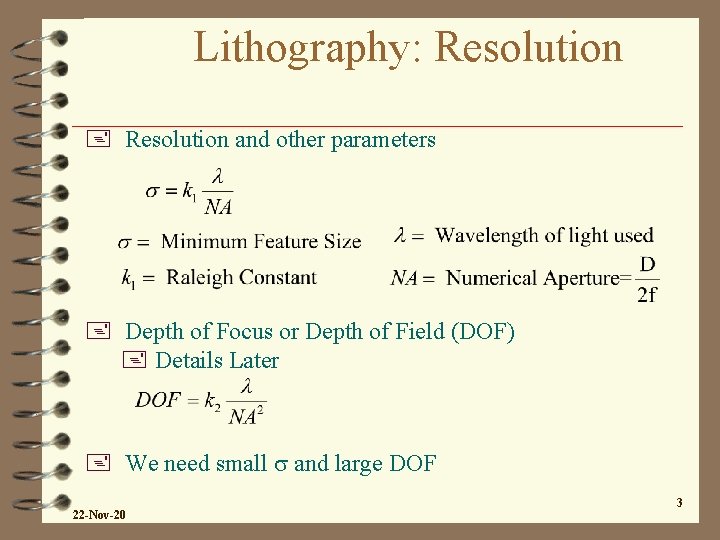
Lithography: Resolution + Resolution and other parameters + Depth of Focus or Depth of Field (DOF) + Details Later + We need small s and large DOF 22 -Nov-20 3
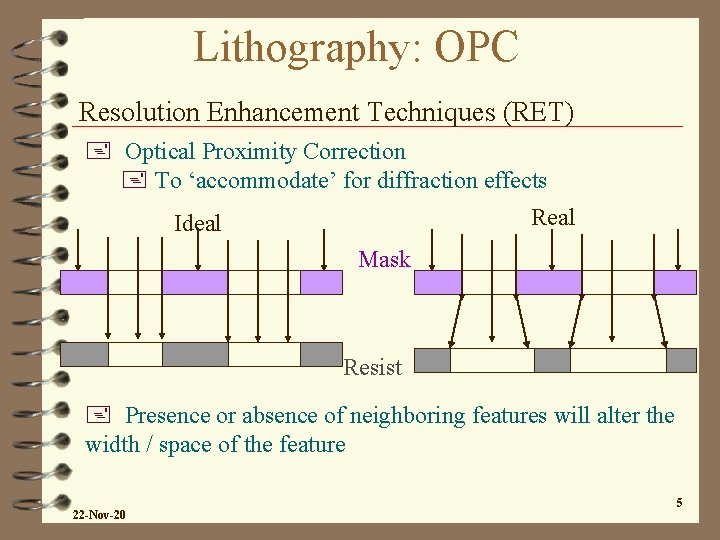
Lithography: OPC Resolution Enhancement Techniques (RET) + Optical Proximity Correction + To ‘accommodate’ for diffraction effects + Presence or absence of other features nearby (proximity) will affect the optical behavior + Corrections are made in the layout to account for it (Hence, Optical Proximity Correction or OPC) + Anti Reflective Coating (ARC) + Phase Shift Masks 22 -Nov-20 4
Lithography: OPC Resolution Enhancement Techniques (RET) + Optical Proximity Correction + To ‘accommodate’ for diffraction effects Real Ideal Mask Resist + Presence or absence of neighboring features will alter the width / space of the feature 22 -Nov-20 5
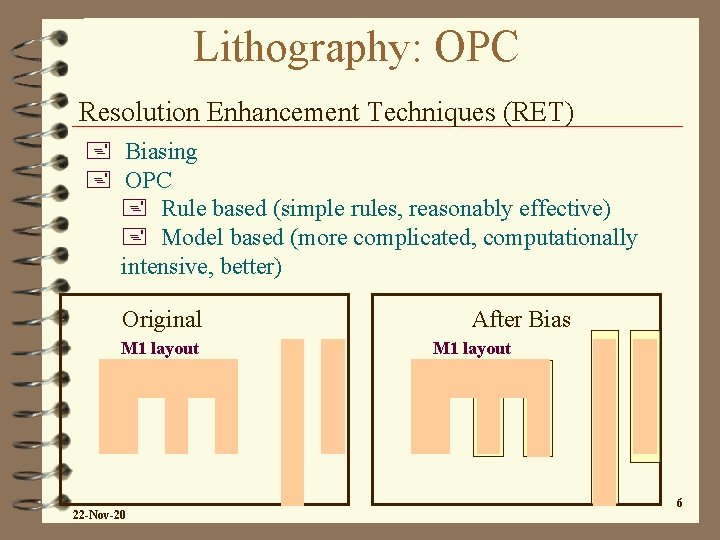
Lithography: OPC Resolution Enhancement Techniques (RET) + Biasing + OPC + Rule based (simple rules, reasonably effective) + Model based (more complicated, computationally intensive, better) Original M 1 layout 22 -Nov-20 After Bias M 1 layout 6
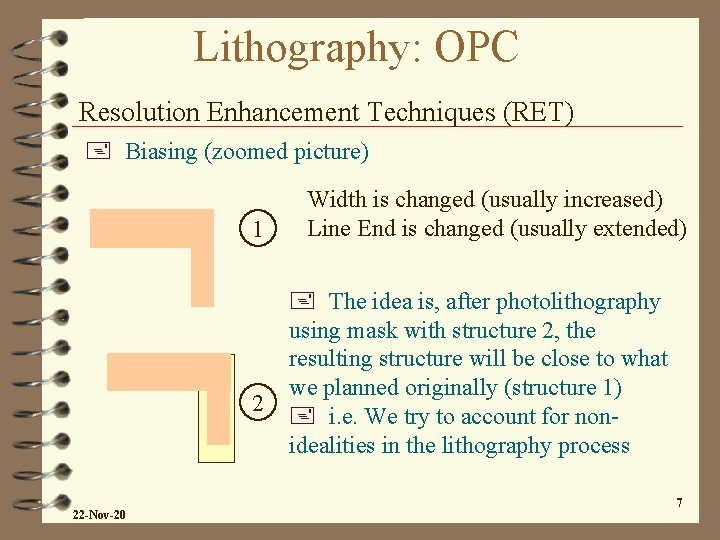
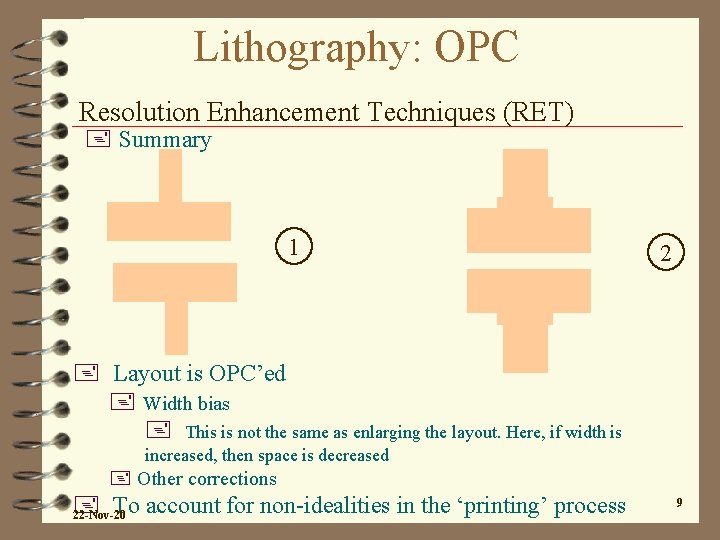
Lithography: OPC Resolution Enhancement Techniques (RET) + Biasing (zoomed picture) 1 2 22 -Nov-20 Width is changed (usually increased) Line End is changed (usually extended) + The idea is, after photolithography using mask with structure 2, the resulting structure will be close to what we planned originally (structure 1) + i. e. We try to account for nonidealities in the lithography process 7
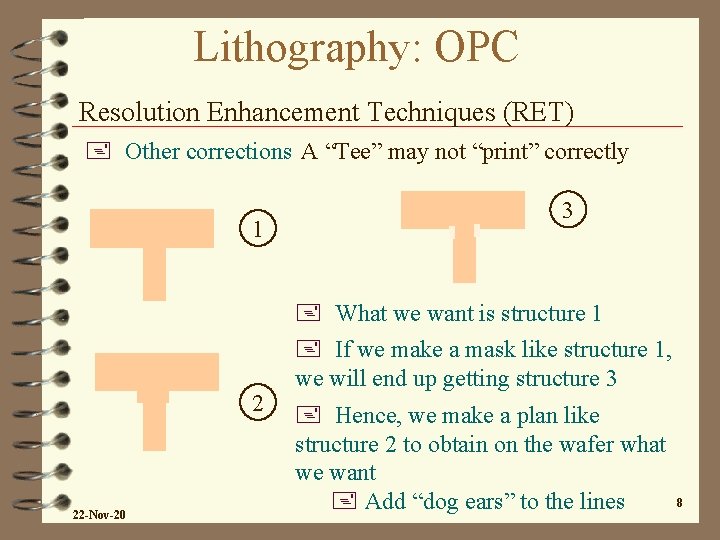
Lithography: OPC Resolution Enhancement Techniques (RET) + Other corrections A “Tee” may not “print” correctly 1 2 22 -Nov-20 3 + What we want is structure 1 + If we make a mask like structure 1, we will end up getting structure 3 + Hence, we make a plan like structure 2 to obtain on the wafer what we want + Add “dog ears” to the lines 8
Lithography: OPC Resolution Enhancement Techniques (RET) + Summary 1 2 + Layout is OPC’ed + Width bias + This is not the same as enlarging the layout. Here, if width is increased, then space is decreased + Other corrections + To account for non-idealities in the ‘printing’ process 22 -Nov-20 9
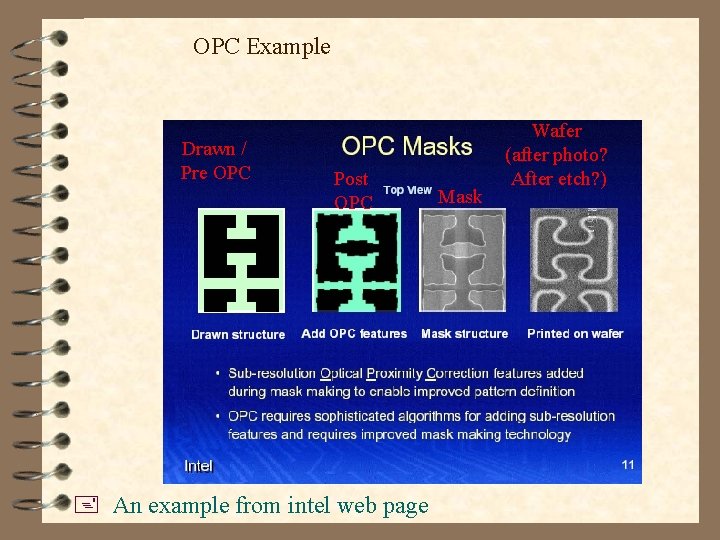
OPC Example Drawn / Pre OPC Post OPC + An example from intel web page Mask Wafer (after photo? After etch? )
OPC vs PPC + Other processes (like etch) also have ‘proximity’ effect + Presence or absence of neighbor will affect how a process behaves for a particular feature + Litho ‘neighborhood’ is about 1 um + Etch neighborhood is probably few microns + CMP neighborhood can be few mm (or many microns) + Correcting for optical (litho) and few other processes is called ‘Process proximity correction’ or PPC + Typically litho + etch corrections are used for PPC + CMP corrections are at a different (larger) scale. + Dummy features 22 -Nov-20 11
Lithography: ARC RET: Anti Reflective Coating + Reflection ==> Standing waves +ARC Animation 22 -Nov-20 12
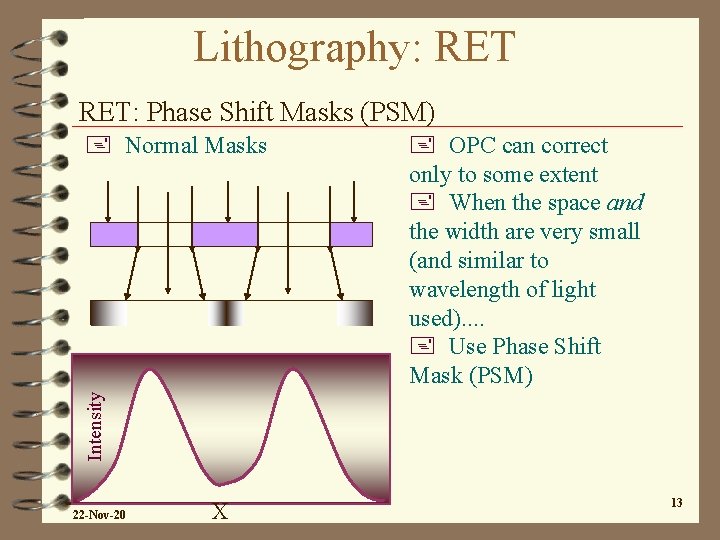
Lithography: RET: Phase Shift Masks (PSM) Amplitude Intensity + Normal Masks 22 -Nov-20 X + OPC can correct only to some extent + When the space and the width are very small (and similar to wavelength of light used). . + Use Phase Shift Mask (PSM) 13
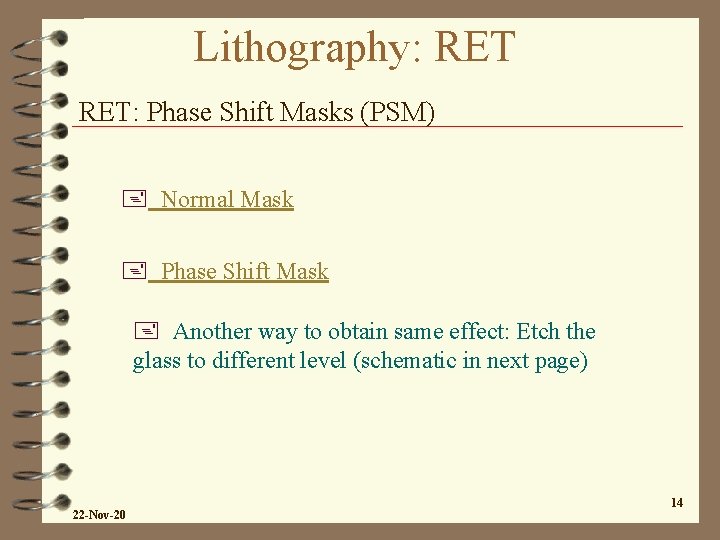
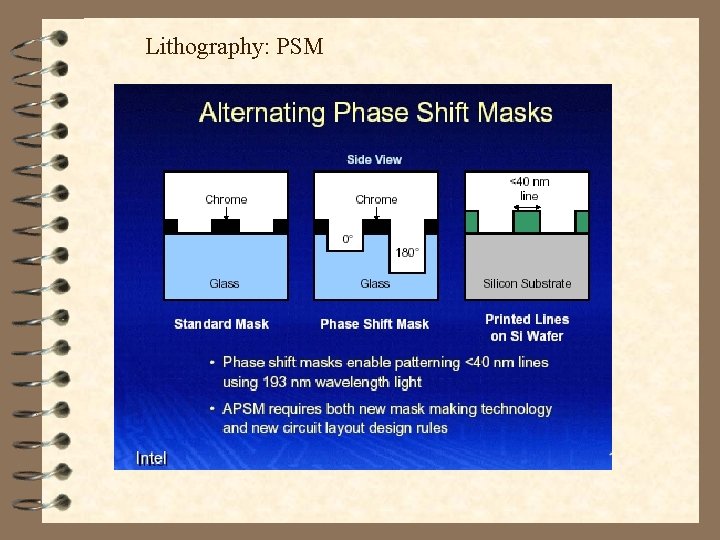
Lithography: RET: Phase Shift Masks (PSM) + Normal Mask + Phase Shift Mask + Another way to obtain same effect: Etch the glass to different level (schematic in next page) 22 -Nov-20 14
Lithography: PSM
Lithography: RET Review + Optical Proximity Correction + Changes in the layout, mask + Anti Reflective Coating + Change in the process + Phase Shift Mask + Change in the Mask +==> Original layout is first generated + Then modified (to indicate where the change of phase is appropriate) + Computer programs which generate the ‘aerial image’ are used to decide where phase shifting is needed 22 -Nov-20 16
Lithography: Production + Depth of Focus + Alignment + Partial Field/ Full Field 22 -Nov-20 17
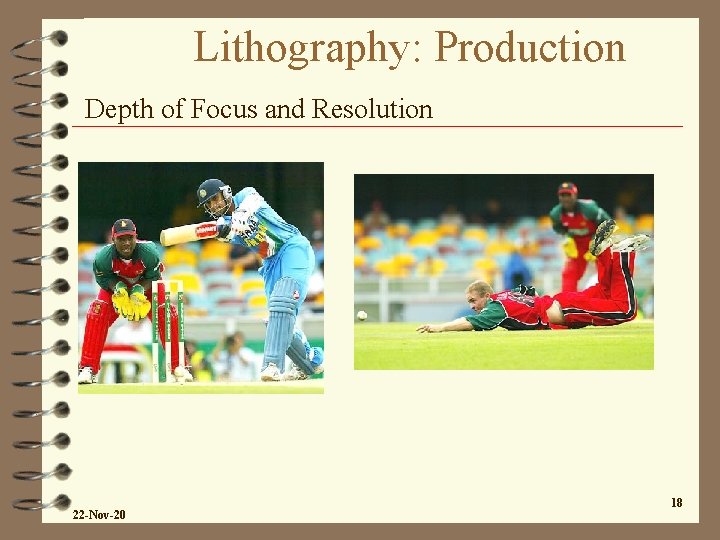
Lithography: Production Depth of Focus and Resolution 22 -Nov-20 18
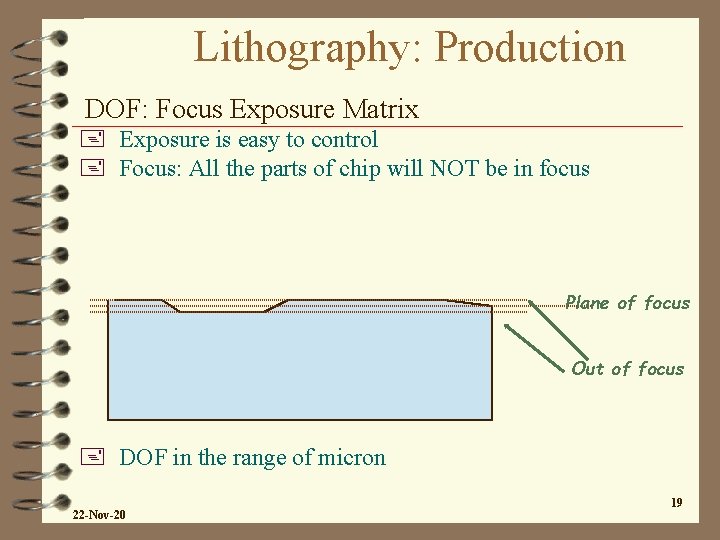
Lithography: Production DOF: Focus Exposure Matrix + Exposure is easy to control + Focus: All the parts of chip will NOT be in focus Plane of focus Out of focus + DOF in the range of micron 22 -Nov-20 19
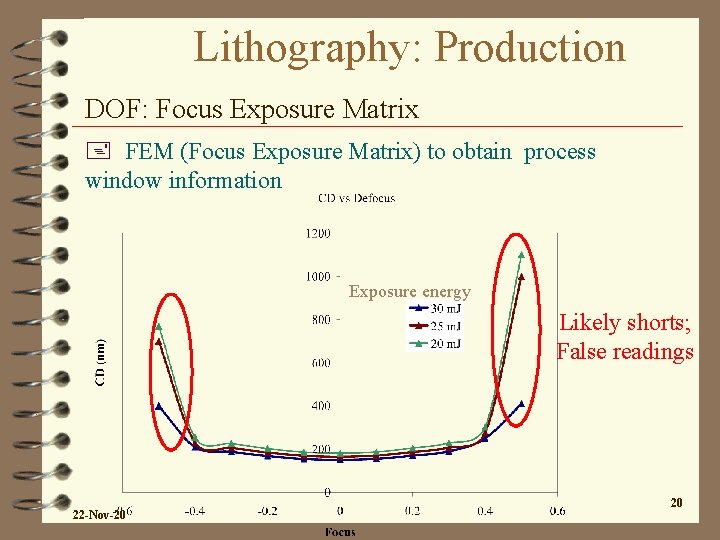
Lithography: Production DOF: Focus Exposure Matrix + FEM (Focus Exposure Matrix) to obtain process window information Exposure energy Likely shorts; False readings 22 -Nov-20 20
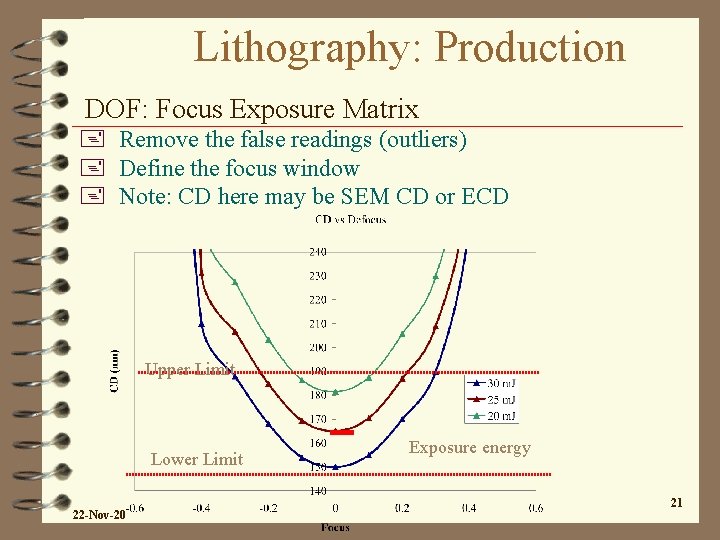
Lithography: Production DOF: Focus Exposure Matrix + Remove the false readings (outliers) + Define the focus window + Note: CD here may be SEM CD or ECD Upper Limit Lower Limit 22 -Nov-20 Exposure energy 21
Lithography: Production + Photo Margin + Depth of focus and exposure margins are very important, particularly in the BEOL + Very little topography in the FEOL ==> usually sufficient photo margin exits + Misalignment + How well can one align to the previous layer? + Should one align to the previous layer or to a standard layer? + Typically a tolerance in the range of +/- 60 nm 22 -Nov-20 22
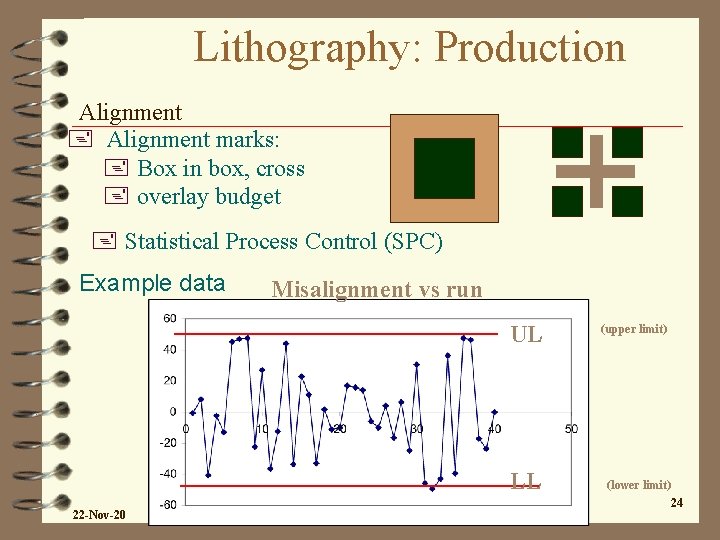
Lithography: Production Alignment + Statistical Process Control (SPC) + Misalignment measured for example, on 2 wafers in a set of 25 wafers (lot) + In each (of the two) wafers, it may be measured in 5 points (minimum) to perhaps 49 points + Average x misalignment for each wafer is plotted (and similarly y misalignment is plotted) + Each misalignment must be below the absolute spec limit. Average must also be below the upper and lower spec 22 -Nov-20 23
Lithography: Production Alignment + Alignment marks: + Box in box, cross + overlay budget + Statistical Process Control (SPC) Example data Misalignment vs run UL LL 22 -Nov-20 (upper limit) (lower limit) 24
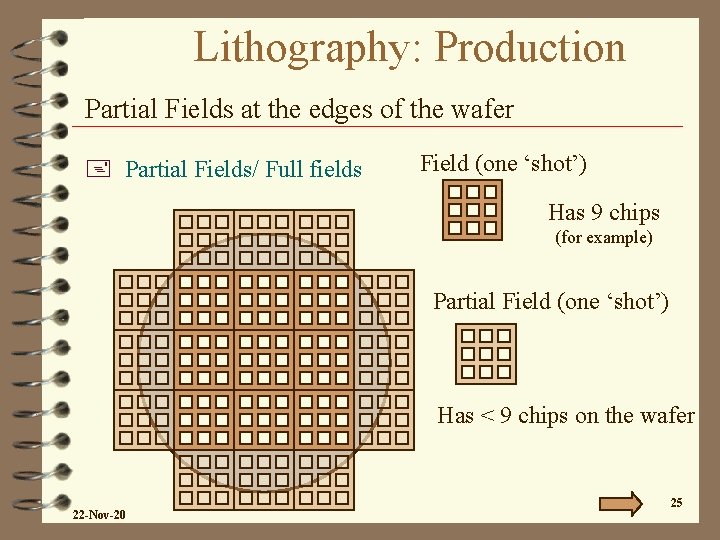
Lithography: Production Partial Fields at the edges of the wafer + Partial Fields/ Full fields Field (one ‘shot’) Has 9 chips (for example) Partial Field (one ‘shot’) Has < 9 chips on the wafer 22 -Nov-20 25
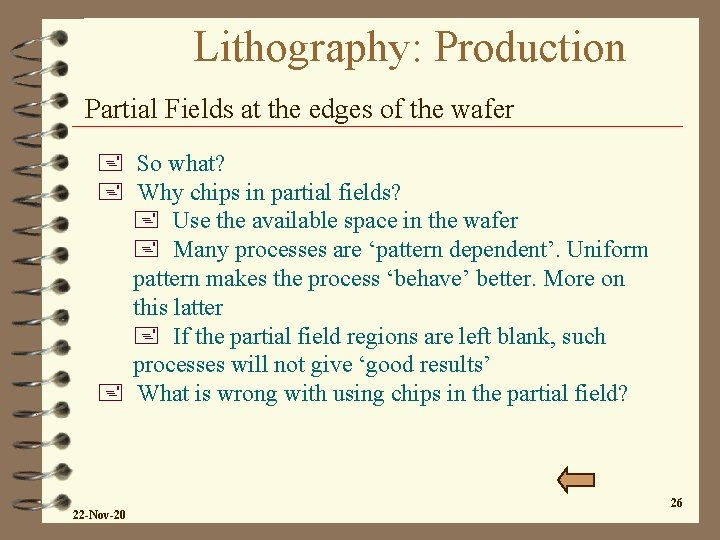
Lithography: Production Partial Fields at the edges of the wafer + So what? + Why chips in partial fields? + Use the available space in the wafer + Many processes are ‘pattern dependent’. Uniform pattern makes the process ‘behave’ better. More on this latter + If the partial field regions are left blank, such processes will not give ‘good results’ + What is wrong with using chips in the partial field? 22 -Nov-20 26
Lithography: Production Partial Fields at the edges of the wafer + Significant number of chips are in partial fields ( the example in previous page is an exaggeration though) + The chips cannot be just thrown away (working chip == money) + All the partial field chips are in the edge + Majority of processes have center/edge variations and usually the edge chips are affected (partial field and full filed edge chips) + Automatic Focus algorithms are not very effective for partial field + Some of the ‘locations’ in the mask, which are used for determining focus, may fall out of the wafer, in the partial fields + Hence Partial field chips fail more + One solution: Modify algorithm for determining focus at partial fields + Optimize chip placements + Edge exclusion (for many processes) 22 -Nov-20 27
Lithography: Production Review + Depth of Focus + Improved by CMP + Alignment marks + Partial Field/ Full Field + Tweak focus algorithms + Optimize the field locations to obtain maximum number of ‘good chips’ (which is not always the same as maximum number of chips possible) 22 -Nov-20 28
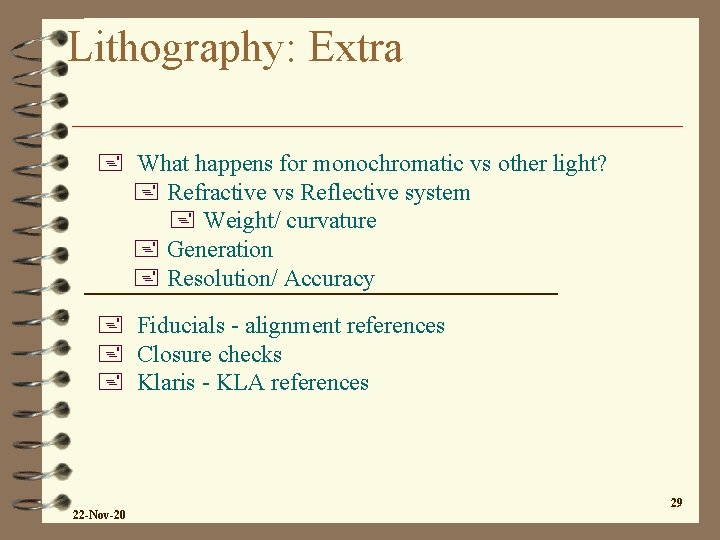
Lithography: Extra + What happens for monochromatic vs other light? + Refractive vs Reflective system + Weight/ curvature + Generation + Resolution/ Accuracy + Fiducials - alignment references + Closure checks + Klaris - KLA references 22 -Nov-20 29
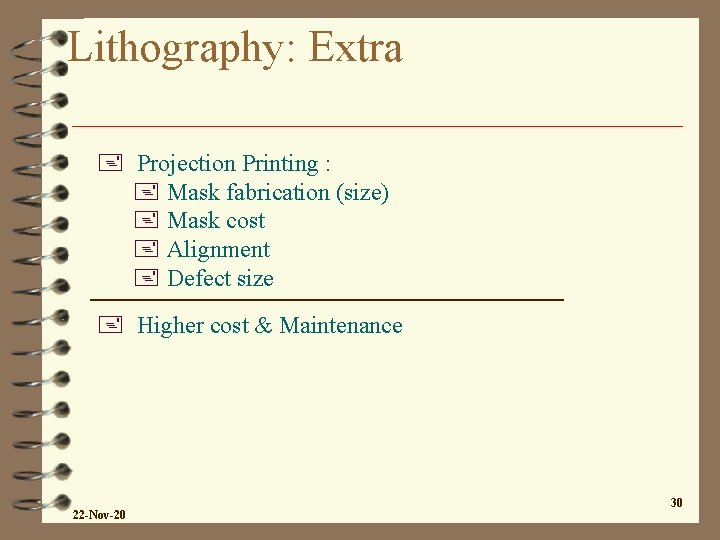
Lithography: Extra + Projection Printing : + Mask fabrication (size) + Mask cost + Alignment + Defect size + Higher cost & Maintenance 22 -Nov-20 30
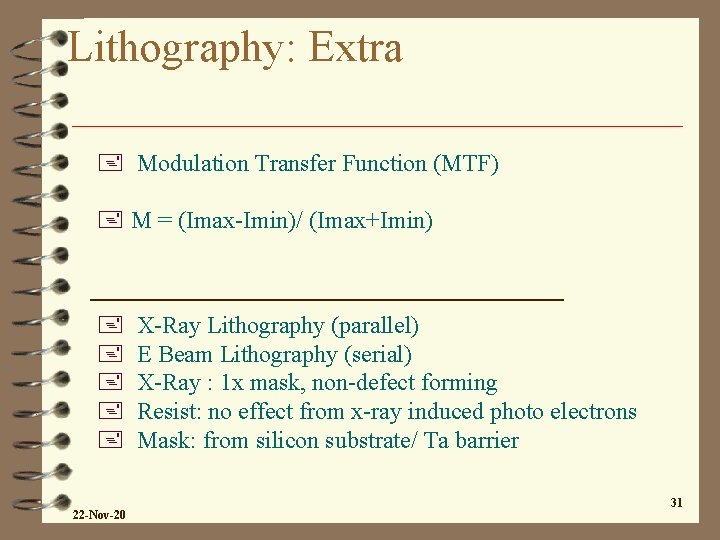
Lithography: Extra + Modulation Transfer Function (MTF) + M = (Imax-Imin)/ (Imax+Imin) + + + 22 -Nov-20 X-Ray Lithography (parallel) E Beam Lithography (serial) X-Ray : 1 x mask, non-defect forming Resist: no effect from x-ray induced photo electrons Mask: from silicon substrate/ Ta barrier 31