
Lithium Poisoning when is hemodialysis indicated Kent R
- Slides: 37
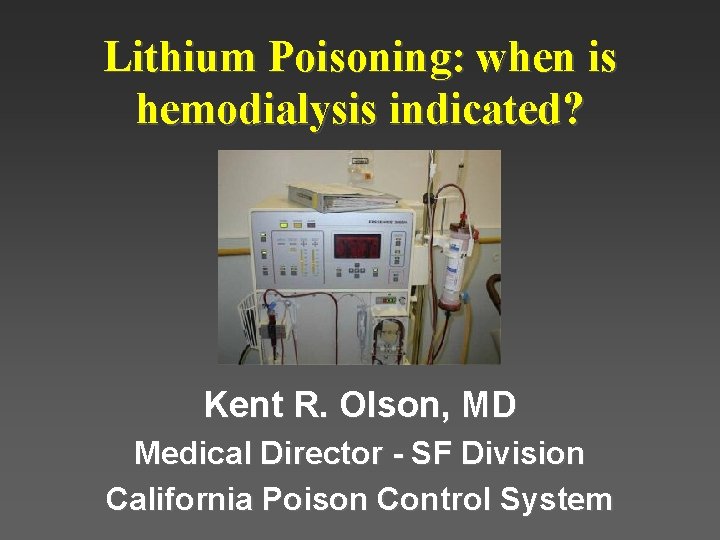
Lithium Poisoning: when is hemodialysis indicated? Kent R. Olson, MD Medical Director - SF Division California Poison Control System
Case • A 32 year old woman ingested 20 lithium carbonate 300 mg tablets in a suicide attempt • She is drowsy and her speech is slurred • Her serum Li = 6 m. Eq/L • Hemodialysis needed?
Lithium • • Alkali metal (like Na, K) Widely used for bipolar disorder Therapeutic range 0. 6 -1. 2 m. Eq/L Toxicity = mainly CNS – – – Tremor, slurred speech, muscle twitching Confusion, delirium, seizures, coma Recovery may take weeks • Toxicity may occur as a result of acute overdose or chronic use
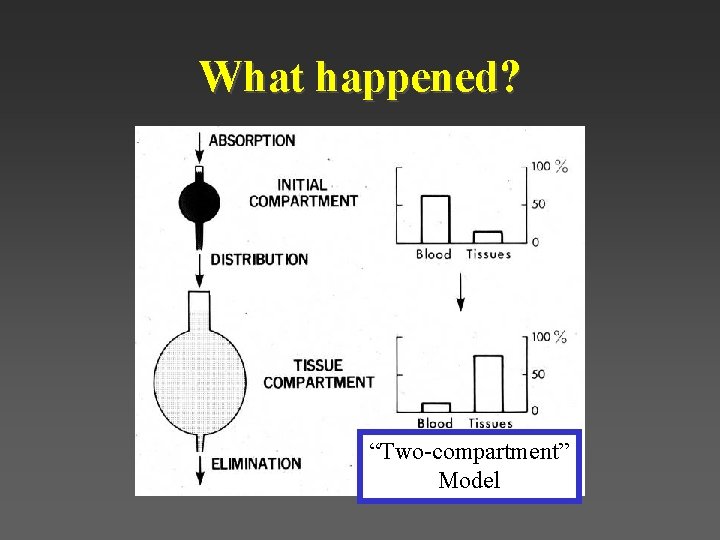
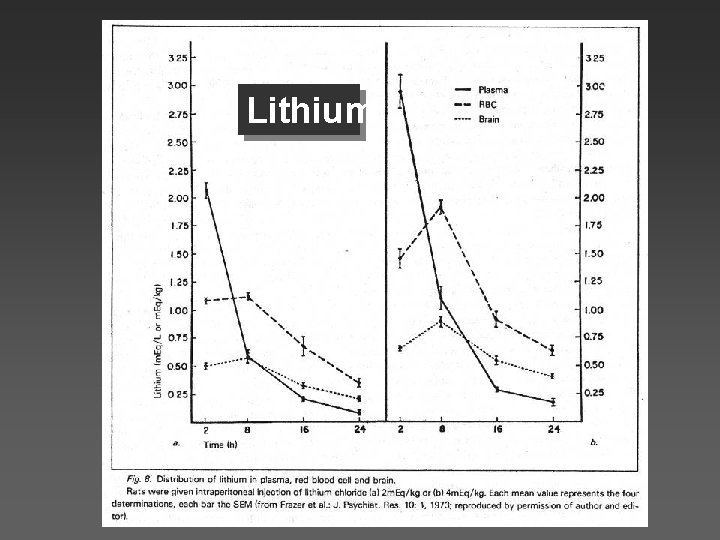
Pharmacokinetics • Completely absorbed orally – – – Volume of distribution approx 0. 8 L/kg Slow entry into CNS Initial serum levels do NOT reflect brain levels • Eliminated entirely by the kidneys – – – Half-life 14 -20 hours Prolonged in patients with renal insufficiency Promoting saline excretion hastens Li removal
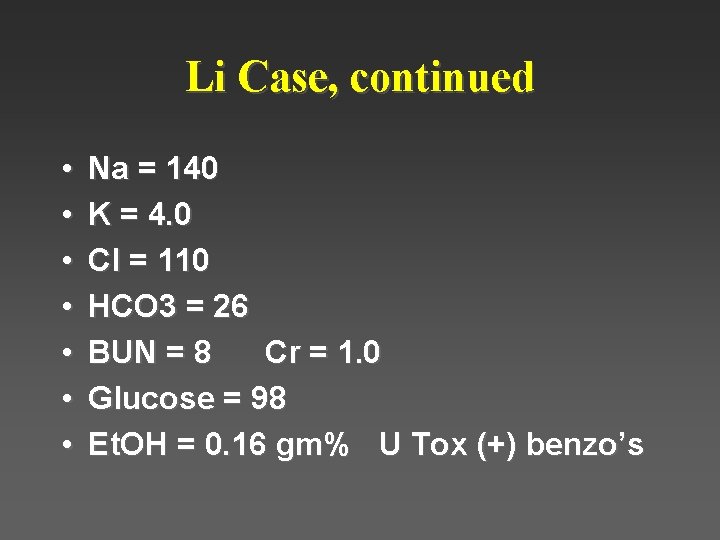
Li Case, continued • • Na = 140 K = 4. 0 Cl = 110 HCO 3 = 26 BUN = 8 Cr = 1. 0 Glucose = 98 Et. OH = 0. 16 gm% U Tox (+) benzo’s
Enhanced drug elimination: • Who needs it? • Will it work? • What’s the best technique?
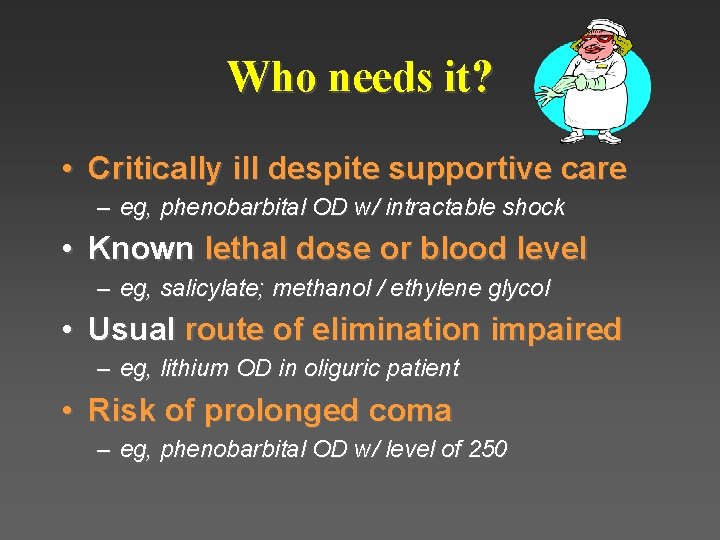
Who needs it? • Critically ill despite supportive care – eg, phenobarbital OD w/ intractable shock • Known lethal dose or blood level – eg, salicylate; methanol / ethylene glycol • Usual route of elimination impaired – eg, lithium OD in oliguric patient • Risk of prolonged coma – eg, phenobarbital OD w/ level of 250
Will it work? • Volume of distribution: – is the drug accessible? – how big a volume to clear? • Clearance (CL): – does the method efficiently cleanse the blood?
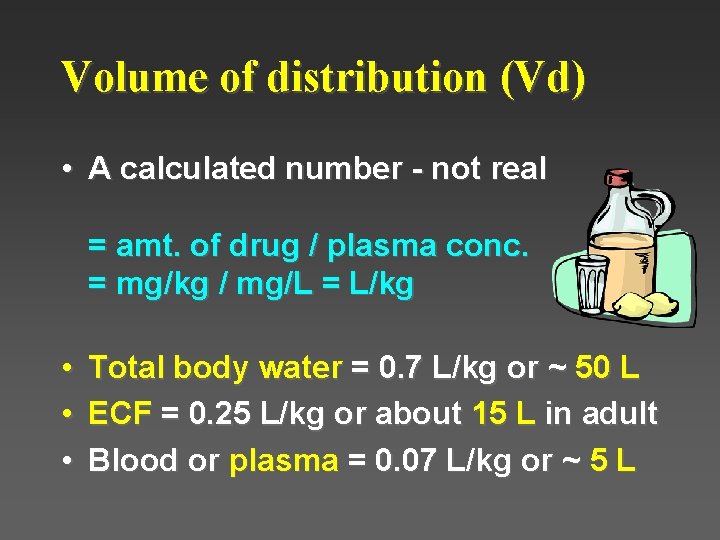
Volume of distribution (Vd) • A calculated number - not real = amt. of drug / plasma conc. = mg/kg / mg/L = L/kg • Total body water = 0. 7 L/kg or ~ 50 L • ECF = 0. 25 L/kg or about 15 L in adult • Blood or plasma = 0. 07 L/kg or ~ 5 L
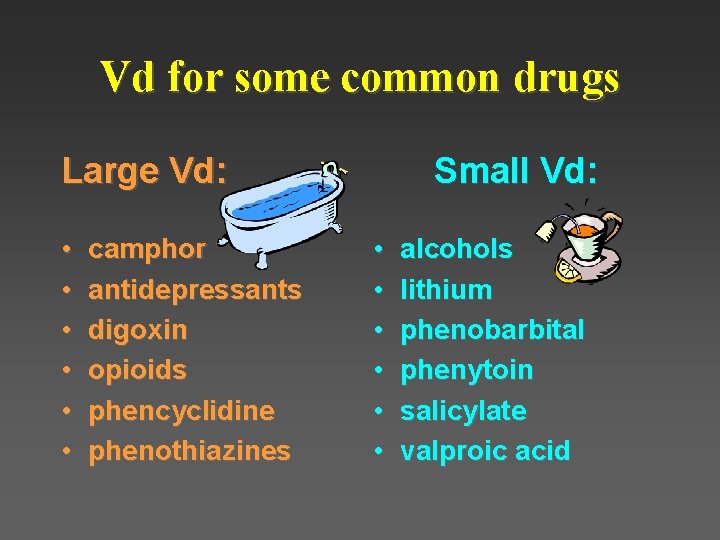
Vd for some common drugs Large Vd: • • • camphor antidepressants digoxin opioids phencyclidine phenothiazines Small Vd: • • • alcohols lithium phenobarbital phenytoin salicylate valproic acid
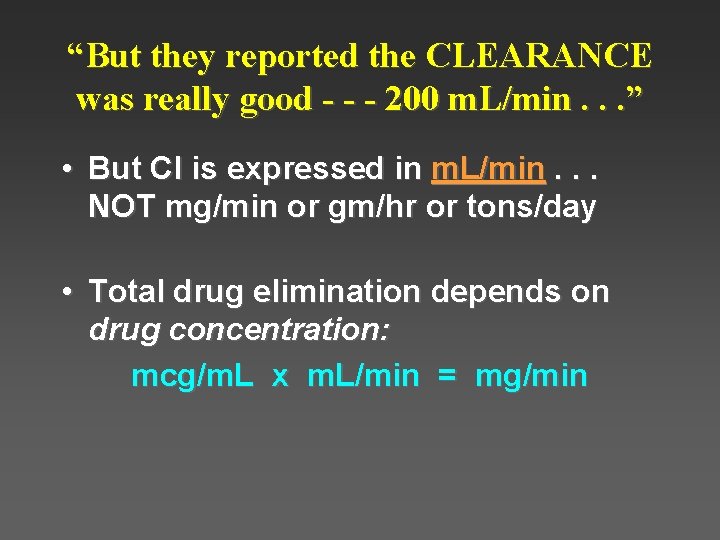
“But they reported the CLEARANCE was really good - - - 200 m. L/min. . . ” • But Cl is expressed in m. L/min. . . NOT mg/min or gm/hr or tons/day • Total drug elimination depends on drug concentration: mcg/m. L x m. L/min = mg/min
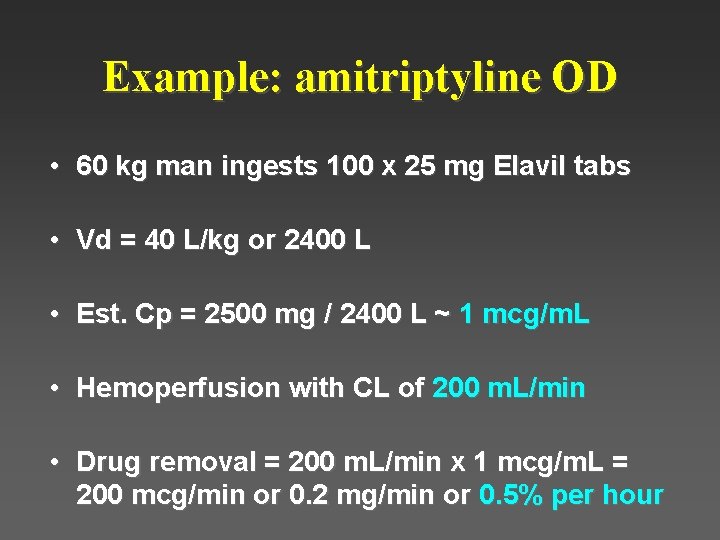
Example: amitriptyline OD • 60 kg man ingests 100 x 25 mg Elavil tabs • Vd = 40 L/kg or 2400 L • Est. Cp = 2500 mg / 2400 L ~ 1 mcg/m. L • Hemoperfusion with CL of 200 m. L/min • Drug removal = 200 m. L/min x 1 mcg/m. L = 200 mcg/min or 0. 2 mg/min or 0. 5% per hour
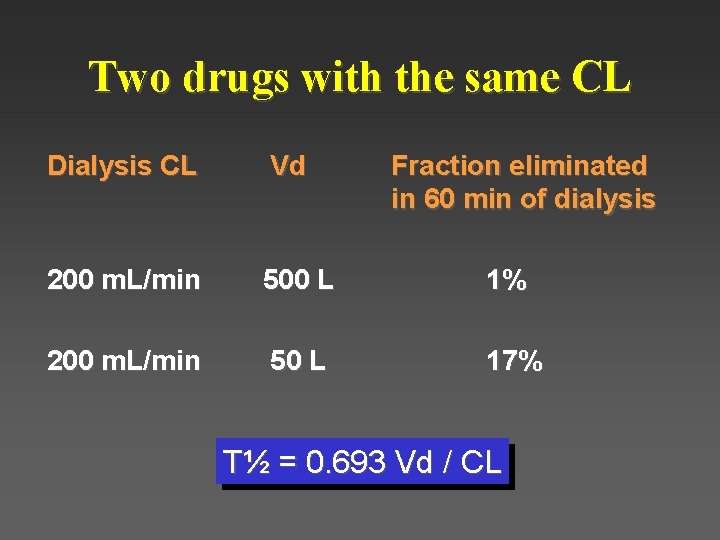
Two drugs with the same CL Dialysis CL Vd Fraction eliminated in 60 min of dialysis 200 m. L/min 500 L 1% 200 m. L/min 50 L 17% T½ = 0. 693 Vd / CL
Which method? • • • Urinary p. H manipulation Peritoneal dialysis Hemoperfusion Multiple dose activated charcoal Continuous hemofiltration
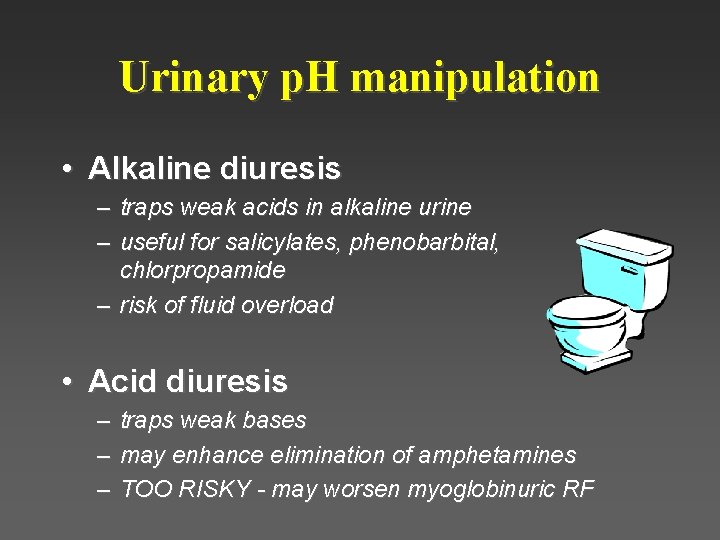
Urinary p. H manipulation • Alkaline diuresis – traps weak acids in alkaline urine – useful for salicylates, phenobarbital, chlorpropamide – risk of fluid overload • Acid diuresis – traps weak bases – may enhance elimination of amphetamines – TOO RISKY - may worsen myoglobinuric RF
Peritoneal dialysis • Theoretically useful if drug is: – – water soluble small (MW <500) not highly protein bound not so bad you don’t mind waiting. . . TOO SLOW • Rarely performed unless it’s the only available method
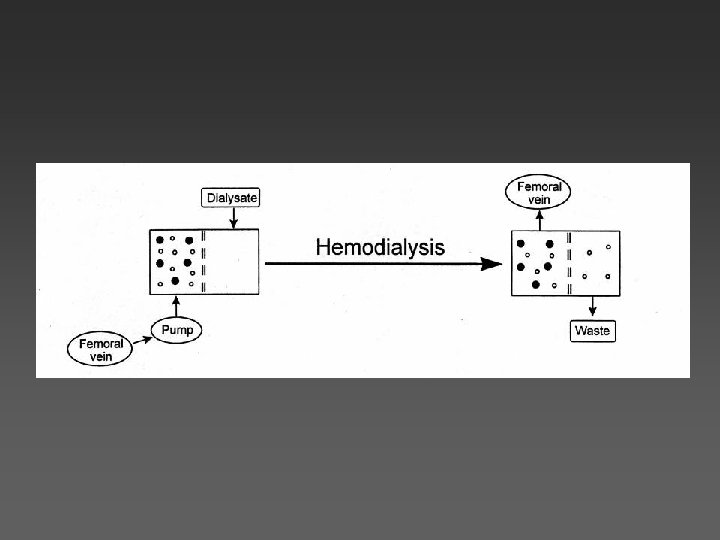
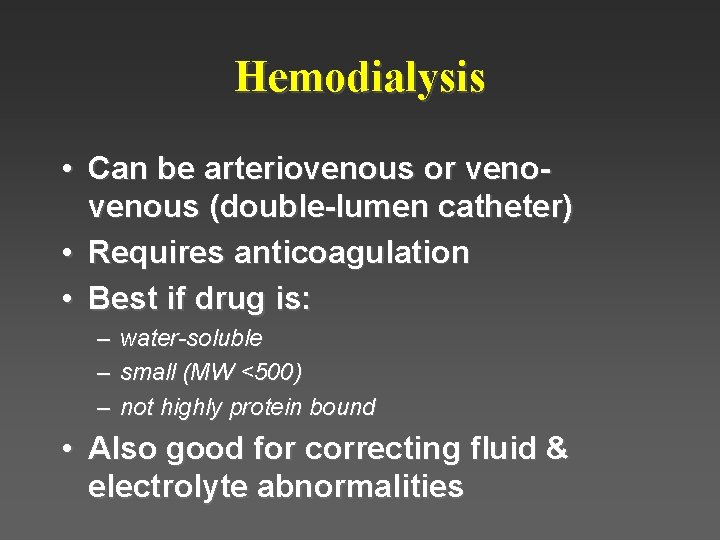
Hemodialysis • Can be arteriovenous or venous (double-lumen catheter) • Requires anticoagulation • Best if drug is: – water-soluble – small (MW <500) – not highly protein bound • Also good for correcting fluid & electrolyte abnormalities
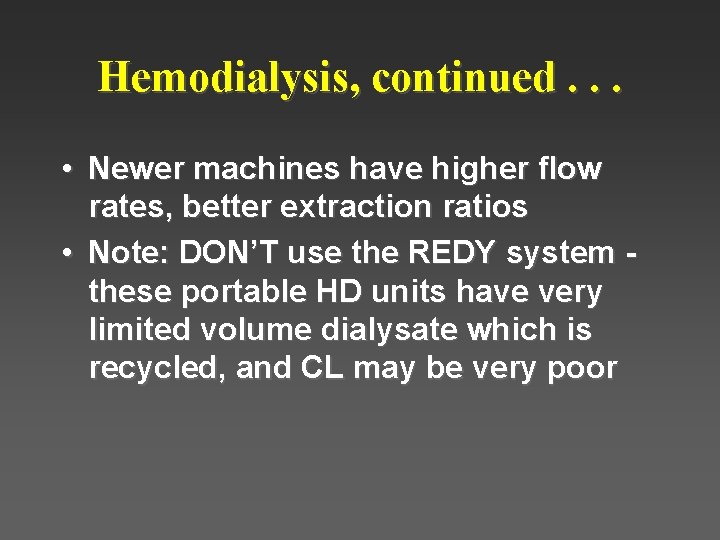
Hemodialysis, continued. . . • Newer machines have higher flow rates, better extraction ratios • Note: DON’T use the REDY system these portable HD units have very limited volume dialysate which is recycled, and CL may be very poor
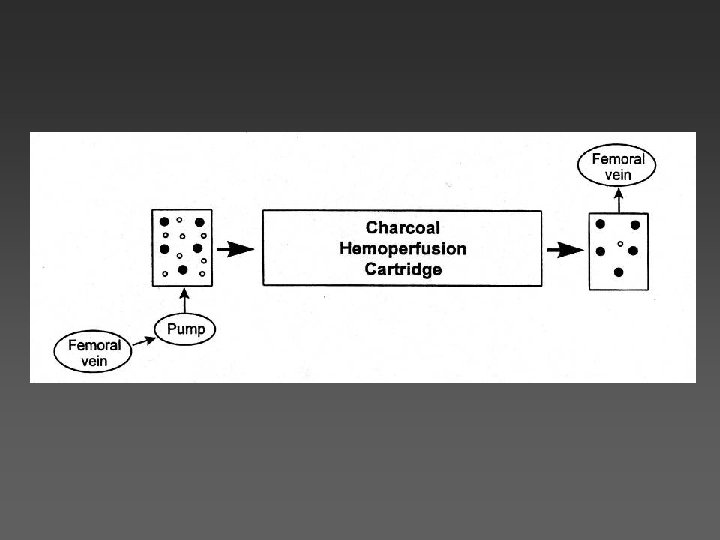
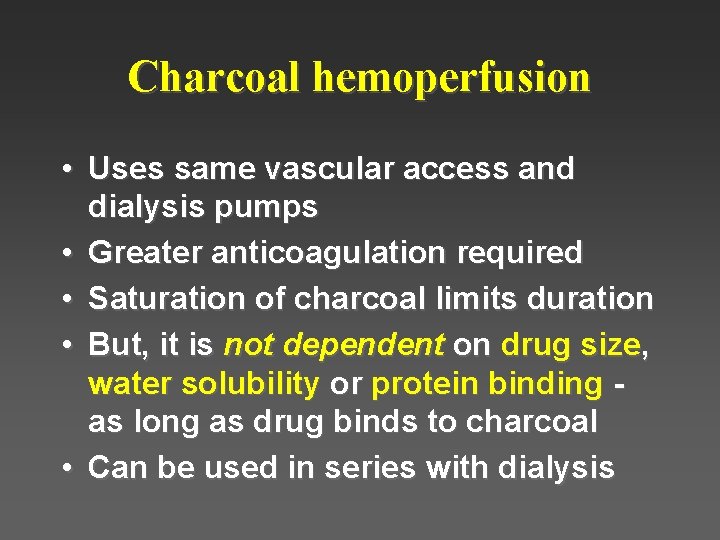
Charcoal hemoperfusion • Uses same vascular access and dialysis pumps • Greater anticoagulation required • Saturation of charcoal limits duration • But, it is not dependent on drug size, water solubility or protein binding as long as drug binds to charcoal • Can be used in series with dialysis
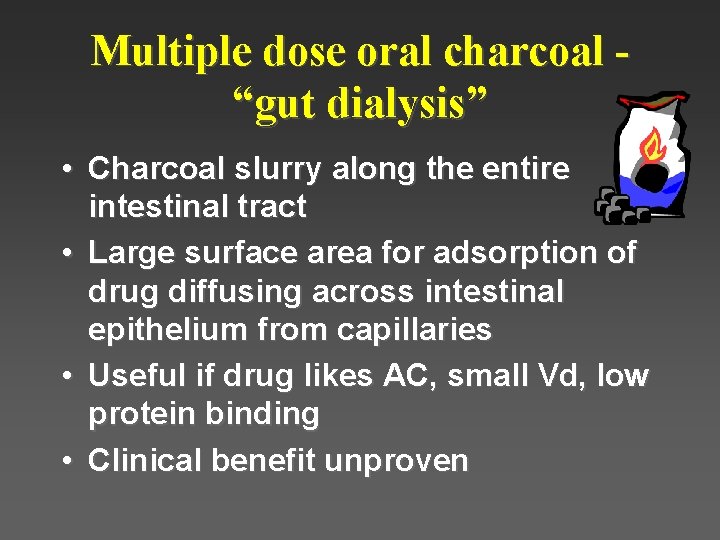
Multiple dose oral charcoal “gut dialysis” • Charcoal slurry along the entire intestinal tract • Large surface area for adsorption of drug diffusing across intestinal epithelium from capillaries • Useful if drug likes AC, small Vd, low protein binding • Clinical benefit unproven
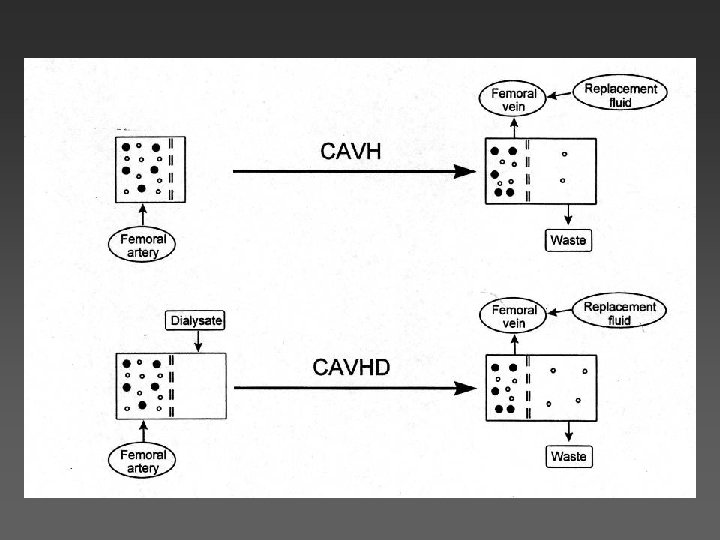
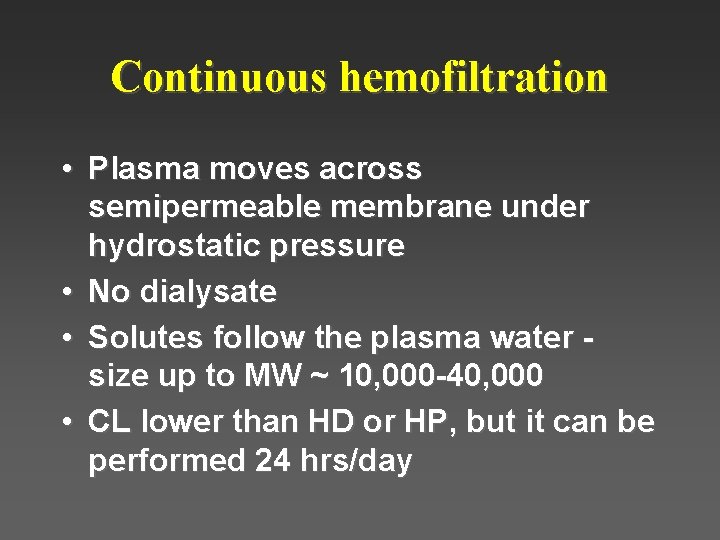
Continuous hemofiltration • Plasma moves across semipermeable membrane under hydrostatic pressure • No dialysate • Solutes follow the plasma water size up to MW ~ 10, 000 -40, 000 • CL lower than HD or HP, but it can be performed 24 hrs/day
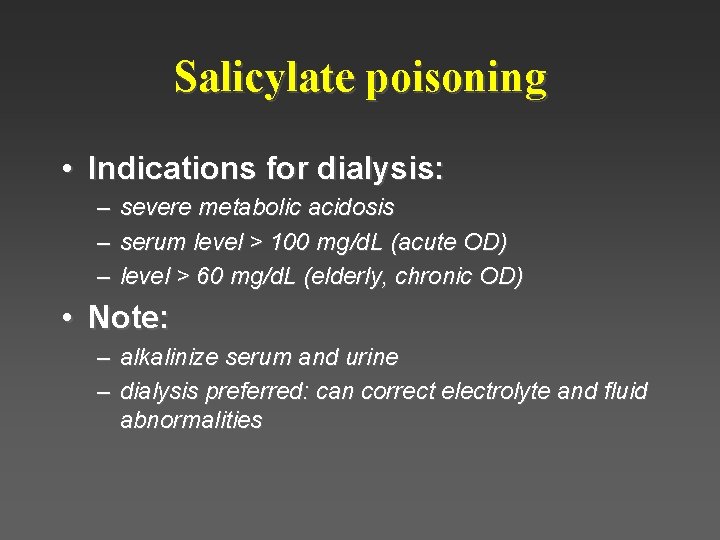
Salicylate poisoning • Indications for dialysis: – – – severe metabolic acidosis serum level > 100 mg/d. L (acute OD) level > 60 mg/d. L (elderly, chronic OD) • Note: – alkalinize serum and urine – dialysis preferred: can correct electrolyte and fluid abnormalities
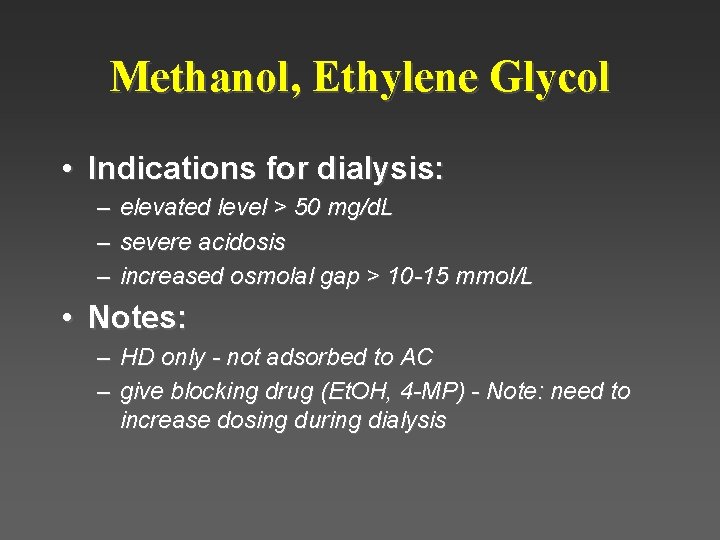
Methanol, Ethylene Glycol • Indications for dialysis: – – – elevated level > 50 mg/d. L severe acidosis increased osmolal gap > 10 -15 mmol/L • Notes: – HD only - not adsorbed to AC – give blocking drug (Et. OH, 4 -MP) - Note: need to increase dosing during dialysis
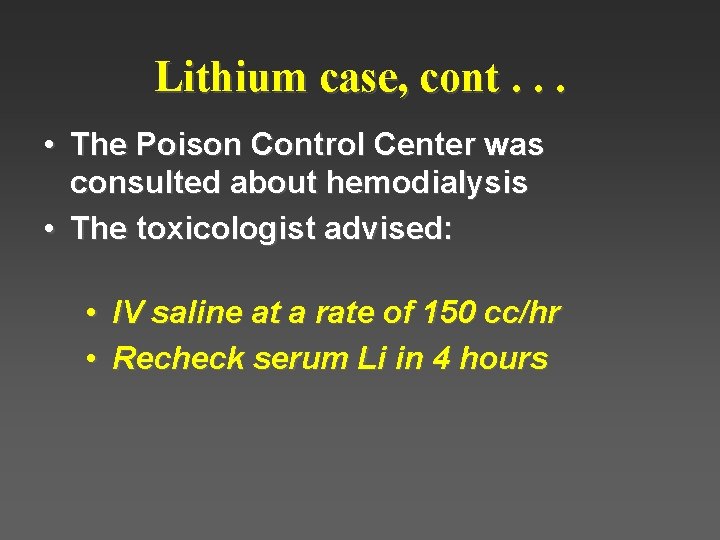
Lithium case, cont. . . • The Poison Control Center was consulted about hemodialysis • The toxicologist advised: • IV saline at a rate of 150 cc/hr • Recheck serum Li in 4 hours
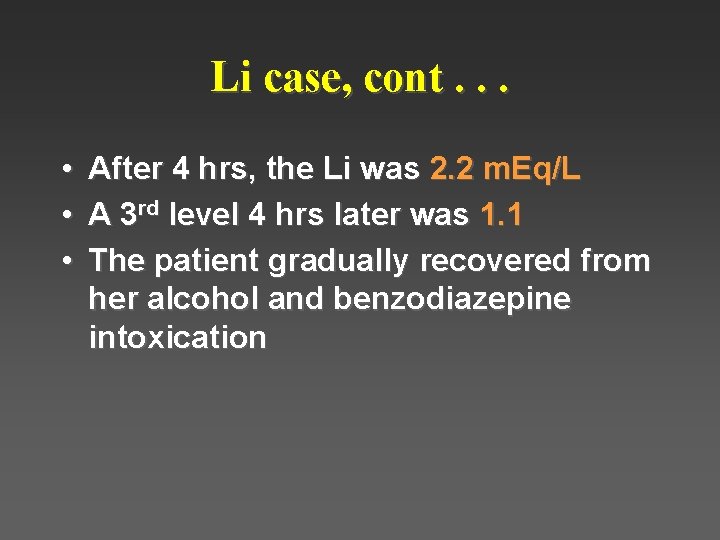
Li case, cont. . . • • • After 4 hrs, the Li was 2. 2 m. Eq/L A 3 rd level 4 hrs later was 1. 1 The patient gradually recovered from her alcohol and benzodiazepine intoxication
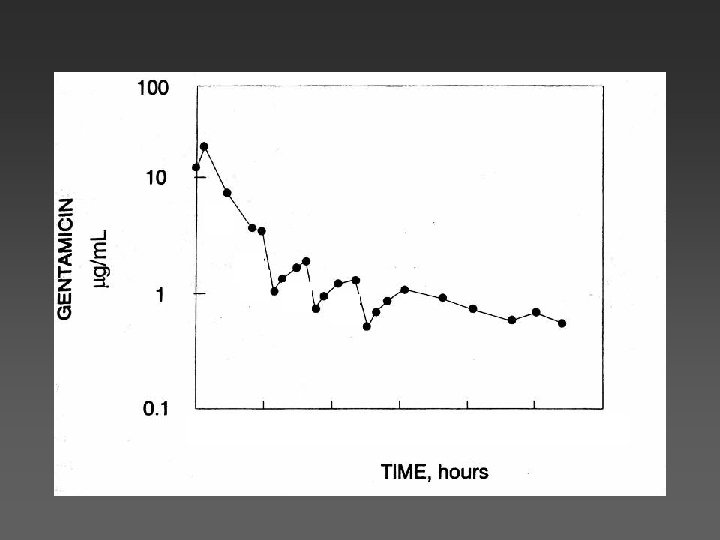
What happened? “Two-compartment” Model
Lithium
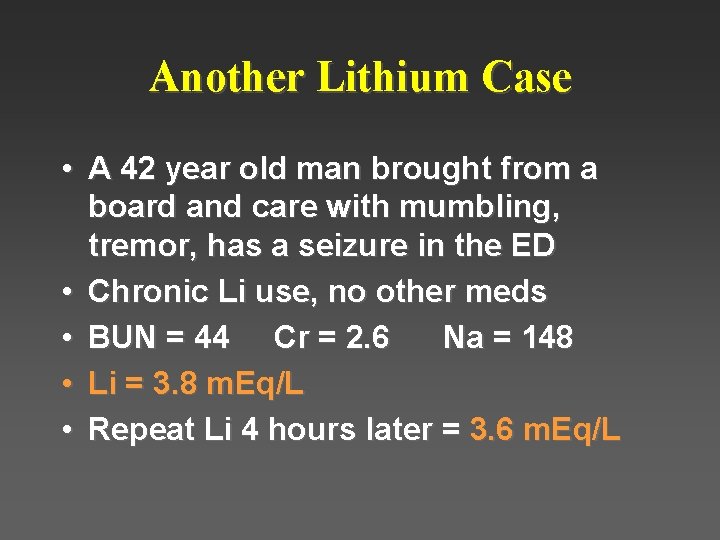
Another Lithium Case • A 42 year old man brought from a board and care with mumbling, tremor, has a seizure in the ED • Chronic Li use, no other meds • BUN = 44 Cr = 2. 6 Na = 148 • Li = 3. 8 m. Eq/L • Repeat Li 4 hours later = 3. 6 m. Eq/L
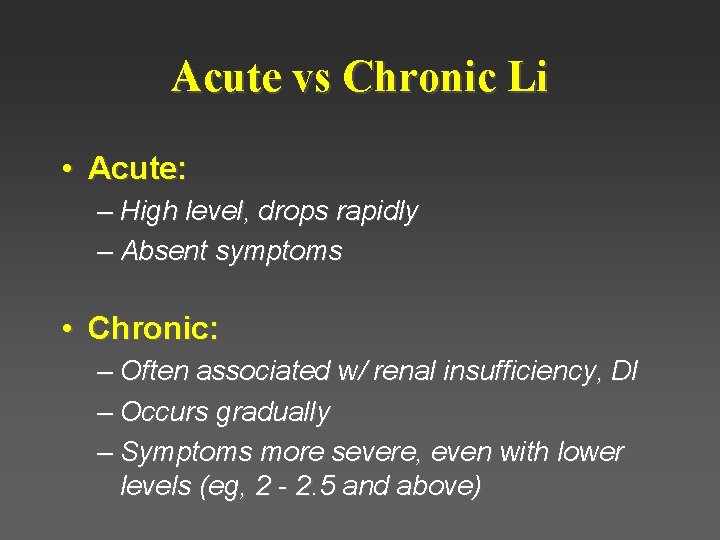
Acute vs Chronic Li • Acute: – High level, drops rapidly – Absent symptoms • Chronic: – Often associated w/ renal insufficiency, DI – Occurs gradually – Symptoms more severe, even with lower levels (eg, 2 - 2. 5 and above)
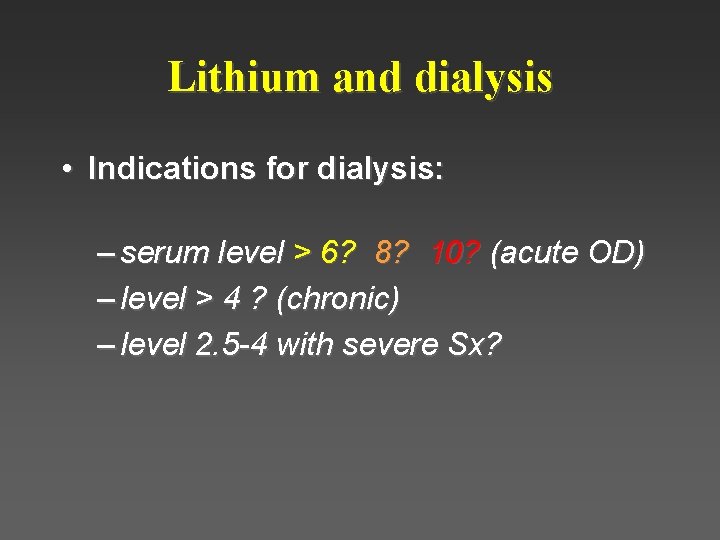
Lithium and dialysis • Indications for dialysis: – serum level > 6? 8? 10? (acute OD) – level > 4 ? (chronic) – level 2. 5 -4 with severe Sx?
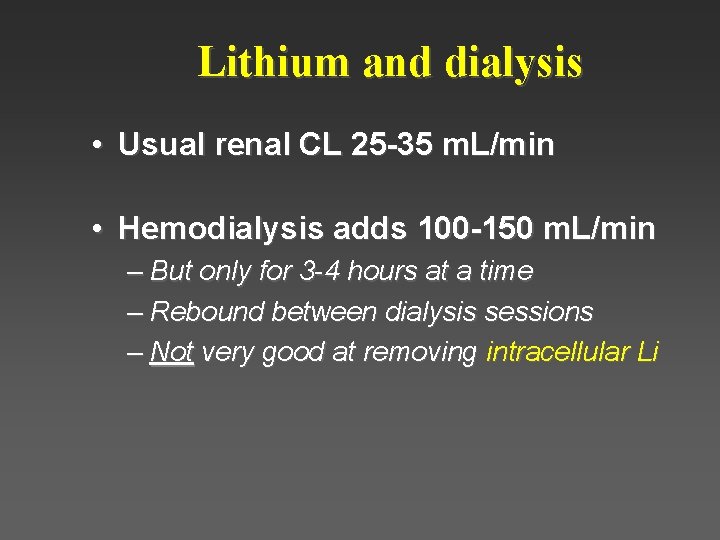
Lithium and dialysis • Usual renal CL 25 -35 m. L/min • Hemodialysis adds 100 -150 m. L/min – But only for 3 -4 hours at a time – Rebound between dialysis sessions – Not very good at removing intracellular Li
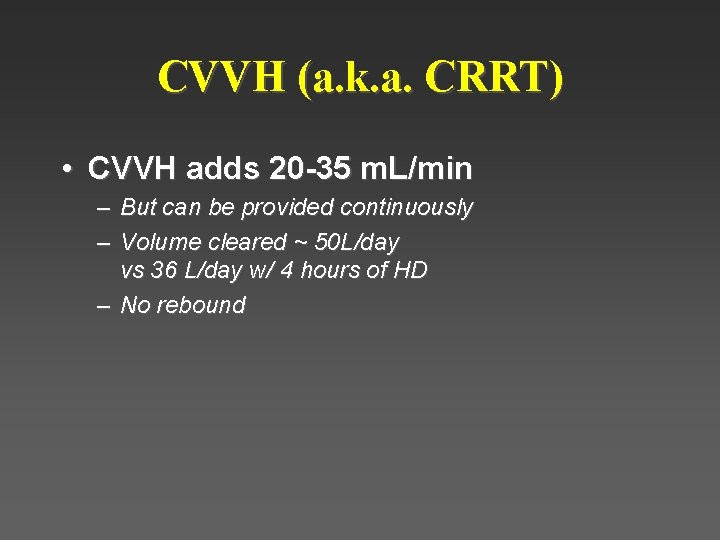
CVVH (a. k. a. CRRT) • CVVH adds 20 -35 m. L/min – But can be provided continuously – Volume cleared ~ 50 L/day vs 36 L/day w/ 4 hours of HD – No rebound
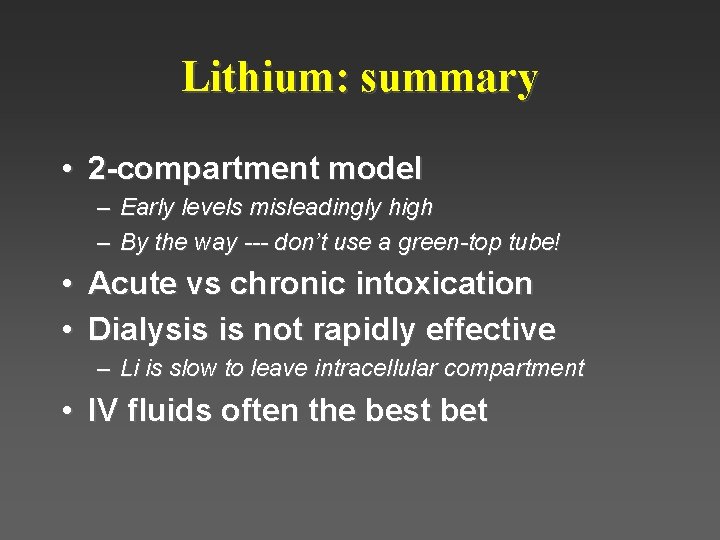
Lithium: summary • 2 -compartment model – Early levels misleadingly high – By the way --- don’t use a green-top tube! • Acute vs chronic intoxication • Dialysis is not rapidly effective – Li is slow to leave intracellular compartment • IV fluids often the best bet