
Lithium Metal Battery Cells Risks and Hazards Li
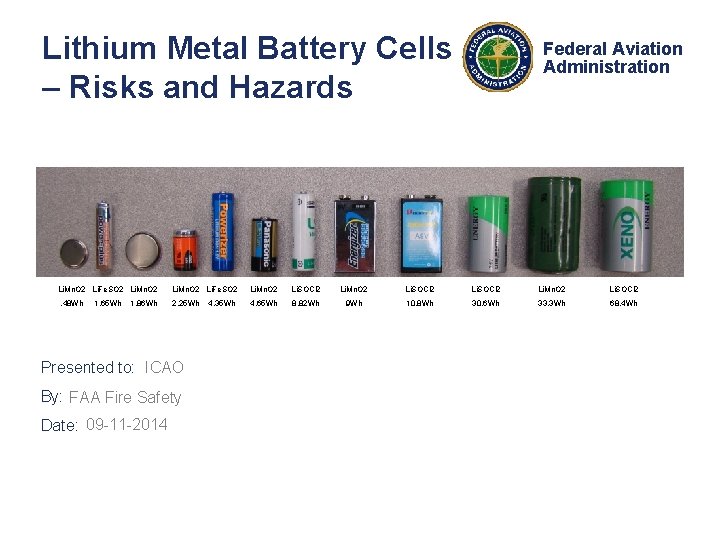
Lithium Metal Battery Cells – Risks and Hazards Li. Mn. O 2 Li. Fe. SO 2 Li. Mn. O 2. 48 Wh 1. 65 Wh 1. 86 Wh Li. Mn. O 2 Li. Fe. SO 2 Li. Mn. O 2 Li. SOCl 2 2. 25 Wh 4. 65 Wh 8. 82 Wh 9 Wh 10. 8 Wh 30. 6 Wh 33. 3 Wh 68. 4 Wh Presented to: ICAO By: FAA Fire Safety Date: 09 -11 -2014 Federal Aviation Administration 4. 35 Wh
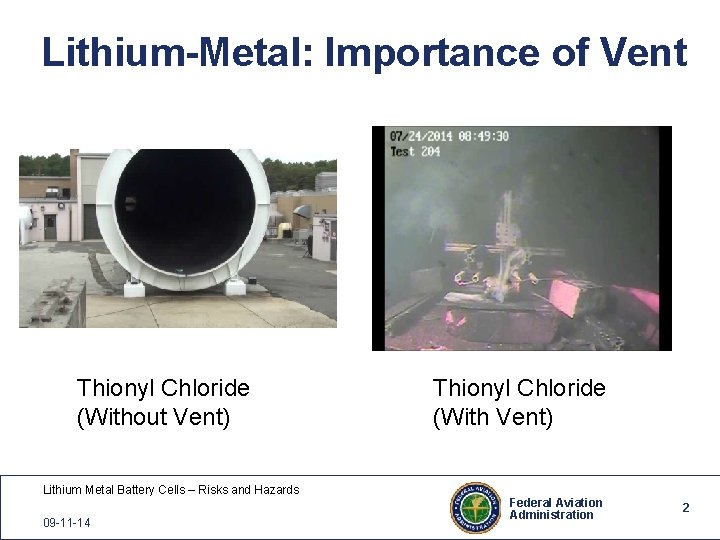
Lithium-Metal: Importance of Vent Thionyl Chloride (Without Vent) Lithium Metal Battery Cells – Risks and Hazards 09 -11 -14 Thionyl Chloride (With Vent) Federal Aviation Administration 2 2
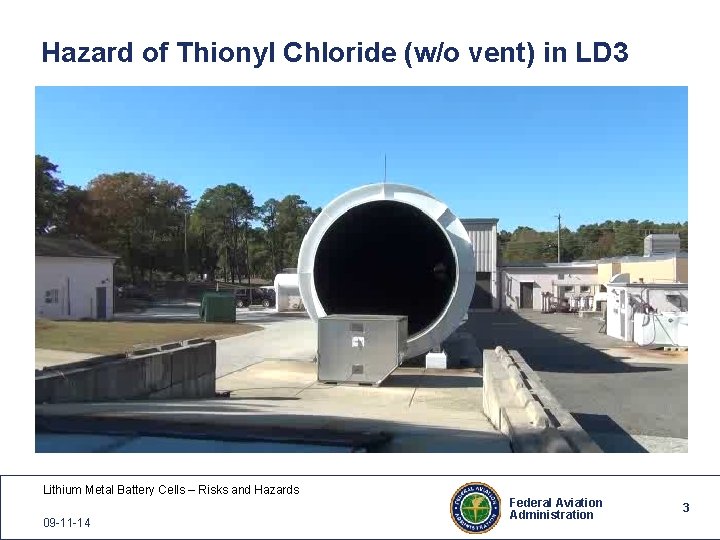
Hazard of Thionyl Chloride (w/o vent) in LD 3 Lithium Metal Battery Cells – Risks and Hazards 09 -11 -14 Federal Aviation Administration 3 3
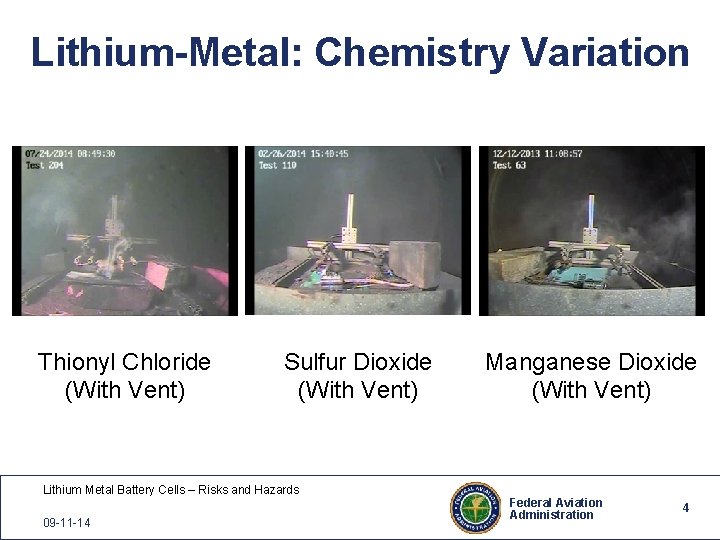
Lithium-Metal: Chemistry Variation Thionyl Chloride (With Vent) Sulfur Dioxide (With Vent) Lithium Metal Battery Cells – Risks and Hazards 09 -11 -14 Manganese Dioxide (With Vent) Federal Aviation Administration 4 4
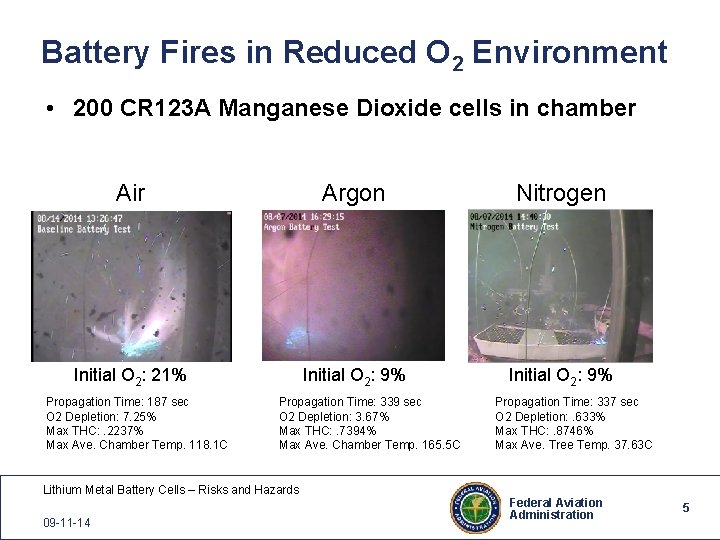
Battery Fires in Reduced O 2 Environment • 200 CR 123 A Manganese Dioxide cells in chamber Air Argon Nitrogen Initial O 2: 21% Initial O 2: 9% Propagation Time: 187 sec O 2 Depletion: 7. 25% Max THC: . 2237% Max Ave. Chamber Temp. 118. 1 C Propagation Time: 339 sec O 2 Depletion: 3. 67% Max THC: . 7394% Max Ave. Chamber Temp. 165. 5 C Lithium Metal Battery Cells – Risks and Hazards 09 -11 -14 Propagation Time: 337 sec O 2 Depletion: . 633% Max THC: . 8746% Max Ave. Tree Temp. 37. 63 C Federal Aviation Administration 5 5
Summary • Cells without adequate vents can explode. • Heat release, propagation and flammability vary among different chemistries of Lithium. Metal cells. • Propagation of cells is slowed by oxygen depletion with either Argon or Nitrogen • Argon was insufficient to fully prevent the battery fire however. Lithium Metal Battery Cells – Risks and Hazards 09 -11 -14 Federal Aviation Administration 6 6
- Slides: 6