
LITERATURE SURVEY Dr Hema N What Why Where





- Slides: 17
LITERATURE SURVEY Dr. Hema. N.
Ø What Ø ? Why? Ø Where?
Introduction Any research normally requires the use of a wide variety of printed literature and electronic sources. The proliferation of medical websites is good news for the researcher. It is fortunate that the internet provides free access to a great deal of the medical literature, either in full text or abstract format. The process of retrieving the information needed for research can be quite complex but adopting a methodical , structured approach removes much of the difficulty.
What is literature searching? A systematic search of the various formal and informal publications used to disseminate academic research in order to find items relevant to the area of interest. An effective literature search will establish that no one else has already undertaken the piece of research that has been intended to undertake. It also helps to find any existing research that already been done in related areas. Reading previous research will enable to acquire a broad understanding of your topic, to determine what are the key issues and to put your own area of interest into context.
Why search the literature? � To find information for essay, assignment, report, book, presentation etc. � To keep up to date. � For professional development. � To do evidence – based practice. � To find out information on specific conditions. � To find outcome measures in a particular area to use in clinical practice. � To find out if others are doing similar research to yourself or to find an expert in a particular field. � To conduct research.
Sources of information � � Books- are a useful source to start looking for information, but not the up to date source of information. Library is the key place to start looking for books. Journals – another key source where the majority of published information appears today and where the most recent material appears. Grey literature – defined as semi published materials, like reports, internal documents, theses etc. not formally published or available commercially and consequently difficult to trace bibliographically. Electronic databases – vast amount of health science information available in electronic databases, they are published online. There are different electronic databases available in the world today, including bibliographic databases, full text databases, statistical databases, image databases and others.
Different Databases � CD-ROM � Cochrane Databases- CDs , VCDs Library � Pub. Med Central � Proquest � DELNET Medical Library Online
Different Databases � Free medical journals � Directory � Medline of Open Access Journals Plus � Ind. MED � World Health Organization � Bio. Med central
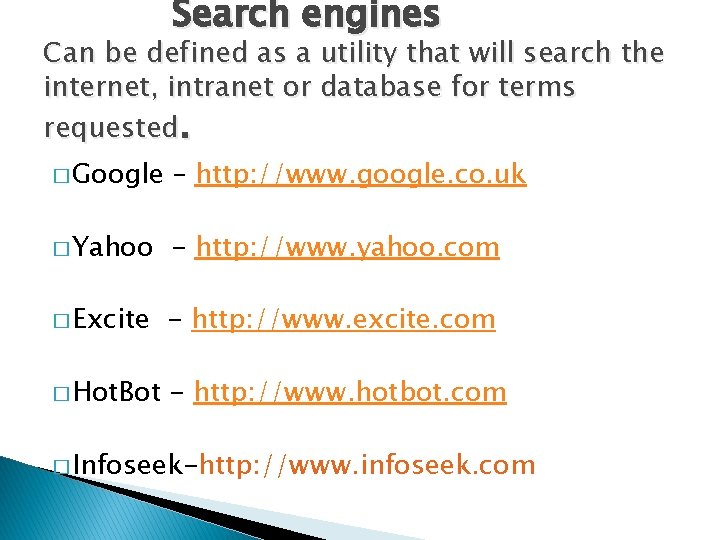
Search engines Can be defined as a utility that will search the internet, intranet or database for terms requested. � Google – http: //www. google. co. uk � Yahoo - http: //www. yahoo. com � Excite - http: //www. excite. com � Hot. Bot - http: //www. hotbot. com � Infoseek-http: //www. infoseek. com
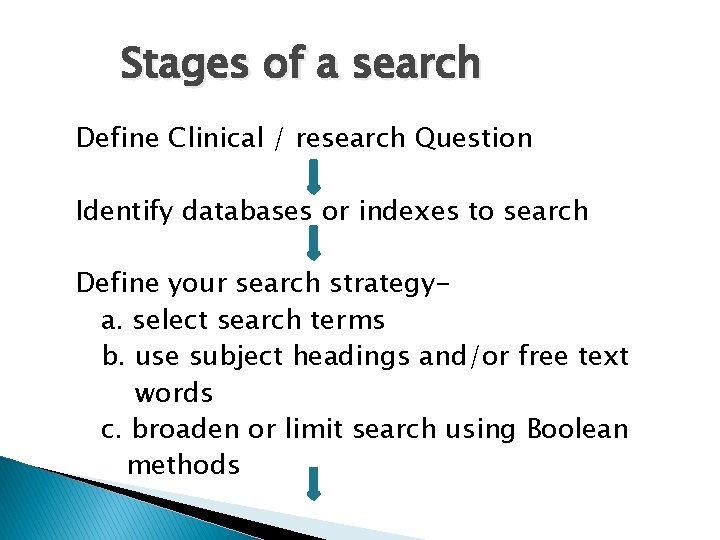
Stages of a search Define Clinical / research Question Identify databases or indexes to search Define your search strategya. select search terms b. use subject headings and/or free text words c. broaden or limit search using Boolean methods
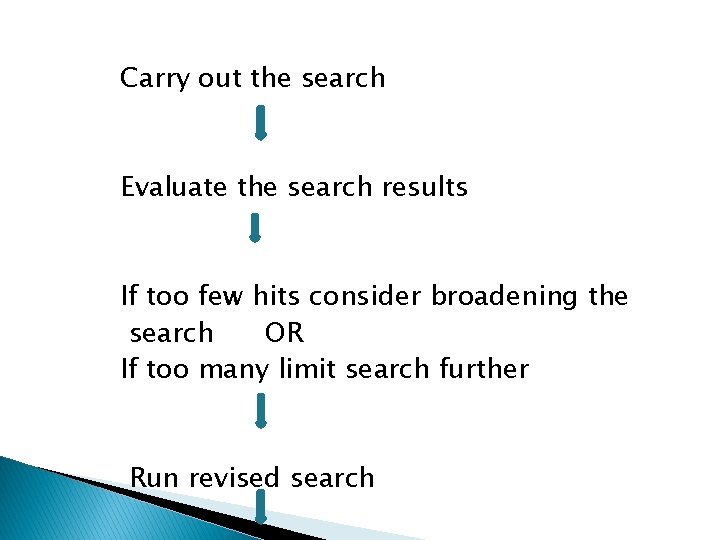
Carry out the search Evaluate the search results If too few hits consider broadening the search OR If too many limit search further Run revised search
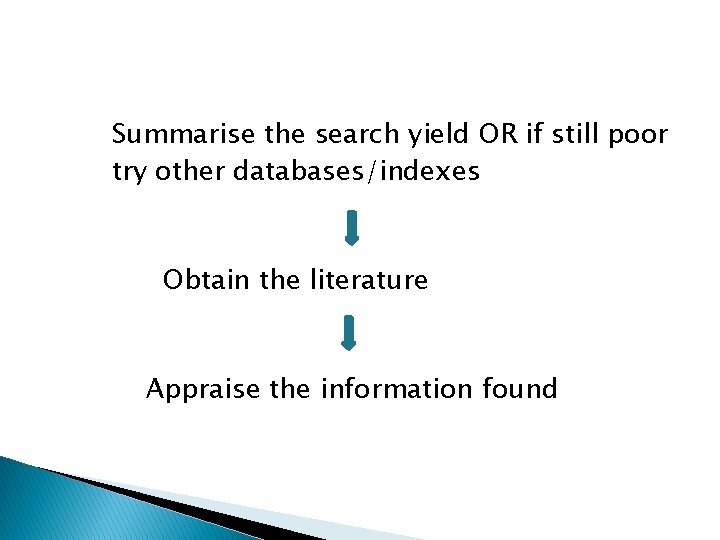
Summarise the search yield OR if still poor try other databases/indexes Obtain the literature Appraise the information found
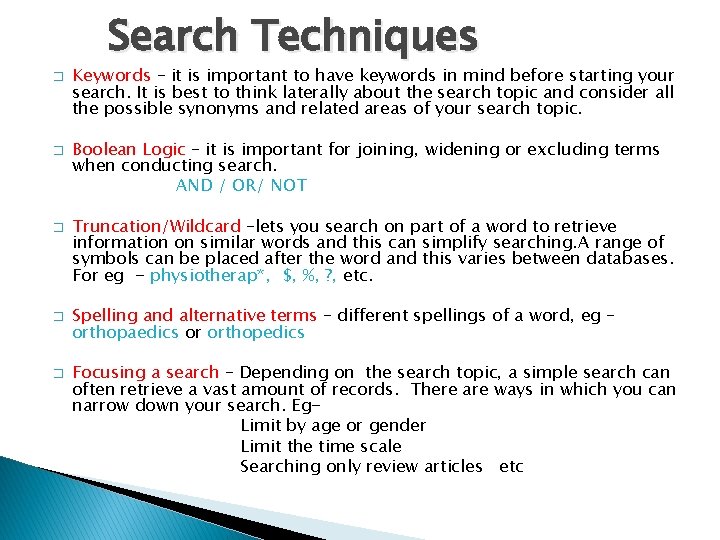
Search Techniques � � � Keywords – it is important to have keywords in mind before starting your search. It is best to think laterally about the search topic and consider all the possible synonyms and related areas of your search topic. Boolean Logic – it is important for joining, widening or excluding terms when conducting search. AND / OR/ NOT Truncation/Wildcard –lets you search on part of a word to retrieve information on similar words and this can simplify searching. A range of symbols can be placed after the word and this varies between databases. For eg - physiotherap*, $, %, ? , etc. Spelling and alternative terms – different spellings of a word, eg – orthopaedics or orthopedics Focusing a search – Depending on the search topic, a simple search can often retrieve a vast amount of records. There are ways in which you can narrow down your search. Eg. Limit by age or gender Limit the time scale Searching only review articles etc
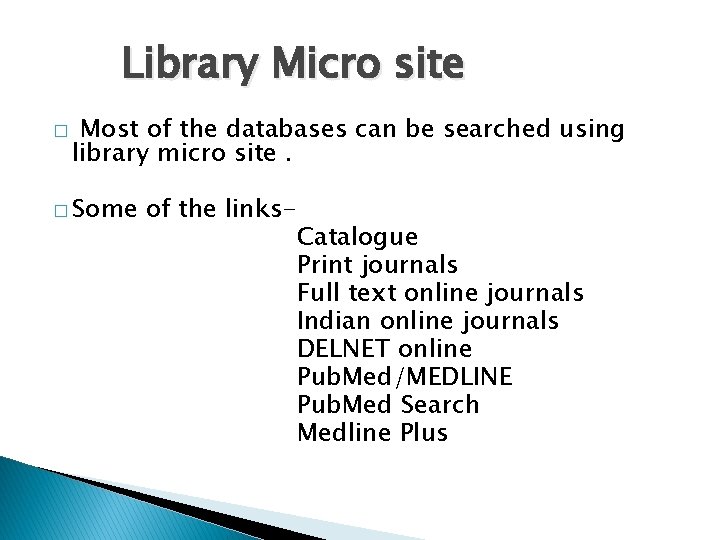
Library Micro site � Most of the databases can be searched using library micro site. � Some of the links. Catalogue Print journals Full text online journals Indian online journals DELNET online Pub. Med/MEDLINE Pub. Med Search Medline Plus
� Health Sciences libraries � Health Sciences publishers � Indian Medical Ethics � Online Resumes � Clinical � World trials Health Organization
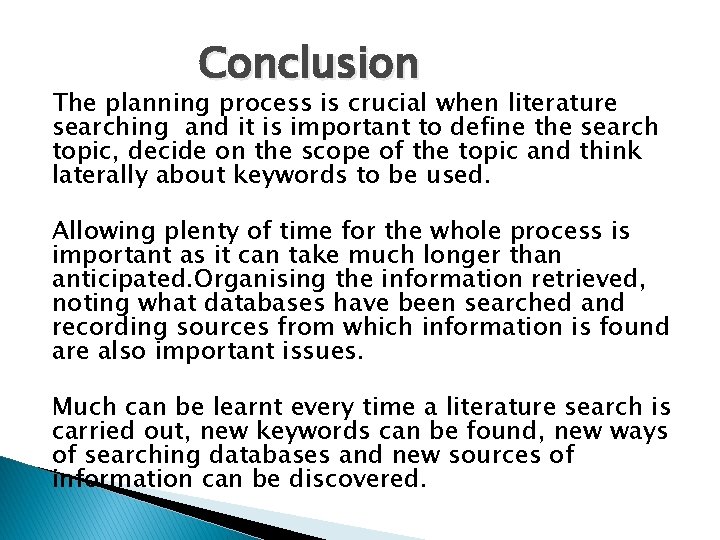
Conclusion The planning process is crucial when literature searching and it is important to define the search topic, decide on the scope of the topic and think laterally about keywords to be used. Allowing plenty of time for the whole process is important as it can take much longer than anticipated. Organising the information retrieved, noting what databases have been searched and recording sources from which information is found are also important issues. Much can be learnt every time a literature search is carried out, new keywords can be found, new ways of searching databases and new sources of information can be discovered.
Thank you