
LITERATURE REVIEWS BEST PRACTICES AND APPLICATION TO AOPS

LITERATURE REVIEWS BEST PRACTICES AND APPLICATION TO AOPS
KNOWLEDGE SYNTHESIS CIHR defines synthesis as • 'the contextualization and integration of research findings of individual research studies within the larger body of knowledge on the topic. • A synthesis must be reproducible and transparent in its methods, using quantitative and/or qualitative methods. ’ • Examples • Systematic review • Scoping review • Rapid review Grimshaw J. A KNOWLEDGE SYNTHESIS CHAPTER. 2010: 1– 56. http: //cihr-irsc. gc. ca/e/41382. html
REVIEW TYPES • Systematic review • A systematic review attempts to identify, appraise and synthesize all the empirical evidence that meets prespecified eligibility criteria to answer a specific research question. Researchers conducting systematic reviews use explicit, systematic methods that are selected with a view aimed at minimizing bias, to produce more reliable findings to inform decision making. https: //www. cochranelibrary. com/about-cochrane-reviews
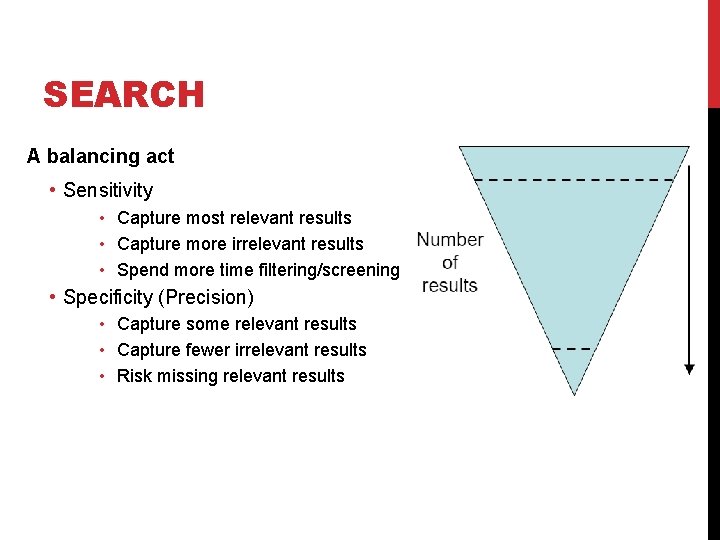
SEARCH A balancing act • Sensitivity • Capture most relevant results • Capture more irrelevant results • Spend more time filtering/screening • Specificity (Precision) • Capture some relevant results • Capture fewer irrelevant results • Risk missing relevant results
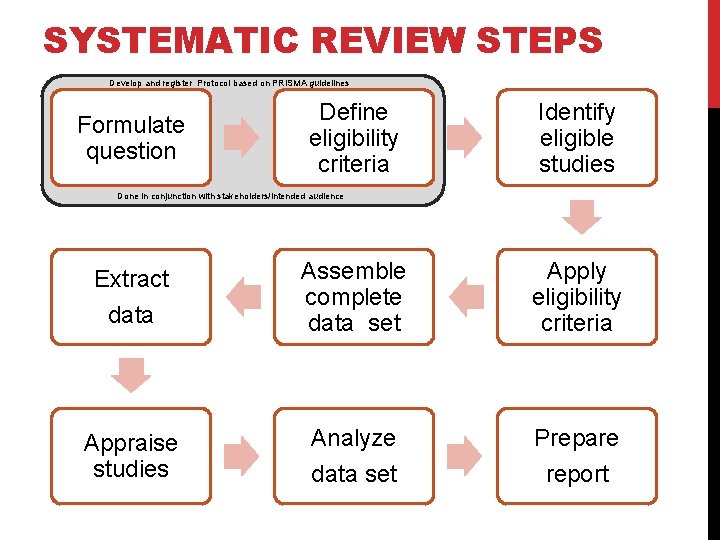
SYSTEMATIC REVIEW STEPS Develop and register Protocol based on PRISMA guidelines Formulate question Define eligibility criteria Identify eligible studies Done in conjunction with stakeholders/intended audience Extract data Assemble complete data_set Apply eligibility criteria Appraise studies Analyze data set Prepare report
REVIEW TYPES • Scoping review • A �scoping review or scoping study is a form of knowledge synthesis that addresses an exploratory research question aimed at mapping key concepts, types of evidence, and gaps in research related to a defined area or field by systematically searching, selecting, and synthesizing existing knowledge. Colquhoun, H. L. , Levac, D. , O’Brien, K. K. , Straus, S. , Tricco, A. C. , Perrier, L. , … Moher, D. (2014). Scoping reviews: time for clarity in definition, methods, and reporting. Journal of Clinical Epidemiology, 5, 1– 4. https: //doi. org/10. 1016/j. jclinepi. 2014. 03. 013
REVIEW TYPES • Rapid review • A rapid review is a form of knowledge synthesis that accelerates the process of conducting a traditional systematic review through streamlining or omitting specific methods to produce evidence for stakeholders in a resource-efficient manner. • Rapid evidence assessments provide a more structured and rigorous search and quality assessment of the evidence than a literature review but are not as exhaustive as a systematic review. Garritty, C. , Gartlehner, G. , Kamel, C. , King, V. , Nussbaumer-Streit, B. , Stevens, A. , Hamel, C. , & Affengruber, L. (2020). Interim Guidance from the Cochrane Rapid Reviews Methods Group. In Cochrane Rapid Reviews (Issue March). Hamel, C. , Michaud, A. , Thuku, M. , Skidmore, B. , Stevens, A. , Nussbaumer-Streit, B. , & Garritty, C. (2021). Defining Rapid Reviews: a systematic scoping review and thematic analysis of definitions and defining characteristics of rapid reviews. Journal of Clinical Epidemiology, 129, 74– 85. https: //doi. org/10. 1016/j. jclinepi. 2020. 09. 041

REVIEW TYPES • Literature review
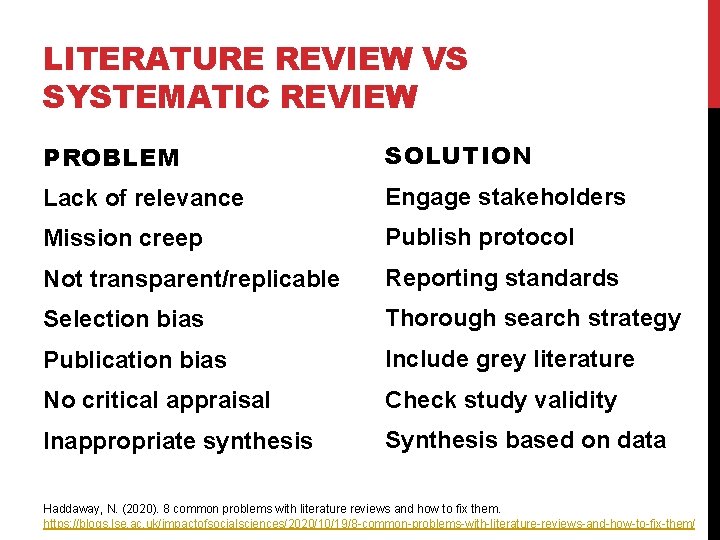
LITERATURE REVIEW VS SYSTEMATIC REVIEW PROBLEM SOLUTION Lack of relevance Engage stakeholders Mission creep Publish protocol Not transparent/replicable Reporting standards Selection bias Thorough search strategy Publication bias Include grey literature No critical appraisal Check study validity Inappropriate synthesis Synthesis based on data Haddaway, N. (2020). 8 common problems with literature reviews and how to fix them. https: //blogs. lse. ac. uk/impactofsocialsciences/2020/10/19/8 -common-problems-with-literature-reviews-and-how-to-fix-them/

GOOD SCIENCE SHOULD BE REPRODUCIBLE TRANSPARENT UNBIASED

S E H T N Y S E G D E L W KNO LITERATURE REVIEWS BEST PRACTICES AND APPLICATION TO AOPS

AOPS ADVERSE OUTCOME PATHWAY (AOP) RESEARCH BRIEF AOP Development and Availability One of the primary objectives of the AOP framework is knowledge assembly -specifically, making information attained through scientific research by subjectmatter experts and distributed in the body of scientific literature accessible to regulators during the decision-making process https: //www. epa. gov/sites/production/files/2017 -03/documents/aop_research_brief_03_2017. pdf USERS’ HANDBOOK SUPPLEMENT TO THE GUIDANCE DOCUMENT FOR DEVELOPING AND ASSESSING AOPs Evidence Supporting this KER Assembly and description of the scientific evidence supporting KERs in an AOP is an important step in the AOP development process that sets the stage for overall assessment of the AOP. https: //one. oecd. org/document/ENV/JM/MONO(2016)12/en/pdf
EMPIRICAL RESEARCH • Research that is based on observation and measurement of phenomena • Data is collected analyze • What is data in a review/synthesis?
AOP + DATA Go to www. menti. com and use the code 1586 5117 Mentimeter
ACTIVITY • Read the first paragraph of section 2. Current status of microplastic toxicity studies https: //doi. org/10. 1016/j. chemosphere. 2019. 05. 003 • Is the search transparent? Is the search reproducible? • What could be done to improve it?
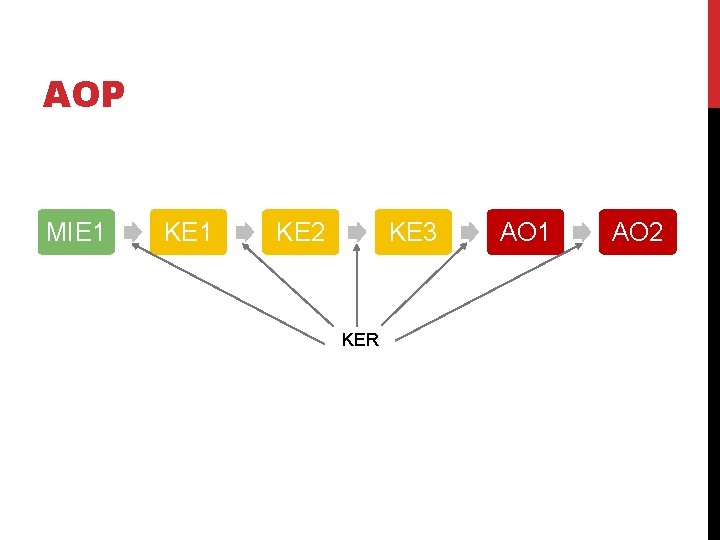
AOP MIE 1 KE 2 KE 3 KER AO 1 AO 2
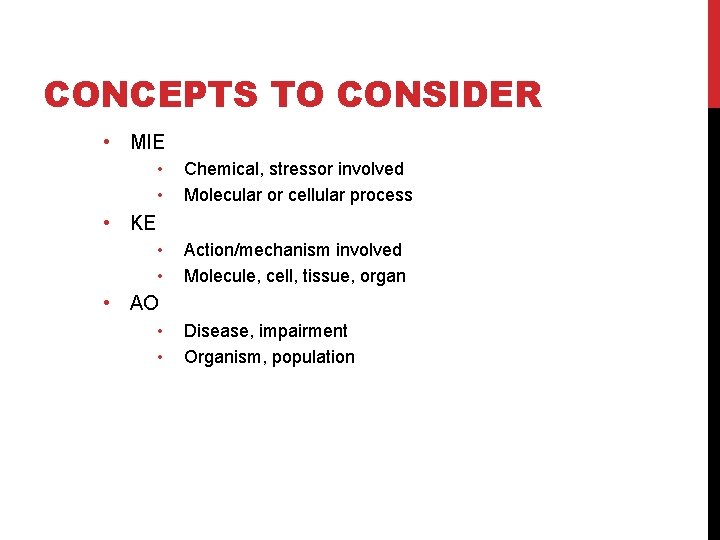
CONCEPTS TO CONSIDER • MIE • • Chemical, stressor involved Molecular or cellular process • • Action/mechanism involved Molecule, cell, tissue, organ • KE • AO • • Disease, impairment Organism, population
QUESTIONS TO CONSIDER • What is your starting point? (MIE, KE, AO) • Where can I find the type of information?
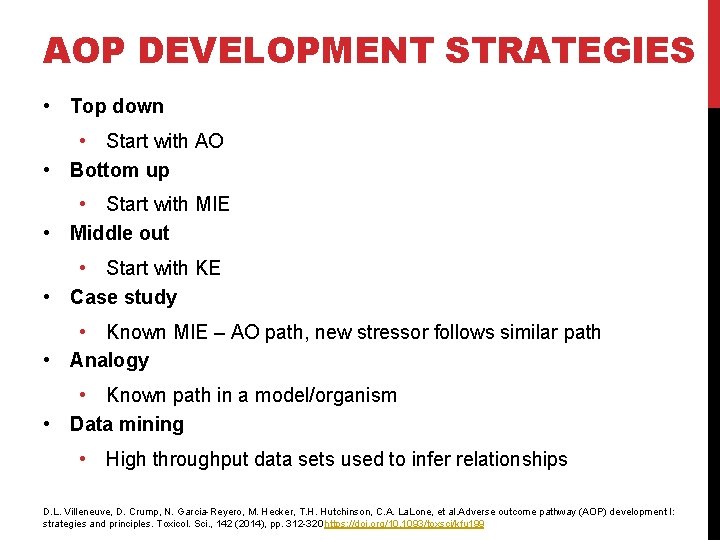
AOP DEVELOPMENT STRATEGIES • Top down • Start with AO • Bottom up • Start with MIE • Middle out • Start with KE • Case study • Known MIE – AO path, new stressor follows similar path • Analogy • Known path in a model/organism • Data mining • High throughput data sets used to infer relationships D. L. Villeneuve, D. Crump, N. Garcia-Reyero, M. Hecker, T. H. Hutchinson, C. A. La. Lone, et al. Adverse outcome pathway (AOP) development I: strategies and principles. Toxicol. Sci. , 142 (2014), pp. 312 -320 https: //doi. org/10. 1093/toxsci/kfu 199
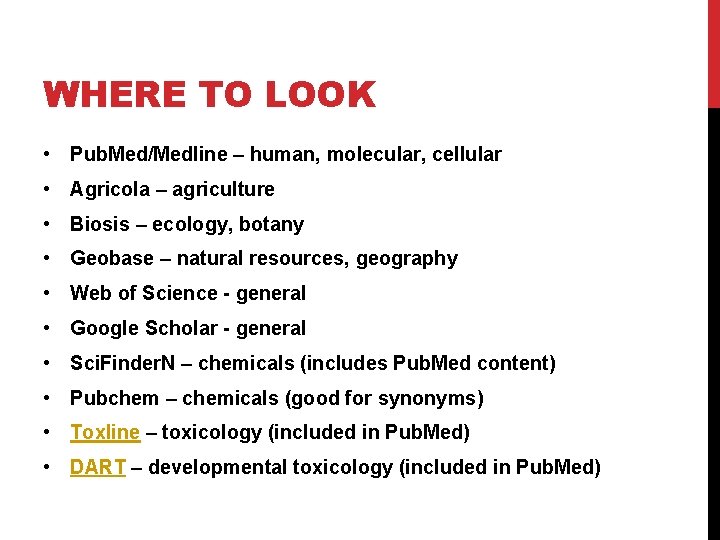
WHERE TO LOOK • Pub. Med/Medline – human, molecular, cellular • Agricola – agriculture • Biosis – ecology, botany • Geobase – natural resources, geography • Web of Science - general • Google Scholar - general • Sci. Finder. N – chemicals (includes Pub. Med content) • Pubchem – chemicals (good for synonyms) • Toxline – toxicology (included in Pub. Med) • DART – developmental toxicology (included in Pub. Med)
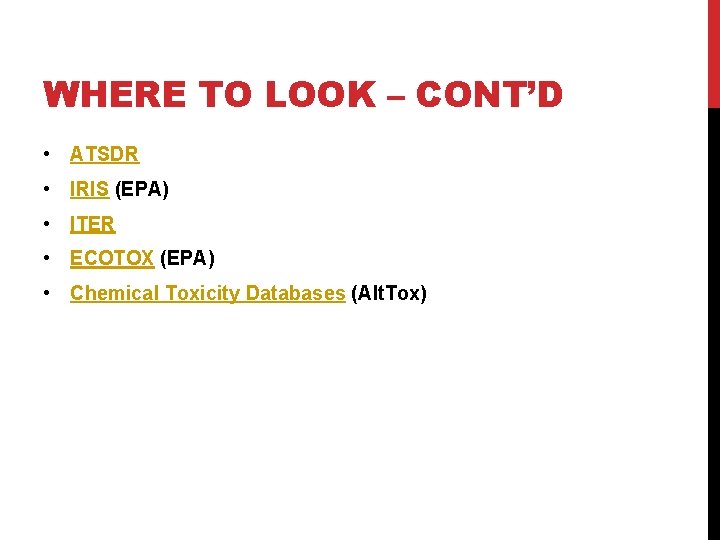
WHERE TO LOOK – CONT’D • ATSDR • IRIS (EPA) • ITER • ECOTOX (EPA) • Chemical Toxicity Databases (Alt. Tox)
BACKGROUND INFO • Find a review • Start with a AO and look at its biology • Identify steps from MIE to AO in a model/organism • Find chemical information • Structure, toxicity, etc. (MIE)
SEARCH PROCESS Identify concepts (MIE, KE, AO) Think of search terms for each concept Combine Search Evaluate results Repeat
QUESTIONS How is rotenone implicated in Parkinson’s disease? What is the effect of polychlorinated dibenzofurans on mortality?
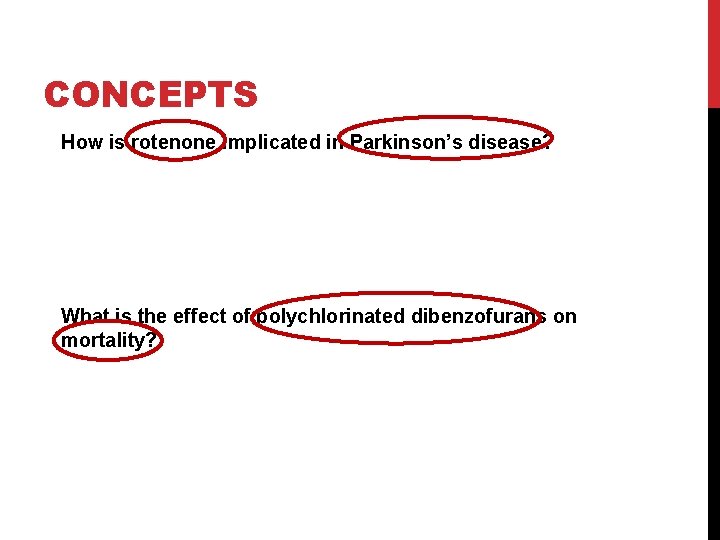
CONCEPTS How is rotenone implicated in Parkinson’s disease? What is the effect of polychlorinated dibenzofurans on mortality?
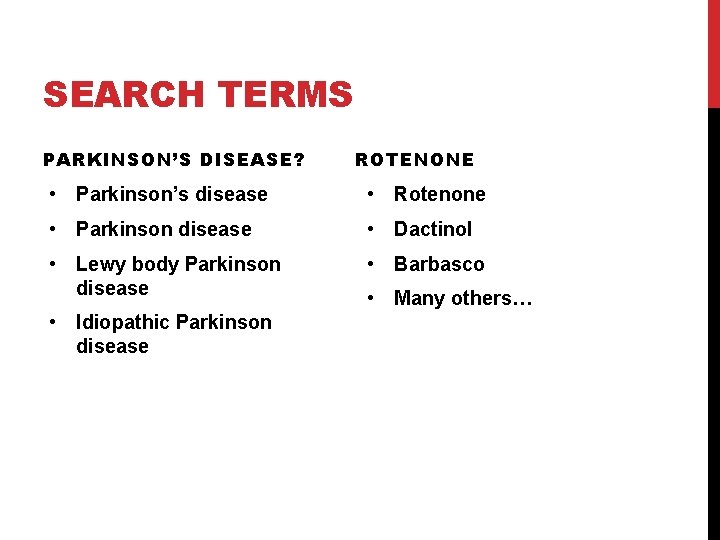
SEARCH TERMS PARKINSON’S DISEASE? ROTENONE • Parkinson’s disease • Rotenone • Parkinson disease • Dactinol • Lewy body Parkinson disease • Barbasco • Idiopathic Parkinson disease • Many others…

DEMO Pub. Chem Pub. Med Me. SH
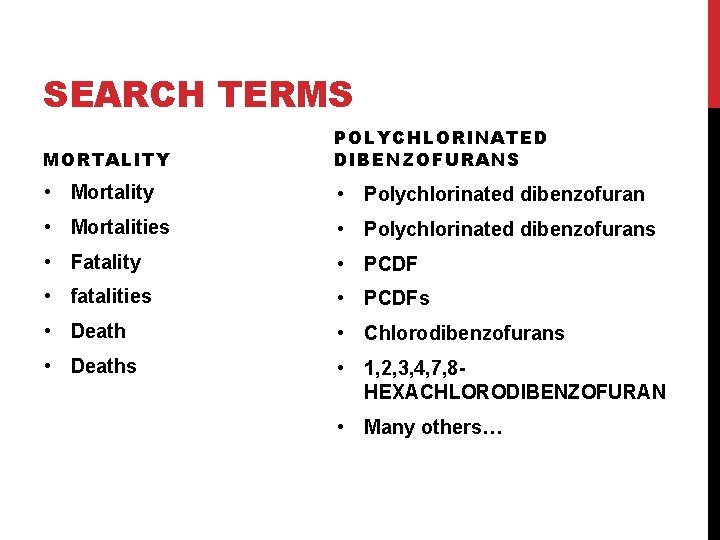
SEARCH TERMS MORTALITY POLYCHLORINATED DIBENZOFURANS • Mortality • Polychlorinated dibenzofuran • Mortalities • Polychlorinated dibenzofurans • Fatality • PCDF • fatalities • PCDFs • Death • Chlorodibenzofurans • Deaths • 1, 2, 3, 4, 7, 8 HEXACHLORODIBENZOFURAN • Many others…

DEMO Web of Science
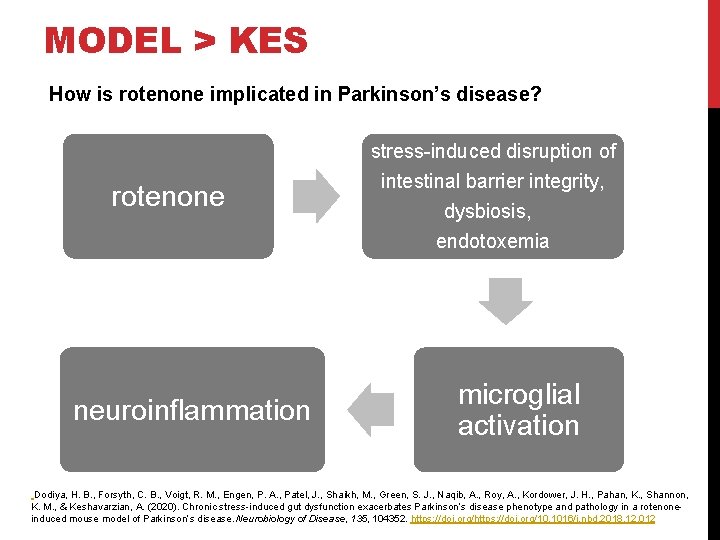
MODEL > KES How is rotenone implicated in Parkinson’s disease? rotenone neuroinflammation stress-induced disruption of intestinal barrier integrity, dysbiosis, endotoxemia microglial activation Dodiya, H. B. , Forsyth, C. B. , Voigt, R. M. , Engen, P. A. , Patel, J. , Shaikh, M. , Green, S. J. , Naqib, A. , Roy, A. , Kordower, J. H. , Pahan, K. , Shannon, K. M. , & Keshavarzian, A. (2020). Chronic stress-induced gut dysfunction exacerbates Parkinson’s disease phenotype and pathology in a rotenoneinduced mouse model of Parkinson’s disease. Neurobiology of Disease, 135, 104352. https: //doi. org/10. 1016/j. nbd. 2018. 12. 012
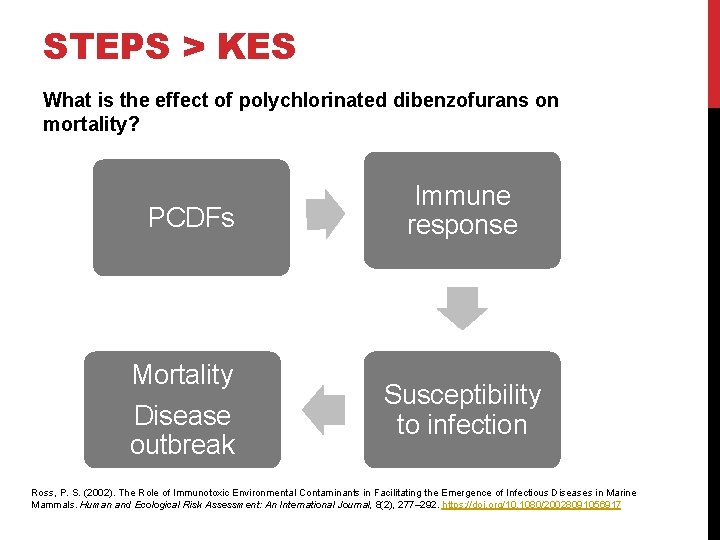
STEPS > KES What is the effect of polychlorinated dibenzofurans on mortality? PCDFs Mortality Disease outbreak Immune response Susceptibility to infection Ross, P. S. (2002). The Role of Immunotoxic Environmental Contaminants in Facilitating the Emergence of Infectious Diseases in Marine Mammals. Human and Ecological Risk Assessment: An International Journal, 8(2), 277– 292. https: //doi. org/10. 1080/20028091056917
ACTIVITY – BACKGROUND INFO • Think of your AOP • Identify concepts you want to look at in the AOP (MIE, AO) • Think of search terms • Run a quick search in your favourite search tool • Identify KEs
NEXT SEARCH STEPS • Once you have your background information you can determine what you to look at in the AOP • Specific KEs? • Whole pathway?
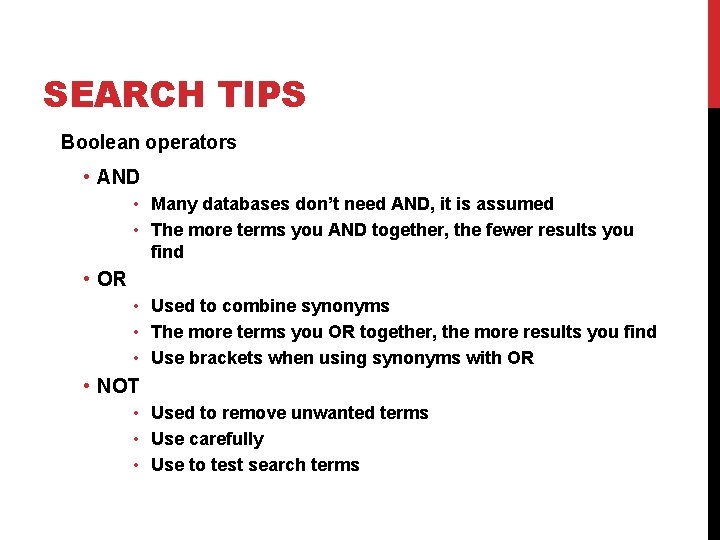
SEARCH TIPS Boolean operators • AND • Many databases don’t need AND, it is assumed • The more terms you AND together, the fewer results you find • OR • Used to combine synonyms • The more terms you OR together, the more results you find • Use brackets when using synonyms with OR • NOT • Used to remove unwanted terms • Use carefully • Use to test search terms
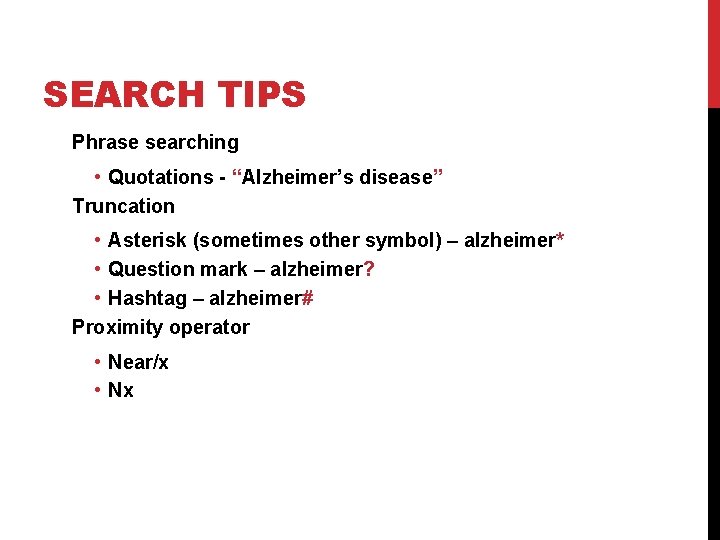
SEARCH TIPS Phrase searching • Quotations - “Alzheimer’s disease” Truncation • Asterisk (sometimes other symbol) – alzheimer* • Question mark – alzheimer? • Hashtag – alzheimer# Proximity operator • Near/x • Nx
CONTROLLED VOCABULARY Controlled vocabulary • An established list of standardized terms used for both indexing and retrieval of information • Thesaurus • Subject Headings Many databases have controlled vocabularies • Pubmed Medical Subject Headings Me. SH • Geobase
DATABASE FILTERS Date Document Type Subject Categories

REFERENCE TRACKING Check references of relevant papers • Web of Science • Scopus • Google Scholar
DEMO • Pub. Med • Web of Science • Scifinder. N • Google Scholar
ACTIVITY • Identify concepts (MIE, KE, AO, known KE path) • Use two databases to find relevant literature
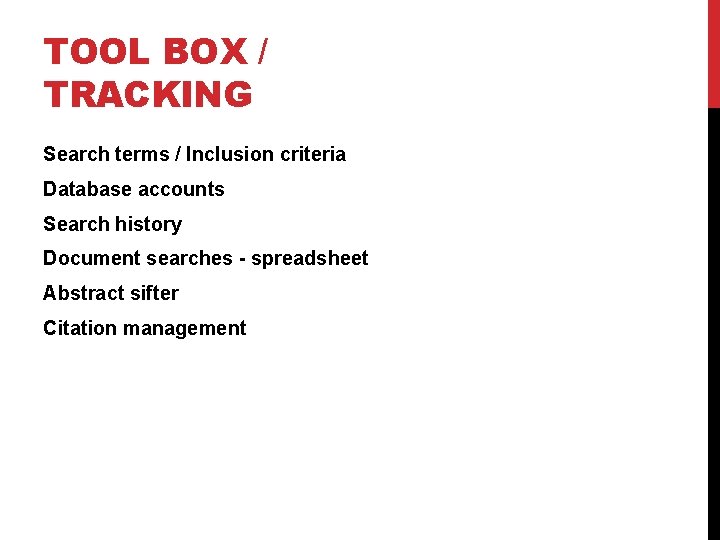
TOOL BOX / TRACKING Search terms / Inclusion criteria Database accounts Search history Document searches - spreadsheet Abstract sifter Citation management
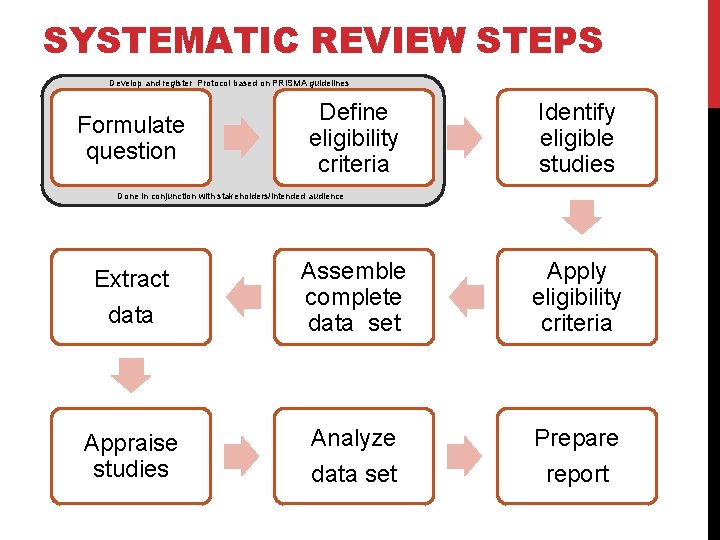
SYSTEMATIC REVIEW STEPS Develop and register Protocol based on PRISMA guidelines Formulate question Define eligibility criteria Identify eligible studies Done in conjunction with stakeholders/intended audience Extract data Assemble complete data_set Apply eligibility criteria Appraise studies Analyze data set Prepare report
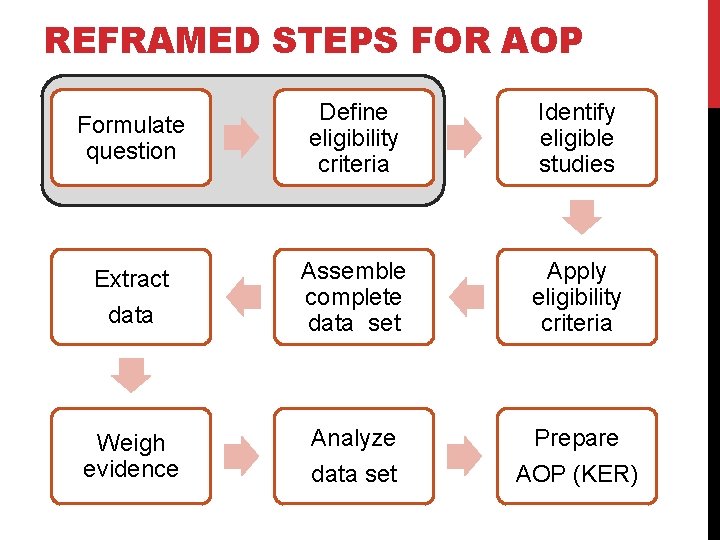
REFRAMED STEPS FOR AOP Formulate question Define eligibility criteria Identify eligible studies Extract data Assemble complete data_set Apply eligibility criteria Weigh evidence Analyze data set Prepare AOP (KER)
- Slides: 43