
Literature Review and Synthesis Burkean Parlor the Source

Literature Review and Synthesis Burkean Parlor & the Source Matrix

From Exploration to Conversation Annotated Bibliography You found a wide range of source material about your brand/product You have gained knowledge about the history, reputation and purpose of your brand/product. With this knowledge, you are beginning to form opinions about the advertisement of your brand/product and its role in society. Literature Review Consider where your sources overlap/diverge. Where do they agree/disagree and what does that tell you about your brand/product? The points where your sources converge or “converse” are threads Create a discussion with those threads to find an arguable point for the next assignment.
Assignment Requirements The Literature Review will be a full 6 -8 page essay 9 -10 sources At least 3 primary At least 4 secondary 3 must be scholarly or specific to advertising/marketing strategy

The Burkean Parlor Metaphor A metaphor introduced by philosopher and rhetorician Kenneth Burke Helps us understand “the unending conversation” – or the cycle of argument and discussion that takes place in the public plane Classic vs. Starbucks

Starbucks Metaphor You walk into a popular Starbucks during a busy hour and wait in line. The line is quite long and, having already determined what you want to order, you observe others in Starbucks. You don’t recognize anyone in the Starbucks, but you begin to pick up on a conversation happening near you. You have no previous knowledge of the conversation, but after listening for a while, you think you’ve caught the gist of the conversation. Coincidentally, someone already engaged in the conversation asks you for your advice on the matter. Since you have listened to the conversation and thought about it for a short while, you provide your opinion. Another person at the table responds, to which you offer another statement. Though the conversation is on the same topic, each person brings a subjective view to the table (quite literally). Despite your growing interest in the conversation, it is your turn to order a drink and you leave the conversation. Your absence does not stop the others from conversing.
What Does This Mean? Where is the gap? Highlights your position in the “unending conversation” You are entering into the discussion and it will continue after you leave You are scholars and experts on your brand So, what do you have to say?

Before: Annotated Bibliography Gathering potential sources Trying to get a strong foundation of our brand Focusing on advertising appeals and techniques After: Argumentative Paper Using our Literature Review to take a stand form an argument What can I conclude from this information? What does this indicate about the brand itself? The Synthesis Process LITERATURE REVIEW
Literature Review Essay based on synthesizing information Structure: Introduction with Descriptive Thesis about Groupings Grouping One Grouping Two Grouping Three… Conclusion and Working Thesis Many writers use a literature review or a critical positioning as a preface to their essay to demonstrate where they are entering into the “conversation. ”

What is Synthesis? Forging connections between the arguments of multiple authors or sources You must first understand describe each argument independently and then make comparisons or connections between the arguments. After discovering the connections, you have to determine what these connections suggest and why it is significant (gist of it).
Why compare different points of view? It makes you aware of counterarguments, passages where claims conflict or at least differ: _writer X says this, but writer Y asserts just the opposite _Writer X interprets this information this way, while writer Y sees it differently. Therefore, it starts you formulating your own counterargument: “neither X nor Y has taken this into account. What if they had? ”

Synthesis Practice Create categories that you would group the monsters into. Write a synthesis for each category to demonstrate how different pictures are grouped together under that particular thread. Remember, a grouping must have at least two sources to have a synthesis.
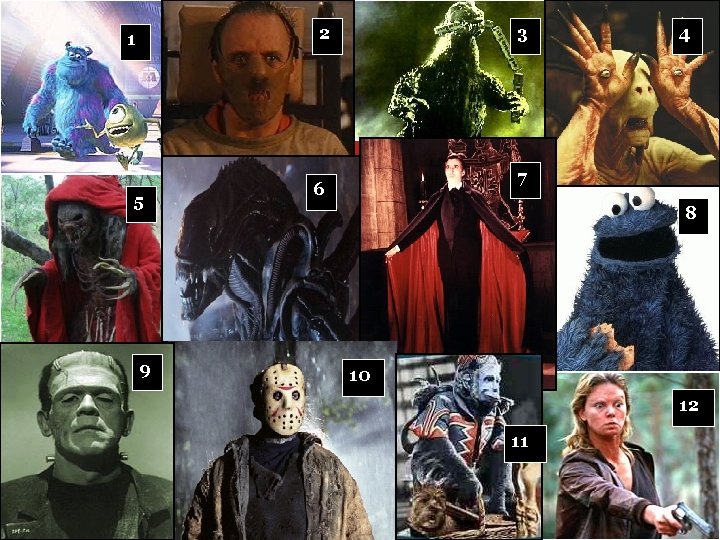
2 1 5 1 9 3 4 7 6 8 10 12 11

Source Matrix: Fill out the source matrix for ALL of the sources in your Annotated Bibliography Analyze Relationships to the other sources List a few that agree and disagree
Creating a Descriptive Thesis • Prompt: What kinds of monsters are presented in popular culture today? • Thesis: If we are answering the question above, what would our descriptive thesis be? ▫ Refer to the Chart, especially the Agree/Disagree columns ▫ Remember your threads/groupings • Like our thesis for Monsters tells us what kinds of monsters are presented in popular culture, the lit. review thesis tells us what kinds of persuasions are used in our brand’s advertisements. • It’s all the info we’ve found, consolidated into groups that make it easy for us to concisely and purposefully tell others what our brand advertises, how it does it, and what other people think of their techniques.
Finding Threads in Your Sources Now take 3 of your sources that you think share similarities and fill out the thread worksheet Try to incorporate at least 1 primary and 1 secondary source + 1 source of your choice in the thread
Homework for Monday! RWL 7 page 32 of the Manual Complete the chart we started in class today (with ALL of your sources) Bring to class on Monday
- Slides: 16