
Literature Review 1 Objectives You should be able
Literature Review 1

Objectives You should be able to: • understand the process of literature review • conduct a literature search • write a literature review 2
Literature Review What is Literature Review? ¡ The Purpose of Literature Review ¡ How to Carry out a Literature Review? ¡
What is Literature Review? It is actually the reading of the works of others before commencing on our own research work. ¡ Literature review can pave the way for better research. ¡ It can help in identifying the relevance of the research. ¡
Steps in reviewing the literature Define your idea in as general terms as possible by using general sources. ¡ Search through the secondary sources. ¡ Search through the primary sources. ¡ Organize your notes. ¡ Write your proposal. ¡
Different types of information and what they do! General sources ¡ Provides an overview of a topic and provides leads to where more information can be found. ¡ Examples are daily newspapers, news weeklies, popular periodicals and magazines, (e. g. IEEE Spectrum), etc. ¡
Different types of information and what they do! • • • Secondary sources Provides a level of information “once removed” from the original work. Examples are books on specific subjects and reviews of research. Primary sources The original reports of the original work or experience Examples are journals, abstracts, scholarly books, etc.
What are the purpose of Literature Review? To ¡ To ¡ limit the problem area. define the problem. avoid unnecessary repetition. search for new approaches. recommend suitable methods. sample current opinions.
The Purpose of Literature Review ¡ ¡ ¡ LIMIT THE PROBLEM AREA The problem should be small enough and sufficiently specific for adequate treatment and competent analysis. Research articles often suggest recommendations for the course that further research should take. DEFINE THE PROBLEM ‘Definition’ means that the researcher knows exactly what he is looking for, so that data when collected analyzed actually relates back to the problem.
The Purpose of Literature Review ¡ ¡ AVOID UNNECESSARY REPETITION Do not assume that because most of the existing research adopts one method that it is the only method or the correct method available in the circumstance. Do not use the approach if you have reservations about its application to the problem. SEARCH FOR NEW APPROACHES Be alert to research approaches which may have been overlooked. Be prepared to adopt a different viewpoint, particularly in areas where research is sparse.
The Purpose of Literature Review RECOMMEND SUITABLE METHODS • Methodology should be appropriate to the research problem. Compile a checklist in which you reference ideas on research design, instrumentation, sampling and data collecting and analysis from various studies. SAMPLE CURRENT OPINIONS • Newspapers, magazines and non-technical articles may contain unique ideas that have not yet been researched.
Benefits of a good literature search ¡ ¡ ¡ It will prevent you from duplicating work that has already been done. By synthesizing information from previous studies, you will be able to provide a stronger background, justification, and discussion of your own study. Relevant studies can provide valuable insights and tips to make your own study better, such as the best methodology or data analysis methods to use. You will be able to find gaps and weaknesses in the existing research and thereby come up with useful and meaningful research questions. You will become familiar with terminologies in your field by using and finding suitable keywords.
How to carry out effective literature review? A Plan for Obtaining Literature ¡ The following plan, arranged in a logical order is intended to provide a systematic means of obtaining relevant literature, once the general area of the research question has been established.
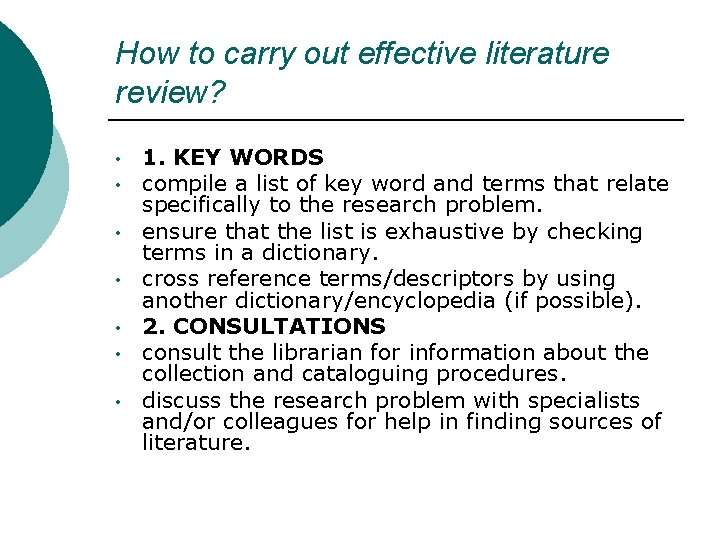
How to carry out effective literature review? • • 1. KEY WORDS compile a list of key word and terms that relate specifically to the research problem. ensure that the list is exhaustive by checking terms in a dictionary. cross reference terms/descriptors by using another dictionary/encyclopedia (if possible). 2. CONSULTATIONS consult the librarian for information about the collection and cataloguing procedures. discuss the research problem with specialists and/or colleagues for help in finding sources of literature.
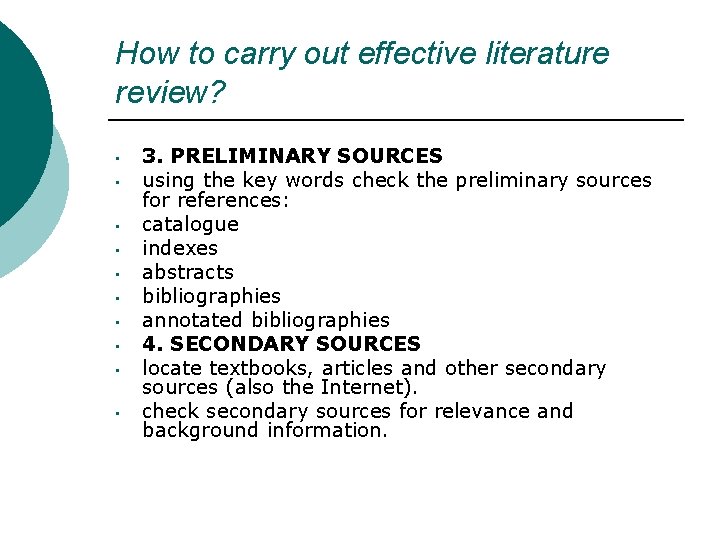
How to carry out effective literature review? • • • 3. PRELIMINARY SOURCES using the key words check the preliminary sources for references: catalogue indexes abstracts bibliographies annotated bibliographies 4. SECONDARY SOURCES locate textbooks, articles and other secondary sources (also the Internet). check secondary sources for relevance and background information.
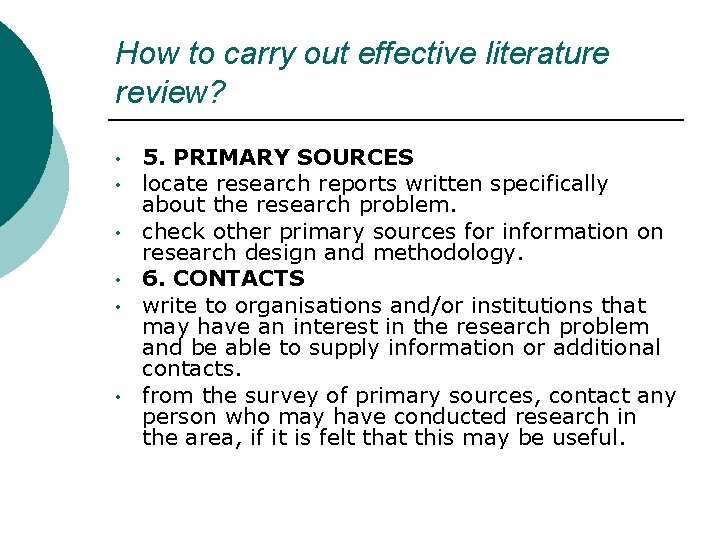
How to carry out effective literature review? • • • 5. PRIMARY SOURCES locate research reports written specifically about the research problem. check other primary sources for information on research design and methodology. 6. CONTACTS write to organisations and/or institutions that may have an interest in the research problem and be able to supply information or additional contacts. from the survey of primary sources, contact any person who may have conducted research in the area, if it is felt that this may be useful.
Using the Literature This covers: • How to write a good literature review • Traps • Example 17
Tips for performing literature search • Note interesting quotes and their references as you go along • Use outstanding review articles • Reference correctly from the start • Organize material you read • Start with a broad search before you focus 18
The Literature How useful are the following sources? journal articles books conference proceedings government and corporate reports newspapers theses and dissertations Internet (electronic journals) magazines 19
Outstanding Review Article From outstanding publisher. Journal : ACM, IEEE, Elsevier, Springer, Taylor & Francis, IEICE, MIT, IOS Press, Pergamon, World. Scientific, dll. 20
WHY WRITE A REVIEW OF THE LITERATURE? Here are some of the questions your literature review should answer: 1. What do we already know in the immediate area concerned? 2. What are the characteristics of the key concepts or the main factors or variables? 3. What are the relationships between these key concepts, factors or variables? 4. What are the existing theories? 5. Where are the inconsistencies or other shortcomings in our knowledge and understanding? 6. What views need to be (further) tested? 7. What evidence is lacking, inconclusive, contradictory or too limited? 8. Why study (further) the research problem? 9. What contribution can the present study be expected to make? 10. What research designs or methods seem unsatisfactory? 21
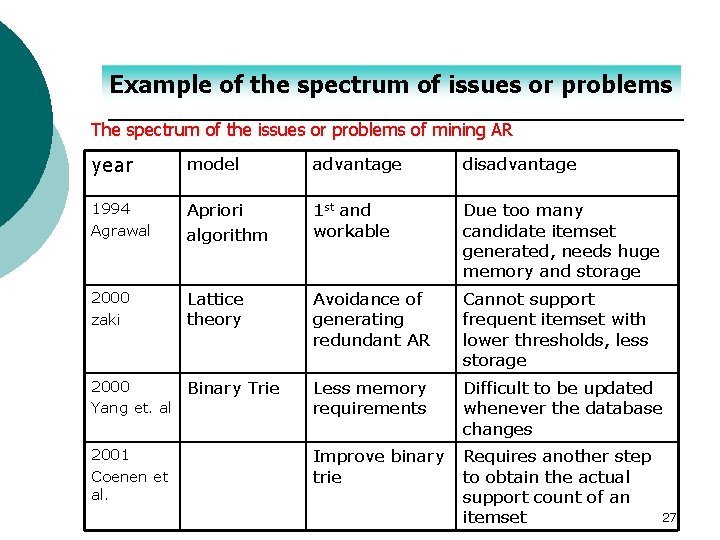
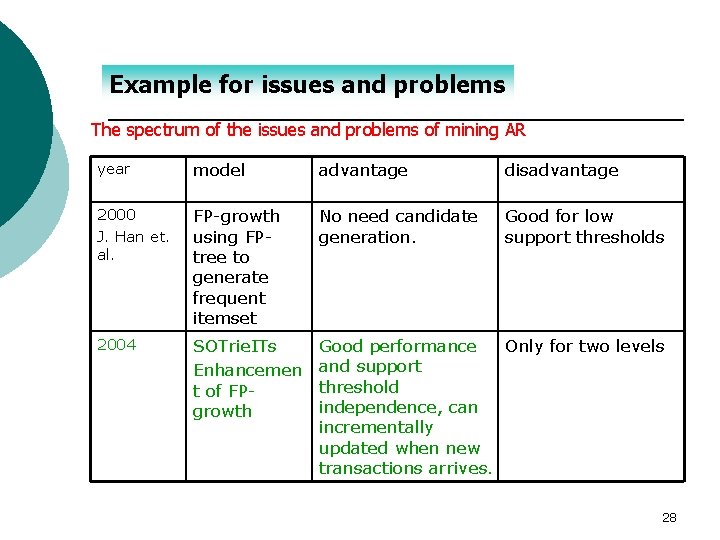
WHY WRITE A REVIEW OF THE LITERATURE? It is not supposed to be just a summary of other people's work! You evaluate relevant research work, show the relationships between different work, and show it relates to your work ( what work has already been done in your research area). Show it relates to the other work (e. g. What other methodologies have been used? How are they similar? How are they different? ) and show it relates to your work (what is its relationship to your methodology? ). The spectrum of the related issues 22
HOW CAN I WRITE A GOOD LITERATURE REVIEW? • It should answer the 10 questions. • You should use the literature to explain your research - after all, you are not writing a literature review just to tell your reader what other researchers have done. • Your aim should be able to show why your research needs to be carried out, . - how you came to choose certain methodologies or theories to work with, - how your work adds to the research already carried out, etc. 23
HOW CAN I WRITE A GOOD LITERATURE REVIEW? Read with a purpose: You should • summarize the work you read and also decide which ideas or information are important to your study (so you can emphasize them), and which are less important and can be covered briefly or left out of your review. • look for the major concepts, conclusions, theories, arguments etc. that underlie the work, and look for similarities and. differences with closely related work. This is difficult when you first start reading, but should become easier the more you read in your area. 24
HOW CAN I WRITE A GOOD LITERATURE REVIEW? Write with a purpose: your aim should be able to evaluate and show relationships between the work already done (Is Researcher A's theory more convincing than Researcher B's? Did Researcher A build on the work of Researcher B? ) and between this work and your own. [It shows the gap between your work and others work]. In order to do this effectively you should carefully plan how you are going to organize your work. 25
Cont…. . Write with a purpose: your aim should be to evaluate and show relationships between the work already done (Is Researcher Y's theory more convincing than Researcher X's? Did Researcher X build on the work of Researcher Y? ) and between this work and your own. In order to do this effectively you should carefully plan how you are going to organize your work. . 26
Example of the spectrum of issues or problems The spectrum of the issues or problems of mining AR year model advantage disadvantage 1994 Agrawal Apriori algorithm 1 st and workable Due too many candidate itemset generated, needs huge memory and storage 2000 zaki Lattice theory Avoidance of generating redundant AR Cannot support frequent itemset with lower thresholds, less storage 2000 Yang et. al Binary Trie Less memory requirements Difficult to be updated whenever the database changes Improve binary trie Requires another step to obtain the actual support count of an itemset 2001 Coenen et al. 27
Example for issues and problems The spectrum of the issues and problems of mining AR year model advantage disadvantage 2000 J. Han et. al. FP-growth using FPtree to generate frequent itemset No need candidate generation. Good for low support thresholds 2004 SOTrie. ITs Enhancemen t of FPgrowth Good performance Only for two levels and support threshold independence, can incrementally updated when new transactions arrives. 28
TRAPS Some traps to avoid: Trying to read everything! As you might already have discovered, if you try to be comprehensive you will never be able to finish the reading! The idea of the literature review is not to provide a summary of all the published work that relates to your research, but a survey of the most relevant and significant work. Reading but not writing! It's easier to read than to write: given the choice, most of us would rather sit down with a cup of coffee and read yet another article instead of putting ourselves in front of the computer to write about what we have already read! Writing takes much more effort, doesn't it? However, writing can help you to understand find relationships between the work you've read, so don't put writing off until you've "finished" reading - after all, you will probably still be doing some reading all the way through to the end of your research project. Also, don't think of what you first write as being the final or near-final version. Writing is a way of thinking, so allow yourself to write as many drafts as you need, changing your ideas and information as you learn more about the context of your research problem. 29
TRAPS Not keeping bibliographic information! The moment will come when you have to write your references page. . . and then you realize you have forgotten to keep the information you need, and that you never got around to putting references into your work. The only solution is to spend a lot of time in the library tracking down all those sources that you read, and going through your writing to find which information came from which source. If you're lucky, maybe you can actually do this before your defense - more likely, you will unable to find all your sources, a big headache for you and your committee. To avoid this nightmare, always keep this information in your notes. Always put references into your writing. Notice how on this course we have referenced the works that we have referred to - you should do the same. 30
LITERATURE REVIEW: AN EXAMPLE The Apriori algorithm is one of the most popular algorithms for mining association rules [3]. It introduces a method to generate candidate itemsets Ck in a pass k using only frequent itemsets Lk 1 in the previous pass. The idea rests on the fact that any subset of a frequent itemset must be frequent as well. Hence, Ck can be generated by joining Lk 1 and deleting those that contain any subset that is not frequent. However, studies reveal that the need for candidate itemset generation is a great disadvantage with respect to scalability and is the main bottleneck in ARM [15]. The use of lattice theory was studied by Zaki [9]. To complement the use of lattices, Zaki uses a vertical database format where each itemset is associated with a list of transactions known as a tid-list. Zaki employs a boolean powerset lattice to represent the database items and introduces algorithms that outperforms Apriori significantly. However, since most databases use a horizontal format, this approach requires an additional conversion step. In addition, the Boolean powerset lattice requires much space to store the labels and tid-lists. 31
LITERATURE REVIEW: AN EXAMPLE Shenoy et al. proposed a compression technique for tid-lists at the expense of efficiency [16]. The adjacency lattice, introduced by Aggarwal and Yu [10], is similar to Zaki’s boolean powerset lattice except that it uses the notion of adjacency among itemsets and does not rely on a vertical database format. Two itemsets are said to be adjacent to each other if one can be transformed to the other with the addition of a single item. To reduce memory requirements, the authors defined a primary threshold that is the minimum support threshold possible to fit all qualified itemsets into the adjacency lattice in main memory. The main strength of this approach is the avoidance of generating redundant association rules. However, it disallows the mining of frequent itemsets at support thresholds lower than the primary threshold. 32
Notice how the writers have: grouped similar information: " The use of lattice theory was studied by Zaki [9]. To complement the use of lattices, Zaki uses a vertical database format where each itemset is associated with a list of transactions known as a tid-list. Zaki employs a boolean powerset lattice to represent the database items and introduces algorithms that outperforms Apriori significantly. However, since most databases use a horizontal format, this approach requires an additional conversion step. In addition, the Boolean powerset lattice requires much space to store the labels and tid-lists. Shenoy et al. proposed a compression technique for tid-lists at the expense of efficiency [16]. " shown the relationship between the work of different researchers, showing similarities/differences: " The adjacency lattice, introduced by Aggarwal and Yu [10], is similar to Zaki’s boolean powerset lattice except that it uses the notion of adjacency among itemsets and does not rely on a vertical database format. ” 33
Notice how the writers have: indicated the position of the work in the research area history: " The Apriori algorithm is one of the most popular algorithms for mining association rules [3]. It introduces a method to generate candidate itemsets C k in a pass k using only frequent itemsets Lk 1 in the previous pass. " moved from a general discussion of the research in AS/RS to the more specific area (optimal container size) that they themselves are researching i. e. they relate previous work to their own to define it, justify it and explain it. 34
- Slides: 34