
Literature of Heian Japan The seeds of Japanese
- Slides: 13
Literature of Heian Japan
“The seeds of Japanese poetry lie in the human heart and grow into leaves of ten thousand words. Many things happen to people of this world, and all that they think and feel is given expression in description of things they see and hear. When we hear the warbling of the mountain thrush in the blossoms or the voice of the frog in the water, we know every living thing has a song. It is poetry which, without effort, moves heaven and earth, stirs the feelings of the invisible gods and spirits, smooths the relations of men and women, and calms the hearts of fierce warriors. ” - Preface to Kokinshū
Purpose of Poetry Most important form of art Used in private communications Used in political and business negotiations To be skilled in poetry showed good character and intelligence. People would have hundreds of popular poems memorized to use in any given situation. Poetry contests were popular and widespread.
The Japanese Aesthetic Suggestion is more powerful than an explicit statement. Budding cherries are better than those in full flower. The crescent moon is better than the full moon. Autumn and spring are better than winter or summer. A love affair at the beginning or end is more interesting than one in the middle. Asymmetry Is always preferable to symmetry Poetry has an uneven number of lines and syllables.
Simplicity Houses are better unpainted than painted. The light scent of plum blossoms is better than the heavy scent of lilacs. Poetry is brief (haiku, tanka). Perishability Old pottery is better than new. Sometimes cracks were patched with gold to show age. Cherry blossoms are prized because their time is so short. Temples are made of wood rather than stone.
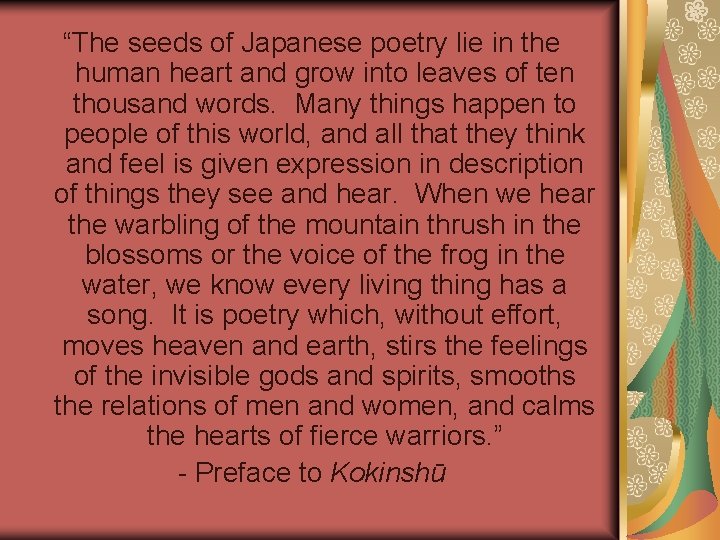
Kokinshū Published about 905 AD Contains 1111 poems written by 130 poets All but 9 are in the form of tanka 5 -7 -7 syllable lines Purpose: To return Japanese poetry to the public arena (rejection of Chinese poetry) Format: Compilation of poems from the previous century as well as contemporary poems
Thematic organization: Each poem is linked to those before and after by a chronological or geographical progression, by imagery, or shifts in theme. Dominant themes: nature and the progression of the seasons love and the progress of love affairs celebration mourning travel parting
How to Read Japanese Poetry The reader must work backwards from the specific situation to the emotion that generated the poem. The reader must use what the poet sees to recreate the moment that inspired it. Keep the Japanese aesthetic in mind. Use the external imagery to understand the internal thoughts of the poet. If working with a sequence, think about the way that the poems connect or show progression.
Translating Japanese Poetry Because of the vast differences in the languages, Japanese poetry is difficult to translate into English. Japanese poetry is not based on the same rhyming and metrical system as English poetry. Japanese poetry is based on number of syllables and line length as well as many double meanings and puns. To get a good representation of meaning, the translator has to be less exact with either the form or the content.
The Pillow Book Written by Sei Shōnagon during the last decade of the 10 th century while she served as a lady in waiting to the Empress Sadako Almost nothing is known about her life except for what is included in the book. The Pillow Book is seen as one of the most important documents of the period because of its detailed picture of upper-class Heian life. Details Shōnagon’s thoughts on an incredible variety of topics
The title (according to Shōnagon) comes from her idea to make leftover notebooks given to her by the Empress into a “pillow. ” However, it is probably just a generic term for a diary that one would keep close to the bed. This genre was very popular among upper-class Heian women. This is a precusor to a later Japanese genre of writing called “occasional writings” or “random notes”
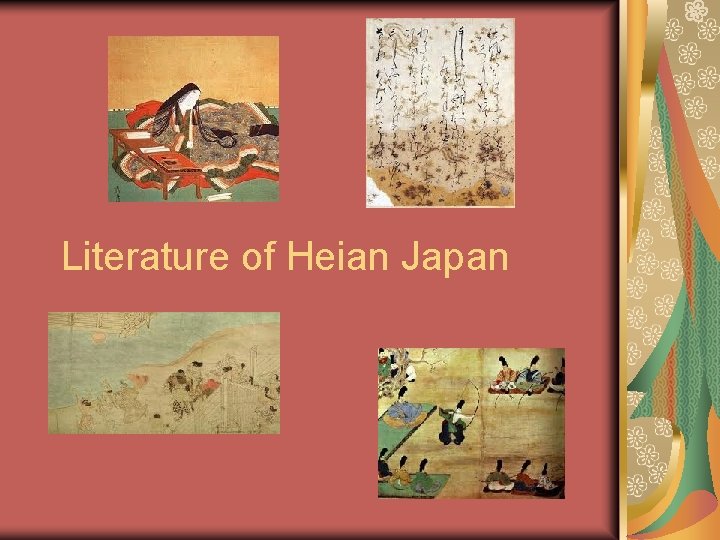
The Tale of Genji Written by Murasaki Shikibu Began writing Genji around 1000 Seen as one of the first popular novels A very long tale of a prince named Genji, his search for the perfect relationship, and his contemplations on philosophical and religious topics Genji is a hero who is different from other medieval heros – taste and senstivity matter more than glory through battle.
Gender Relations in Heian Japan Marriage was polygamous for aristocratic men. First marriages were arranged by parents around the age of 12 or 13. Second and third wives generally had their own residences. It was acceptable for both men and women to have affairs, but women could not initiate them. Women waited, hidden, behind screens for men to call on them. A familiar theme in upper-class women’s writing is jealously of a rival for her husband’s affection.