
Literature and Language Family Members 1 2 3

Literature and Language
Family Members 1 2 3 4 Mango/21111112/ Winnie/21111119/ Adela/21111110/ Kevin/211111104/
Germanic Languages Latin literature Romance Languages Literature of the Middle Ages
Germanic languages —— a sub-branch Indo-European (IE) language family
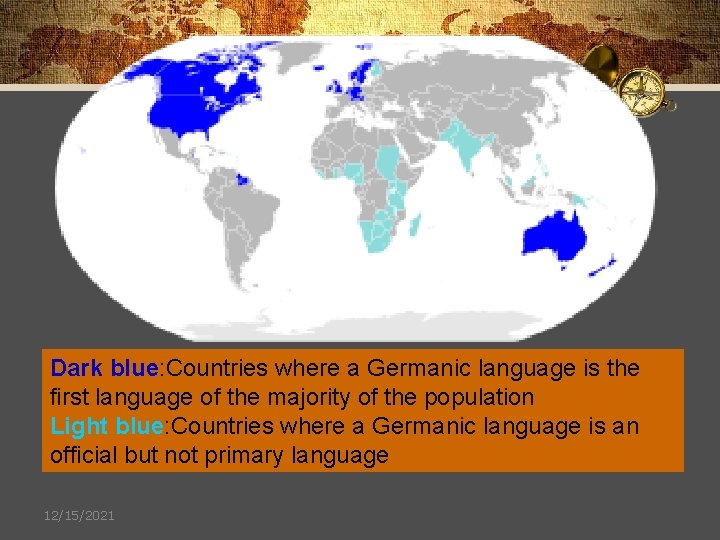
Dark blue: Countries where a Germanic language is the first language of the majority of the population Light blue: Countries where a Germanic language is an official but not primary language 12/15/2021

Ancestor, Morphology and classification • Common ancestor——Proto-Germanic (Common Germanic). • Most widely spoken——English and German • East Germanic languages(extinct) • North Germanic languages • West Germanic languages 12/15/2021
Characteristics(7 kinds) • Large numbers of vowels. • A change known as Germanic umlaut. • A large class of verbs that use a dental suffix • The use of so-called strong and weak adjectives • Grimm's Law • Some words with etymologies. • The sound change known as Verner's Law. 12/15/2021
Writing • many Germanic languages use a variety of accent marks and extra letters, including umlauts, the ß (Eszett), IJ, Ø, Æ, Å, Ä, Ü, Ö, Ð, Ȝ, and the Latinized runes Þ and Ƿ (with its Latin counterpart W). • In print, German used to be prevalently set in blackletter typefaces (e. g. fraktur or schwabacher) until the 1940 s, whereas Kurrent and since the early 20 th century Sütterlin was used for German handwriting. 12/15/2021
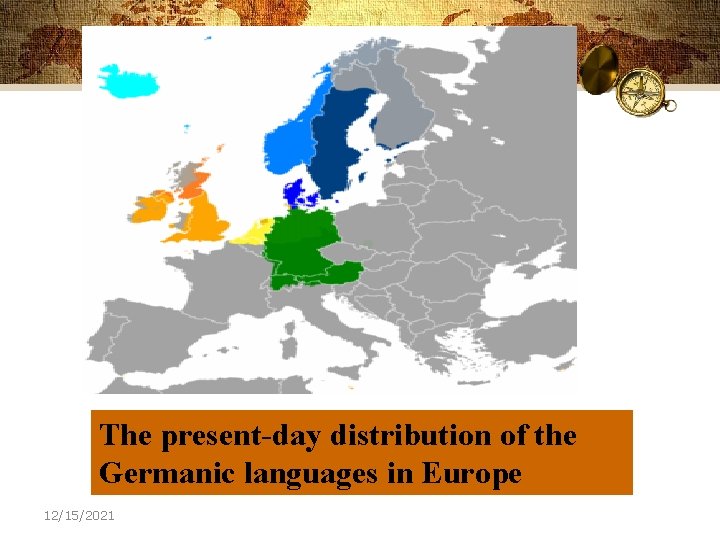
The present-day distribution of the Germanic languages in Europe 12/15/2021
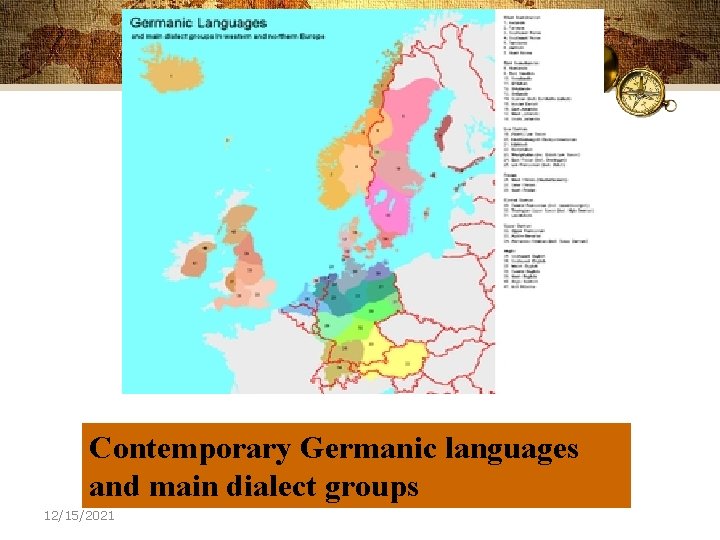
Contemporary Germanic languages and main dialect groups 12/15/2021
Latin languages —— the Middle Ages
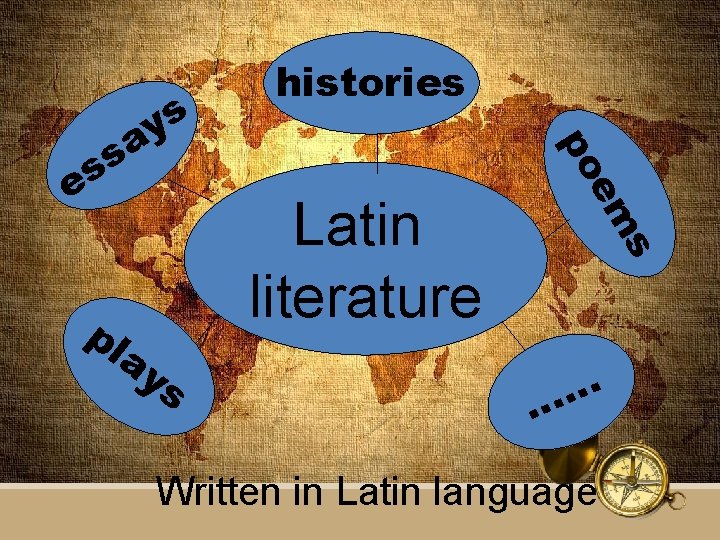
s ay s Latin literature em pl po s y a s es histories …… Written in Latin language
Latin literature in the Middle Ages Pagan Latin literature showed a final burst of vitality in the late 200 s and 400 s. 12/15/2021
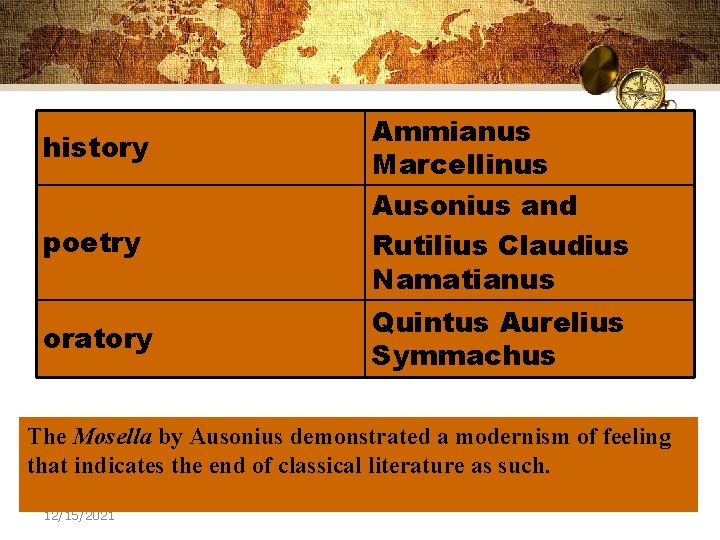
history poetry oratory Ammianus Marcellinus Ausonius and Rutilius Claudius Namatianus Quintus Aurelius Symmachus The Mosella by Ausonius demonstrated a modernism of feeling that indicates the end of classical literature as such. 12/15/2021
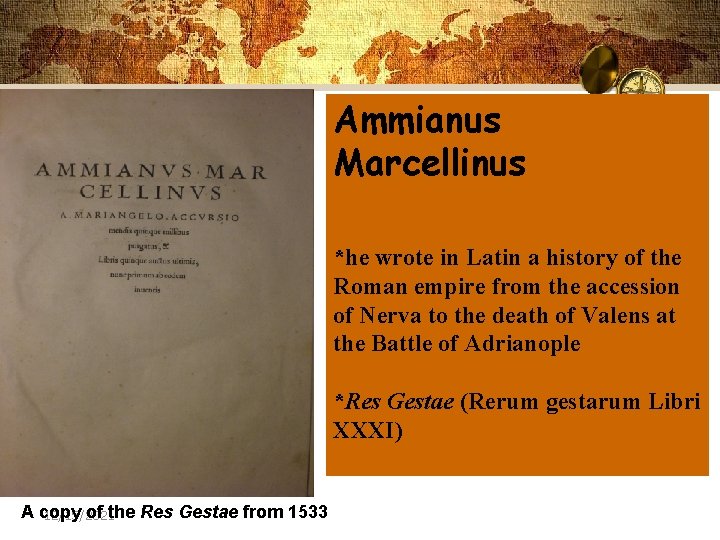
Ammianus Marcellinus *he wrote in Latin a history of the Roman empire from the accession of Nerva to the death of Valens at the Battle of Adrianople *Res Gestae (Rerum gestarum Libri XXXI) A copy of the Res Gestae from 1533 12/15/2021
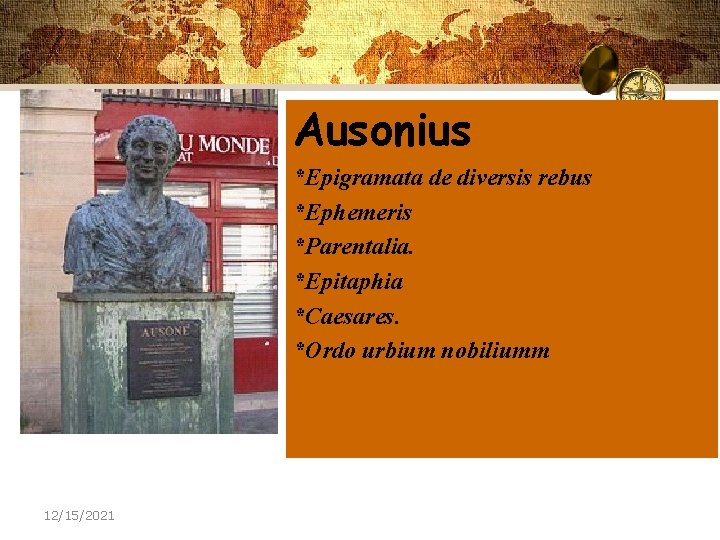
Ausonius *Epigramata de diversis rebus *Ephemeris *Parentalia. *Epitaphia *Caesares. *Ordo urbium nobiliumm 12/15/2021
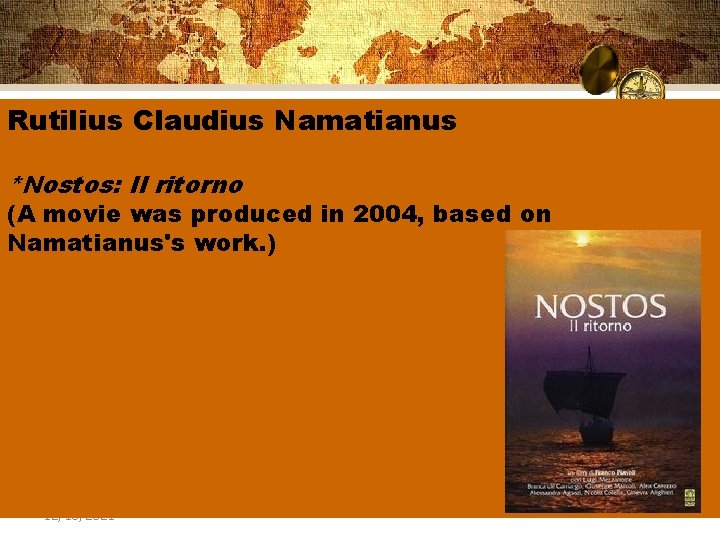
Rutilius Claudius Namatianus *Nostos: Il ritorno (A movie was produced in 2004, based on Namatianus's work. ) 12/15/2021
Quintus Aurelius Symmachus *Nine books of letters *Panegyrics *Fragments of various oration 12/15/2021
Meanwhile * Other men laid the foundations of Christian Latin literature during the 300 s and 400 s. * They included the church fathers Augustine of Hippoo, Jeromee, and Ambrosee, and the first great Christian poet, Prudentiuss. 12/15/2021
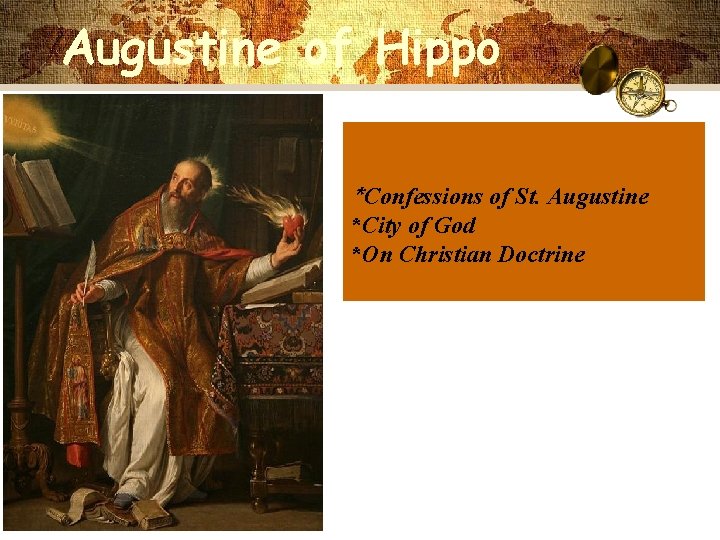
Augustine of Hippo *Confessions of St. Augustine *City of God *On Christian Doctrine 12/15/2021
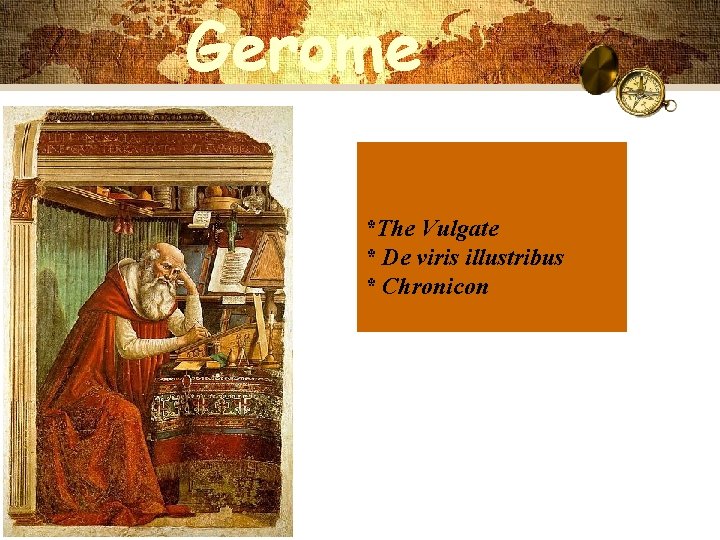
Gerome *The Vulgate * De viris illustribus * Chronicon 12/15/2021
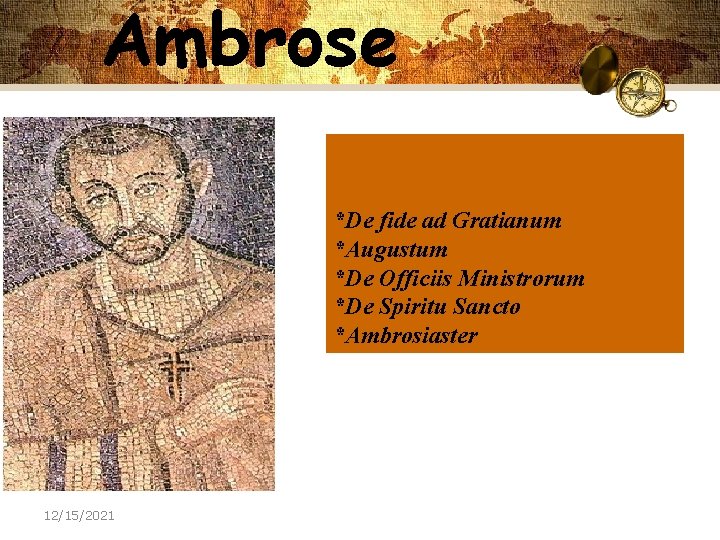
Ambrose *De fide ad Gratianum *Augustum *De Officiis Ministrorum *De Spiritu Sancto *Ambrosiaster 12/15/2021
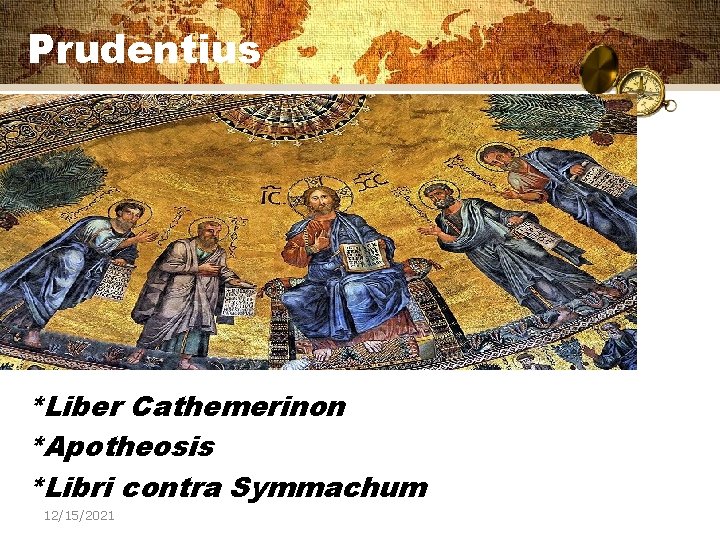
Prudentius *Liber Cathemerinon *Apotheosis *Libri contra Symmachum 12/15/2021
Romance languages —— Part of a series on Indo-European topics
Details: • Brief introduction • Origins • Linguistic features • Modern status 25
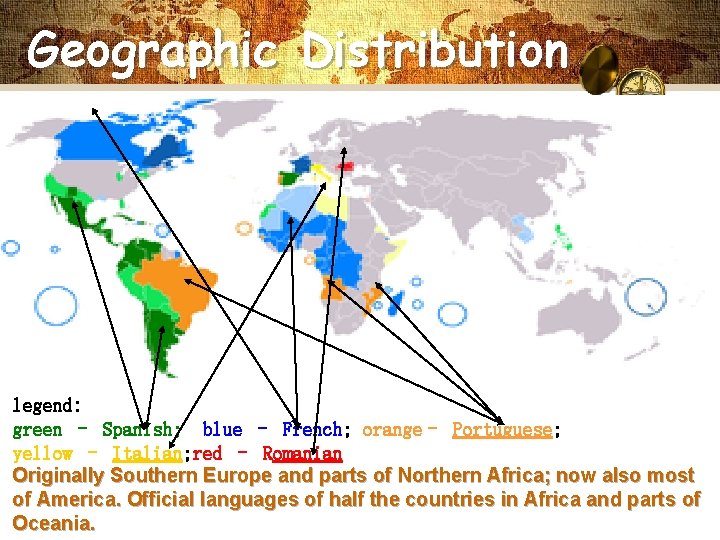
Geographic Distribution legend: green – Spanish; blue – French; orange– Portuguese; yellow – Italian; red – Romanian Originally Southern Europe and parts of Northern Africa; now also most of America. Official languages of half the countries in Africa and parts of Oceania.
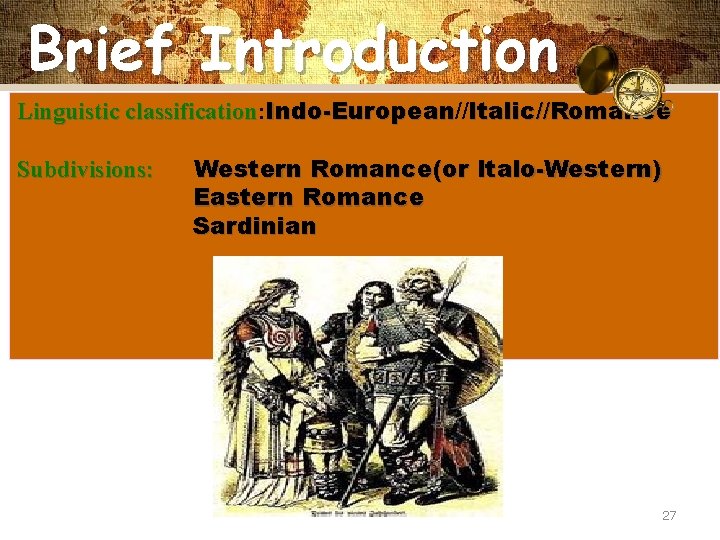
Brief Introduction Linguistic classification: classification Indo-European// Indo-European Italic//Romance Subdivisions: Western Romance(or Italo-Western) Eastern Romance Sardinian 27
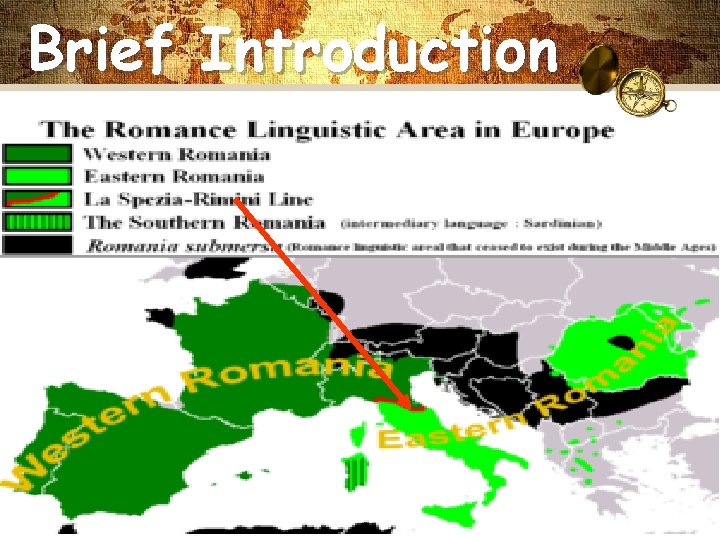
Brief Introduction 28
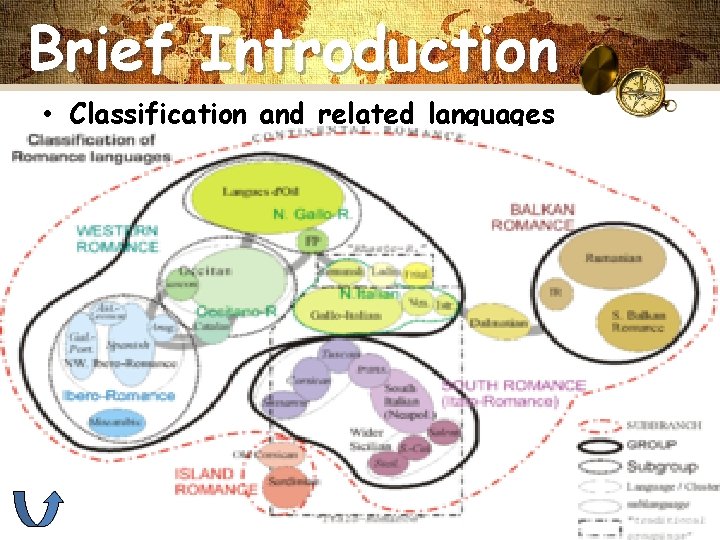
Brief Introduction • Classification and related languages 12/15/2021
Origins: • Romance languages are the continuation of Vulgar Latin, the popular sociolect of Latin spoken by soldiers, settlers and merchants of the Roman Empire. • During the Empire's decline, influenced by Portugal, Spain and France, which lasted for about 2 centuries. • The phonology , morphology , and lexicon of all Romance languages are overwhelmingly evolved forms of Vulgar Latin. • There are some notable differences between today's Romance languages and their Roman ancestor. Ⅰ. Romance languages have lost the declension system Ⅱ. SVO sentence structure Ⅲ. extensive use of prepositions 30
Linguistic features: • Romance languages are moderately inflecting. • A fairly strict subject–verb–object word order. • In general, nouns, adjectives and determiners inflect only according to grammatical gender and grammatical number. • Most Romance languages are null subject languages. • All Romance languages have two articles ——definite and indefinite. • The phonology of most Romance languages is of moderate size with few unusual phonemes. • Word accent is of the stress and is free. • Verbs are inflected according to a complex morphology. 31
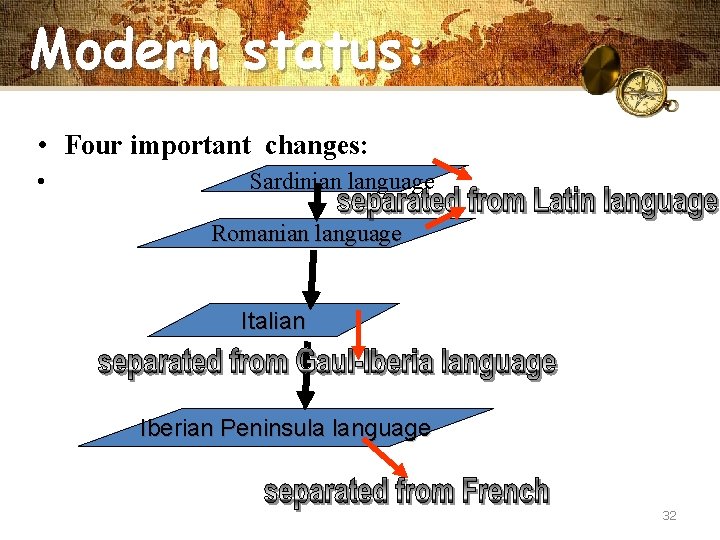
Modern status: • Four important changes: • Sardinian language Romanian language Italian Iberian Peninsula language 32
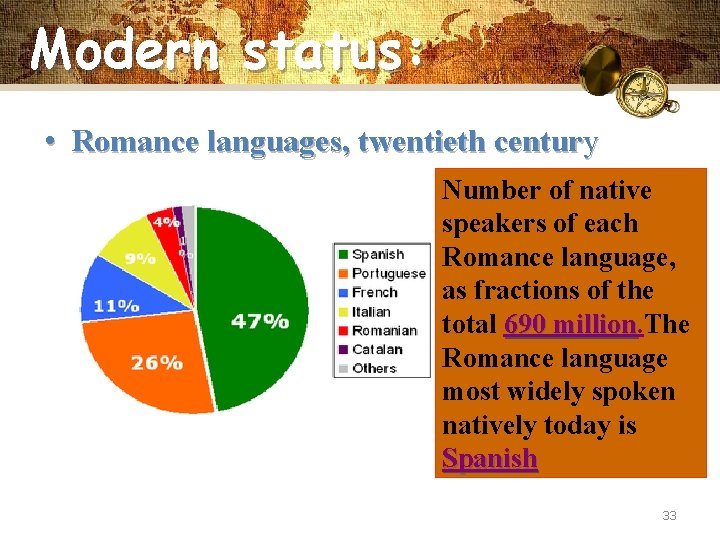
Modern status: • Romance languages, twentieth century Number of native speakers of each Romance language, as fractions of the total 690 million. The million Romance language most widely spoken natively today is Spanish 33
Modern status: • The remaining Romance languages survive mostly as spoken languages for informal contact. • There are many indistinguishable dialects in Romance language which makes it difficult to learn. • In the late 20 th and early 21 st century, some measures has been done to protect them and recover their prestige and lost rights. Yet it is unclear whether these political changes will be enough to reverse the decline of minority Romance languages. 34
Literature of the Middle Ages
Literature of the Middle Ages • Medieval literature—— all written works available in Europe and beyond during the Middle Ages. • Language——Latin • Anonymity • Style 12/15/2021
style • Religious • Secular • Women's literature • Allegory 12/15/2021
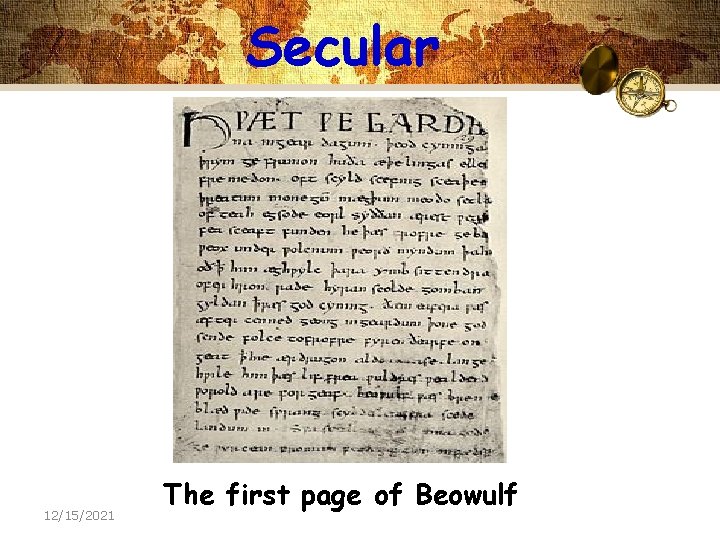
Secular 12/15/2021 The first page of Beowulf
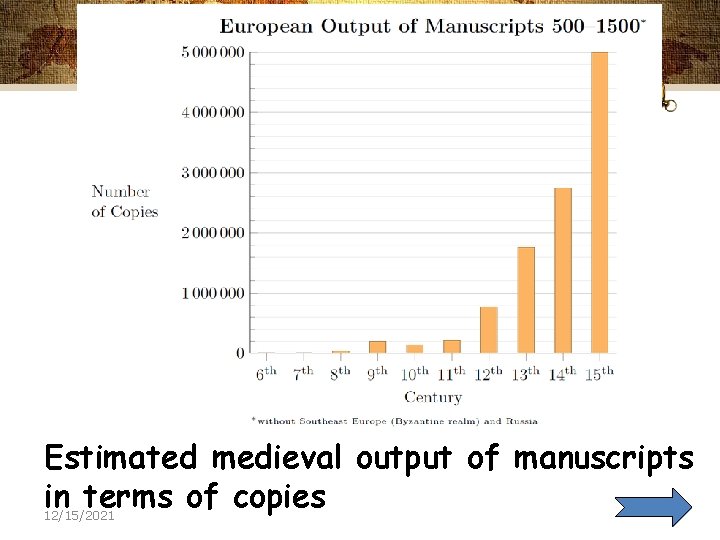
Estimated medieval output of manuscripts in terms of copies 12/15/2021
References Romance language: Harris, Martin; Vincent, Nigel (1988). The Romance Languages. London: Routledge. Posner, Rebecca (1996). The Romance Languages. Cambridge: Cambridge University Press. Price, Glanville (1971). The French language: present and past. Edward Arnold. Lapesa, Rafael (1981). Historia de la Lengua Española. Madrid: Editorial Gredos. Devoto, Giacomo; Giacomelli, Gabriella (2002). I Dialetti delle Regioni d'Italia (3 rd ed. ). Milano: RCS Libri (Tascabili Bompiani). Williams, Edwin B. (1968). From Latin to Portuguese, Historical Phonology and Morphology of the Portuguese Language (2 nd ed. ). University of Pennsylvania. Latin language: Allen, William Sidney (2004). Vox Latina – a Guide to the Pronunciation of Classical Latin (2 nd ed. ). Cambridge: Cambridge University Press. Jenks, Paul Rockwell (1911). A Manual of Latin Word Formation for Secondary Schools. New York: D. C. Heath & Co. Sihler, Andrew L (2008). New comparative grammar of Greek and Latin. New York: Oxford University Press. Waquet, Françoise; Howe, John (Translator) (2003). Latin, or the Empire of a Sign: From the Sixteenth to the Twentieth Centuries. Verso.
References Germantic language: König, Ekkehard; van der Auwera, Johan (1994). The Germanic languages. London: Routledge. Helfenstein, James (1870). A comparative grammar of the Teutonic languages. London: Mac. Millan and Co. Wright, Joseph C. (1919). Grammar of the Gothic language. London: Oxford University Press. Robinson, Orrin (1992). Old English and its closest relatives. Stanford: Stanford University Press. </ref> Waterman, John C. (1976). A history of the German language. Prospect Heights, Illinois: Waveland Press. Wright, Joseph (1906). An Old High German primer, 2 nd edition. Oxford: Clarendon Press. Ringe, Don (2006). A linguistic history of English: From Proto-Indo-European to Proto. Germanic. Oxford: Oxford University Press. Literature: Buringh, Eltjo; van Zanden, Jan Luiten: "Charting the “Rise of the West”: Manuscripts and Printed Books in Europe, A Long-Term Perspective from the Sixth through Eighteenth Centuries", The Journal of Economic History, Vol. 69, No. 2 (2009), pp. 409– 445 (416, table 1)
creation: a song poetry Le Papillon ODE TO THE WEST WIND
Le Papillon • It's a French song that was used in the famous movie Le Papillon directed by Philippe Muyl. • A girl named was an orphan and adopted by a neighbour. She likes asking questions on matter whom she is talking with. The song is the dialogue between the girl and grandpa.
Pourquoi les poules pondent des oeufs? 为什么鸡会下蛋? Pour que les oeufs fassent des poules. 因为蛋都变成小鸡 Pourquoi les amoureux s''embrassent? 为什么情侣要亲吻? C''est pour que les pigeons roucoulent. 因为鸽子们咕咕叫 Pourquoi les jolies fleurs se fanent? 为什么漂亮的花会凋谢? Parce que ca fait partie du charme. 因为那是游戏的一部分 Pourquoi le diable et le bon Dieu? 为什么会有魔鬼又会有上帝? C''est pour faire parler les curieux. 是为了让好奇的人有话可说 Pourquoi le feu brule le bois? 为什么木头会在火里燃烧? C''est pour bien rechauffer nos coeurs or. 是为了我们像毛毯一样的 暖 Pourquoi la mer se retire? 为什么大海会有低潮? C''est pour qu''on lui dise "Encore. "是为了让人们说:再来点 Pourquoi le soleil disparait? 为什么太阳会消失? Pour l''autre partie du decor. 为了地球另一边的装饰 Pourquoi le diable et le bon Dieu? 为什么会有魔鬼又会有上帝? C''est pour faire parler les curieux. 是为了让好奇的人有话可说 Pourquoi le loup mange l''agneau? 为什么狼要吃小羊? Parce qu''il faut bien se nourrir. 因为他们也要吃东西 Pourquoi le lievre et la tortue? 为什么是乌龟和兔子跑? Parce que rien ne sert de courir. 因为光跑没什么用 Pourquoi les anges ont-ils des ailes? 为什么天使会有翅膀? Pour nous faire croire au Pere Noel. 为了让我们相信有圣诞老人 Pourquoi le diable et le bon Dieu? 为什么会有魔鬼又会有上帝? C''est pour faire parler les curieux. 是为了让好奇的人有话可说
ODE TO THE WEST WIND (V) Shelly • • • • Make me thy lyre, even as the forest is: What if my leaves are falling like its own! The tumult of thy mighty harmonies Will take from both a deep, autumnal tone, Sweet though in sadness. Be thou, Spirit fierce, My spirit! Be thou me, impetuous one! Drive my dead thoughts over the universe Like withered leaves to quicken a new birth! And, by the q of this verse, Scatter, as from an unextinguished hearth Ashes and sparks, my words among mankind! Be through my lips to unawakened Earth The trumpet of a prophecy! O Wind, If Winter comes, can Spring be far behind?

Do you Have any question? THANK YOU!
- Slides: 46