
Literary translation competence measurement Henri Bloemen Winibert Segers
Literary translation competence measurement Henri Bloemen & Winibert Segers Budapest 17 th of October 2015
ELV (Expertisecentrum Literair Vertalen) competence model (2014) • translating competence • linguistic competence • textual competence • heuristic competence • literary-cultural competence • professional competence • evaluative competence • research competence

Five step scheme for competence measurement • naming the competence and sub-competencies • defining the competence and sub-competencies • describing the competence and sub-competencies (competence descriptors / can-do statements) • behavioral indicators (objectively observable and dichotomously scorable / the expected behavior is observable or not) • development of reliable and valid measuring instruments
Reliability A test is reliable if it produces the same results, again and again, when measuring the same thing.
Example reliability Two different evaluators give the same score to a translation.
Validity A test is valid if it measures what it claims to measure.
Example validity An instrument that measures linguistic competence should not measure at the same time literary-cultural competence.
Reliability and validity Reliability is a necessary but not sufficient condition for validity.
Competence measurement and translation product evaluation • Competence measurement is person-, subject-bound. → What does the translator know (knowledge), can (skills) and which attitude should she/he adopt (attitude)? • Translation product evaluation (target text evaluation) is productbound. • Relationship between competence and product? (Does a competent translator make good translation products? This question cannot be answered. )
Practical proposal for a literary translation competence test • Disappointing results of other competence projects (legal translators, social translators) • One test taken in 80 minutes (8 x 10 minutes) • 10 minutes per competence • The validity of the test can become compromised, if the test is too long. (The test will measure endurance and resistance to fatigue rather than literary translation competence. ) • Literary translation competence test French → English
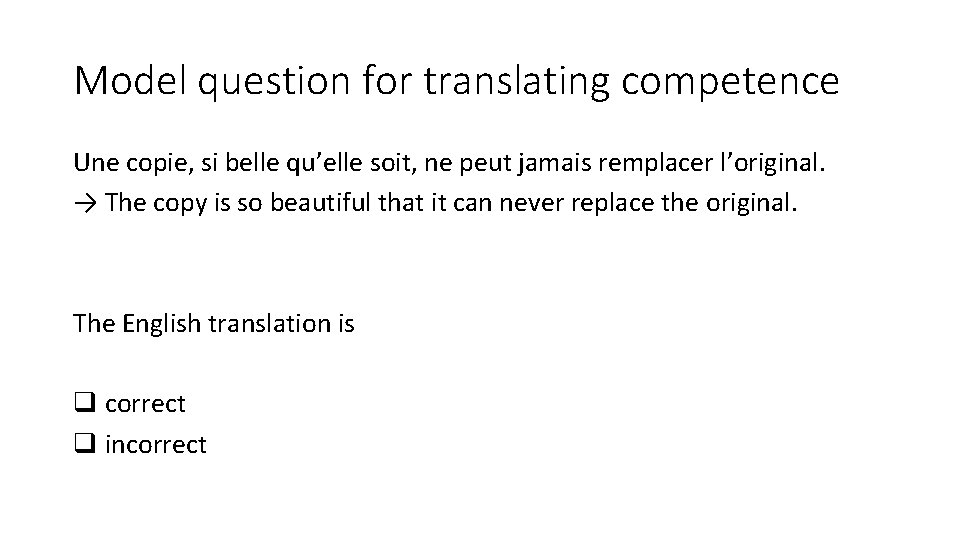
Model question for translating competence Une copie, si belle qu’elle soit, ne peut jamais remplacer l’original. → The copy is so beautiful that it can never replace the original. The English translation is q correct q incorrect
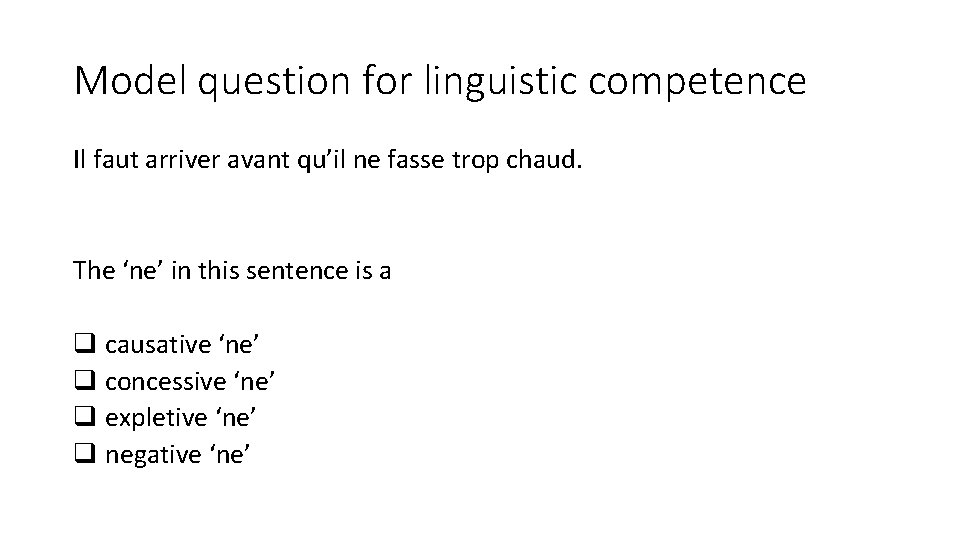
Model question for linguistic competence Il faut arriver avant qu’il ne fasse trop chaud. The ‘ne’ in this sentence is a q causative ‘ne’ q concessive ‘ne’ q expletive ‘ne’ q negative ‘ne’
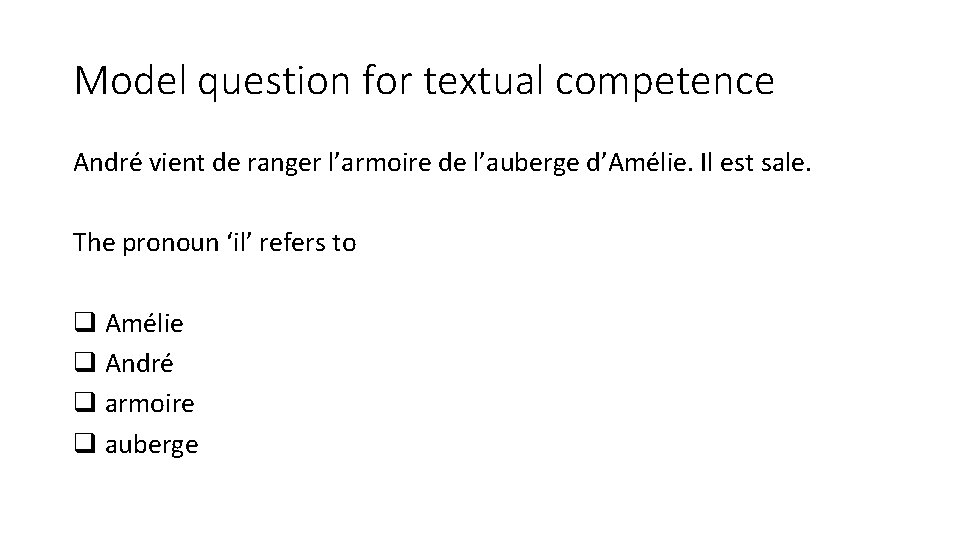
Model question for textual competence André vient de ranger l’armoire de l’auberge d’Amélie. Il est sale. The pronoun ‘il’ refers to q Amélie q André q armoire q auberge
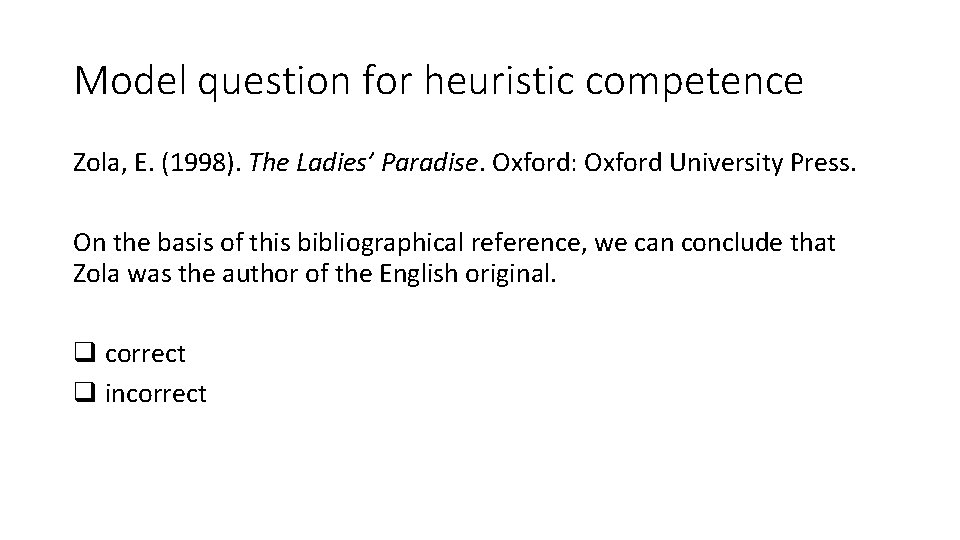
Model question for heuristic competence Zola, E. (1998). The Ladies’ Paradise. Oxford: Oxford University Press. On the basis of this bibliographical reference, we can conclude that Zola was the author of the English original. q correct q incorrect
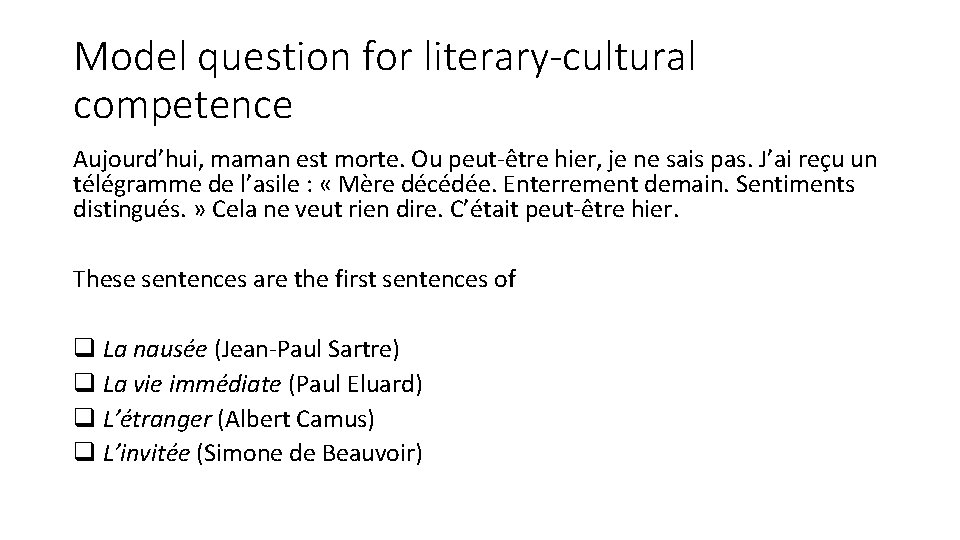
Model question for literary-cultural competence Aujourd’hui, maman est morte. Ou peut-être hier, je ne sais pas. J’ai reçu un télégramme de l’asile : « Mère décédée. Enterrement demain. Sentiments distingués. » Cela ne veut rien dire. C’était peut-être hier. These sentences are the first sentences of q La nausée (Jean-Paul Sartre) q La vie immédiate (Paul Eluard) q L’étranger (Albert Camus) q L’invitée (Simone de Beauvoir)
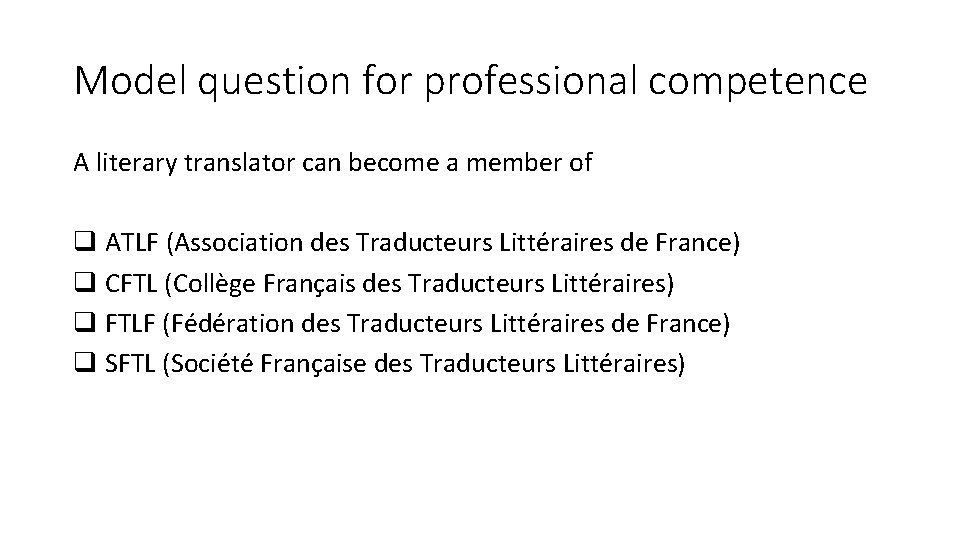
Model question for professional competence A literary translator can become a member of q ATLF (Association des Traducteurs Littéraires de France) q CFTL (Collège Français des Traducteurs Littéraires) q FTLF (Fédération des Traducteurs Littéraires de France) q SFTL (Société Française des Traducteurs Littéraires)
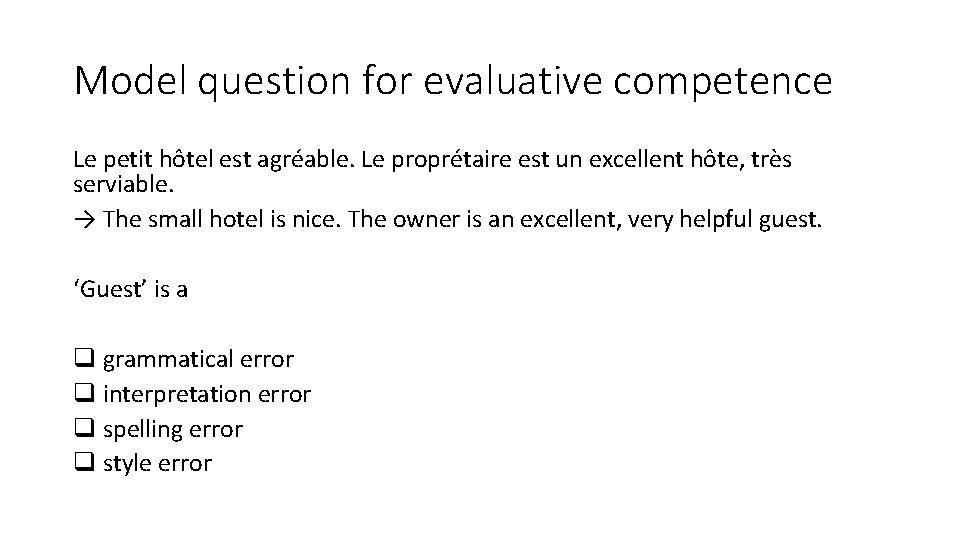
Model question for evaluative competence Le petit hôtel est agréable. Le proprétaire est un excellent hôte, très serviable. → The small hotel is nice. The owner is an excellent, very helpful guest. ‘Guest’ is a q grammatical error q interpretation error q spelling error q style error
Model question for research competence ‘Rebuilding the Bridge at Bommel. Notes on the Limits of Translatability’ is an article written by q James S. Holmes q Roman Jakobson q Jiří Levý q Gideon Toury
- Slides: 18