
Literary Terms Review Pt 1 Allegory An allegory

- Slides: 29
+ Literary Terms Review Pt. 1
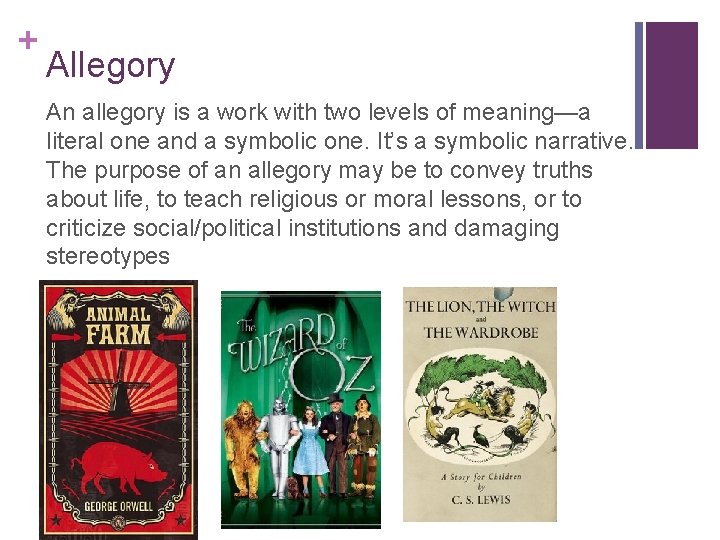
+ Allegory An allegory is a work with two levels of meaning—a literal one and a symbolic one. It’s a symbolic narrative. The purpose of an allegory may be to convey truths about life, to teach religious or moral lessons, or to criticize social/political institutions and damaging stereotypes
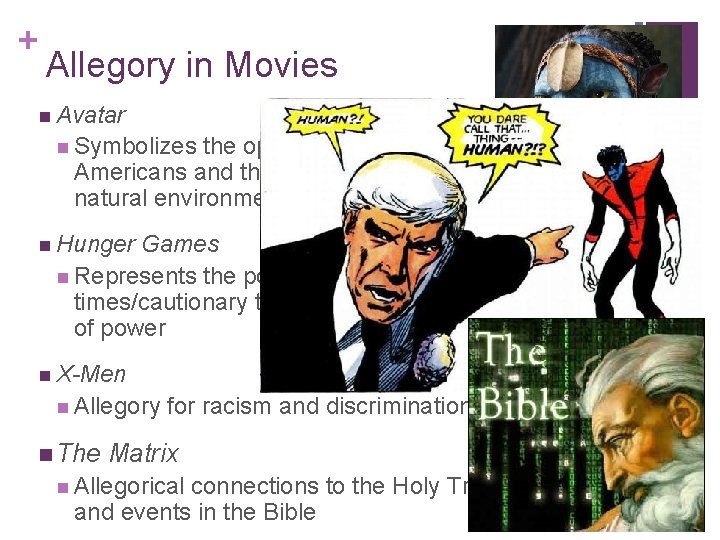
+ Allegory in Movies n Avatar n Symbolizes the oppression of Native Americans and the destruction of the natural environment n Hunger Games n Represents the politics of modern times/cautionary tale of politics and abuse of power n X-Men n Allegory n The for racism and discrimination Matrix n Allegorical connections to the Holy Trinity and events in the Bible
+ Alliteration is the repetition of consonant sounds at the beginning of two or more words in a row. Ex: “Deep into the darkness the dragon dropped. ” Ex: From James Joyce’s “The Dead” “His soul swooned slowly as he heard the snow falling faintly through the universe and faintly falling, like the descent of their last end, upon all the living and the dead. ” NON-example: “He’s called Gorgeous George. ” NON-example: “The shiny snake crept toward me. ”
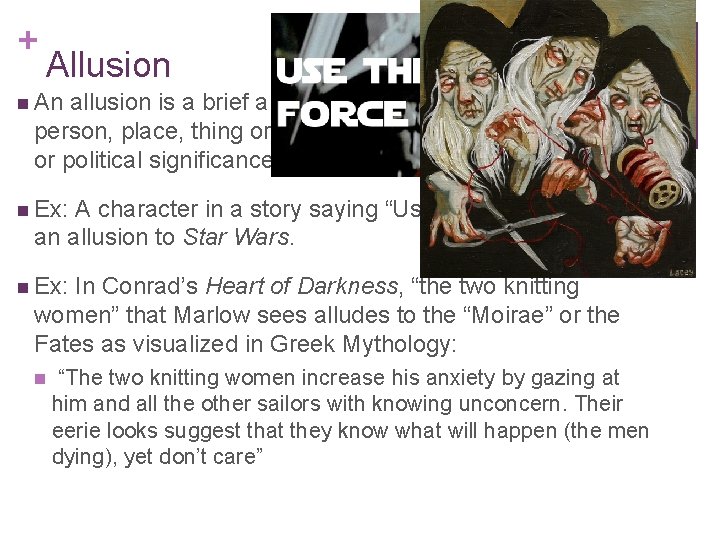
+ Allusion n An allusion is a brief and indirect reference to a famous person, place, thing or idea of historical, cultural, literary, or political significance. n Ex: A character in a story saying “Use the force, ” would be an allusion to Star Wars. n Ex: In Conrad’s Heart of Darkness, “the two knitting women” that Marlow sees alludes to the “Moirae” or the Fates as visualized in Greek Mythology: n “The two knitting women increase his anxiety by gazing at him and all the other sailors with knowing unconcern. Their eerie looks suggest that they know what will happen (the men dying), yet don’t care”
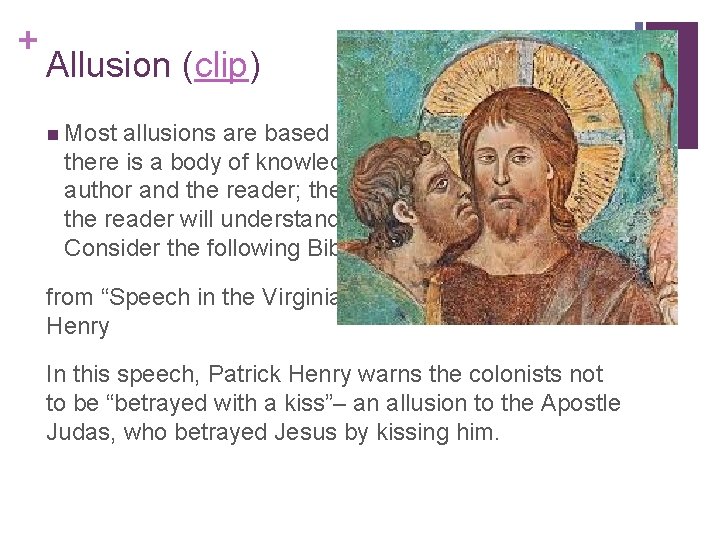
+ Allusion (clip) n Most allusions are based on the assumption that there is a body of knowledge that is shared by the author and the reader; therefore, it is assumed that the reader will understand the author’s reference. Consider the following Biblical example: from “Speech in the Virginia Convention” by Patrick Henry In this speech, Patrick Henry warns the colonists not to be “betrayed with a kiss”– an allusion to the Apostle Judas, who betrayed Jesus by kissing him.
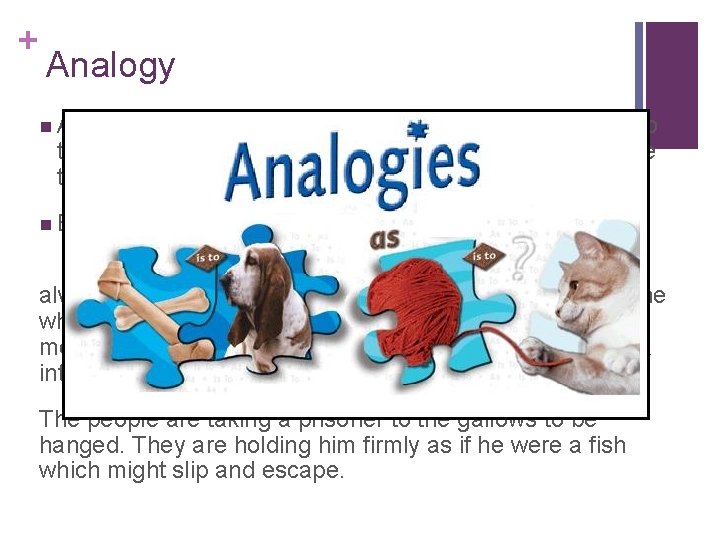
+ Analogy n An analogy is a point-by-point comparison between two things for the purpose of clarifying the less familiar of the two subjects. n Ex: From George Orwell’s narrative essay “A Hanging. ” “They crowded very close about him, with their hands always on him in a careful, caressing grip, as though all the while feeling him to make sure he was there. It was like men handling a fish which is still alive and may jump back into the water. ” The people are taking a prisoner to the gallows to be hanged. They are holding him firmly as if he were a fish which might slip and escape.
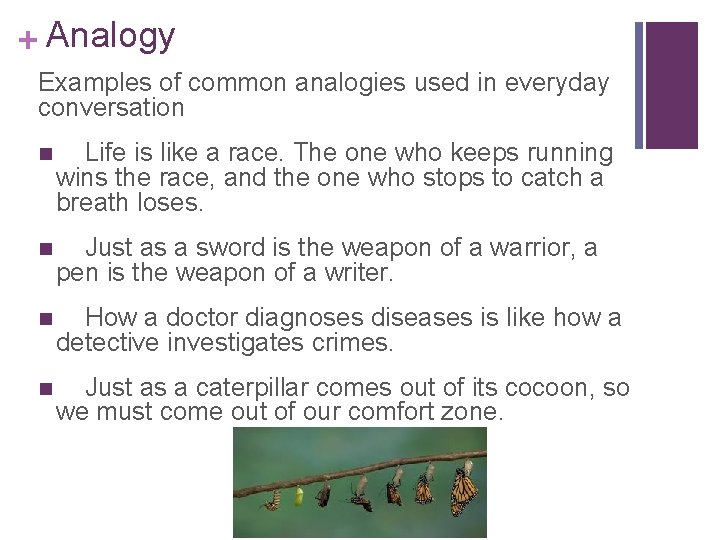
+ Analogy Examples of common analogies used in everyday conversation n Life is like a race. The one who keeps running wins the race, and the one who stops to catch a breath loses. n Just as a sword is the weapon of a warrior, a pen is the weapon of a writer. n How a doctor diagnoses diseases is like how a detective investigates crimes. n Just as a caterpillar comes out of its cocoon, so we must come out of our comfort zone.
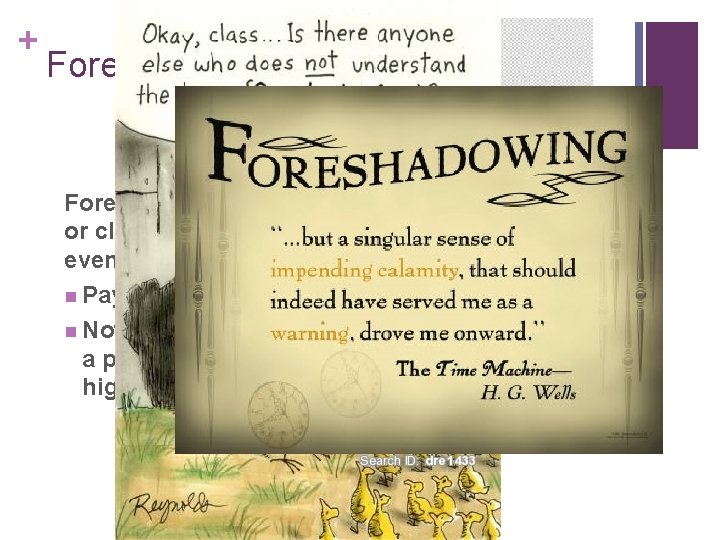
+ Foreshadowing is when a writer provides hints or clues in early scenes or discussions to set up events that will occur later n Pay attention to repeated or emphasized ideas n Notice when authors/speakers/characters make a pointed statement or when the author highlights or emphasizes an action
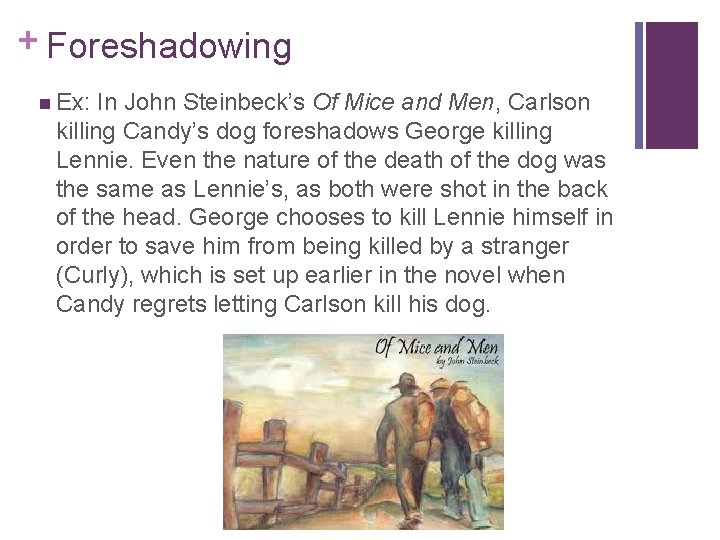
+ Foreshadowing n Ex: In John Steinbeck’s Of Mice and Men, Carlson killing Candy’s dog foreshadows George killing Lennie. Even the nature of the death of the dog was the same as Lennie’s, as both were shot in the back of the head. George chooses to kill Lennie himself in order to save him from being killed by a stranger (Curly), which is set up earlier in the novel when Candy regrets letting Carlson kill his dog.
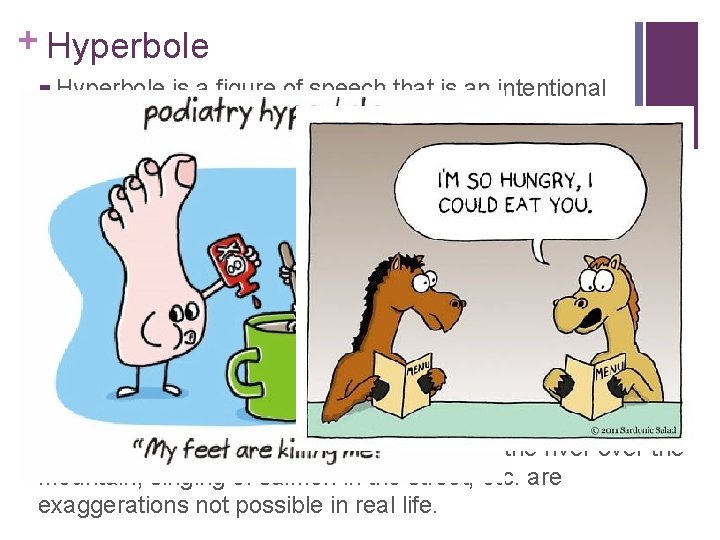
+ Hyperbole n Hyperbole is a figure of speech that is an intentional exaggeration used for emphasis or comic effect. n Ex: “I’ve told you a thousand times!” n Ex: From W. H Auden’s poem “As I Walked One Evening” I’ll love you, dear, I’ll love you Till China and Africa meet, And the river jumps over the mountain And the salmon sing in the street, I’ll love you till the ocean Is folded and hung up to dry The use of hyperbole can be noticed in the above lines. The meeting of China and Africa, the jumping of the river over the mountain, singing of salmon in the street, etc. are exaggerations not possible in real life.
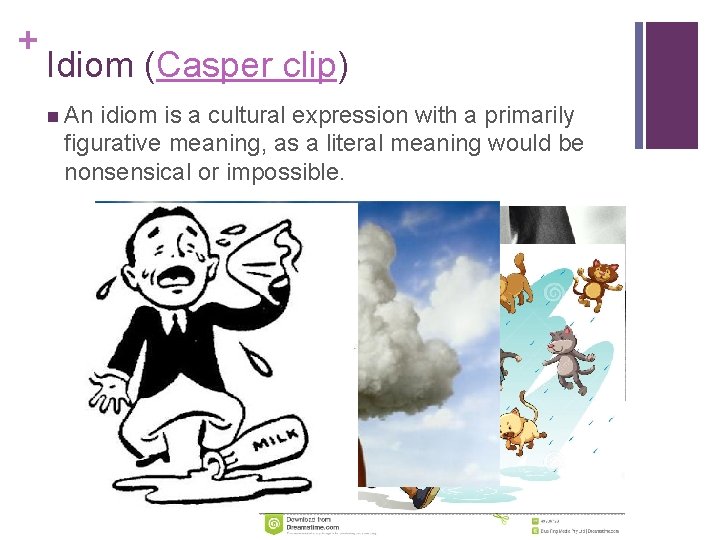
+ Idiom (Casper clip) n An idiom is a cultural expression with a primarily figurative meaning, as a literal meaning would be nonsensical or impossible.
+ Imagery n Descriptive words and phrases that describe something using sensory language (the five senses)—sight, sound, smell, taste, and touch. n The writer describes in such detail that the reader can picture it in his/her mind n “word picture”
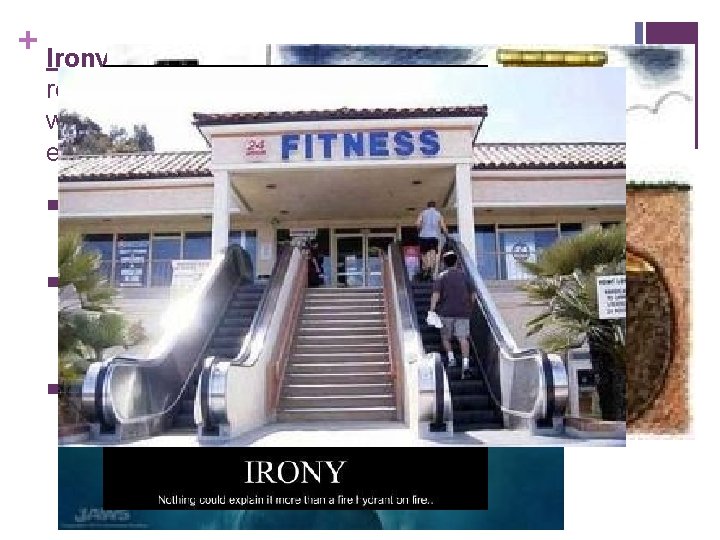
+ Irony (clip): contrast between appearance and reality—usually when reality is the opposite of what it seems—contrast between what is expected and what actually happens n Dramatic Irony: the reader knows something the characters do not n Verbal Irony: exists when someone knowingly exaggerates or says one thing and means another (clip) n Situational Irony: a contrast between what a reader or character expects and what actually exists or happens in a peculiar situation or circumstance
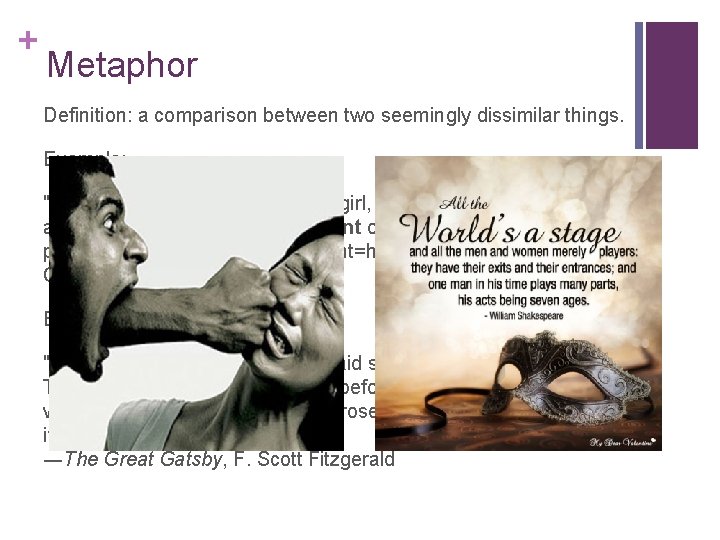
+ Metaphor Definition: a comparison between two seemingly dissimilar things. Example: "She really was a most charming girl, and might have passed for a captive fairy, whom that truculent ogre, Old Barley, had pressed into his service. " (truculent=hostile)--Great Expectations, Charles Dickens Example: " 'Her voice is full of money, ' he said suddenly. That was it. I’d never understood before. It was full of money-that was the inexhaustible charm that rose and fell in it, the jingle of it, the cymbals’ song of it. ” ―The Great Gatsby, F. Scott Fitzgerald
+ Mood The feeling of the reader created by the author/text through language/word choice (description, imagery, powerful vocabulary, and/or figures of speech/literary devices) Definition: Mood is how the READER feels about the atmosphere in the text n Example: “The river, reflecting the clear blue of the sky, glistened and sparkled as it flowed noiselessly on. ”—Charles Dickens from “Pickwick Papers” n Example: “For the moon never beams, without bringing me dreams Of the beautiful Annabel Lee; And the stars never rise, but I feel the bright eyes Of the beautiful Annabel Lee; And so, all the night-tide, I lie down by the side Of my darling—my life and my bride, In her sepulchre there by the sea— In her tomb by the sounding sea. ”—”Annabel Lee” by Edgar Allen Poe n This tells a tragic story of love and loss. The mood that this poem provokes in the reader is generally one of sadness and nostalgia. Poe inspires this mood by establishing a somber psychological setting and showing the art of the relationship up to Annabel Lee’s death.
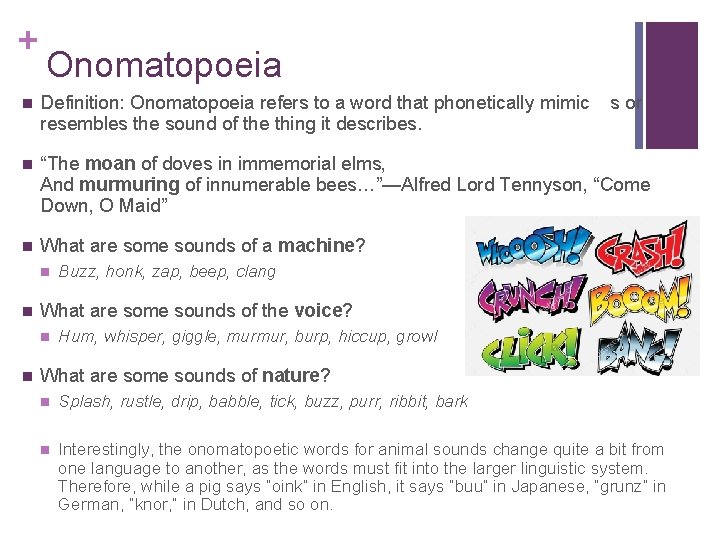
+ Onomatopoeia n Definition: Onomatopoeia refers to a word that phonetically mimic resembles the sound of the thing it describes. n “The moan of doves in immemorial elms, And murmuring of innumerable bees…”—Alfred Lord Tennyson, “Come Down, O Maid” n What are some sounds of a machine? n n Buzz, honk, zap, beep, clang What are some sounds of the voice? n n s or Hum, whisper, giggle, murmur, burp, hiccup, growl What are some sounds of nature? n Splash, rustle, drip, babble, tick, buzz, purr, ribbit, bark n Interestingly, the onomatopoetic words for animal sounds change quite a bit from one language to another, as the words must fit into the larger linguistic system. Therefore, while a pig says “oink” in English, it says “buu” in Japanese, “grunz” in German, “knor, ” in Dutch, and so on.
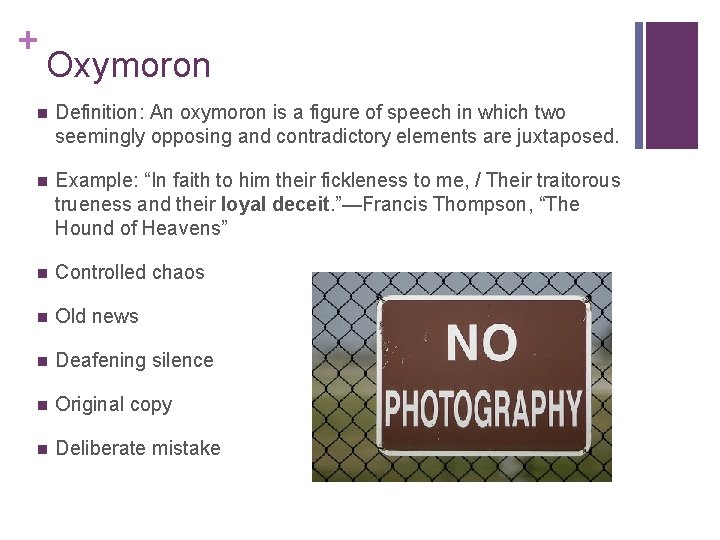
+ Oxymoron n Definition: An oxymoron is a figure of speech in which two seemingly opposing and contradictory elements are juxtaposed. n Example: “In faith to him their fickleness to me, / Their traitorous trueness and their loyal deceit. ”—Francis Thompson, “The Hound of Heavens” n Controlled chaos n Old news n Deafening silence n Original copy n Deliberate mistake
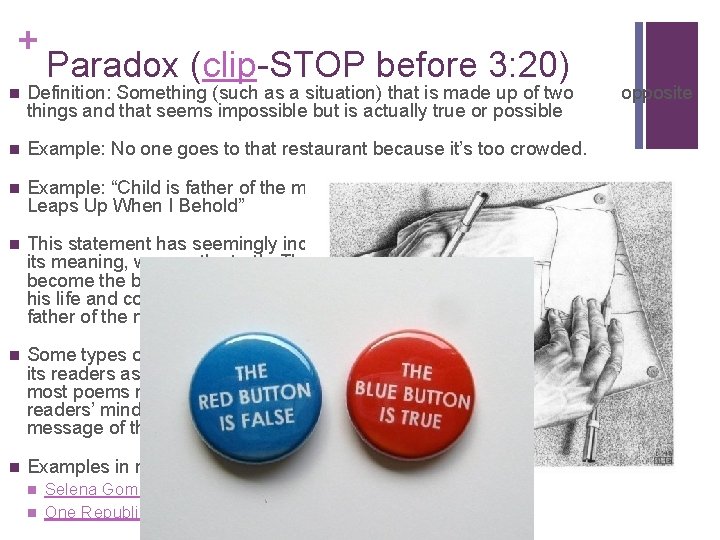
+ Paradox (clip-STOP before 3: 20) n Definition: Something (such as a situation) that is made up of two things and that seems impossible but is actually true or possible n Example: No one goes to that restaurant because it’s too crowded. n Example: “Child is father of the man”—William Wordsworth from “My Heart Leaps Up When I Behold” n This statement has seemingly incorrect proposition but when we look deep into its meaning, we see the truth. The poet is saying that the childhood experiences become the basis for all adult occurrences. The childhood of a person shapes his life and consequently “fathers” or creates the grown-up adult. So, “Child is father of the man. ” n Some types of paradox in poetry are meant to communicate a tone of irony to its readers as well as lead their thoughts to the immediate subject. Paradox in most poems normally strives to create feelings of intrigue and interest in readers’ minds to make them think deeper and harder to enjoy the real message of the poem. n Examples in music: n n Selena Gomez (stop at 0: 48) One Republic (stop at 1: 25) opposite
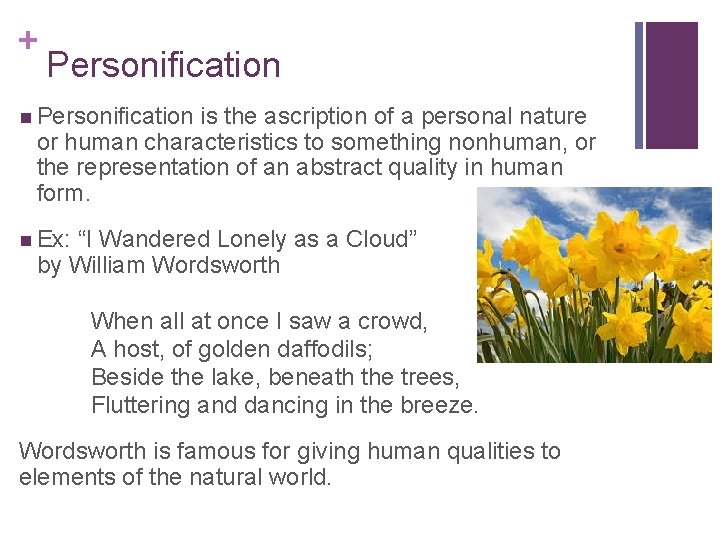
+ Personification n Personification is the ascription of a personal nature or human characteristics to something nonhuman, or the representation of an abstract quality in human form. n Ex: “I Wandered Lonely as a Cloud” by William Wordsworth When all at once I saw a crowd, A host, of golden daffodils; Beside the lake, beneath the trees, Fluttering and dancing in the breeze. Wordsworth is famous for giving human qualities to elements of the natural world.
+ Personification n Ex: Taken from L. M. Montgomery’s The Green Gables Letters “I hied me away to the woods—away back into the sunwashed alleys carpeted with fallen gold and glades where the moss is green and vivid yet. The woods are getting ready to sleep—they are not yet asleep but they are disrobing and are having all sorts of little bed-time conferences and whisperings and good-nights. ” The forest has been beautifully personified as the forest is getting ready to sleep, busy in bed-time chatting and wishing good-nights, all of which are human customs.
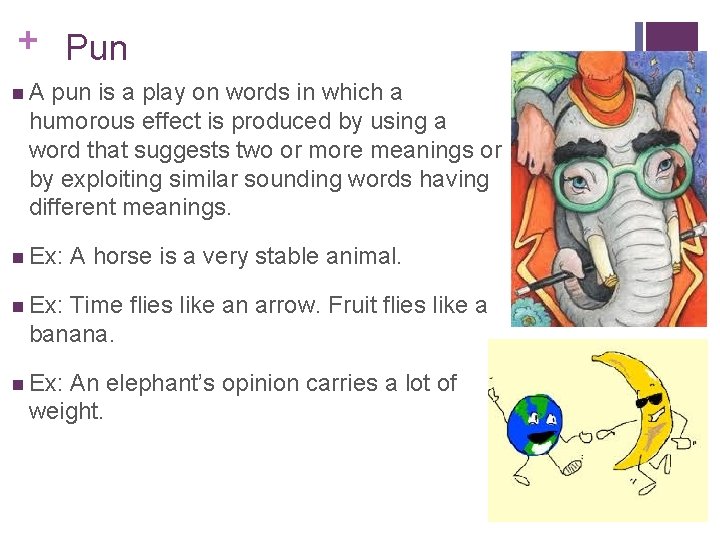
+ Pun n. A pun is a play on words in which a humorous effect is produced by using a word that suggests two or more meanings or by exploiting similar sounding words having different meanings. n Ex: A horse is a very stable animal. n Ex: Time flies like an arrow. Fruit flies like a banana. n Ex: An elephant’s opinion carries a lot of weight.
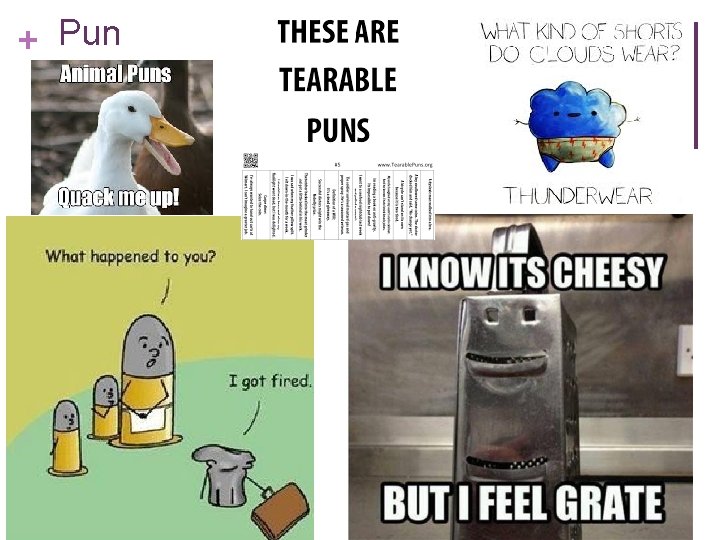
+ Pun
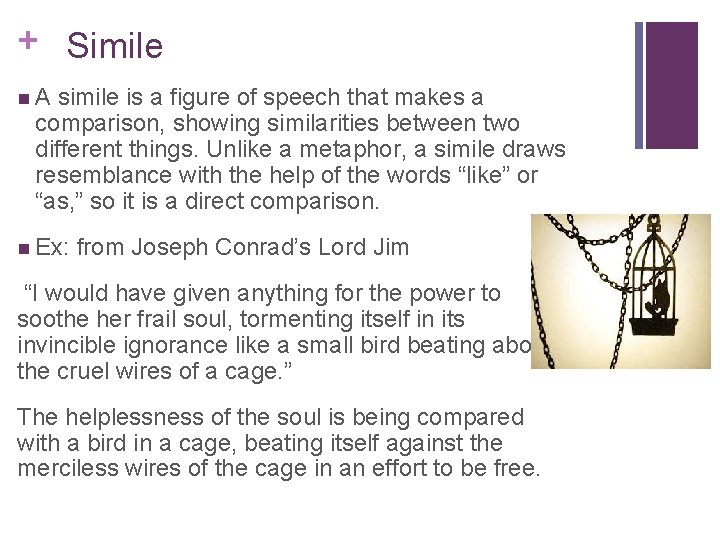
+ Simile n. A simile is a figure of speech that makes a comparison, showing similarities between two different things. Unlike a metaphor, a simile draws resemblance with the help of the words “like” or “as, ” so it is a direct comparison. n Ex: from Joseph Conrad’s Lord Jim “I would have given anything for the power to soothe her frail soul, tormenting itself in its invincible ignorance like a small bird beating about the cruel wires of a cage. ” The helplessness of the soul is being compared with a bird in a cage, beating itself against the merciless wires of the cage in an effort to be free.
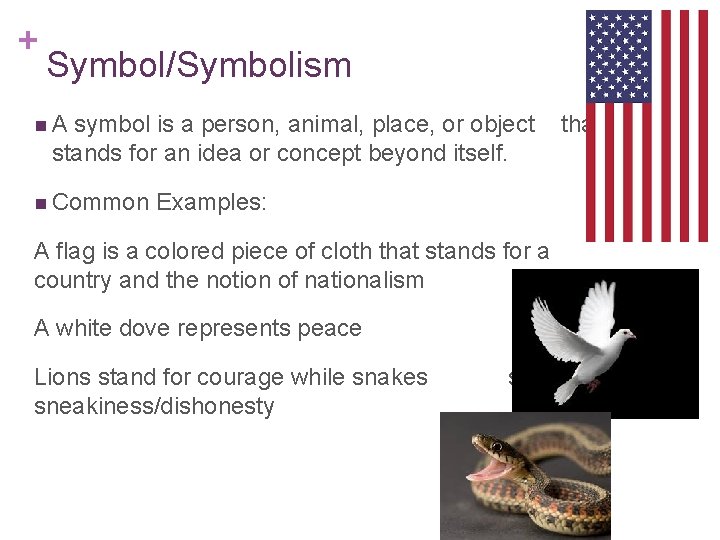
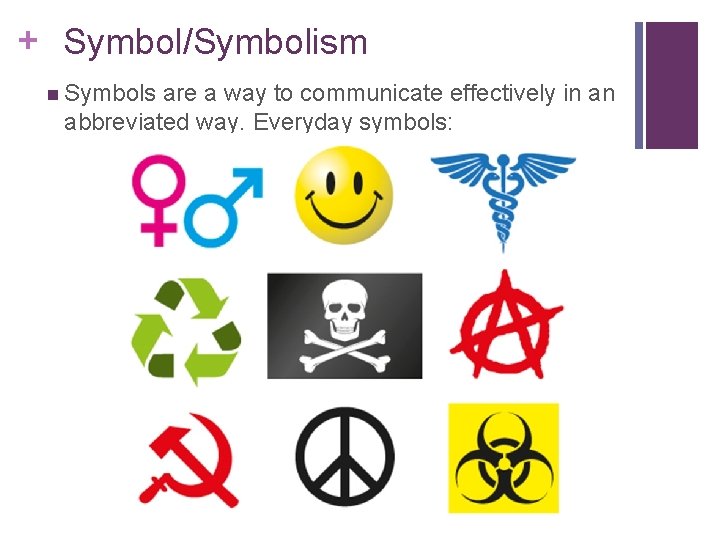
+ Symbol/Symbolism n. A symbol is a person, animal, place, or object stands for an idea or concept beyond itself. n Common that Examples: A flag is a colored piece of cloth that stands for a country and the notion of nationalism A white dove represents peace Lions stand for courage while snakes sneakiness/dishonesty symbolize
+ Symbol/Symbolism n Symbols are a way to communicate effectively in an abbreviated way. Everyday symbols:
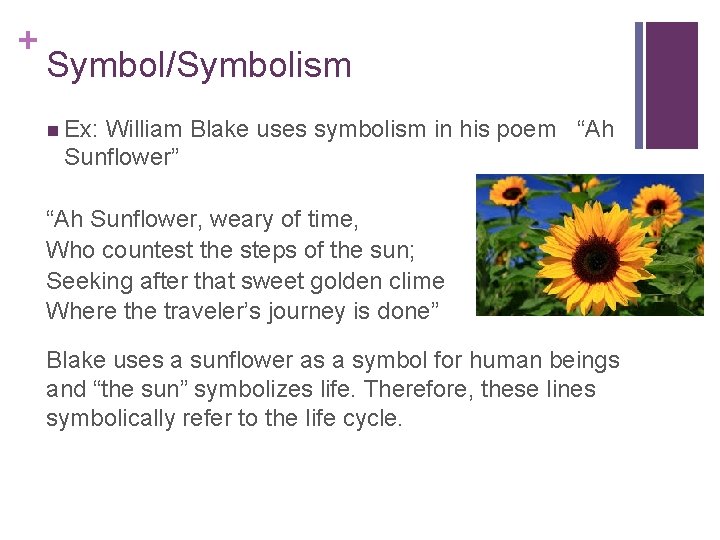
+ Symbol/Symbolism n Ex: William Blake uses symbolism in his poem “Ah Sunflower” “Ah Sunflower, weary of time, Who countest the steps of the sun; Seeking after that sweet golden clime Where the traveler’s journey is done” Blake uses a sunflower as a symbol for human beings and “the sun” symbolizes life. Therefore, these lines symbolically refer to the life cycle.
+ Tone n Tone is the AUTHOR’S attitude toward the audience, the subject, or the occasion n You can recognize tone by looking at the language/word choices the author uses, as these choices will reveal the author’s perspective or opinion n Consider the tone of The School by Donald Barthelme. Words like "died" and "depressing" set a hopeless and unhappy tone: And the trees all died. They were orange trees. I don’t know why they died, they just died. Something wrong with the soil possibly or maybe the stuff we got from the nursery wasn’t the best. We complained about it. So we’ve got thirty kids there, each kid had his or her own little tree to plant and we’ve got these thirty dead trees. All these kids looking at these little brown sticks, it was depressing. n The image of “little brown sticks” and the notion of disappointed children also reflect a sober, dejected tone.
+ Tone n Holden Caulfield in J. D Salinger’s Catcher in the Rye reveals his personality through the tone he adopts throughout the novel. Consider some of Holden’s remarks: n “All morons hate it when you call them a moron. ” n “If a girl looks swell when she meets you, who gives a damn if she’s late? Nobody. ” n “Goddamn money. It always ends up making you blue as hell. ” n “People never believe you. ” n Holden’s tone is bitter and pessimistic as he criticizes people and elements of his environment. His character may reveal the attitude of the writer toward life, as it is common for writers to use their characters as their mouthpieces.