
Literary terms onomatopoeia adverbs metaphor repetition alliteration sibilance
Literary terms: onomatopoeia, adverbs, metaphor, repetition, alliteration, sibilance, powerful adjectives, simile, monosyllabic phrase, pathetic fallacy, emotive language, short sentences, structure, sensuous description, rule of three, extended vocabulary, varied punctuation Check out the blog for more revision materials: http: //www. justuslearning. com/? p=303 Miss L. Hamilton Extend your thinking@ Bishop Justus 2013/2014 Year 11 Term 3 – English Language Exam Lesson 2: Question 3 LQ: Am I able to respond to the question regarding thoughts and feelings and analyse the language used to express them?
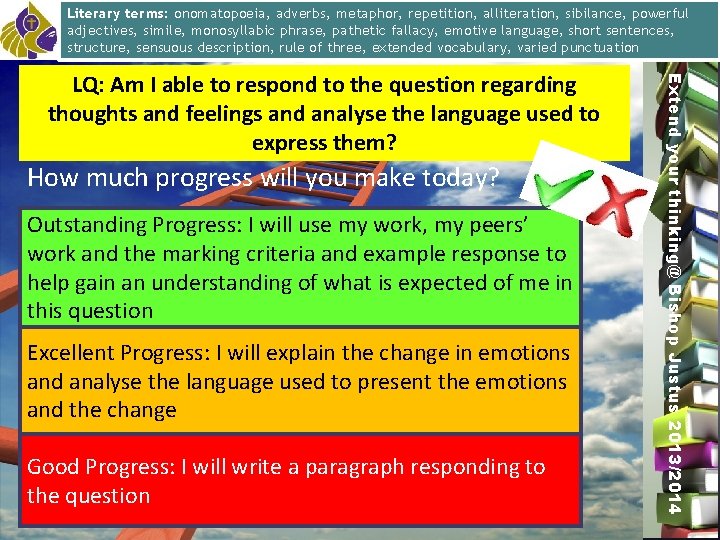
Literary onomatopoeia, metaphor, repetition, alliteration, sibilance, Literary terms: Techniques: Dramaticadverbs, irony, imagery, simile, metaphor, oxymoron, rule ofpowerful 3 adjectives, simile, portrays, monosyllabic phrase, pathetic fallacy, emotive language, short sentences, Formula Words: suggests, emphasises, represents, reflects, illustrates, highlights structure, sensuous description, rulecharacter, of three, extended vocabulary, varied punctuation Key Words: Shakespeare, tragedy, Verona, interpretation, Elizabethan audience How much progress will you make today? Outstanding Progress: I will use my work, my peers’ work and the marking criteria and example response to help gain an understanding of what is expected of me in this question Excellent Progress: I will explain the change in emotions and analyse the language used to present the emotions and the change Good Progress: I will write a paragraph responding to the question Extend your thinking@ Bishop Justus 2013/2014 LQ: Am I able to respond to the question regarding thoughts and feelings and analyse the language used to express them?
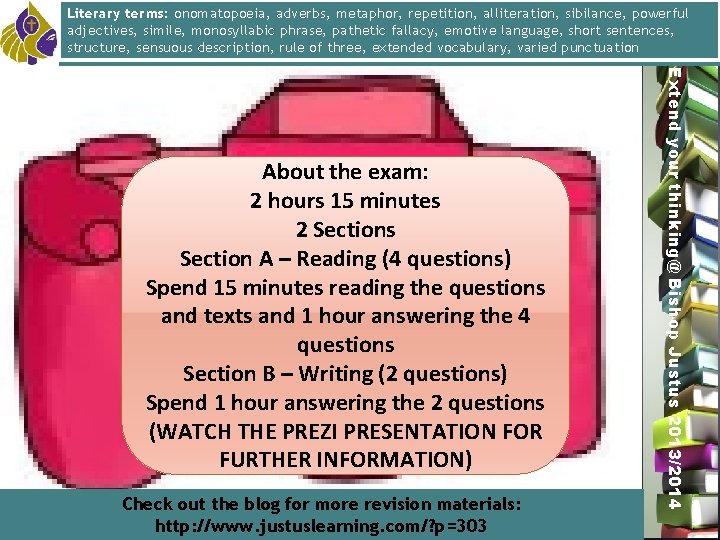
Literary terms: onomatopoeia, adverbs, metaphor, repetition, alliteration, sibilance, powerful adjectives, simile, monosyllabic phrase, pathetic fallacy, emotive language, short sentences, structure, sensuous description, rule of three, extended vocabulary, varied punctuation Check out the blog for more revision materials: http: //www. justuslearning. com/? p=303 Miss L. Hamilton Extend your thinking@ Bishop Justus 2013/2014 About the exam: 2 hours 15 minutes 2 Sections Section A – Reading (4 questions) Spend 15 minutes reading the questions and texts and 1 hour answering the 4 questions Section B – Writing (2 questions) Spend 1 hour answering the 2 questions (WATCH THE PREZI PRESENTATION FOR FURTHER INFORMATION)
Literary terms: onomatopoeia, adverbs, metaphor, repetition, alliteration, sibilance, powerful adjectives, simile, monosyllabic phrase, pathetic fallacy, emotive language, short sentences, structure, sensuous description, rule of three, extended vocabulary, varied punctuation Extend your thinking@ Bishop Justus 2013/2014 Check out the blog for more revision materials: http: //www. justuslearning. com/? p=303 Miss L. Hamilton

Literary terms: onomatopoeia, adverbs, metaphor, repetition, alliteration, sibilance, powerful adjectives, simile, monosyllabic phrase, pathetic fallacy, emotive language, short sentences, structure, sensuous description, rule of three, extended vocabulary, varied punctuation Extend your thinking@ Bishop Justus 2013/2014 Check out the blog for more revision materials: http: //www. justuslearning. com/? p=303 Miss L. Hamilton
Literary terms: onomatopoeia, adverbs, metaphor, repetition, alliteration, sibilance, powerful adjectives, simile, monosyllabic phrase, pathetic fallacy, emotive language, short sentences, structure, sensuous description, rule of three, extended vocabulary, varied punctuation Review your 3 points in relation to the examiner’s report and divide these up in the group for each person or pair to write one paragraph Extension Task: How will you ensure your response flows and the development of thoughts and feelings is explored? Check out the blog for more revision materials: LQ: http: //www. justuslearning. com/? p=303 Miss L. Hamilton Extend your thinking@ Bishop Justus 2013/2014 Starter: Group Recap Activity
Literary terms: onomatopoeia, adverbs, metaphor, repetition, alliteration, sibilance, powerful adjectives, simile, monosyllabic phrase, pathetic fallacy, emotive language, short sentences, structure, sensuous description, rule of three, extended vocabulary, varied punctuation Write your paragraph responding to the question: ‘Explain some of the thoughts and feelings Parrado and Canessa have whilst searching for rescue. ’ Consider the marking criteria and your target grade Extend your thinking@ Bishop Justus 2013/2014 Introduction: Individual/Paired Writing Task Extension Task: Can you use make your writing perceptive and detailed? Check out the blog for more revision materials: LQ: http: //www. justuslearning. com/? p=303 Miss L. Hamilton
Literary terms: onomatopoeia, adverbs, metaphor, repetition, alliteration, sibilance, powerful adjectives, simile, monosyllabic phrase, pathetic fallacy, emotive language, short sentences, structure, sensuous description, rule of three, extended vocabulary, varied punctuation Look through your whole response and ensure it is the best that it can be Consider the example response which scored full marks – how can you improve your response in line with that? Extension Task: Extend your vocabulary and ensure you are analysing language and explaining in detail Check out the blog for more revision materials: LQ: http: //www. justuslearning. com/? p=303 Miss L. Hamilton Extend your thinking@ Bishop Justus 2013/2014 Task 1: Group Evaluation Task
Literary terms: onomatopoeia, adverbs, metaphor, repetition, alliteration, sibilance, powerful adjectives, simile, monosyllabic phrase, pathetic fallacy, emotive language, short sentences, structure, sensuous description, rule of three, extended vocabulary, varied punctuation Swap responses with another group and mark their work using the marking criteria 1. Provide the mark and band 2. Highlight the parts that are particularly good 3. Include a WWW/EBI comment Extension Task: Rewrite a paragraph and improve it Check out the blog for more revision materials: LQ: http: //www. justuslearning. com/? p=303 Miss L. Hamilton Extend your thinking@ Bishop Justus 2013/2014 Task 2: Group Evaluation Task
Literary terms: onomatopoeia, adverbs, metaphor, repetition, alliteration, sibilance, powerful adjectives, simile, monosyllabic phrase, pathetic fallacy, emotive language, short sentences, structure, sensuous description, rule of three, extended vocabulary, varied punctuation Share the highest marked response and discuss as a class why that got the highest mark Write yourself a target for question 3 Extension Task: Use the blog and past papers at home to help you meet this target Check out the blog for more revision materials: LQ: http: //www. justuslearning. com/? p=303 Miss L. Hamilton Extend your thinking@ Bishop Justus 2013/2014 Plenary: Consolidation Task
Literary onomatopoeia, metaphor, repetition, alliteration, sibilance, Literary terms: Techniques: Dramaticadverbs, irony, imagery, simile, metaphor, oxymoron, rule ofpowerful 3 adjectives, simile, portrays, monosyllabic phrase, pathetic fallacy, emotive language, short sentences, Formula Words: suggests, emphasises, represents, reflects, illustrates, highlights structure, sensuous description, rulecharacter, of three, extended vocabulary, varied punctuation Key Words: Shakespeare, tragedy, Verona, interpretation, Elizabethan audience How much progress will you make today? Outstanding Progress: I will use my work, my peers’ work and the marking criteria and example response to help gain an understanding of what is expected of me in this question Excellent Progress: I will explain the change in emotions and analyse the language used to present the emotions and the change Good Progress: I will write a paragraph responding to the question Extend your thinking@ Bishop Justus 2013/2014 LQ: Am I able to respond to the question regarding thoughts and feelings and analyse the language used to express them?
- Slides: 11