
Literary Terms Literature COMMUNICATIONS 12 32 SETTING Setting


- Slides: 15
Literary Terms: Literature COMMUNICATIONS 12
#32. SETTING � Setting is the TIME and PLACE of the story � Setting is key to establishing MOOD or EMOTION in a story
#23. PLOT � Plot � See is what happens in a story your plot chart notes for details of how a plot works
26. POINT OF VIEW � � � The point of view of a story refers to who is telling the story. First Person: Narrator uses “I” Second Person: Narrator uses “you” Third Person/Limited Omniscient: A god-like narrator who follows the thoughts and feelings of one character. Uses “he” or “she” Omniscient: God-like narrator who knows the thoughts and feelings of all characters Dramatic/Objective: The story is told through the actions and dialogue of the characters
12. IRONY � Irony is when what happens is the opposite of what is expected. There a few kinds of irony. � Dramatic Irony: The audience knows something that the character does not. � Verbal Irony: When the opposite of what is meant is said (basic form: sarcasm) � Situational Irony: when the opposite of what was expected happens.
Dramatic Irony: You know what the farmer does not
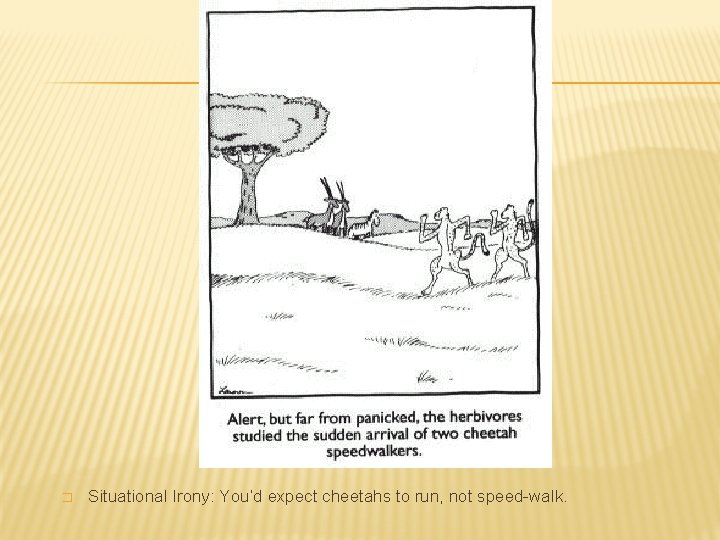
� Situational Irony: You’d expect cheetahs to run, not speed-walk.
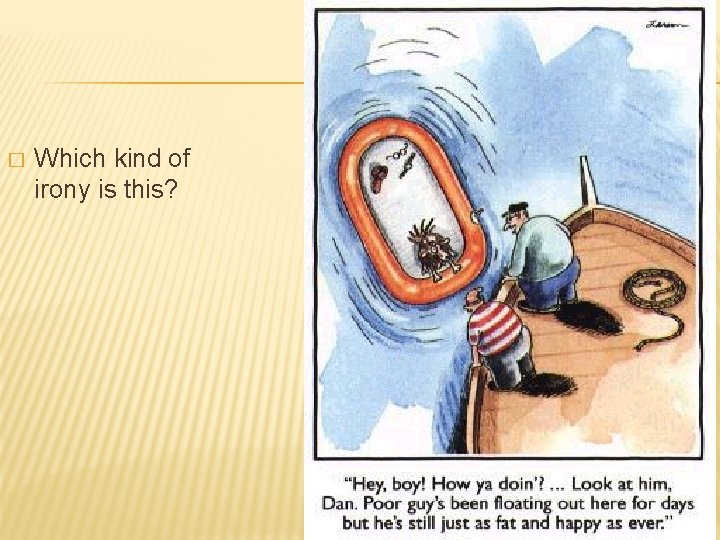
� Which kind of irony is this?
16. NARRATOR � The teller of the story � An unreliable narrator is a story teller whose story may be biased and whose views cannot be trusted by the reader
5. CONFLICT � Conflict is the problem of the story � Two types: External and Internal External: Person vs. Nature Person vs. Society Internal: Person vs. Self
39. THEME � Theme is the overarching idea or message meant to be communicated to the reader � When written about in formal writing, theme should always be communicated as a statement. � Eg. One must open one’s heart to love
38. SYMBOL �A symbol is a person, object, or thing in a piece of writing that represents an idea, concept or emotion. � Eg. Lion for courage � Symbols may take on different meaning depending upon the context in which they appear
11. IMAGERY � Imagery is the language in a piece of writing that appeals to the five senses. � Sight, sound, touch, taste, smell
3. CHARACTER �A character is the player of the story. � Round: Many traits are described � Dynamic: The character grows and changes in the course of the story � Flat: Few traits are described � Static: The character does not grow or change in the course of the story.
7. FORSHADOWING �A literary device where the author gives clues or suggestions as to what is going to happen later in the literary work.