
Literary Movements Understanding Literature through genre and historical

- Slides: 18
Literary Movements Understanding Literature through genre and historical time periods……. . Mrs. Atkins: 10 th grade honors presentation
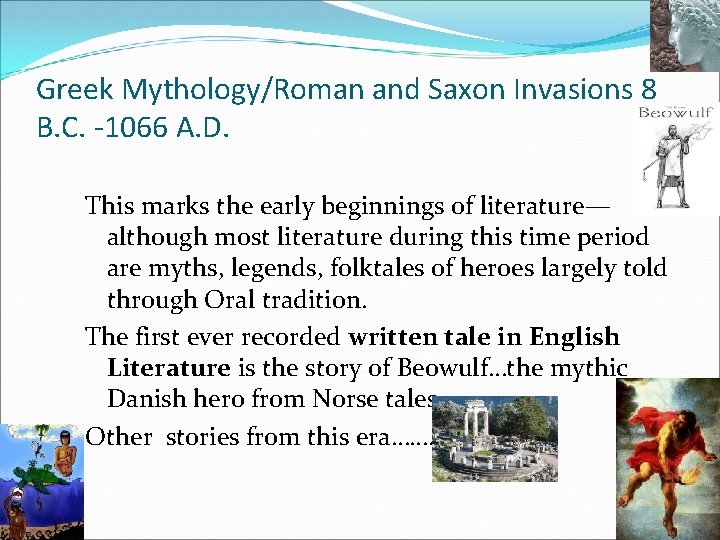
Greek Mythology/Roman and Saxon Invasions 8 B. C. -1066 A. D. This marks the early beginnings of literature— although most literature during this time period are myths, legends, folktales of heroes largely told through Oral tradition. The first ever recorded written tale in English Literature is the story of Beowulf…the mythic Danish hero from Norse tales. Other stories from this era…….
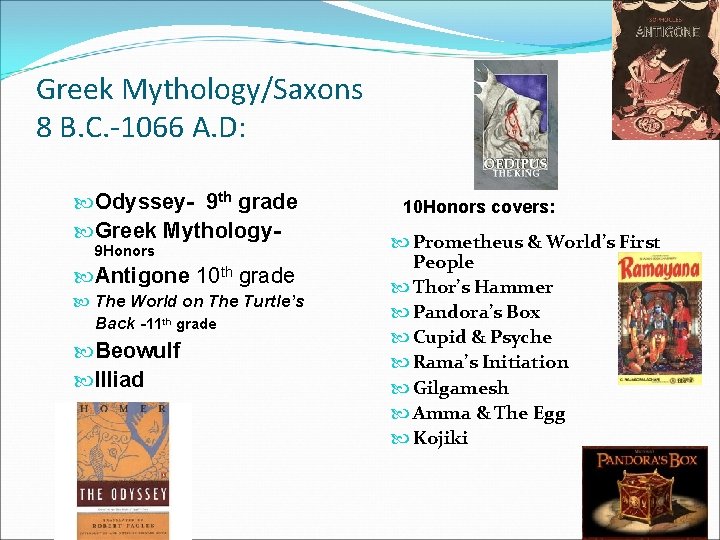
Greek Mythology/Saxons 8 B. C. -1066 A. D: Odyssey- 9 th grade Greek Mythology 9 Honors Antigone 10 th grade The World on The Turtle’s Back -11 th grade Beowulf Illiad 10 Honors covers: Prometheus & World’s First People Thor’s Hammer Pandora’s Box Cupid & Psyche Rama’s Initiation Gilgamesh Amma & The Egg Kojiki
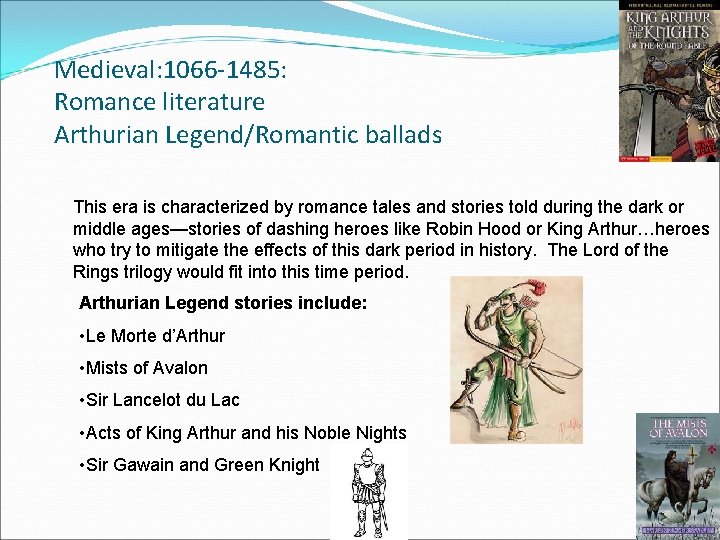
Medieval: 1066 -1485: Romance literature Arthurian Legend/Romantic ballads This era is characterized by romance tales and stories told during the dark or middle ages—stories of dashing heroes like Robin Hood or King Arthur…heroes who try to mitigate the effects of this dark period in history. The Lord of the Rings trilogy would fit into this time period. Arthurian Legend stories include: • Le Morte d’Arthur • Mists of Avalon • Sir Lancelot du Lac • Acts of King Arthur and his Noble Nights • Sir Gawain and Green Knight
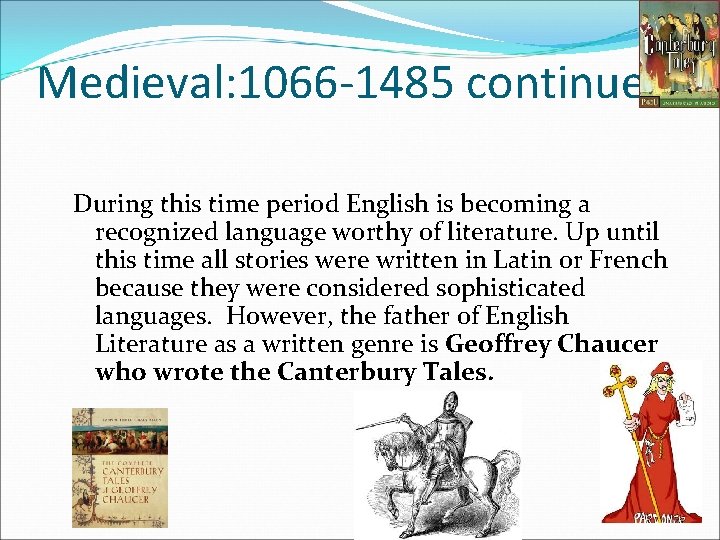
Medieval: 1066 -1485 continued During this time period English is becoming a recognized language worthy of literature. Up until this time all stories were written in Latin or French because they were considered sophisticated languages. However, the father of English Literature as a written genre is Geoffrey Chaucer who wrote the Canterbury Tales.
Renaissance 1485 -1600 Shakespeare/Sonnets Art, Literature, Science flourish after the dark ages and Europe experiences a cultural renaissance—rebirth marked by poets, artists, writers. The sonnet emerges, plays are performed openly in theatres, and Shakespeare takes the stage…. Romeo & Juliet 9 H Julius Caesar 10 P/10 H Midsummer’s Nights Dream 10 P Macbeth 10 H Hamlet AP Lit Othello AP Lit Lear AP Lit Sonnets by: • Petrarch • Spenser • Shakespeare Shall I Compare thee to a summer’s day…….
Biblical Literature, Puritans & American Colonists(1600 s-1750 s) Milton (Pardise Lost), Blake (Poison Tree, Lamb Poems John Donne: [Tales of Love/Death] A Valediction Forbidding Mourning Holy Sonnet 10: Death Be Not Proud Omar Khayyam: Rubaiyat Ecclesiastes Chapter 3 Psalms Prodigal Son Genesis Cain & Abel Sinner’s In the Hands of Angry God John Milton’s: Paradise Lost While England struggled to restore spiritual and religious order to society after Enjoying the “renaissance” lifestyle, many quakers and puritans left for the New World in America where they could start anew. King James in England Had the bible written in English: King James version and many literary writers Of the era focused on religious and metaphysical themes. *The Scarlet Letter & The Crucible accurately reflect this time period although neither texts were Written during this time period.
Puritan beliefs �Puritans believed: �T – total depravity (Adam’s fall – humanity did not have the privilege of talking to God) �U – unconditional salvation (can’t earn it) �L – limited atonement (Christ did not die for all sinners, but only the elect) �I – irresistible grace (you can’t earn or refuse it) �P – perseverance of grace (once you are in a state of grace, you cannot lose it) �Colonists believed in human reason and intelligence. Science and reason would ultimately triumph over ignorance and create a better world for all. This faith in science, reason, progress, and freedom came to be known as “the Enlightenment. ”
Age of Reason 1750 -1800 Highly instructive or didactic movement teaching values, encouraging freedom/independence � The Age of Enlightenment refers to the 18 th century in European philosophy, and is often thought of as part of a larger period which includes the Age of Reason. � The term also more specifically refers to a historical intellectual movement, "The Enlightenment. " This movement advocated rationality as a means to establish an authoritative system of ethics, aesthetics, and knowledge. � The intellectual leaders of this movement regarded themselves as courageous and elite, and regarded their purpose as leading the world toward progress and out of a long period of doubtful tradition, full of irrationality, superstition, and tyranny, (which they believed began during a historical period they called the "Dark Ages"). � This movement also provided a framework for the American and French Revolutions, as well leading to the rise of capitalism and the birth of socialism. Patriotism grows Instills pride � Creates common agreement about issues � National mission and the American character`
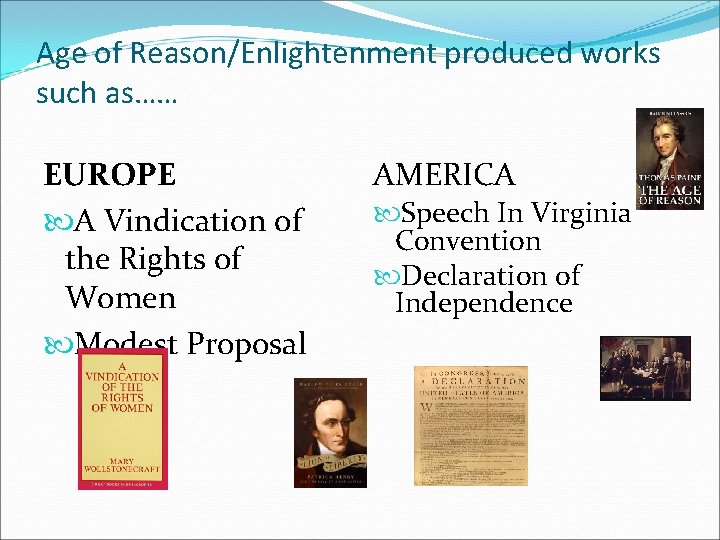
Age of Reason/Enlightenment produced works such as…… EUROPE A Vindication of the Rights of Women Modest Proposal AMERICA Speech In Virginia Convention Declaration of Independence
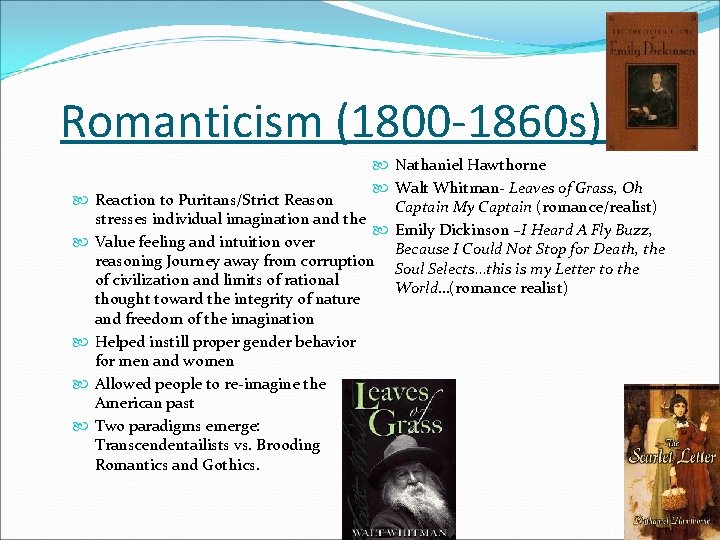
Romanticism (1800 -1860 s); Nathaniel Hawthorne Walt Whitman- Leaves of Grass, Oh Reaction to Puritans/Strict Reason Captain My Captain (romance/realist) stresses individual imagination and the Emily Dickinson –I Heard A Fly Buzz, Value feeling and intuition over Because I Could Not Stop for Death, the reasoning Journey away from corruption Soul Selects…this is my Letter to the of civilization and limits of rational World…(romance realist) thought toward the integrity of nature and freedom of the imagination Helped instill proper gender behavior for men and women Allowed people to re-imagine the American past Two paradigms emerge: Transcendentailists vs. Brooding Romantics and Gothics.
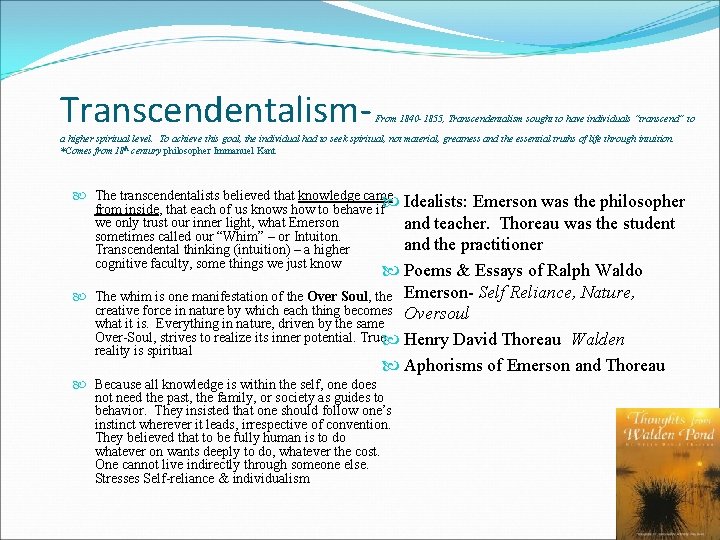
Transcendentalism- From 1840 -1855, Transcendentalism sought to have individuals “transcend” to a higher spiritual level. To achieve this goal, the individual had to seek spiritual, not material, greatness and the essential truths of life through intuition. *Comes from 18 th century philosopher Immanuel Kant The transcendentalists believed that knowledge came from inside, that each of us knows how to behave if Idealists: Emerson was the philosopher we only trust our inner light, what Emerson and teacher. Thoreau was the student sometimes called our “Whim” – or Intuiton. and the practitioner Transcendental thinking (intuition) – a higher cognitive faculty, some things we just know Poems & Essays of Ralph Waldo The whim is one manifestation of the Over Soul, the Emerson- Self Reliance, Nature, creative force in nature by which each thing becomes Oversoul what it is. Everything in nature, driven by the same Over-Soul, strives to realize its inner potential. True Henry David Thoreau Walden reality is spiritual Aphorisms of Emerson and Thoreau Because all knowledge is within the self, one does not need the past, the family, or society as guides to behavior. They insisted that one should follow one’s instinct wherever it leads, irrespective of convention. They believed that to be fully human is to do whatever on wants deeply to do, whatever the cost. One cannot live indirectly through someone else. Stresses Self-reliance & individualism
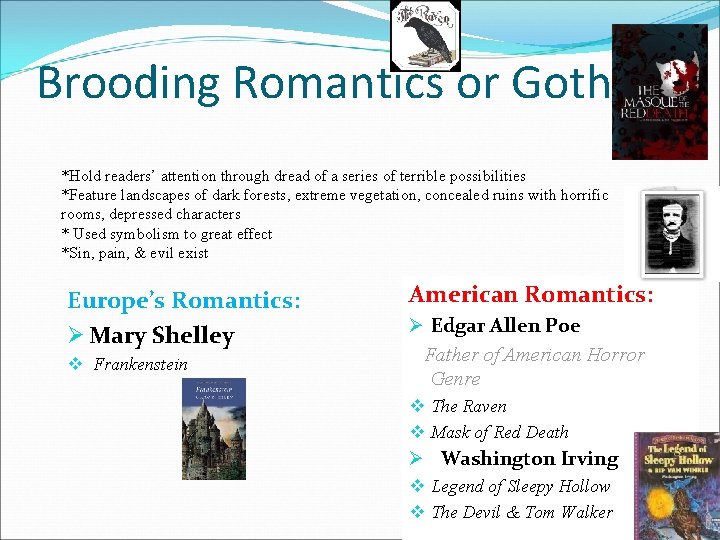
Brooding Romantics or Gothics *Hold readers’ attention through dread of a series of terrible possibilities *Feature landscapes of dark forests, extreme vegetation, concealed ruins with horrific rooms, depressed characters * Used symbolism to great effect *Sin, pain, & evil exist Europe’s Romantics: Ø Mary Shelley v Frankenstein American Romantics: Ø Edgar Allen Poe Father of American Horror Genre v The Raven v Mask of Red Death Ø Washington Irving v Legend of Sleepy Hollow v The Devil & Tom Walker
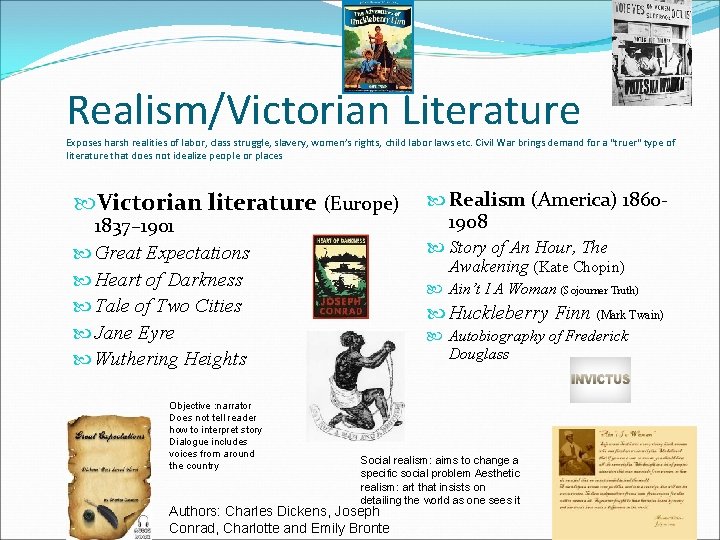
Realism/Victorian Literature Exposes harsh realities of labor, class struggle, slavery, women’s rights, child labor laws etc. Civil War brings demand for a "truer" type of literature that does not idealize people or places Victorian literature (Europe) 1837– 1901 Great Expectations Heart of Darkness Tale of Two Cities Jane Eyre Wuthering Heights Objective : narrator Does not tell reader how to interpret story Dialogue includes voices from around the country Realism (America) 18601908 Story of An Hour, The Awakening (Kate Chopin) Ain’t I A Woman (Sojourner Truth) Huckleberry Finn (Mark Twain) Autobiography of Frederick Douglass Social realism: aims to change a specific social problem Aesthetic realism: art that insists on detailing the world as one sees it Authors: Charles Dickens, Joseph Conrad, Charlotte and Emily Bronte
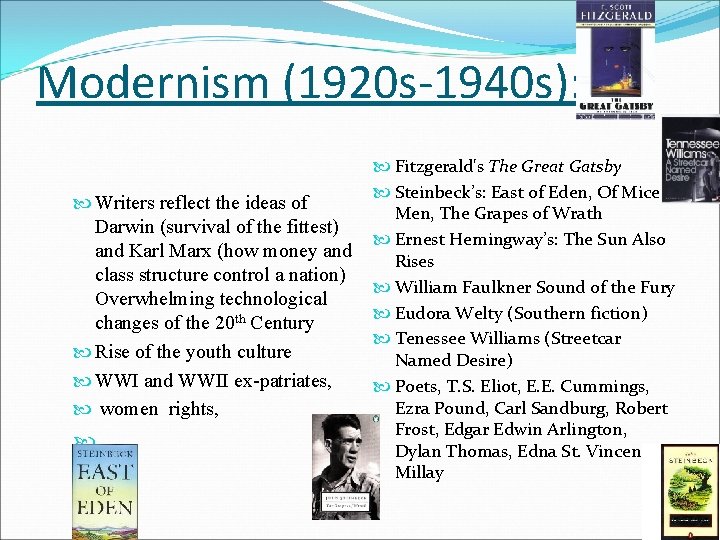
Modernism (1920 s-1940 s): Writers reflect the ideas of Darwin (survival of the fittest) and Karl Marx (how money and class structure control a nation) Overwhelming technological changes of the 20 th Century Rise of the youth culture WWI and WWII ex-patriates, women rights, Fitzgerald's The Great Gatsby Steinbeck’s: East of Eden, Of Mice & Men, The Grapes of Wrath Ernest Hemingway’s: The Sun Also Rises William Faulkner Sound of the Fury Eudora Welty (Southern fiction) Tenessee Williams (Streetcar Named Desire) Poets, T. S. Eliot, E. E. Cummings, Ezra Pound, Carl Sandburg, Robert Frost, Edgar Edwin Arlington, Dylan Thomas, Edna St. Vincent Millay
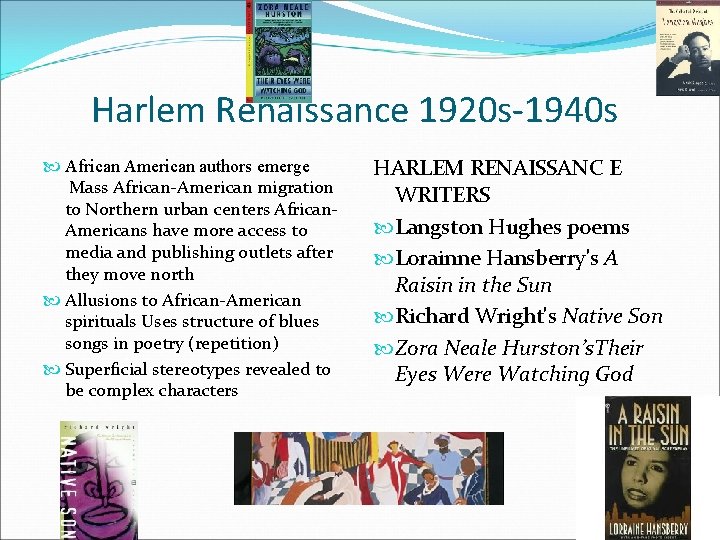
Harlem Renaissance 1920 s-1940 s African American authors emerge Mass African-American migration to Northern urban centers African. Americans have more access to media and publishing outlets after they move north Allusions to African-American spirituals Uses structure of blues songs in poetry (repetition) Superficial stereotypes revealed to be complex characters HARLEM RENAISSANC E WRITERS Langston Hughes poems Lorainne Hansberry's A Raisin in the Sun Richard Wright's Native Son Zora Neale Hurston’s. Their Eyes Were Watching God
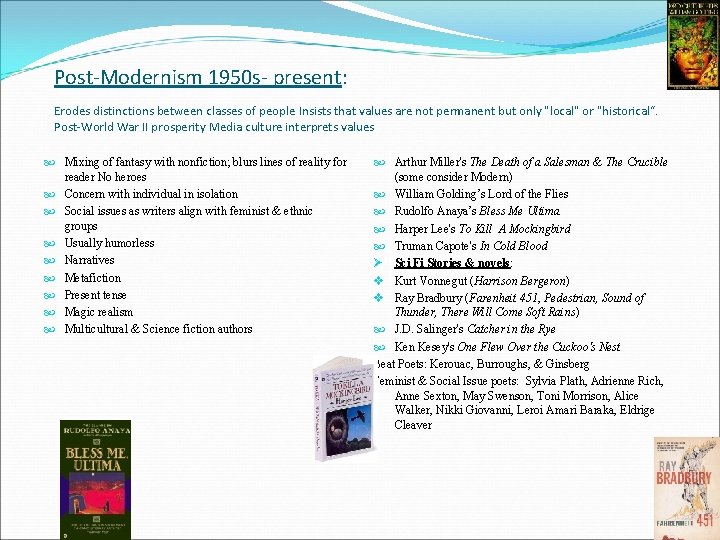
Post-Modernism 1950 s- present: Erodes distinctions between classes of people Insists that values are not permanent but only "local" or "historical“. Post-World War II prosperity Media culture interprets values Mixing of fantasy with nonfiction; blurs lines of reality for reader No heroes Concern with individual in isolation Social issues as writers align with feminist & ethnic groups Usually humorless Narratives Metafiction Present tense Magic realism Multicultural & Science fiction authors Arthur Miller's The Death of a Salesman & The Crucible (some consider Modern) William Golding’s Lord of the Flies Rudolfo Anaya’s Bless Me Ultima Harper Lee's To Kill A Mockingbird Truman Capote's In Cold Blood Ø Sci Fi Stories & novels: v Kurt Vonnegut (Harrison Bergeron) v Ray Bradbury (Farenheit 451, Pedestrian, Sound of Thunder, There Will Come Soft Rains) J. D. Salinger's Catcher in the Rye Ken Kesey's One Flew Over the Cuckoo's Nest Beat Poets: Kerouac, Burroughs, & Ginsberg Feminist & Social Issue poets: Sylvia Plath, Adrienne Rich, Anne Sexton, May Swenson, Toni Morrison, Alice Walker, Nikki Giovanni, Leroi Amari Baraka, Eldrige Cleaver
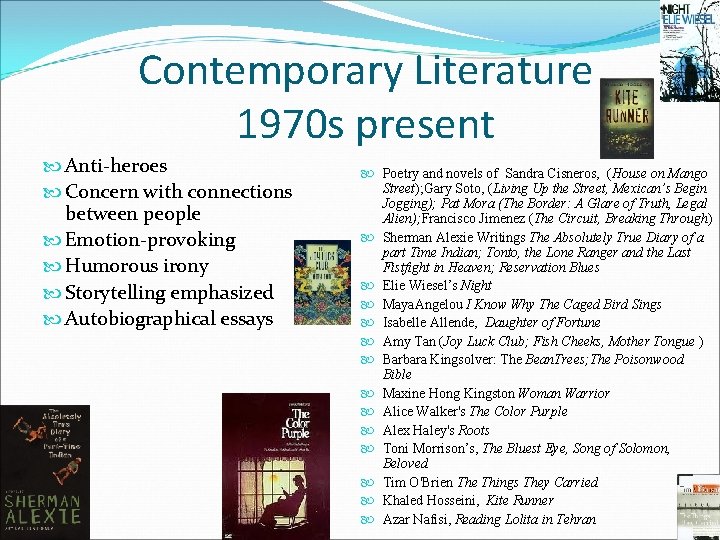
Contemporary Literature 1970 s present Anti-heroes Concern with connections between people Emotion-provoking Humorous irony Storytelling emphasized Autobiographical essays Poetry and novels of Sandra Cisneros, (House on Mango Street); Gary Soto, (Living Up the Street, Mexican’s Begin Jogging); Pat Mora (The Border: A Glare of Truth, Legal Alien); Francisco Jimenez (The Circuit, Breaking Through) Sherman Alexie Writings The Absolutely True Diary of a part Time Indian; Tonto, the Lone Ranger and the Last Fistfight in Heaven; Reservation Blues Elie Wiesel’s Night Maya. Angelou I Know Why The Caged Bird Sings Isabelle Allende, Daughter of Fortune Amy Tan (Joy Luck Club; Fish Cheeks, Mother Tongue ) Barbara Kingsolver: The Bean. Trees; The Poisonwood Bible Maxine Hong Kingston Woman Warrior Alice Walker's The Color Purple Alex Haley's Roots Toni Morrison’s, The Bluest Eye, Song of Solomon, Beloved Tim O'Brien The Things They Carried Khaled Hosseini, Kite Runner Azar Nafisi, Reading Lolita in Tehran