
Literary Genre Juno Jason Reitman Literary genre deals
- Slides: 21
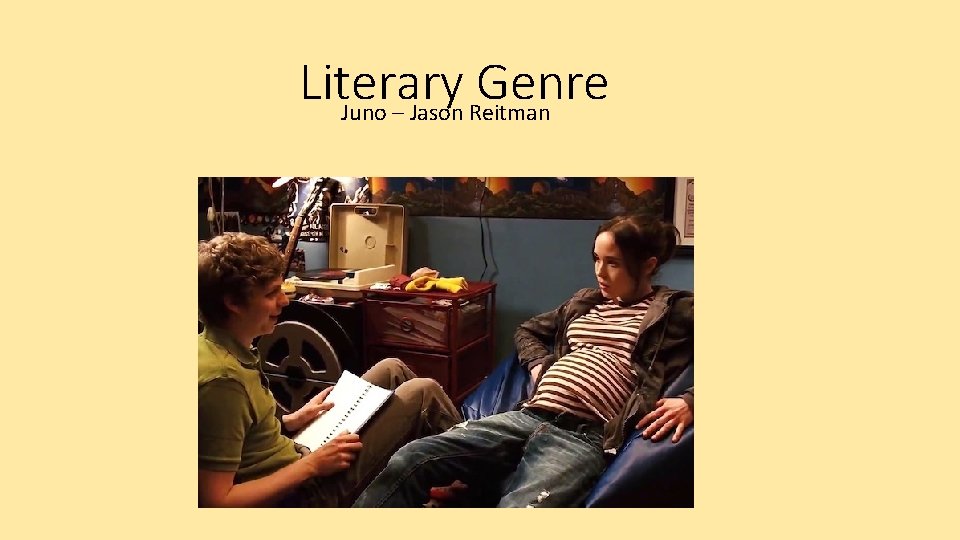
Literary Genre Juno – Jason Reitman
• Literary genre deals with how a story is told. On a basic level, the texts tell their stories differently depending on whether they are a novel, play or film. For the novel, this involves the use of descriptive prose with a narrator(s) forwarding the plot. In the play the story is told through the dialogue and stage directions. • While we may study drama by reading its text, it is often easy to lose sight of the fact that playwrights intend for their work to be performed on stage and not simply read in a classroom. In this light, the performance of actors and indeed the production will be as critical as the text. • This also applies to film-although interestingly we don’t study a film by reading its screenplay. However what distinguishes film from the other media is the ability of a director to use different camera angles and more elaborate sets/locations to tell a story.
Example of Layout • 1. Intro • 2. Text type – anchor text (x) • 3. Text type – (y) + anchor text (x) • 4. Text type – (y)+(z)+(x) • 5. Characterisation – anchor text (x) • 6. Characterisation – (y) + (x) • 7. Characterisation – (z) + (x) + (y) • 8. Narrative Directions – (x) • 9. Narrative Directions – (y) + (x) • 10. Narrative Directions – (z) + (x) + (y) • 11. Conclusion
Our Sub – Headings • Text type • Genre • Chronology • Characterisation • Dialogue • Imagery and Symbolism • Narrative Directions
Text Type: • The text is a film, which means that events and episodes can be presented in a far more sophisticated manner than a play or novel, due to powerful storytelling resources such as camera and special effects. As a result, there are no restrictions over details such as temporal (time) change, which would require significant page space and explanation in a novel, or time to change scene, appearance and introduce such in a drama.
• This is seen in Reitman’s film, as camerawork can instantly and easily introduce a change of setting. The film begins at Centennial Lane, where Juno Mac. Guff stands facing the curbs at fall, before wincing and shielding her eyes from the sun as she looks at an abandoned living room set on the street. Suddenly the camera switches to the basement, where a flashback shows Juno in her first sexual encounter, talking to Paulie who is hidden by a shadow while a vintage record player plays a sixties Brazilian track.
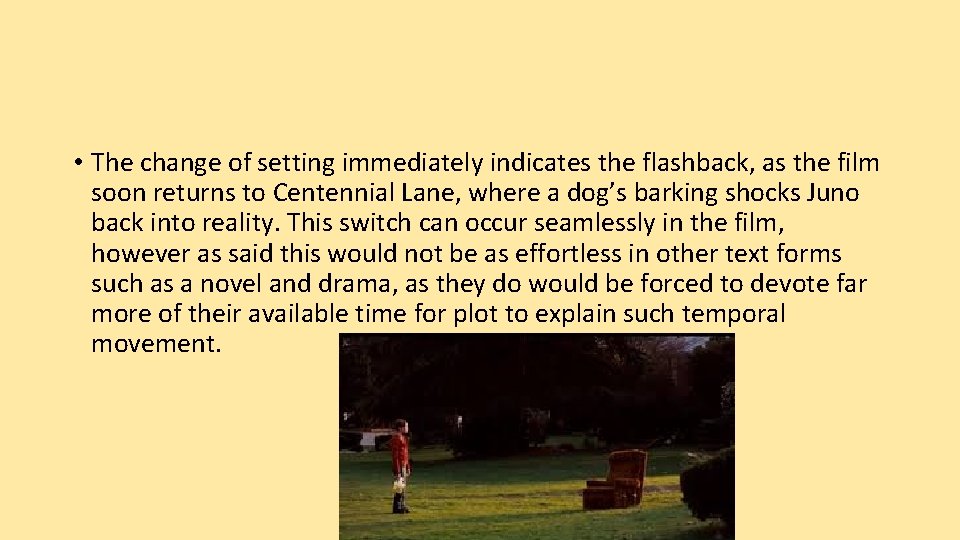
• The change of setting immediately indicates the flashback, as the film soon returns to Centennial Lane, where a dog’s barking shocks Juno back into reality. This switch can occur seamlessly in the film, however as said this would not be as effortless in other text forms such as a novel and drama, as they do would be forced to devote far more of their available time for plot to explain such temporal movement.
Genre: • Reitman’s film is told heart-warmingly, as Juno displays considerable strength for a sixteen year old despite the sizeable upheaval that pregnancy will bring to her life. • She deals with the unexpected occurrence in a strong and upbeat manner, rather than becoming depressed and downbeat: indeed it would be unsurprising if she did adopt the latter emotional mind-set due to her young age and how much of a disruption pregnancy will be.
• Juno’s straightforwardness in considering the pregnancy displays her calmness and resoluteness throughout the film, such as when she reveals this to her parents, “I’m pregnant”. She does not depend on her parents for assistance and has planned for all eventualities, indicating how she does not allow the situation to overcome her: “But, uh, ah, I’m going to give it up for adoption and I already found the perfect couple, they’re going to pay for the medical expenses and everything. And in, what, ah, thirty-odd weeks we can just pretend that this never happened. ”
• While her plan to have the child adopted may be seen by some as selfish, it can alternatively be taken that she is showing considering maturity in that she does not base this decision on convenience. • Rather, she realizes that the child will have a better upbringing if raised in a conventional familial dynamic, which once again presents Juno as concerned with the child first and foremost: “I was thinking I could, like, have this baby, and give it to someone that like totally needs it, like a woman with a bum ovary or a couple of nice lesbos. ”
Chronology: • The text is a film, which means that events and episodes can be presented in a far more sophisticated manner than a play or novel, due to powerful storytelling resources such as camera and special effects. As a result, there are no restrictions over details such as temporal change, which would require significant page space and explanation in a novel, or time to change scene, appearance and introduce such in a drama.
• This is seen in Reitman’s film, as camerawork can instantly and easily introduce a change of setting. The film begins at Centennial Lane, where Juno Mac. Guff stands facing the curbs at fall, before wincing and shielding her eyes from the sun as she looks at an abandoned living room set on the street. Suddenly the camera switches to the basement, where a flashback shows Juno in her first sexual encounter, talking to Paulie who is hidden by a shadow while a vintage record player plays a sixties Brazilian track. • The change of setting immediately indicates the flashback, as the film soon returns to Centennial Lane, where a dog’s barking shocks Juno back into reality. This switch can occur seamlessly in the film, however as said this would not be as effortless in other text forms such as a novel and drama, as they do would be forced to devote far more of their available time for plot to explain such temporal movement.
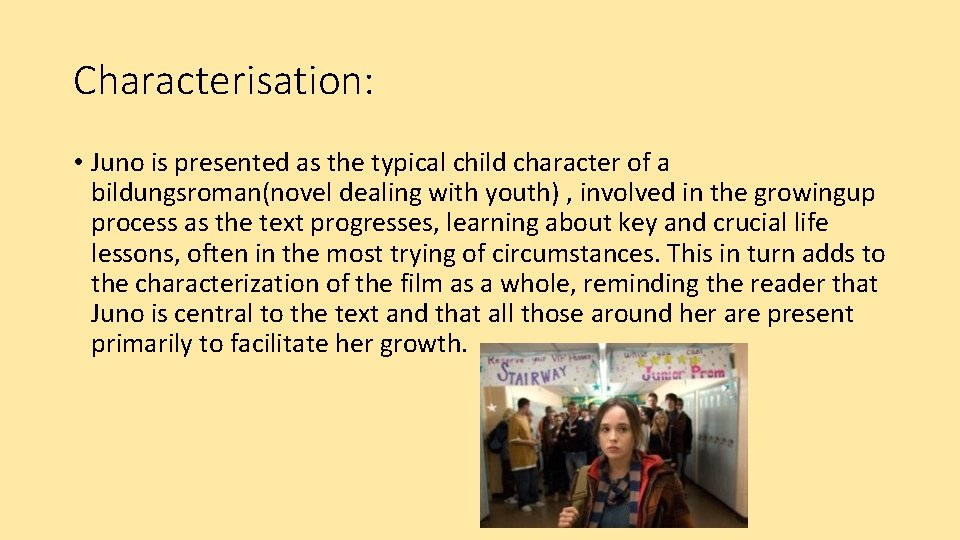
Characterisation: • Juno is presented as the typical child character of a bildungsroman(novel dealing with youth) , involved in the growingup process as the text progresses, learning about key and crucial life lessons, often in the most trying of circumstances. This in turn adds to the characterization of the film as a whole, reminding the reader that Juno is central to the text and that all those around her are present primarily to facilitate her growth.
• An example of Juno’s growth and learning can be seen with her growing relationship with Mark, as the protagonist initially does not believe there will be any long-term or damaging consequences to striking up a close connection with Mark, seen in such moments as when she calls him for a chat: “So I’ve been spending a lot of time listening to that weird CD you made me… I sort of like it. I mean, it’s cute. ” • However, as the film draws to a close Juno learns that such a close connection can often foster romantic feelings, as Mark reveals his plans to leave, “I’m getting my own place in the city…. And I’ve got it all planned out”, and that he hopes for some relationship with the teenager: “But I thought you’d be cool if…”
• In response, Juno admits her ignorance of the potential for romanticism in such situations by revealing her belief that they could have an intimate relationship but remain only friends: “I just liked being your friend. I sort of liked becoming furniture in your weird life. ” • It is only now, in such an awkward moment, that she begins to learn the important life-lesson, of how easily people can fall in or out of love, as she has contributed to this here: “Yeah I guess… Is this my fault? Is Vanessa mad at you because of me? ”
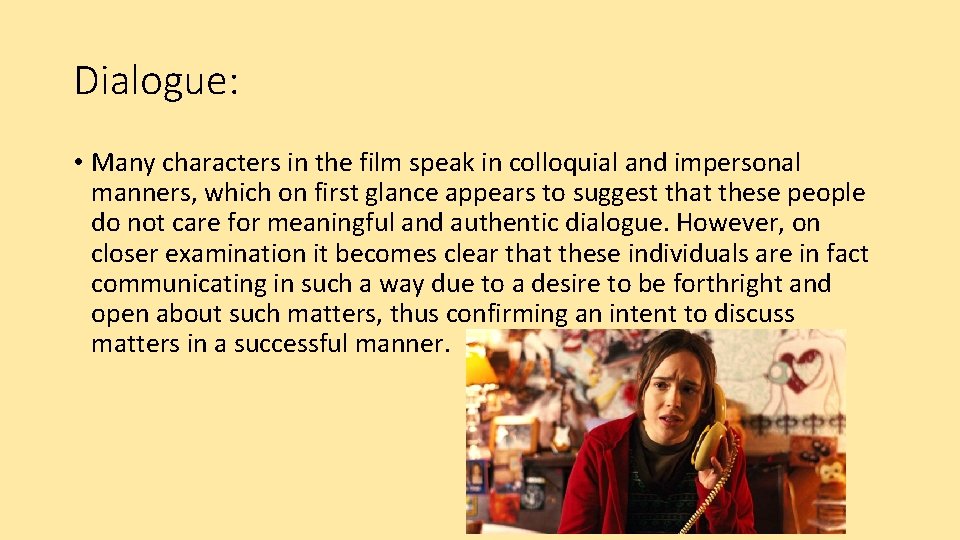
Dialogue: • Many characters in the film speak in colloquial and impersonal manners, which on first glance appears to suggest that these people do not care for meaningful and authentic dialogue. However, on closer examination it becomes clear that these individuals are in fact communicating in such a way due to a desire to be forthright and open about such matters, thus confirming an intent to discuss matters in a successful manner.
• Such dialogue is seen when Leah and Juno discuss potential parents for Juno’s unborn child, with the latter reading out one ad: “All right, how about this one? ‘Healthy, educated couple seeking infant to join our family of five. You will be compensated. Help us complete the circle of love. ” • Juno responds in a sarcastic manner, however this is more representative of her openness about the matter and a desire to give her baby up to the right parents, rather than those who appear unsuitable. • She thus holds no punches, and uses her communication modes to clearly articulate that this couple are not deemed suitable to raise her unborn child: “Yeesh, they sound like a cult, is what they sound like! And besides they already have three kids. They’re just like greedy little bitches!”
Imagery and Symbolism • The film is rife with symbolism, from its very beginning, when the audience sit down to watch the text called ‘Juno’. This is an obvious reference to the iconic Roman goddess of the same name: Juno was the deity of fertility and marriage, often associated with child birth, which represents and foreshadows the subject matter of the film, a teenage pregnancy. It is also noteworthy, if one explores the symbol in depth, that the symbol of Juno the goddess was a peacock.
• In ancient times the peacock was thought to have flesh that could not decay, and thus the animal represented strength and an ability to overcome the obstacles that seemed destined to overcome it. Like earlier, the symbol can be seen to represent and foreshadow the subject matter of the film, as Juno does not allow her pregnancy to overawe or subdue her, which would not be surprising considering her young age and emotional mind-set which has not yet fullyformed, as the film later shows us.
Narrative Directions: • There is no narrator in the drama, however other techniques such as lighting alert the audience to key parts of the drama and messages we should be aware of. Such an indirect mode of communicating information reinforces that the audience has a heightened role in perceiving events: the effect of these plot elements are only suggested rather than definitively confirmed, meaning that the audience will be left to ultimately identify what has been presented to them.
• Throughout the film Juno, the protagonist, is always shown in the light: the only exception is when she learns that she is pregnant. Light obviously implies optimism and hope, while darkness represents despair, and it can be taken that the moment when the protagonist is without light is indicative of her desire to not be pregnant, hence her purchasing of several pregnancy kits, so as to find a negative result. • However, as the film progresses, she is always shown in the light, which can be seen to represent how she has a newfound optimism and does not allow the pregnancy to subdue her emotional mind-set. • She happily speaks about in carefree terms so as to imply that her mood is not threatened by this unexpected occurrence, seen with her conversation with Vanessa: “Your parents are probably wondering where you are… Nah I mean, I’m already pregnant, so what other kinds of shenanigans could I get into? ”