
Literary and Dramatic Terms and Language from Elizabethan
Literary and Dramatic Terms and Language from Elizabethan England
Featuring: The Shakespearean Tragedy
Contents Part One: Drama Part Two: Tragedy Part Three: Shakespeare’s Poetic Language Part Four: Shakespeare’s Word Play Part Five: Important Elements
Part One: DRAMA This genre differs from other types of literature. drama = the branch of literature especially intended to be acted out upon the stage; a play

Script Remember that a play or drama is intended to be performed. The written version of that performance is called a script. The script is a set of directions that shows the writer’s intentions for the actors and the story itself. A page of Shakespeare’s original script.
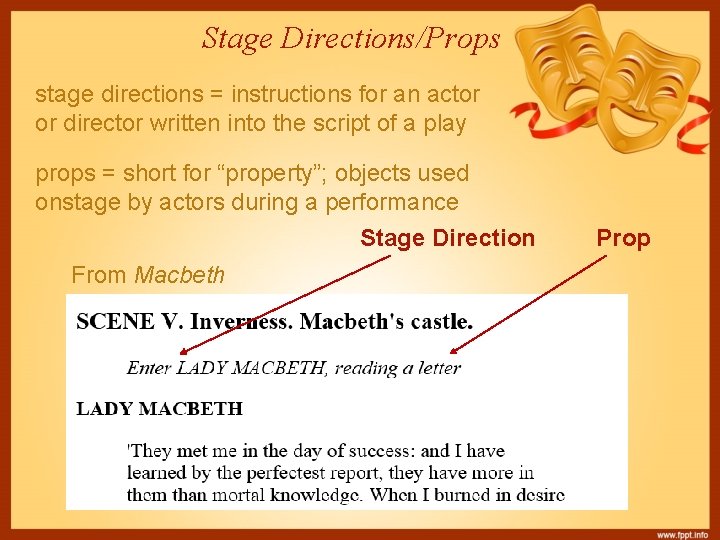
Stage Directions/Props stage directions = instructions for an actor or director written into the script of a play props = short for “property”; objects used onstage by actors during a performance Stage Direction From Macbeth Prop
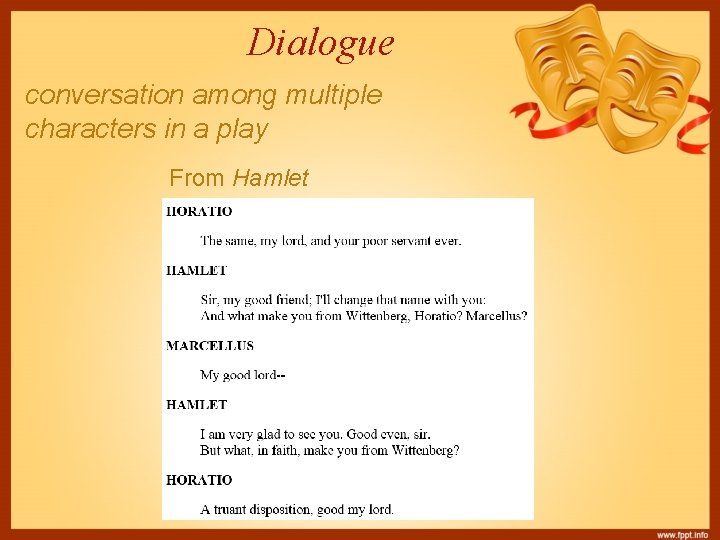
Dialogue conversation among multiple characters in a play From Hamlet
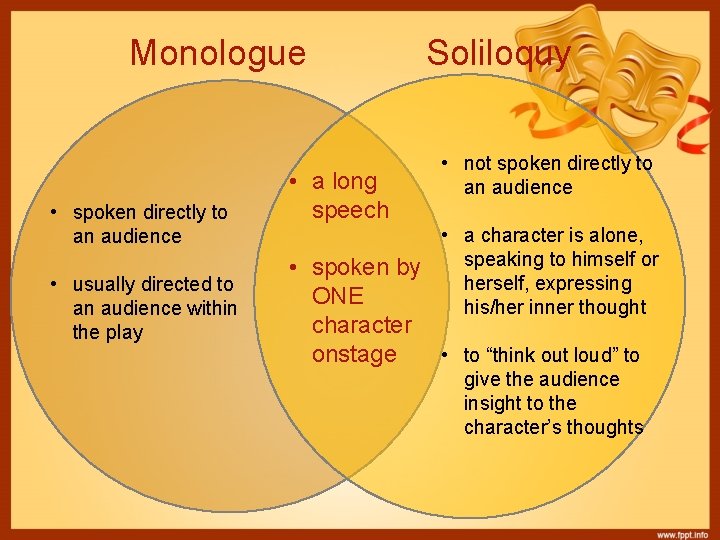
Monologue • spoken directly to an audience • usually directed to an audience within the play Soliloquy • a long speech • not spoken directly to an audience • a character is alone, speaking to himself or • spoken by herself, expressing ONE his/her inner thought character onstage • to “think out loud” to give the audience insight to the character’s thoughts
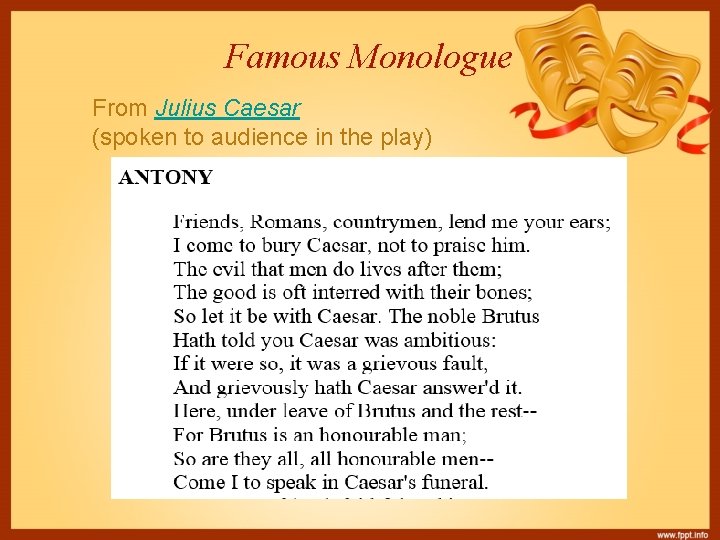
Famous Monologue From Julius Caesar (spoken to audience in the play)
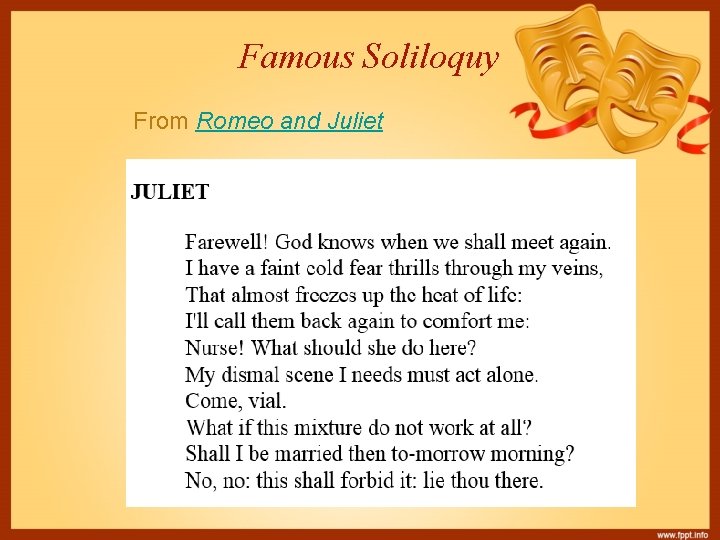
Famous Soliloquy From Romeo and Juliet
Aside Spoken words, usually in an undertone, that certain characters onstage are not intended to hear From Macbeth Begin at 6: 30 mark. Notice several times that the three men do not hear as Macbeth turns away and comments about the news.
Part Two: TRAGEDY Some Review Tragedies differ from other plays (such as comedies). tragedy = a serious play showing how a protagonist’s character leads to his own permanent downfall
Aristotle a famous Greek philosopher whose model for dramatic tragedy has stood for over 2000 years Because many of Shakespeare’s tragedies include Aristotle’s concepts, it is reasonable to believe that Shakespeare read Aristotle’s work. Aristotelian Concepts Used in Shakespeare’s Tragedies • Tragic hero • Tragic Flaw • Catharsis • Chorus • Comic Relief
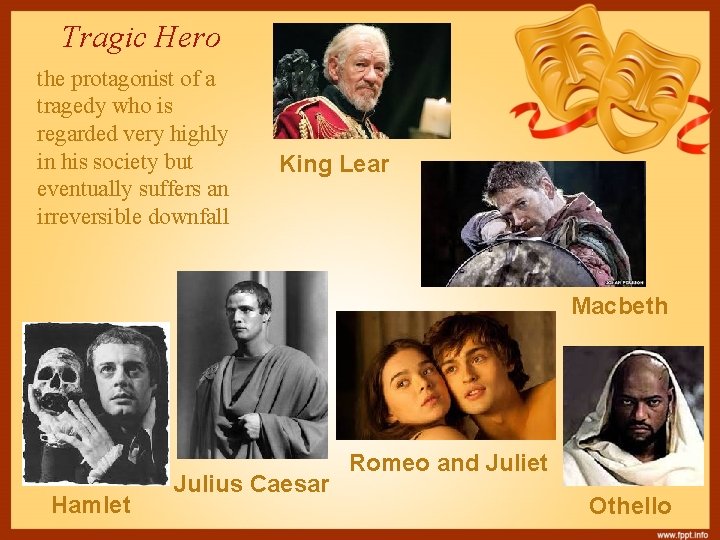
Tragic Hero the protagonist of a tragedy who is regarded very highly in his society but eventually suffers an irreversible downfall King Lear Macbeth Hamlet Julius Caesar Romeo and Juliet Othello
Tragic Flaw A character defect, flaw, or weakness that afflicts a tragic hero and leads to his downfall– AKA Hamartia Ambition Gullibility Jealousy Pride—AKA Hubris Rebellion
Catharsis the purification of emotions; the state of being cleansed It is believed that an audience goes through a process of catharsis during a tragedy. CATHARSIS 1. The audience connects with the characters. 2. The audience reflects upon the flaws, sins, and weaknesses presented onstage. 3. The audience experiences intense emotions such as pity, anger, or sadness. 4. The audience is renewed as justice is served and lessons are learned.
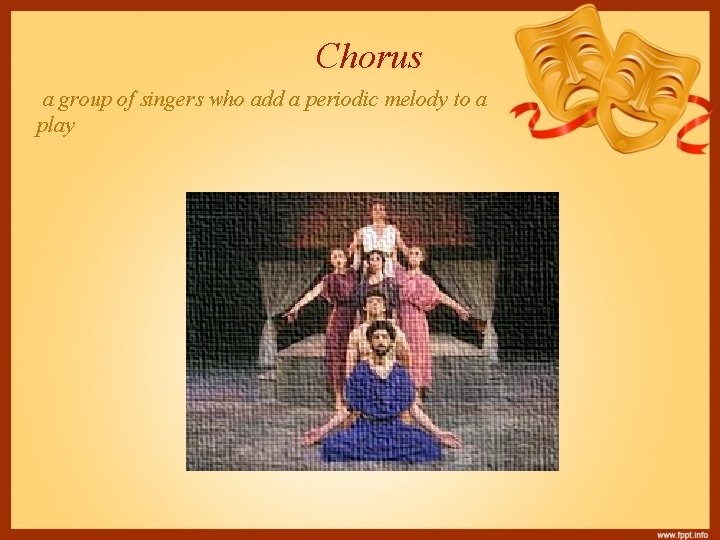
Chorus a group of singers who add a periodic melody to a play
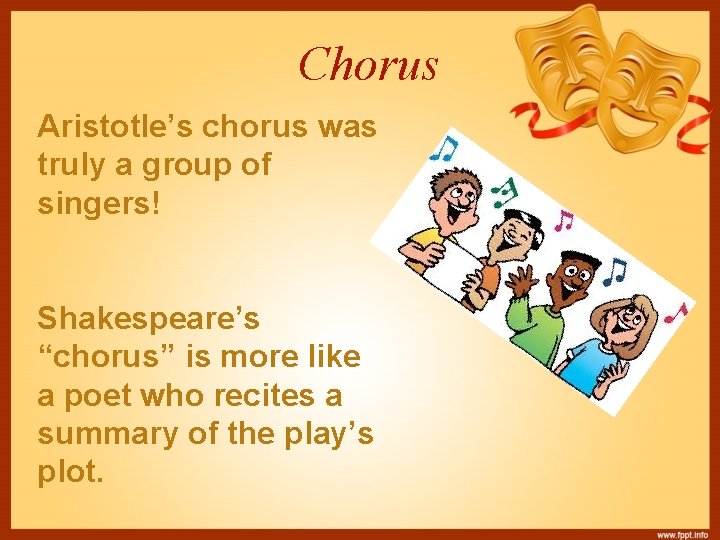
Chorus Aristotle’s chorus was truly a group of singers! Shakespeare’s “chorus” is more like a poet who recites a summary of the play’s plot.
Comic Relief A light-hearted or comical scene in a tragedy that provides the audience with an emotional break or “relief” from the play’s intensity Click the picture to see the porter (gate opener) in Macbeth. He’s supposed to open the gate when someone knocks! Shakespeare used characters that provided comic relief for the audience.
Part Three: SHAKESPEARE’S POETIC LANGUAGE Shakespeare’s poetry has lasted over 400 years! Did you know that there are over 1500 words possibly created by Shakespeare?
Renaissance Language Many of the words used in Shakespeare’s time are no longer used. Other words are still in use but have different usage today. Note these words to help you understand the text. Shakespeare’s Word Modern Meaning An, and If Anon Soon Art Are Aye Yes But Except for Dost or doth Does or Do E’en Even E’re Ever
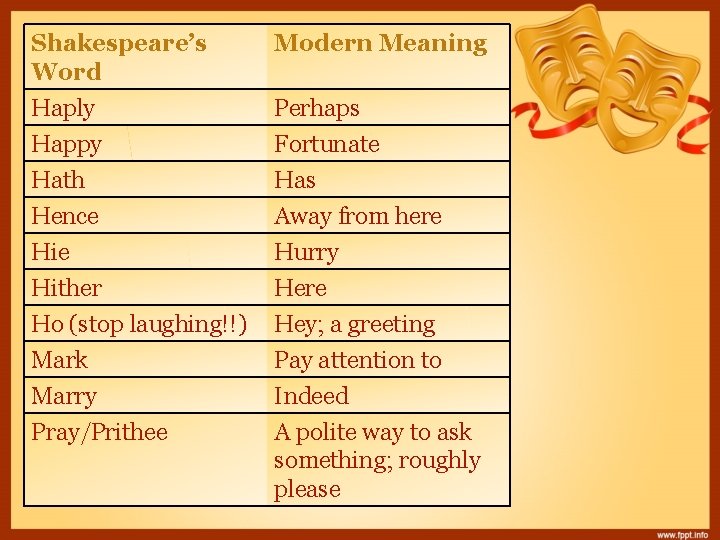
Shakespeare’s Word Modern Meaning Haply Happy Perhaps Fortunate Hath Hence Hither Has Away from here Hurry Here Ho (stop laughing!!) Mark Marry Pray/Prithee Hey; a greeting Pay attention to Indeed A polite way to ask something; roughly please
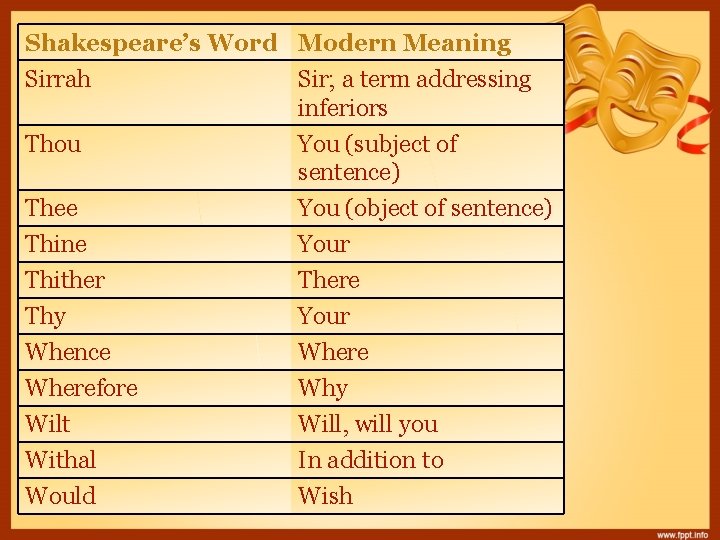
Shakespeare’s Word Modern Meaning Sirrah Sir; a term addressing inferiors Thou You (subject of sentence) Thee Thine Thither Thy Whence Wherefore Wilt Withal Would You (object of sentence) Your There Your Where Why Will, will you In addition to Wish
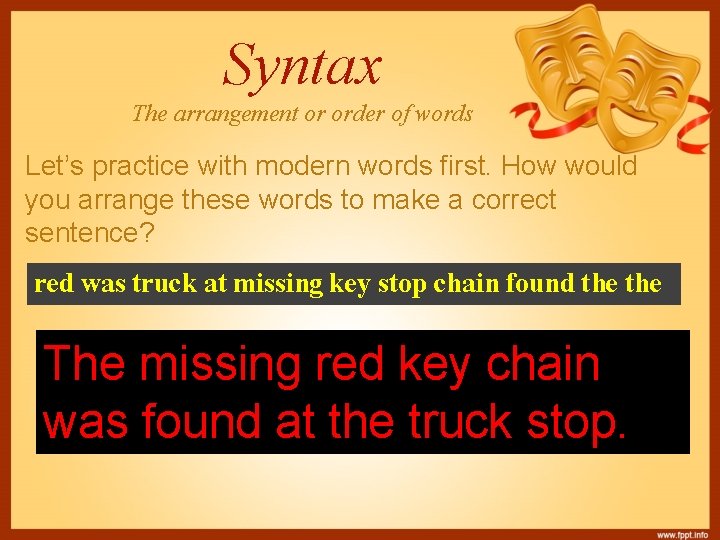
Syntax The arrangement or order of words Let’s practice with modern words first. How would you arrange these words to make a correct sentence? red was truck at missing key stop chain found the The missing red key chain was found at the truck stop.
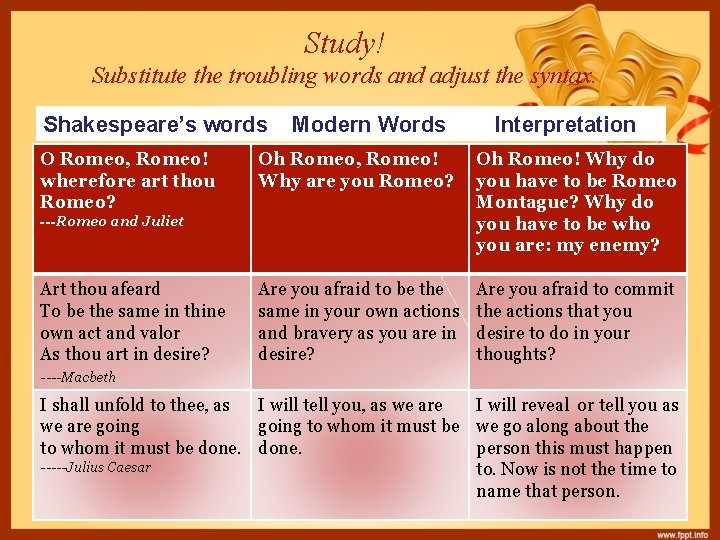
Study! Substitute the troubling words and adjust the syntax. Shakespeare’s words O Romeo, Romeo! wherefore art thou Romeo? Modern Words Oh Romeo, Romeo! Why are you Romeo? Oh Romeo! Why do you have to be Romeo Montague? Why do you have to be who you are: my enemy? Are you afraid to be the same in your own actions and bravery as you are in desire? Are you afraid to commit the actions that you desire to do in your thoughts? ---Romeo and Juliet Art thou afeard To be the same in thine own act and valor As thou art in desire? Interpretation ----Macbeth I shall unfold to thee, as I will tell you, as we are I will reveal or tell you as we are going to whom it must be we go along about the to whom it must be done. person this must happen -----Julius Caesar to. Now is not the time to name that person.
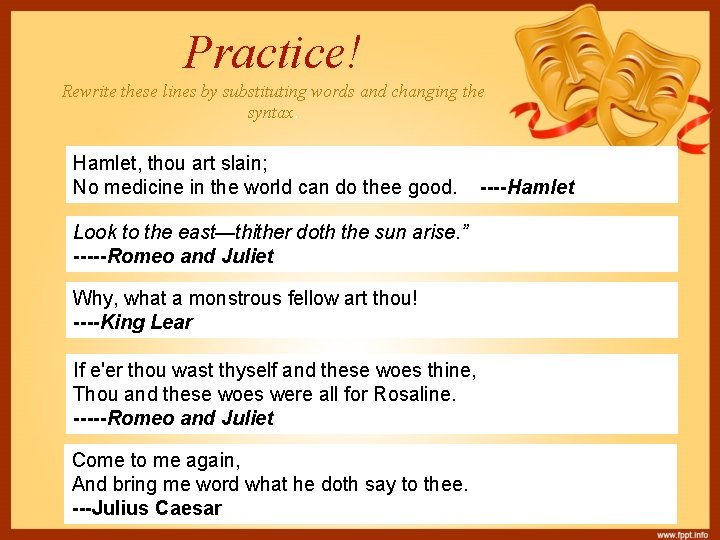
Practice! Rewrite these lines by substituting words and changing the syntax. Hamlet, thou art slain; No medicine in the world can do thee good. Look to the east—thither doth the sun arise. ” -----Romeo and Juliet Why, what a monstrous fellow art thou! ----King Lear If e'er thou wast thyself and these woes thine, Thou and these woes were all for Rosaline. -----Romeo and Juliet Come to me again, And bring me word what he doth say to thee. ---Julius Caesar ----Hamlet
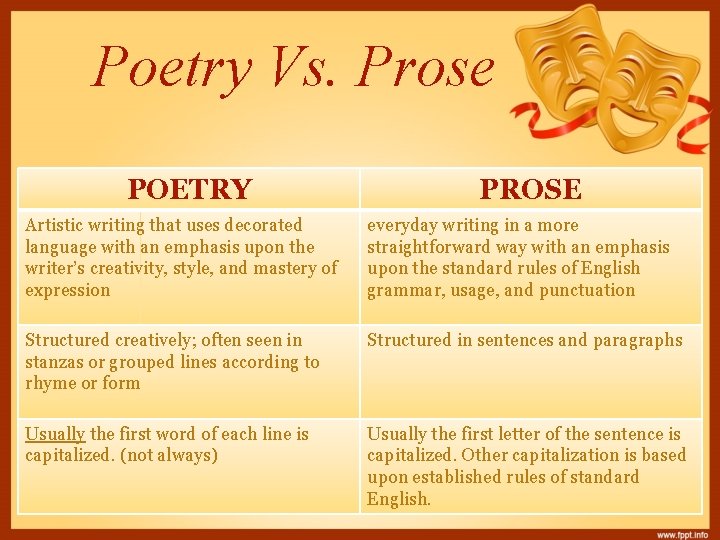
Poetry Vs. Prose POETRY PROSE Artistic writing that uses decorated language with an emphasis upon the writer’s creativity, style, and mastery of expression everyday writing in a more straightforward way with an emphasis upon the standard rules of English grammar, usage, and punctuation Structured creatively; often seen in stanzas or grouped lines according to rhyme or form Structured in sentences and paragraphs Usually the first word of each line is capitalized. (not always) Usually the first letter of the sentence is capitalized. Other capitalization is based upon established rules of standard English.
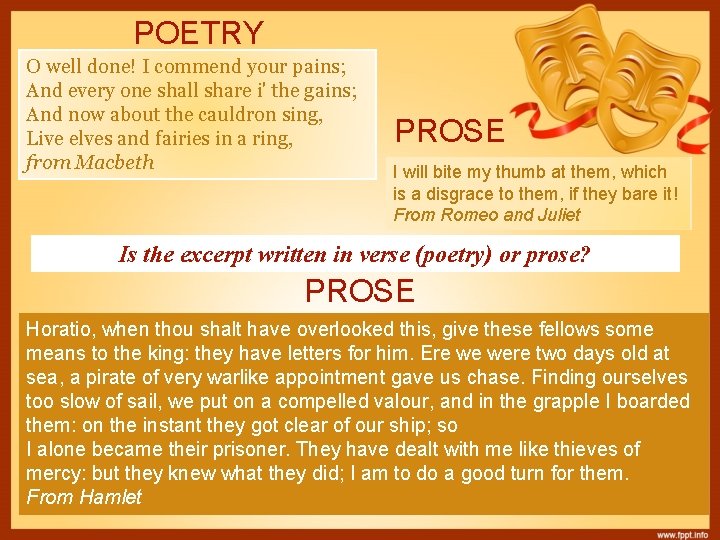
POETRY O well done! I commend your pains; And every one shall share i' the gains; And now about the cauldron sing, Live elves and fairies in a ring, from Macbeth PROSE I will bite my thumb at them, which is a disgrace to them, if they bare it! From Romeo and Juliet Is the excerpt written in verse (poetry) or prose? PROSE Horatio, when thou shalt have overlooked this, give these fellows some means to the king: they have letters for him. Ere we were two days old at sea, a pirate of very warlike appointment gave us chase. Finding ourselves too slow of sail, we put on a compelled valour, and in the grapple I boarded them: on the instant they got clear of our ship; so I alone became their prisoner. They have dealt with me like thieves of mercy: but they knew what they did; I am to do a good turn for them. From Hamlet
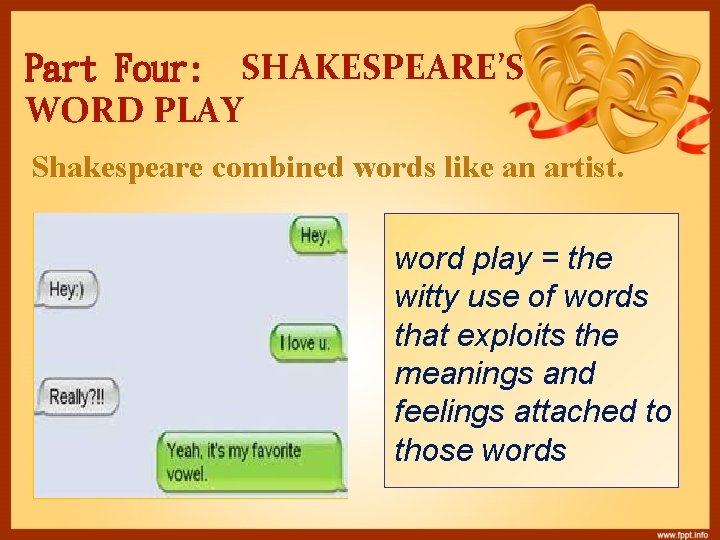
Part Four: SHAKESPEARE’S WORD PLAY Shakespeare combined words like an artist. word play = the witty use of words that exploits the meanings and feelings attached to those words
Paradox a contradictory statement that contains a truth; a statement that presents opposite ideas, even though both ideas are somewhat truthful “A rich man is no richer than a poor man. ” EXPLANATION: A rich man has more “stuff” than a poor man. How can a rich man be “no richer” than a poor man? Hmmm…. Maybe he’s “no richer” because he still has the same problems with family, health, or temptation. We are all equal as humans. “I am nobody. ” EXPLANATION: This statement begins with “I am. ” If I am, then I DO exist! How can I be “nobody, ” a person who does not exist? Hmmm…. . Maybe I mean that even though I DO exist, I do not feel important. No one else seems to notice me. Other people make me feel like “nobody. ”
Paradox Can you explain these examples of Shakespeare’s use of paradox? 1. Fair is foul, and foul is fair: Hover through the fog and filthy air. 2. First Witch: (You will be) Lesser than Macbeth, and greater. 3. First Witch: When shall we three meet again? Second Witch: When the battle’s lost and won. From Macbeth
Metaphor A comparison of two unlike things in which something is said to be another because of shared characteristics. Can you figure out what is being compared in these metaphors? But, soft! what light through yonder window breaks? It is the east, and Juliet is the sun. From Romeo and Juliet Out, out, brief candle! Life's but a walking shadow, a poor player That struts and frets his hour upon the stage And then is heard no more from Macbeth
Pun a play on words that uses words with similar sounds or similar meanings to make a point No w t h pun at’ ny! s I'd tell you a chemistry joke, but I know I wouldn't get a reaction. EXPLANATION: In chemistry, the chemicals react to one another; when telling jokes, one expects the audience to respond or ‘react’ to the punch line. I can't believe I got fired from the calendar factory. All I did was take a day off. EXPLANATION: “take a day off” refers to both removing a day from the calendar and not going to work
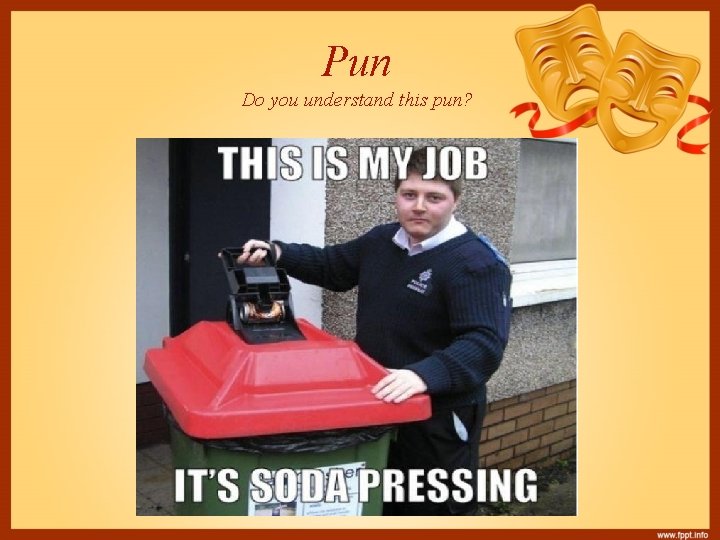
Pun Do you understand this pun?
Shakespeare’s Puns A play on words that uses words with similar sounds or similar meanings to make a point Romeo: I dreamed a dream tonight. Mercutio: And so did I. Romeo: Well, what was yours? Mercutio: That dreamers often lie. From Romeo and Juliet Can you explain the pun? Which word used by Mercutio has more than one meaning? The word is LIE! Mercutio says that dreamers lie because people lie down to sleep (and dream). He also suggests that dreamers lie, which means Romeo is not telling the truth.
Part Five: IMPORTANT ELEMENTS Outstanding writers use devices to create a world. Shakespeare used these elements effectively. You will find many of them present in all classic forms of literature.
Fate An unchangeable power that controls events of our lives It is the stars, The stars above us, govern our conditions. (King Lear, 4. 3. 37), Kent I fear too early, for my mind misgives Some consequence, yet hanging in the stars Shall bitterly begin his fearful date With this night's revels, and expire the term Of a dispised life, clos'd in my breast, By some vile forfeit of untimely death. But he that hath the steerage of my course Direct my sail. (Romeo and Juliet, 1. 4. 113), Romeo In general, Shakespeare’s society had the following beliefs about fate: 1. Many events in life are just bound to happen; there’s nothing people can do about them. (Think in terms of having good luck or bad luck. ) 2. Superstition, astrology, zodiacs, and the stars were very powerful influences.
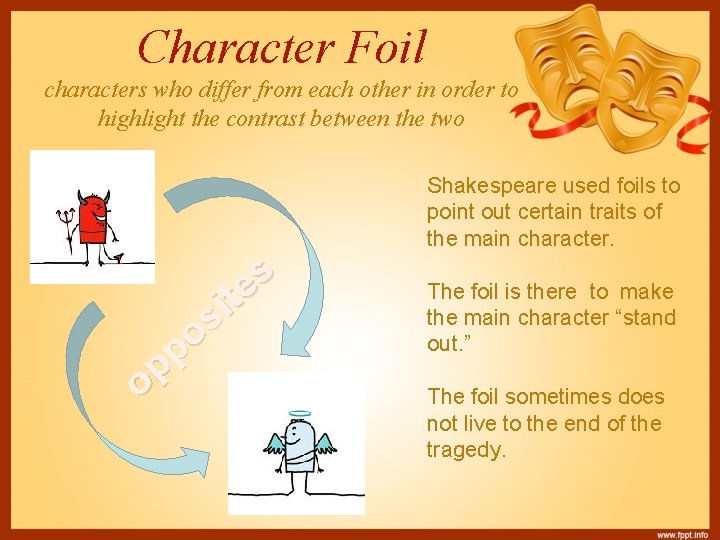
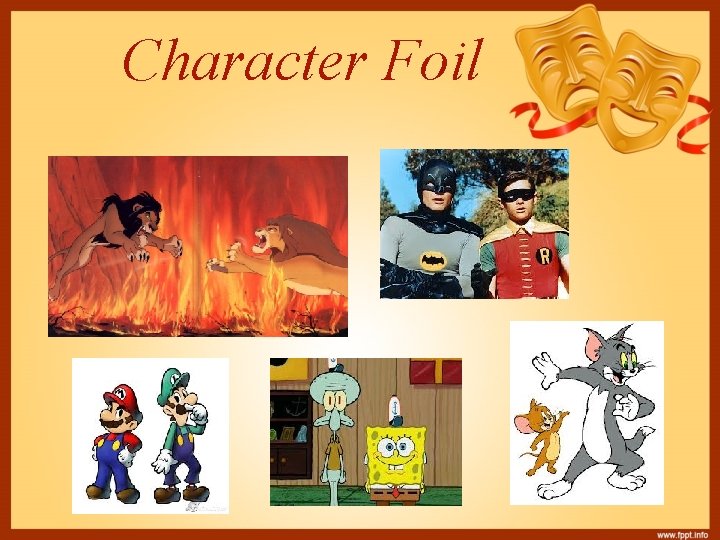
Character Foil characters who differ from each other in order to highlight the contrast between the two s ti e s o p p o Shakespeare used foils to point out certain traits of the main character. The foil is there to make the main character “stand out. ” The foil sometimes does not live to the end of the tragedy.
Character Foil
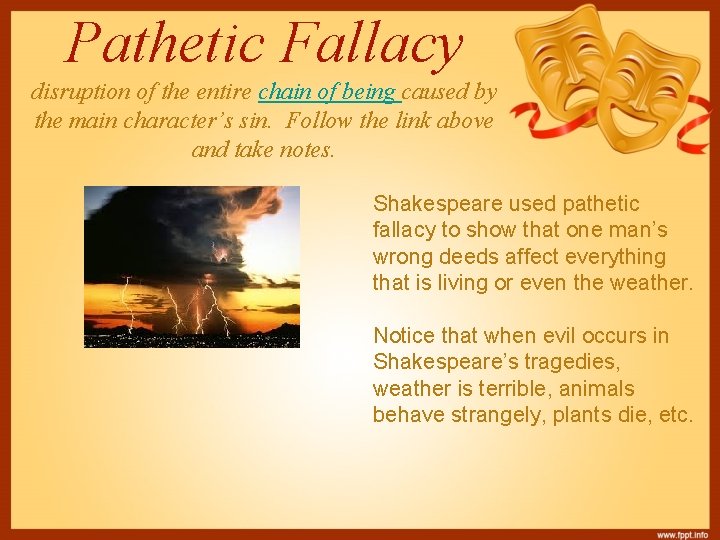
Pathetic Fallacy disruption of the entire chain of being caused by the main character’s sin. Follow the link above and take notes. Shakespeare used pathetic fallacy to show that one man’s wrong deeds affect everything that is living or even the weather. Notice that when evil occurs in Shakespeare’s tragedies, weather is terrible, animals behave strangely, plants die, etc.
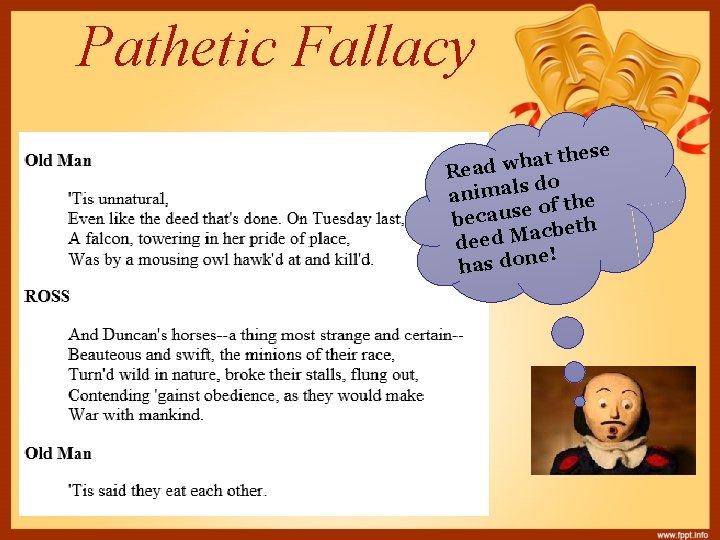
Pathetic Fallacy these t a h w Read s do animal the f o e s u beca eth b c a M deed e! has don
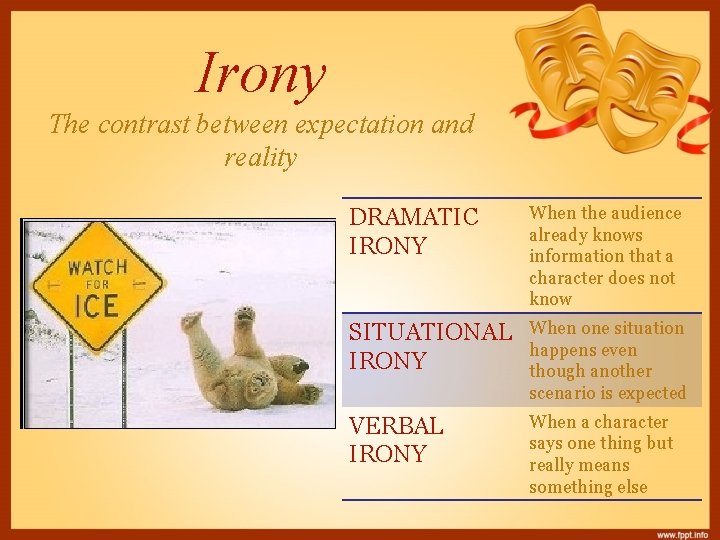
Irony The contrast between expectation and reality DRAMATIC IRONY When the audience already knows information that a character does not know SITUATIONAL IRONY When one situation happens even though another scenario is expected VERBAL IRONY When a character says one thing but really means something else
Irony The contrast between expectation and reality Duncan: Give me your hand; Conduct me to mine host: We love him highly and Shall continue our graces toward him. From Macbeth Which irony is displayed here? Why?
Plot • The sequence of events in a literary work • Exposition - The plot usually begins with this: • Introduces the setting, characters and situation.
Conflict • The struggle that develops – man vs. man – man vs. himself – man vs. society – man vs. nature
Climax • The turning point of the story - everything begins to unravel from here • Typically the point at the which the outcome is no longer in doubt – Thus begins the falling action
Resolution AKA Denouement • The end of the central conflict • Explains how all the events finally play out. • In drama, the last act
Theme • Central idea • Insight about life which explains the downfall • Macbeth - Unchecked ambition can lead to corruption
Other Dramatic Elements The actual script contains several parts • Dramatis Personae —Latin, “dramatic persons” or simply put, the cast of characters • Extras —persons in the cast who have few/no speaking parts. • Acts —the major divisions of the play, usually 5 -7. Each may be set in a different “place”. – The castle – The battlefield • Scenes —the parts into which each act is divided. Likewise, may be in different ’places’
THE END
Works Cited The previous information is incorporated and adapted from a Powerpoint presentation by. Tara Armstead (much of slides 1 -43, rights purchased through Teachers Pay Teachers) as well as the following: Centrelli, Kelly. "Thou, Thee, Thy, Thine & Ye: Shakespearean English. " un. Enlightened Academy. N. p. , n. d. Web. 29 Mar. 2014. <http: //unenlightenedenglish. com/2009/07/thou-thee-thy-thine-yeshakespearean-english> Hylton, Jeremy. "Macbeth. " The Complete Works of William Shakespeare. MIT, n. d. Web. 27 Mar. 2014. <http: //shakespeare. mit. edu/>. "Ian Mc. Diarmid as Porter in Macbeth (1978). " You. Tube, 27 Apr. 2013. Web. 29 Mar. 2014. <https: //www. youtube. com/watch? v=c. QKdya. JHgl. M>. Mabillard, Amanda. "Characteristics of Elizabethan Drama. " Shakespeare Online. Metheun and Company, n. d. Web. 29 Mar. 2014. <http: //www. shakespeare-online. com/>. Mc. Manus, Barbara. "Outline of Aristotle's Theory of Tragedy. " Outline of Aristotle's Theory of Tragedy. The College of New Rochelle, 5 Nov. 1999. Web. 27 Mar. 2014. <http: //www 2. cnr. edu/home/bmcmanus/poetics. html>.
- Slides: 51