
LITERARY ANALYSIS WHAT YOU NEED TO KNOW ABOUT
LITERARY ANALYSIS WHAT YOU NEED TO KNOW ABOUT BUILDING A SUCCESSFUL AND STYLISH ARGUMENT
INTRODUCTIONS Hook • First impression of the paper! • Should avoid all prompt wording • Start NEAR prompt, but DO NOT answer the prompt directly • Can talk about particular theme, character, nature of the work as a whole, historical info THAT RELATES TO PROMPT. • Boring: There are many themes in this work. One of them is X and Remarque reveals is through Y and Z. Thesis: Answer the prompt clearly in exactly one sentence. Somewhere in these 2 -3 sentences, mention book name and author.
HOW TO BUILD A SUCCESSFUL BODY PARAGRAPH Planning • Basic foundation: Find a pattern, think something about it. • Annotate/mark/post-it your book to be ready Choosing CDs: • Should be directly related to thesis AND topic sentence. • Ex. TS: Remarque uses imagery to show effect of war on the soldiers. • “ One of the recruits has a fit. I have been watching him for a long time, grinding his teeth and shutting his fists. These hunted, protruding eyes, we know them too well…He had collapsed like a rotten tree” (Remarque 109). • What 5 -7 word phrases can be taken and embedded to support the TS? • Reader should be able to look ONLY at quoted material and see how it supports TS and Thesis. • NEED AT LEAST TWO CDs PER BODY PARAGRAPH
HOW TO BUILD A SUCCESSFUL BODY PARAGRAPH Put chunks in a thoughtful order to show the progression of your ideas. • Should not read as a random list of metaphors • (CD 1: This is ____! CD 2: This is _____ too!) • How does the pattern change/grow? • What are the layers of meaning? • Your CD will point to the answers to these questions!
HOW TO BUILD A SUCCESSFUL BODY PARAGRAPH: TOPIC SENTENCE Once you’ve gathered your examples, write a topic sentence that explains what idea binds them together. • Find the pattern, name it, and relate back to thesis. • Average: Remarque uses metaphors to show the horror of war. (missing YOUR idea) • Better: Remarque uses metaphors comparing men to animals to reveal the horrors that the soldiers go through.
HOW TO BUILD A SUCCESSFUL BODY PARAGRAPH CD’s: Embedding • Embedding shows your grasp of the text and mature writing skills. • Choose a SMALL quote: 5 -7 words. • If taking out words in between, use “…” • To change words (usually verbs and pronouns) use [brackets]. Change the [whole] word, not just one [l]etter. • CITE page number at the “END OF THE SENTENCE” (Palmer 7). notice punctuation
WHAT TO PUT IN YOUR CD OTHER THAN THE QUOTE • CD should include context: what is happening, who is saying what to whom, where are we in the story? • Focus on the STORY vs. the writing (Remarque writes, “we become instant human animals”) • If your CD does not support thesis and TS, the whole chunk becomes weak.
How to Build a Successful Body Paragraph: Commentary is NOT: • A sentence explaining what happens in quote (quote summary) • A sentence explaining what is happening in the story at that moment or AFTER that moment (plot summary) • An explanation of WHY the quote is a particular literary device. • Avoid quote and plot summary.
HOW TO BUILD A SUCCESSFUL BODY PARAGRAPH: COMMENTARY Commentary is: • Two sentences that explain • How quote reveals meaning • What the meaning is • How it relates to thesis • An examination of the specific given quote—how does the device reveal something? What does it reveal?
HOW TO BUILD A SUCCESSFUL BODY PARAGRAPH: CONCLUDING SENTENCE AND CONCLUSIONS Concluding Sentence: last sentence of BP • Summarize paragraph in a non-robotic way. • Can function as a transition to next BP (body paragraph) Conclusion: Last paragraph of essay • • Summarizes argument Connects to larger point, theme, issue in work Makes paper feel finished Connect to hook if possible
MISC. INFORMATION Avoid: • 1 st and 2 nd person (I, me, my, your, we, us, our) • Past tense---always write in present tense • General words: good, bad, happy, sad, things, stuff, really, very • Quality judgments: “amazing metaphors, masterful writing” • “The reader”—already implied in the act of writing the essay • “This shows that”—take it out and keep writing. The sentence will still make sense and get directly to the point!
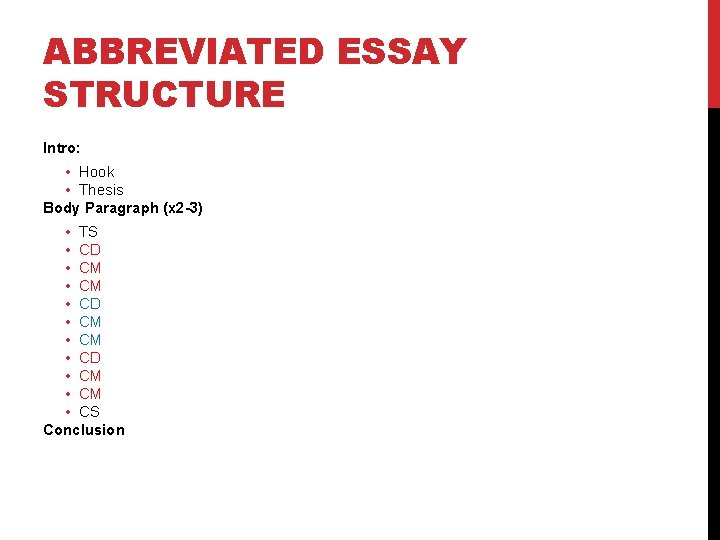
ABBREVIATED ESSAY STRUCTURE Intro: • Hook • Thesis Body Paragraph (x 2 -3) • TS • CD • CM • CD • CM • CS Conclusion
- Slides: 12