
Literary Analysis The Freudian Approach Freud and his

- Slides: 10
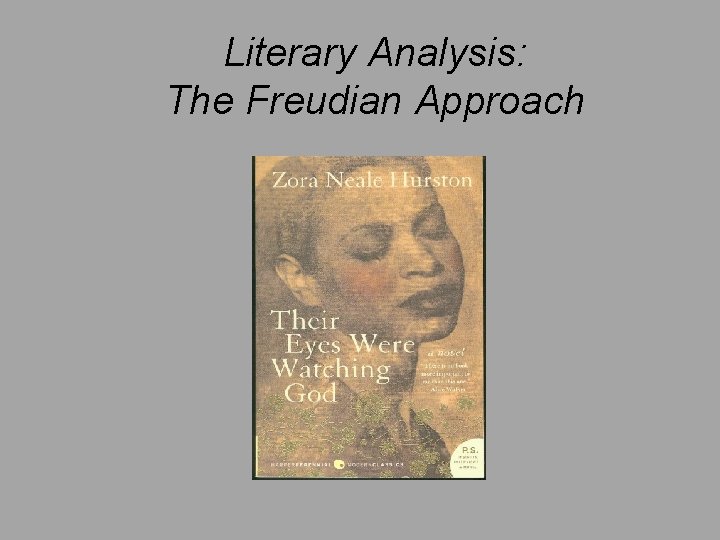
Literary Analysis: The Freudian Approach
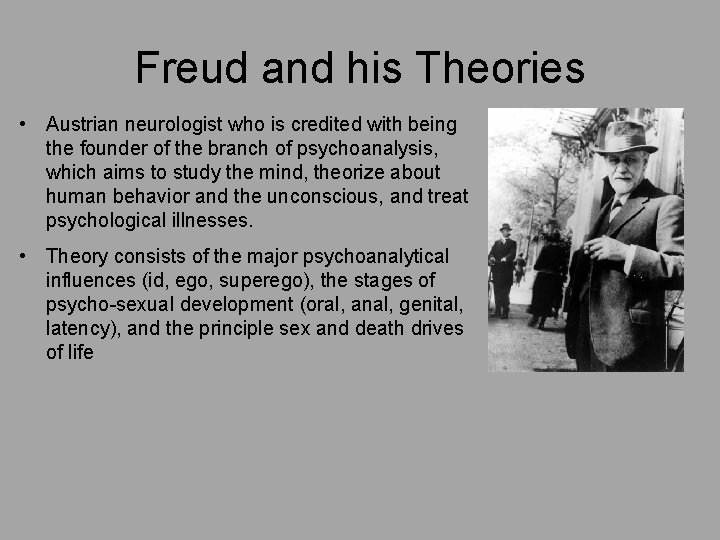
Freud and his Theories • Austrian neurologist who is credited with being the founder of the branch of psychoanalysis, which aims to study the mind, theorize about human behavior and the unconscious, and treat psychological illnesses. • Theory consists of the major psychoanalytical influences (id, ego, superego), the stages of psycho-sexual development (oral, anal, genital, latency), and the principle sex and death drives of life
Id Part of the psyche associated with instinctual, repressed, possibly antisocial desires, often sexual or aggressive. The id acts upon the pleasure principle, which is a demand that an instinctive desire be granted, regardless of practical or social consequences. The pleasure principle centers around seeking pleasure and avoiding pain. For example, a person acting solely on the demands of her id would go to sleep in the middle of class if she was tired, without regard to consequences. The id is often centered around the idea of self preservation and instinctual drives. Freud believes that there are two principal drives; sex and death, and the id attempts to satiate the needs of these two drives with no consideration of consequences. The id can also be separated into two types of actions: reflex actions and primary processes. A reflex is an instinctual action that takes away displeasure immediately, such as a sneeze, while a primary process is a wish fulfilling image of what is desired. For example, if someone is very thirsty she will visualize a cold glass of water, which will clearly not satisfy her need; however since the id cannot distinguish between reality and what exists in the mind, the ego must deal with reality to solve the id’s desires.
Ego As opposed to the id, which acts upon the pleasure principle, the ego acts upon the reality principle, which seeks to bring pleasure to the id’s drive without causing long term pain or grief. The ego is what has been developed by experience, not instinct, in a person’s personality. The ego’s task is to find the balance between primitive drives and reality, and is responsible for an individual’s safety. Sometimes the ego can be a way in which the id is expressed if the consequences of the actions are marginal. The ego conforms to societal norms and serves as a mediator between the id and the superego, because it is constantly trying to appease the aggressive instinctual drives of the id, and the perfection driven ideals of the superego. The goal of the ego is to allow the individual to express her desires in a socially acceptable way. The ego regulates memory, perception, thought, decision-making, and voluntary movements. Continuing with the previous sleep example, while the id would want a person to simply fall asleep if she were tired, the ego would force the person to find a place and a time where it was acceptable to fall asleep.
Superego The superego is the part of the psyche associated with morals taught by parents early in life, and the idea of right and wrong. The superego will punish an individual with guilt if the person does something morally unacceptable, and is often in conflict with the id. The superego has two parts, the conscience and the ego ideal. The conscience monitors thoughts and feelings and measures them against the internal values or standards of an individual. The ego ideal is the person that an individual aspires to be, usually based on identification with a parental figure in a person’s life. The individual also measure himself up against the ego ideal to judge personal performance. While the ego works to express the id in a socially respectable manner, the superego works to repress the id completely. The superego strives for perfection.
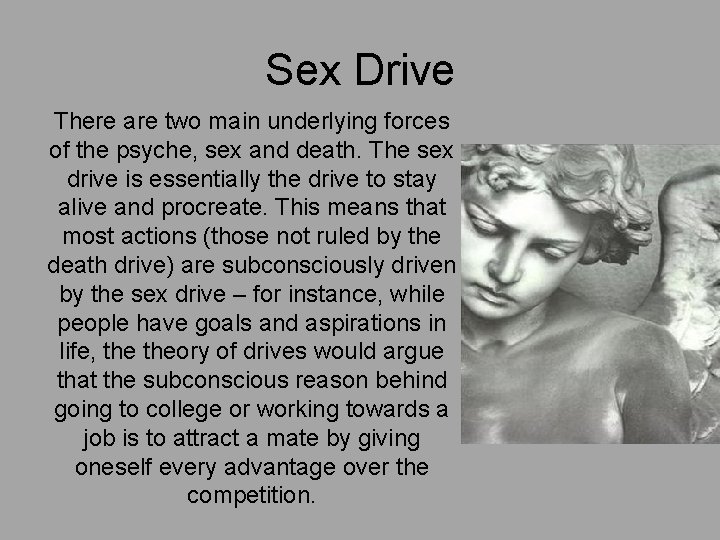
Sex Drive There are two main underlying forces of the psyche, sex and death. The sex drive is essentially the drive to stay alive and procreate. This means that most actions (those not ruled by the death drive) are subconsciously driven by the sex drive – for instance, while people have goals and aspirations in life, theory of drives would argue that the subconscious reason behind going to college or working towards a job is to attract a mate by giving oneself every advantage over the competition.
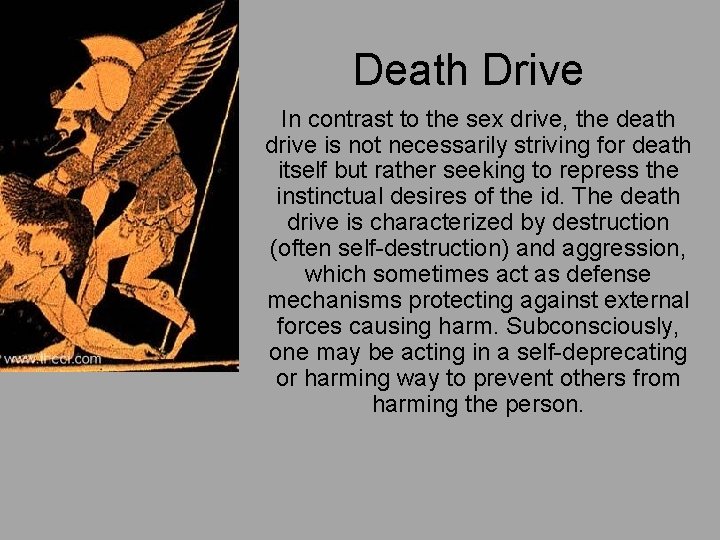
Death Drive In contrast to the sex drive, the death drive is not necessarily striving for death itself but rather seeking to repress the instinctual desires of the id. The death drive is characterized by destruction (often self-destruction) and aggression, which sometimes act as defense mechanisms protecting against external forces causing harm. Subconsciously, one may be acting in a self-deprecating or harming way to prevent others from harming the person.
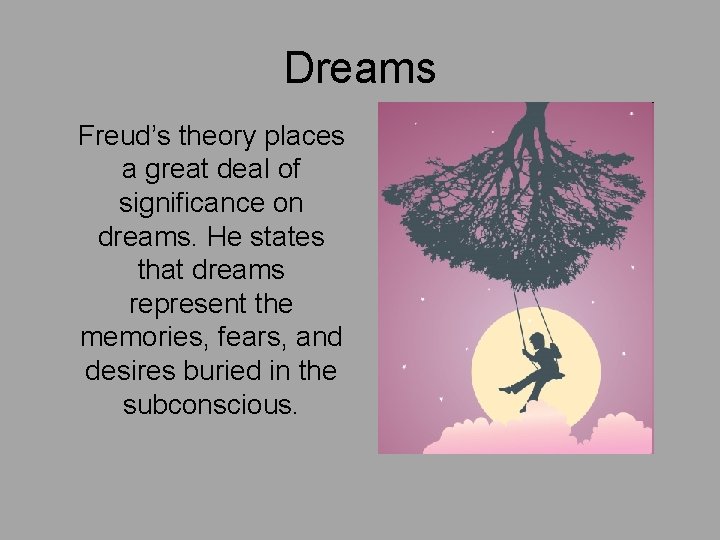
Dreams Freud’s theory places a great deal of significance on dreams. He states that dreams represent the memories, fears, and desires buried in the subconscious.
Projection is an aspect of Freud’s original defense mechanism, repression. In projection, a person represses their true feelings/problems (ie fear, guilt) by projecting them on someone else. One example is that if a child feared his father, who loved collecting butterflies, he would become fearful of all bugs in an attempt to stay away from his real fear; his father. Another part of projection is when you think everyone is more like you than they truly are. For example, a man who is in love with a woman might think the woman loves him as well.
Works Cited ego ideal. " Mosby's Medical, Nursing, & Allied Health Dictionary. 5 th ed. Mosby, 1998. Health Reference Center Academic. Web. 28 Oct. 2009. http: //find. galegroup. com/gtx/start. do? prod. Id=HRCA&user. Group. Name=bed Eros. Digital image. Lins Domain. Web. 28 Oct. 2009. <http: //www. linsdomain. com/gods&goddesses/pictures/eros. jpg>. : "id. (Definition). " The New Dictionary of Cultural Literacy, 3 rd ed. . Houghton Mifflin Harcourt Publishing Company, 2002. NA. General One. File. Gale. Bedford High School. 26 Oct. 2009 <http: //find. galegroup. com/gps/start. do? prod. Id=IPS>. "pleasure principle. (Definition). " The New Dictionary of Cultural Literacy, 3 rd ed. . Houghton Mifflin Harcourt Publishing Company, 2002. NA. General One. File. Gale. Bedford High School. 26 Oct. 2009 <http: //find. galegroup. com/gps/start. do? prod. Id=IPS>. Frances, Allen. "Ego. " World Book Advanced. World Book, 2009. Web. 27 Oct. 2009. "Psychoanalysis. " Gale Encyclopedia of Science. Thomson Gale, 2001. NA. Academic One. File. Gale. Bedford Public Library (MA). 27 Oct. 2009<http: //find. galegroup. Sigmun Freud. Digital image. Web. <http: //www. phillwebb. net/history/twentiethcentury/Continental/Psychoanalysis/ Freud/Freud 6. jpg Hurston, Zora Neale. Their Eyes Were Watching God. New York: J. B. Lippincott, Inc. , 1937. Print. com/gtx/start. do ? prod. Id=AONE>. "superego. (Definition). " The New Dictionary of Cultural Literacy, 3 rd ed. Houghton Mifflin Harcourt Publishing Company, 2002. Academic One. File. Web. 28 Oct. 2009. <http: //find. galegroup. com/gtx/start. do? prod. Id=AONE&user. Group. Name=bed>. "superego. " Mosby's Medical, Nursing, & Allied Health Dictionary. 5 th ed. Mosby, 1998. Health Reference Center Academic. Web. 28 Oct. 2009. <http: //find. galegroup. com/gtx/start. do? prod. Id=HRCA&user Group. Name=bed>. "psychoanalysis. " The Columbia Encyclopedia. 6 th ed. Columbia University Press, 2000. 31533. General One. File. Web. 28 Oct. 2009. <http: //find. galegroup. com/gtx/start. do? prod. Id=ITOF &user. Group Name=bed>. Their Eyes Were Watching God. Digital image. Http: //www. ci. longmont. co. us/Library/adult/images/their_eyes_were_ watching_god. jpg. Web.