
Literary Analysis English Language Arts Types of Literary

- Slides: 12
Literary Analysis English Language Arts
Types of Literary Analysis Comparative Literary Analysis Close Reading Theoretical Literary Analysis Applied Literary Analysis
Comparative Literary Analysis This type of literary analysis asks the writer to create an argument that supports the idea that this piece is best understood when read with another. The similarities and differences in the text create an ongoing dialogue that better explains the meaning of both texts.
Close Reading is comprised of three parts. The first part entails looking at the purpose or the MEANING of the text. The second part focuses on the WRITING STRATEGY style and its significance. The third part analyzes the LANGUAGE in the text and its role in understanding the text.
Close Reading: Meaning. Impressions. What is the main idea? What are the supporting details? If you were to dissect this paper, what would you find? What is the purpose of the text? What implications revolve around the title? The main character? The narrator? What symbols are used and why?
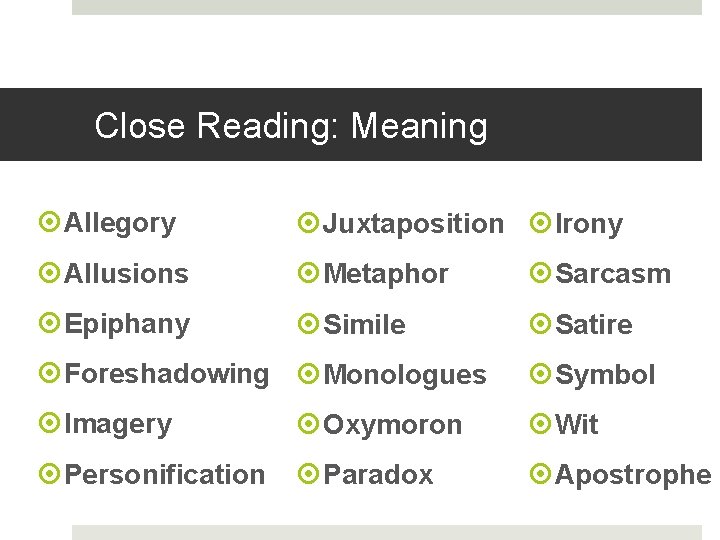
Close Reading: Meaning Allegory Juxtaposition Irony Allusions Metaphor Sarcasm Epiphany Simile Satire Foreshadowing Monologues Symbol Imagery Oxymoron Wit Personification Paradox Apostrophe
Close Reading: Writing Strategy Writing Style. How does the author format the text? What is the effect of the narrative technique? How does the plot diagram unfold? Are the transitions effective? How does the author’s tone influence the atmosphere? How is the author directly or indirectly characterizing? Is it effective? Intentional?
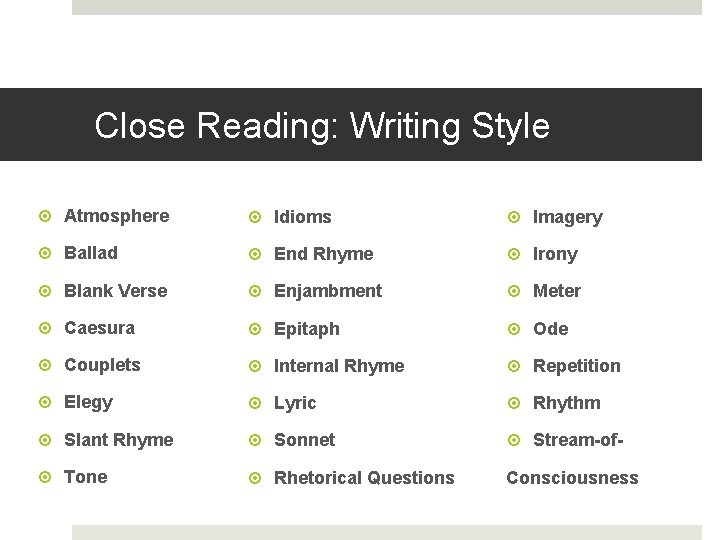
Close Reading: Writing Style Atmosphere Idioms Imagery Ballad End Rhyme Irony Blank Verse Enjambment Meter Caesura Epitaph Ode Couplets Internal Rhyme Repetition Elegy Lyric Rhythm Slant Rhyme Sonnet Stream-of- Tone Rhetorical Questions Consciousness
Close Reading: Language. How does the diction effect the story? How is dialect and dialogue implemented? How is word choice and connotative meanings used to enhance the originality or atmosphere of the piece? How are similes, metaphors, hyperboles, and understatements included? Does word choice add to the culture of the novel? How so?
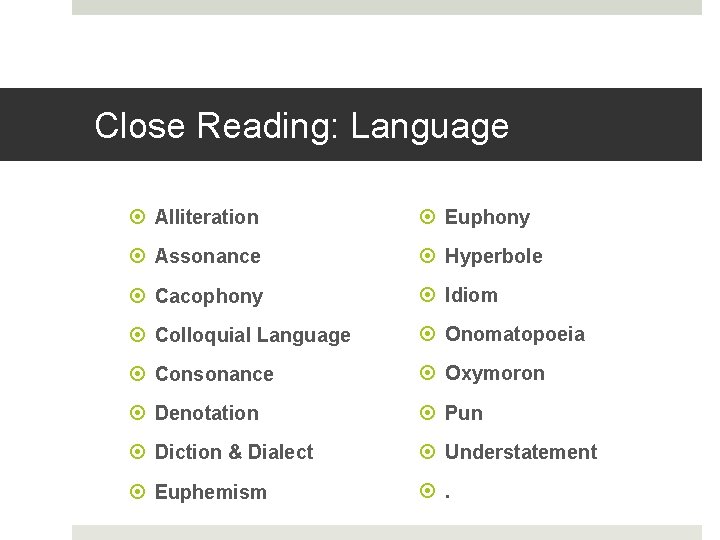
Close Reading: Language Alliteration Euphony Assonance Hyperbole Cacophony Idiom Colloquial Language Onomatopoeia Consonance Oxymoron Denotation Pun Diction & Dialect Understatement Euphemism .
Theoretical Literary Analysis Theoretical literary analysis is comprised of a close reading and a larger critical lens. Therefore, one’s argument analyzes all of the three critical aspects of close reading, but also ties this into an overarching theoretical framework. Additional research on the writer’s behalf is necessary.
Applied Literary Analysis Applied literary analysis is when you better understand a text by trying to connect with what you are analyzing on a personal level and reflecting on that overlap.