
Literacy Writing Imaginative part 1 of 3 You
- Slides: 5
Literacy Writing – Imaginative, part 1 (of 3) • You will need: • Sharp pencil, plain and lined paper, something to look at (an object or a view out your window) and someone to help you read through the lesson. • Follow the lesson plan or skip to slide 4.
Literacy Writing – Imaginative, part 1 (of 3) • Learning Intention (LI): to develop my own ideas for imaginative writing. • Success Criteria (SC): I can describe my setting using amazing adjectives. I can use The Descriptive Bubble to describe what I can see, hear and feel.
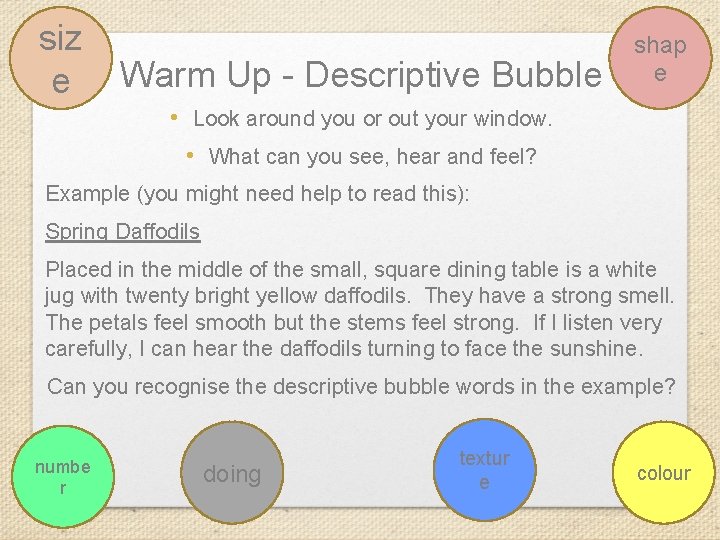
siz e Warm Up - Descriptive Bubble shap e • Look around you or out your window. • What can you see, hear and feel? Example (you might need help to read this): Spring Daffodils Placed in the middle of the small, square dining table is a white jug with twenty bright yellow daffodils. They have a strong smell. The petals feel smooth but the stems feel strong. If I listen very carefully, I can hear the daffodils turning to face the sunshine. Can you recognise the descriptive bubble words in the example? numbe r doing textur e colour
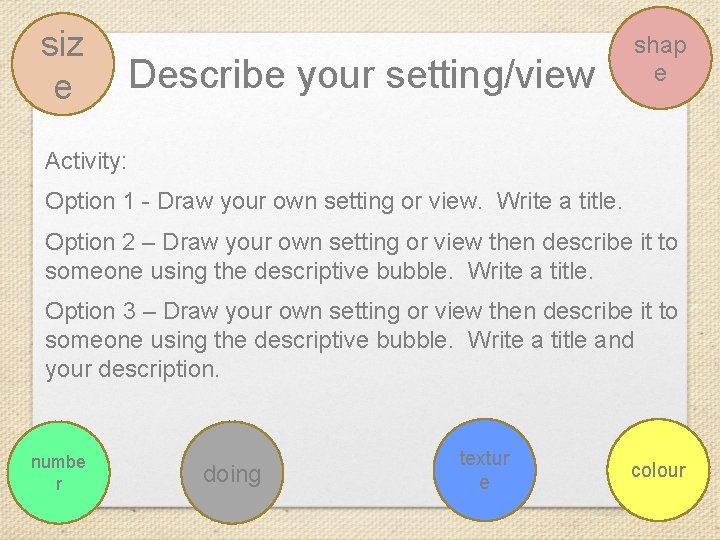
siz e Describe your setting/view shap e Activity: Option 1 - Draw your own setting or view. Write a title. Option 2 – Draw your own setting or view then describe it to someone using the descriptive bubble. Write a title. Option 3 – Draw your own setting or view then describe it to someone using the descriptive bubble. Write a title and your description. numbe r doing textur e colour
• Activity: Assessment and Plenary Sit or lie in a quiet spot. What can you hear? How would you describe the sound(s) you hear? RELAX • Think: Did you successfully describe your setting or view? Choose an assessment method and draw it beside your work. 1 – I struggled 4 – I’m doing well Red – not there yet 2 – I found some difficult Orange – getting there 3 – I think I’m getting it 5 – I have got it! Green – got it! • Next step: Next time you go outside, think about all the things you can see, hear and feel. What stories could you imagine about the setting or view?