
Literacy Weekly planning grid Week beginning 180520 P
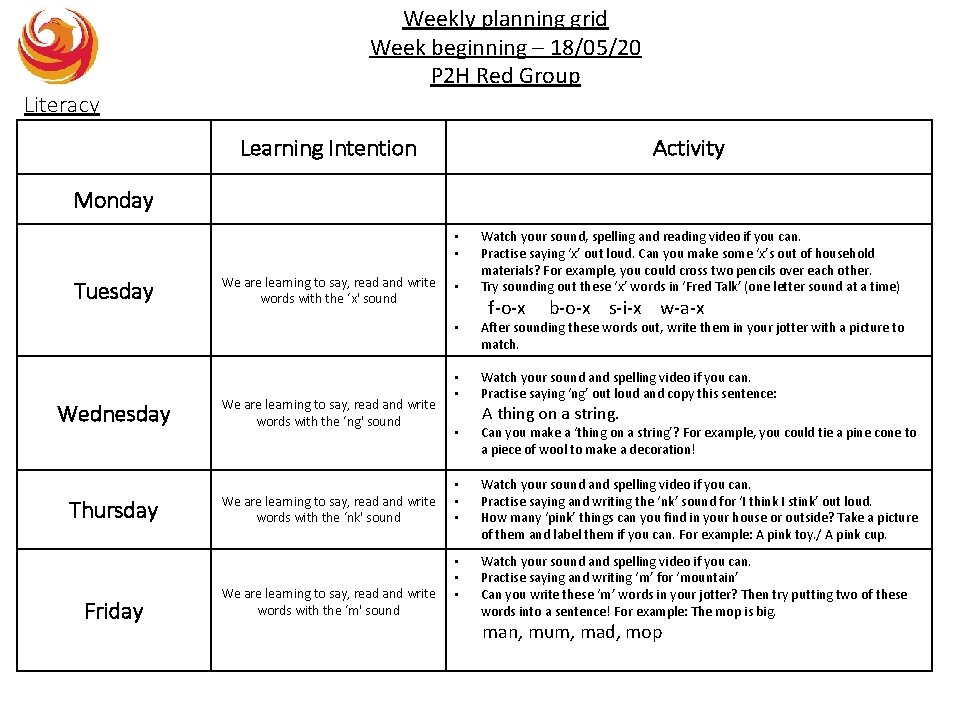
Literacy Weekly planning grid Week beginning – 18/05/20 P 2 H Red Group Learning Intention Activity Monday • • Tuesday Wednesday Thursday Friday We are learning to say, read and write words with the ‘x' sound We are learning to say, read and write words with the ‘ng' sound We are learning to say, read and write words with the ‘nk' sound We are learning to say, read and write words with the ‘m' sound • Watch your sound, spelling and reading video if you can. Practise saying ‘x’ out loud. Can you make some ‘x’s out of household materials? For example, you could cross two pencils over each other. Try sounding out these ‘x’ words in ‘Fred Talk’ (one letter sound at a time) f-o-x b-o-x s-i-x w-a-x • After sounding these words out, write them in your jotter with a picture to match. • • Watch your sound and spelling video if you can. Practise saying ‘ng’ out loud and copy this sentence: A thing on a string. • Can you make a ‘thing on a string’? For example, you could tie a pine cone to a piece of wool to make a decoration! • • • Watch your sound and spelling video if you can. Practise saying and writing the ‘nk’ sound for ‘I think I stink’ out loud. How many ‘pink’ things can you find in your house or outside? Take a picture of them and label them if you can. For example: A pink toy. / A pink cup. • • • Watch your sound and spelling video if you can. Practise saying and writing ‘m’ for ‘mountain’ Can you write these ‘m’ words in your jotter? Then try putting two of these words into a sentence! For example: The mop is big. man, mum, mad, mop
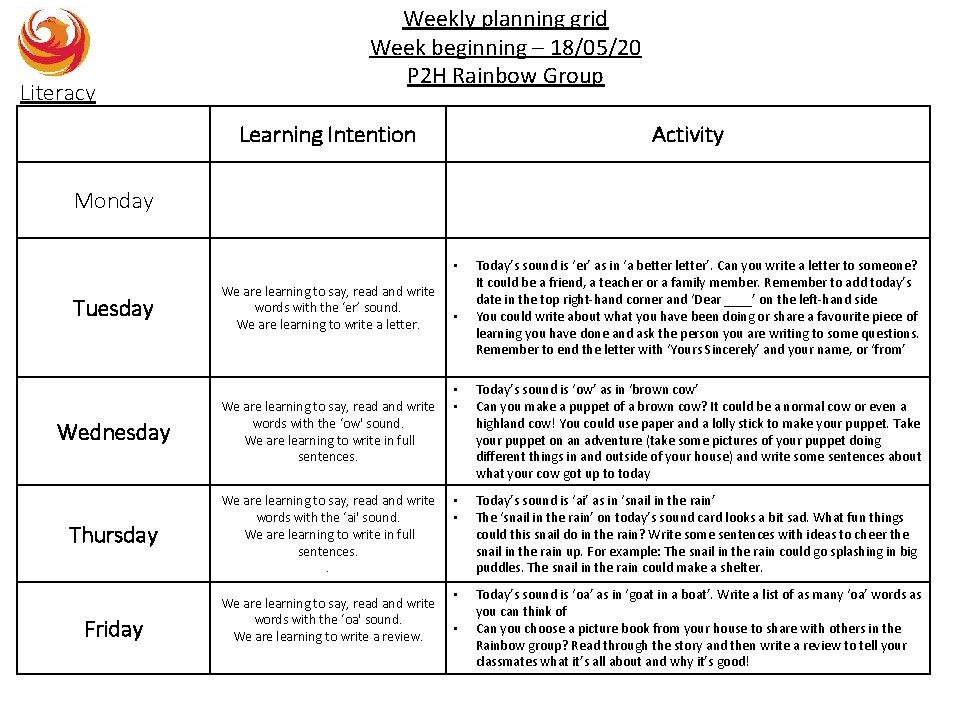
Literacy Weekly planning grid Week beginning – 18/05/20 P 2 H Rainbow Group Learning Intention Activity Monday • Tuesday We are learning to say, read and write words with the ‘er’ sound. We are learning to write a letter. Wednesday We are learning to say, read and write words with the ‘ow' sound. We are learning to write in full sentences. Thursday We are learning to say, read and write words with the ‘ai' sound. We are learning to write in full sentences. . Friday We are learning to say, read and write words with the ‘oa' sound. We are learning to write a review. • Today’s sound is ‘er’ as in ‘a better letter’. Can you write a letter to someone? It could be a friend, a teacher or a family member. Remember to add today’s date in the top right-hand corner and ‘Dear ____’ on the left-hand side You could write about what you have been doing or share a favourite piece of learning you have done and ask the person you are writing to some questions. Remember to end the letter with ‘Yours Sincerely’ and your name, or ‘from’ • • Today’s sound is ‘ow’ as in ‘brown cow’ Can you make a puppet of a brown cow? It could be a normal cow or even a highland cow! You could use paper and a lolly stick to make your puppet. Take your puppet on an adventure (take some pictures of your puppet doing different things in and outside of your house) and write some sentences about what your cow got up to today • • Today’s sound is ‘ai’ as in ‘snail in the rain’ The ‘snail in the rain’ on today’s sound card looks a bit sad. What fun things could this snail do in the rain? Write some sentences with ideas to cheer the snail in the rain up. For example: The snail in the rain could go splashing in big puddles. The snail in the rain could make a shelter. • Today’s sound is ‘oa’ as in ‘goat in a boat’. Write a list of as many ‘oa’ words as you can think of Can you choose a picture book from your house to share with others in the Rainbow group? Read through the story and then write a review to tell your classmates what it’s all about and why it’s good! •
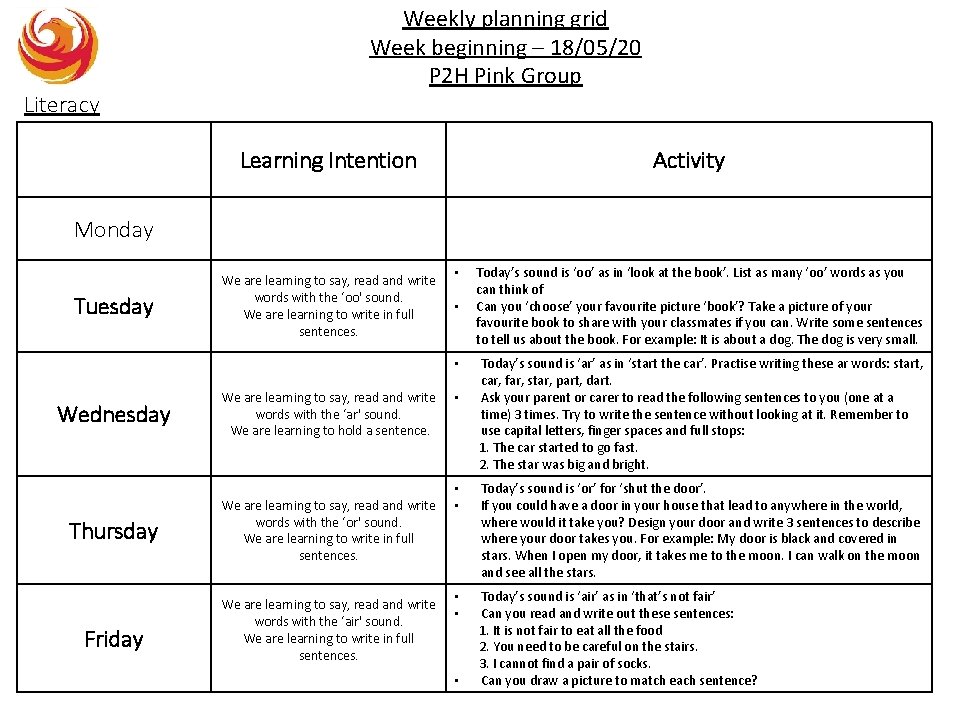
Literacy Weekly planning grid Week beginning – 18/05/20 P 2 H Pink Group Learning Intention Activity Monday Tuesday We are learning to say, read and write words with the ‘oo' sound. We are learning to write in full sentences. • • • Wednesday Thursday Friday We are learning to say, read and write words with the ‘ar' sound. We are learning to hold a sentence. We are learning to say, read and write words with the ‘or' sound. We are learning to write in full sentences. We are learning to say, read and write words with the ‘air' sound. We are learning to write in full sentences. • Today’s sound is ‘oo’ as in ‘look at the book’. List as many ‘oo’ words as you can think of Can you ‘choose’ your favourite picture ‘book’? Take a picture of your favourite book to share with your classmates if you can. Write some sentences to tell us about the book. For example: It is about a dog. The dog is very small. Today’s sound is ‘ar’ as in ‘start the car’. Practise writing these ar words: start, car, far, star, part, dart. Ask your parent or carer to read the following sentences to you (one at a time) 3 times. Try to write the sentence without looking at it. Remember to use capital letters, finger spaces and full stops: 1. The car started to go fast. 2. The star was big and bright. • • Today’s sound is ‘or’ for ‘shut the door’. If you could have a door in your house that lead to anywhere in the world, where would it take you? Design your door and write 3 sentences to describe where your door takes you. For example: My door is black and covered in stars. When I open my door, it takes me to the moon. I can walk on the moon and see all the stars. • • Today’s sound is ‘air’ as in ‘that’s not fair’ Can you read and write out these sentences: 1. It is not fair to eat all the food 2. You need to be careful on the stairs. 3. I cannot find a pair of socks. Can you draw a picture to match each sentence? •
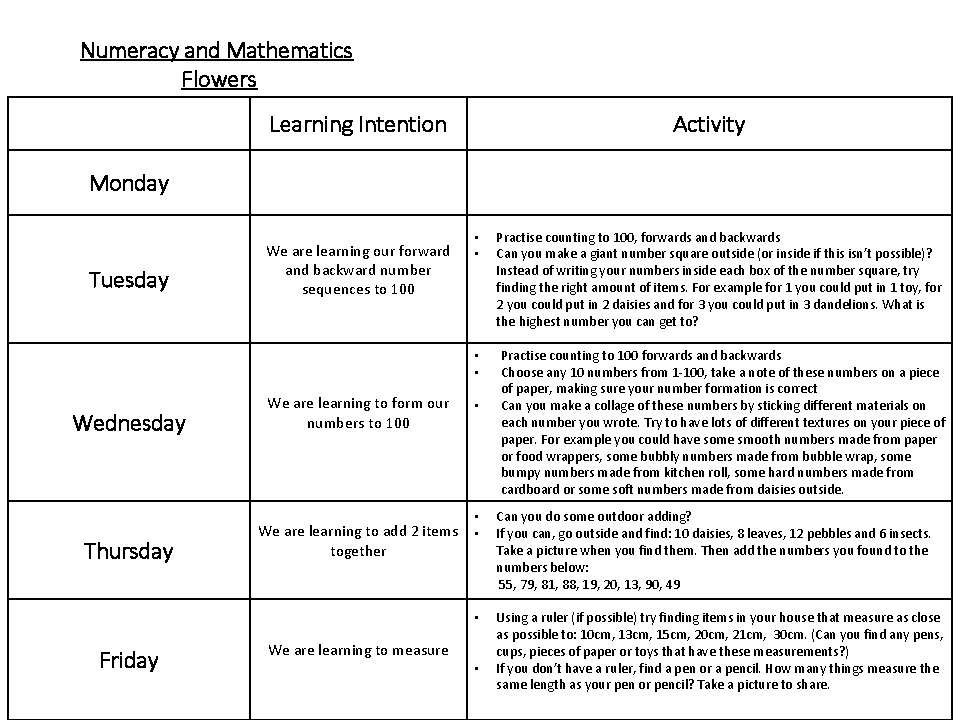
Numeracy and Mathematics Flowers Learning Intention Activity Monday Tuesday Wednesday Thursday Friday We are learning our forward and backward number sequences to 100 We are learning to form our numbers to 100 We are learning to add 2 items together We are learning to measure • • Practise counting to 100, forwards and backwards Can you make a giant number square outside (or inside if this isn’t possible)? Instead of writing your numbers inside each box of the number square, try finding the right amount of items. For example for 1 you could put in 1 toy, for 2 you could put in 2 daisies and for 3 you could put in 3 dandelions. What is the highest number you can get to? • • Practise counting to 100 forwards and backwards Choose any 10 numbers from 1 -100, take a note of these numbers on a piece of paper, making sure your number formation is correct Can you make a collage of these numbers by sticking different materials on each number you wrote. Try to have lots of different textures on your piece of paper. For example you could have some smooth numbers made from paper or food wrappers, some bubbly numbers made from bubble wrap, some bumpy numbers made from kitchen roll, some hard numbers made from cardboard or some soft numbers made from daisies outside. • • • Can you do some outdoor adding? If you can, go outside and find: 10 daisies, 8 leaves, 12 pebbles and 6 insects. Take a picture when you find them. Then add the numbers you found to the numbers below: 55, 79, 81, 88, 19, 20, 13, 90, 49 • Using a ruler (if possible) try finding items in your house that measure as close as possible to: 10 cm, 13 cm, 15 cm, 20 cm, 21 cm, 30 cm. (Can you find any pens, cups, pieces of paper or toys that have these measurements? ) If you don’t have a ruler, find a pen or a pencil. How many things measure the same length as your pen or pencil? Take a picture to share. •
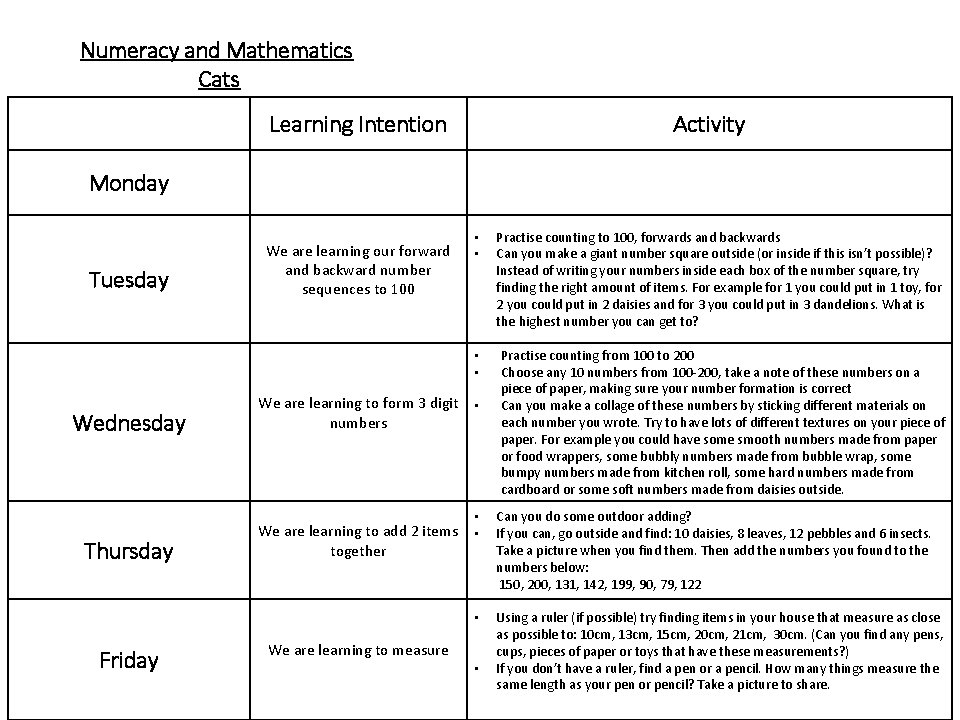
Numeracy and Mathematics Cats Learning Intention Activity Monday Tuesday Wednesday Thursday Friday We are learning our forward and backward number sequences to 100 • • Practise counting to 100, forwards and backwards Can you make a giant number square outside (or inside if this isn’t possible)? Instead of writing your numbers inside each box of the number square, try finding the right amount of items. For example for 1 you could put in 1 toy, for 2 you could put in 2 daisies and for 3 you could put in 3 dandelions. What is the highest number you can get to? • • Practise counting from 100 to 200 Choose any 10 numbers from 100 -200, take a note of these numbers on a piece of paper, making sure your number formation is correct Can you make a collage of these numbers by sticking different materials on each number you wrote. Try to have lots of different textures on your piece of paper. For example you could have some smooth numbers made from paper or food wrappers, some bubbly numbers made from bubble wrap, some bumpy numbers made from kitchen roll, some hard numbers made from cardboard or some soft numbers made from daisies outside. We are learning to form 3 digit • numbers We are learning to add 2 items together We are learning to measure • • Can you do some outdoor adding? If you can, go outside and find: 10 daisies, 8 leaves, 12 pebbles and 6 insects. Take a picture when you find them. Then add the numbers you found to the numbers below: 150, 200, 131, 142, 199, 90, 79, 122 • Using a ruler (if possible) try finding items in your house that measure as close as possible to: 10 cm, 13 cm, 15 cm, 20 cm, 21 cm, 30 cm. (Can you find any pens, cups, pieces of paper or toys that have these measurements? ) If you don’t have a ruler, find a pen or a pencil. How many things measure the same length as your pen or pencil? Take a picture to share. •
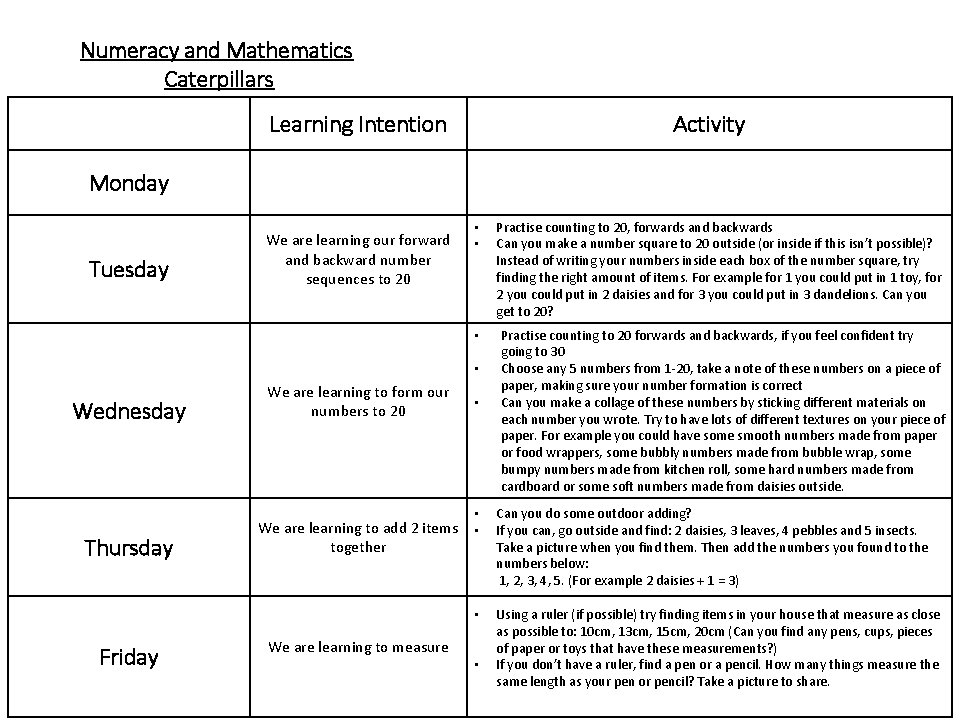
Numeracy and Mathematics Caterpillars Learning Intention Activity Monday Tuesday We are learning our forward and backward number sequences to 20 • • Practise counting to 20, forwards and backwards Can you make a number square to 20 outside (or inside if this isn’t possible)? Instead of writing your numbers inside each box of the number square, try finding the right amount of items. For example for 1 you could put in 1 toy, for 2 you could put in 2 daisies and for 3 you could put in 3 dandelions. Can you get to 20? • Practise counting to 20 forwards and backwards, if you feel confident try going to 30 Choose any 5 numbers from 1 -20, take a note of these numbers on a piece of paper, making sure your number formation is correct Can you make a collage of these numbers by sticking different materials on each number you wrote. Try to have lots of different textures on your piece of paper. For example you could have some smooth numbers made from paper or food wrappers, some bubbly numbers made from bubble wrap, some bumpy numbers made from kitchen roll, some hard numbers made from cardboard or some soft numbers made from daisies outside. • Wednesday Thursday Friday We are learning to form our numbers to 20 We are learning to add 2 items together We are learning to measure • • • Can you do some outdoor adding? If you can, go outside and find: 2 daisies, 3 leaves, 4 pebbles and 5 insects. Take a picture when you find them. Then add the numbers you found to the numbers below: 1, 2, 3, 4, 5. (For example 2 daisies + 1 = 3) • Using a ruler (if possible) try finding items in your house that measure as close as possible to: 10 cm, 13 cm, 15 cm, 20 cm (Can you find any pens, cups, pieces of paper or toys that have these measurements? ) If you don’t have a ruler, find a pen or a pencil. How many things measure the same length as your pen or pencil? Take a picture to share. •
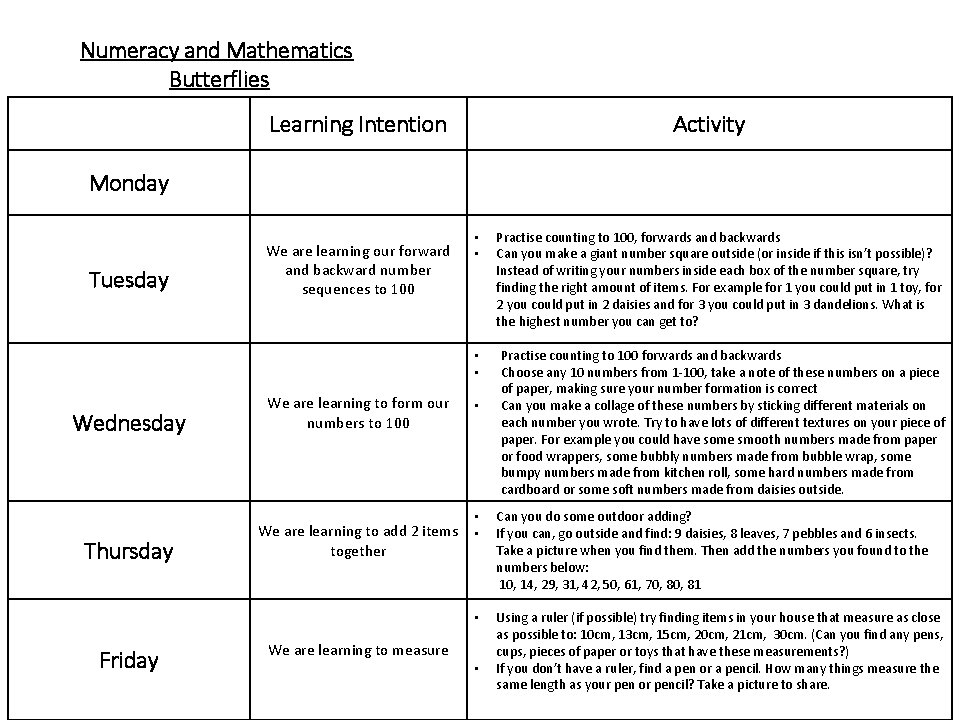
Numeracy and Mathematics Butterflies Learning Intention Activity Monday Tuesday Wednesday Thursday Friday We are learning our forward and backward number sequences to 100 We are learning to form our numbers to 100 We are learning to add 2 items together We are learning to measure • • Practise counting to 100, forwards and backwards Can you make a giant number square outside (or inside if this isn’t possible)? Instead of writing your numbers inside each box of the number square, try finding the right amount of items. For example for 1 you could put in 1 toy, for 2 you could put in 2 daisies and for 3 you could put in 3 dandelions. What is the highest number you can get to? • • Practise counting to 100 forwards and backwards Choose any 10 numbers from 1 -100, take a note of these numbers on a piece of paper, making sure your number formation is correct Can you make a collage of these numbers by sticking different materials on each number you wrote. Try to have lots of different textures on your piece of paper. For example you could have some smooth numbers made from paper or food wrappers, some bubbly numbers made from bubble wrap, some bumpy numbers made from kitchen roll, some hard numbers made from cardboard or some soft numbers made from daisies outside. • • • Can you do some outdoor adding? If you can, go outside and find: 9 daisies, 8 leaves, 7 pebbles and 6 insects. Take a picture when you find them. Then add the numbers you found to the numbers below: 10, 14, 29, 31, 42, 50, 61, 70, 81 • Using a ruler (if possible) try finding items in your house that measure as close as possible to: 10 cm, 13 cm, 15 cm, 20 cm, 21 cm, 30 cm. (Can you find any pens, cups, pieces of paper or toys that have these measurements? ) If you don’t have a ruler, find a pen or a pencil. How many things measure the same length as your pen or pencil? Take a picture to share. •
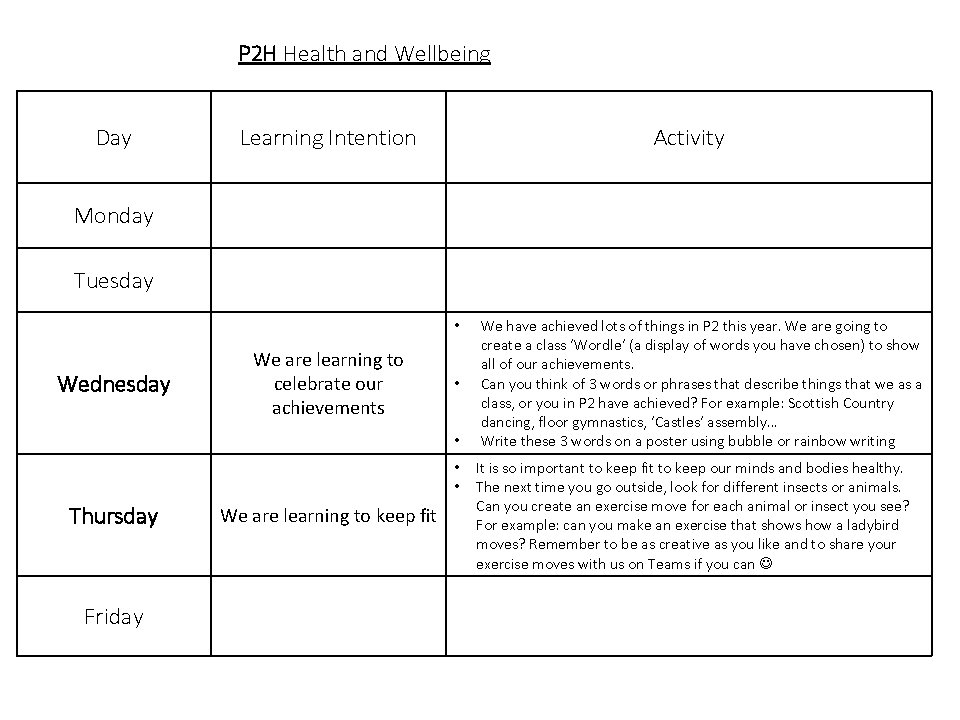
P 2 H Health and Wellbeing Day Learning Intention Activity Monday Tuesday • Wednesday We are learning to celebrate our achievements • • Thursday Friday We are learning to keep fit We have achieved lots of things in P 2 this year. We are going to create a class ‘Wordle’ (a display of words you have chosen) to show all of our achievements. Can you think of 3 words or phrases that describe things that we as a class, or you in P 2 have achieved? For example: Scottish Country dancing, floor gymnastics, ‘Castles’ assembly… Write these 3 words on a poster using bubble or rainbow writing It is so important to keep fit to keep our minds and bodies healthy. The next time you go outside, look for different insects or animals. Can you create an exercise move for each animal or insect you see? For example: can you make an exercise that shows how a ladybird moves? Remember to be as creative as you like and to share your exercise moves with us on Teams if you can
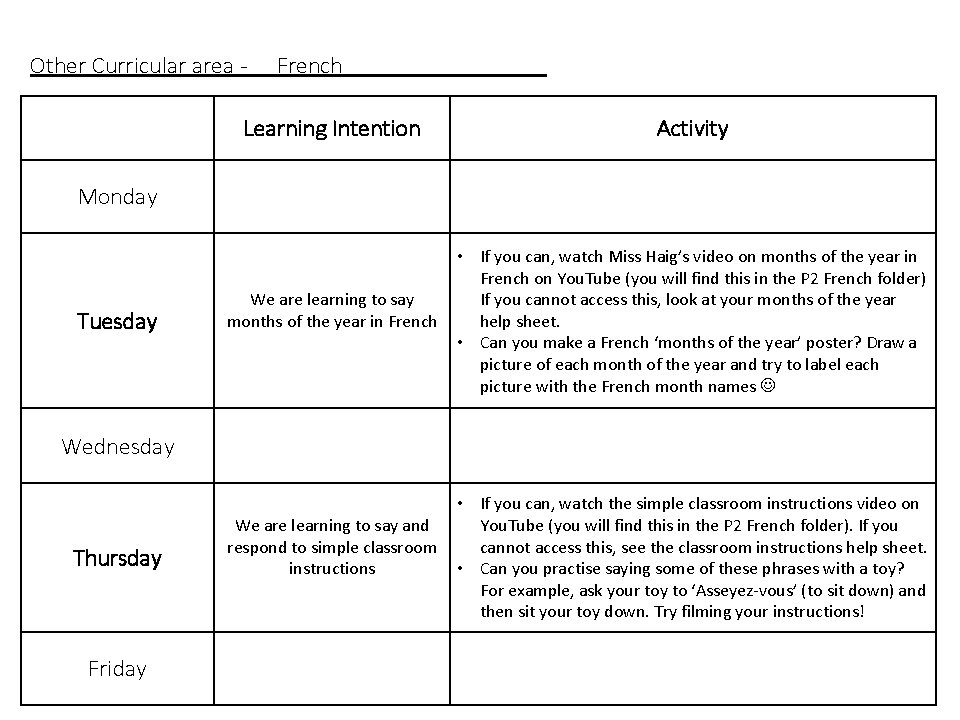
Other Curricular area - __French_________ Learning Intention Activity Monday Tuesday We are learning to say months of the year in French • If you can, watch Miss Haig’s video on months of the year in French on You. Tube (you will find this in the P 2 French folder) If you cannot access this, look at your months of the year help sheet. • Can you make a French ‘months of the year’ poster? Draw a picture of each month of the year and try to label each picture with the French month names Wednesday Thursday Friday We are learning to say and respond to simple classroom instructions • If you can, watch the simple classroom instructions video on You. Tube (you will find this in the P 2 French folder). If you cannot access this, see the classroom instructions help sheet. • Can you practise saying some of these phrases with a toy? For example, ask your toy to ‘Asseyez-vous’ (to sit down) and then sit your toy down. Try filming your instructions!
- Slides: 9