
Literacy Toolkit One Definitions of Literacy is not
- Slides: 31
Literacy Toolkit One
Definitions of Literacy is not narrowly about the mechanics of being able to decode the words on a page or write a grammatically correct sentence, although these are essential skills in their own right. It is about the skills needed to understand written and spoken language, to interpret what has been written or said, and draw inferences from the evidence that surrounds us. It is also about being able to communicate in our turn – fluently, cogently and persuasively.
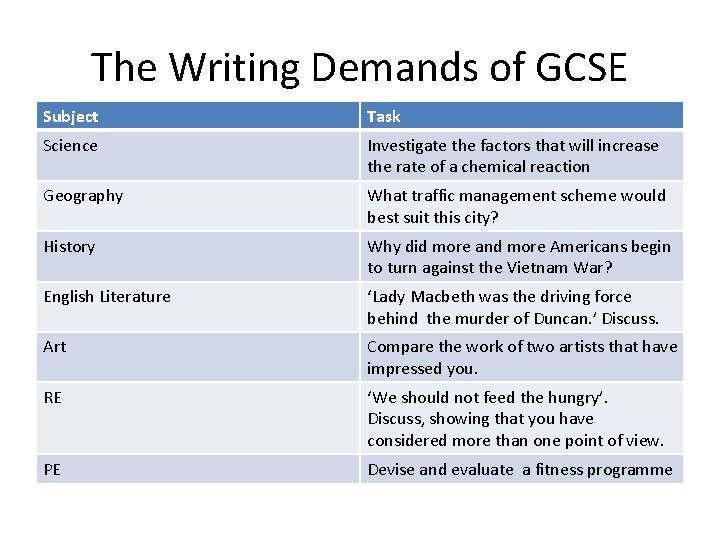
The Writing Demands of GCSE Subject Task Science Investigate the factors that will increase the rate of a chemical reaction Geography What traffic management scheme would best suit this city? History Why did more and more Americans begin to turn against the Vietnam War? English Literature ‘Lady Macbeth was the driving force behind the murder of Duncan. ’ Discuss. Art Compare the work of two artists that have impressed you. RE ‘We should not feed the hungry’. Discuss, showing that you have considered more than one point of view. PE Devise and evaluate a fitness programme
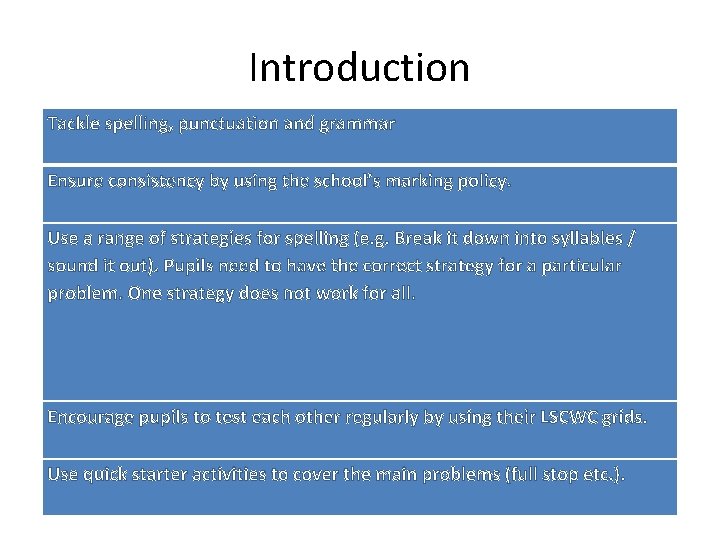
Introduction Tackle spelling, punctuation and grammar Ensure consistency by using the school’s marking policy. Use a range of strategies for spelling (e. g. Break it down into syllables / sound it out). Pupils need to have the correct strategy for a particular problem. One strategy does not work for all. Encourage pupils to test each other regularly by using their LSCWC grids. Use quick starter activities to cover the main problems (full stop etc. ).
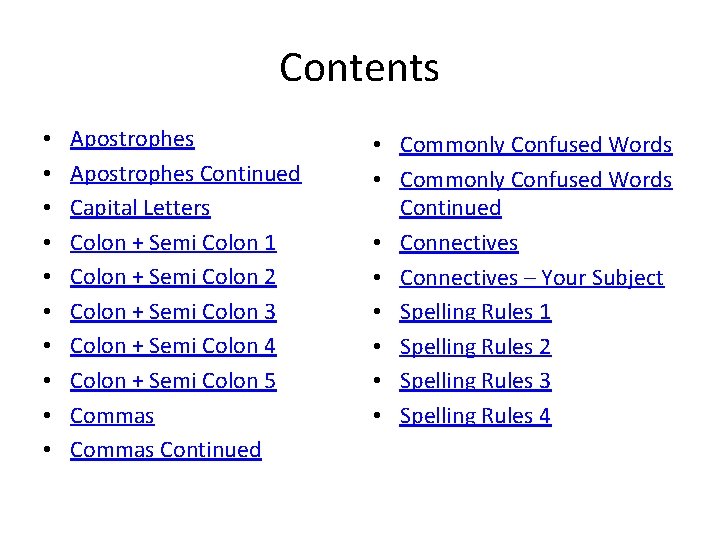
Contents • • • Apostrophes Continued Capital Letters Colon + Semi Colon 1 Colon + Semi Colon 2 Colon + Semi Colon 3 Colon + Semi Colon 4 Colon + Semi Colon 5 Commas Continued • Commonly Confused Words Continued • Connectives – Your Subject • Spelling Rules 1 • Spelling Rules 2 • Spelling Rules 3 • Spelling Rules 4
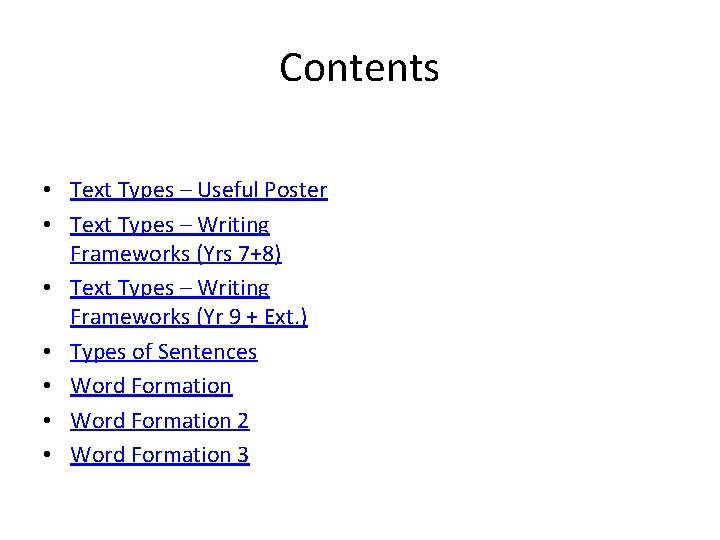
Contents • Text Types – Useful Poster • Text Types – Writing Frameworks (Yrs 7+8) • Text Types – Writing Frameworks (Yr 9 + Ext. ) • Types of Sentences • Word Formation 2 • Word Formation 3
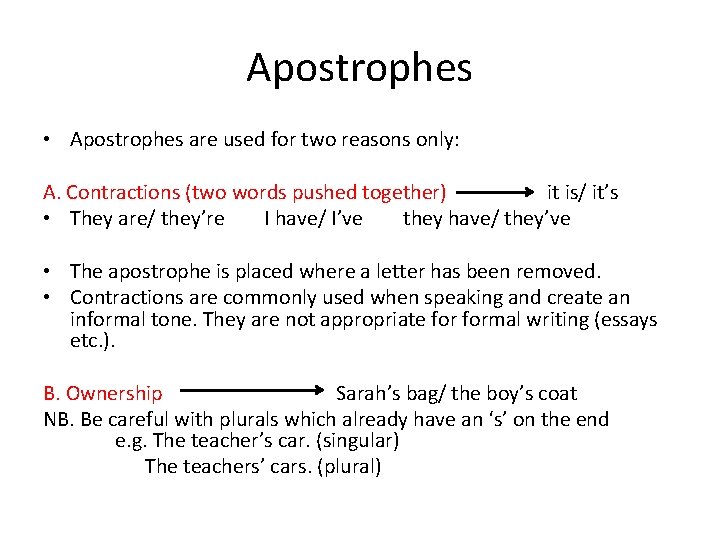
Apostrophes • Apostrophes are used for two reasons only: A. Contractions (two words pushed together) it is/ it’s • They are/ they’re I have/ I’ve they have/ they’ve • The apostrophe is placed where a letter has been removed. • Contractions are commonly used when speaking and create an informal tone. They are not appropriate formal writing (essays etc. ). B. Ownership Sarah’s bag/ the boy’s coat NB. Be careful with plurals which already have an ‘s’ on the end e. g. The teacher’s car. (singular) The teachers’ cars. (plural)
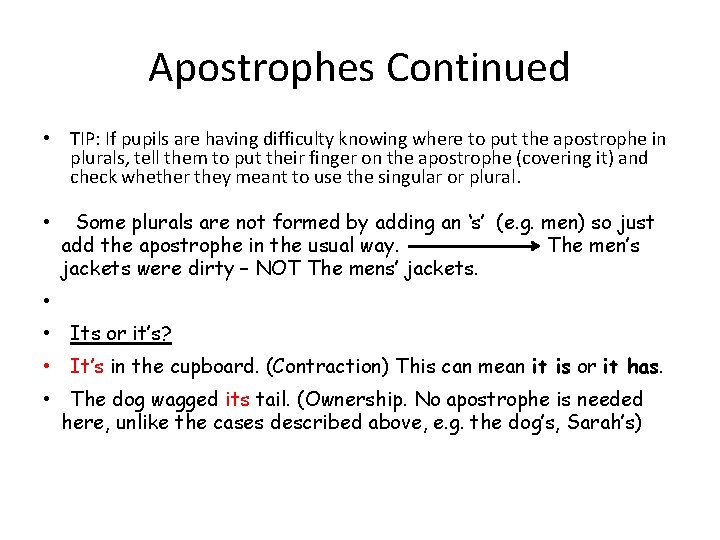
Apostrophes Continued • TIP: If pupils are having difficulty knowing where to put the apostrophe in plurals, tell them to put their finger on the apostrophe (covering it) and check whether they meant to use the singular or plural. • Some plurals are not formed by adding an ‘s’ (e. g. men) so just add the apostrophe in the usual way. The men’s jackets were dirty – NOT The mens’ jackets. • • Its or it’s? • It’s in the cupboard. (Contraction) This can mean it is or it has. • The dog wagged its tail. (Ownership. No apostrophe is needed here, unlike the cases described above, e. g. the dog’s, Sarah’s)
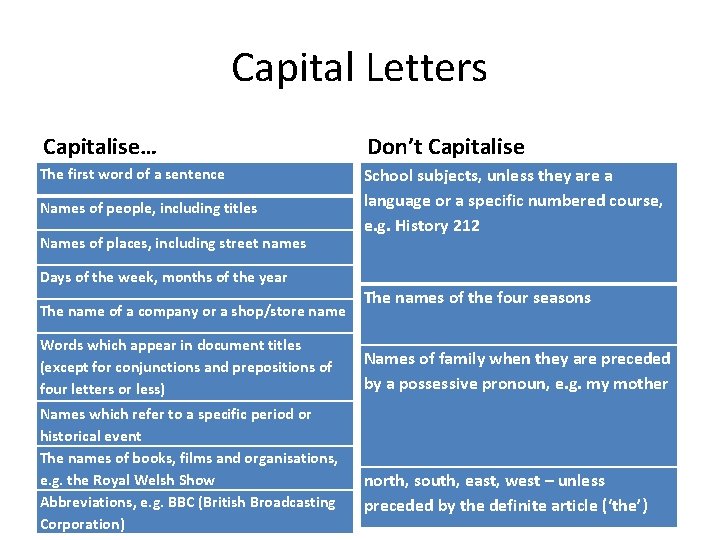
Capital Letters Capitalise… Don’t Capitalise The first word of a sentence School subjects, unless they are a language or a specific numbered course, e. g. History 212 Names of people, including titles Names of places, including street names Days of the week, months of the year The name of a company or a shop/store name Words which appear in document titles (except for conjunctions and prepositions of four letters or less) Names which refer to a specific period or historical event The names of books, films and organisations, e. g. the Royal Welsh Show Abbreviations, e. g. BBC (British Broadcasting Corporation) The names of the four seasons Names of family when they are preceded by a possessive pronoun, e. g. my mother north, south, east, west – unless preceded by the definite article (‘the’)
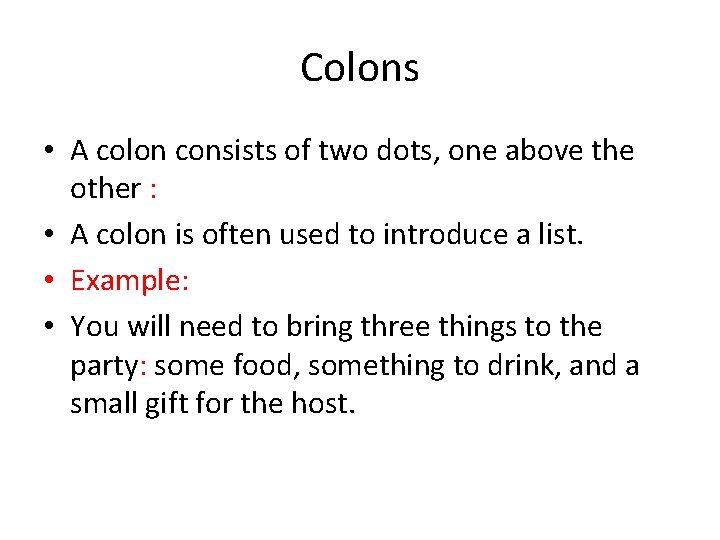
Colons • A colon consists of two dots, one above the other : • A colon is often used to introduce a list. • Example: • You will need to bring three things to the party: some food, something to drink, and a small gift for the host.
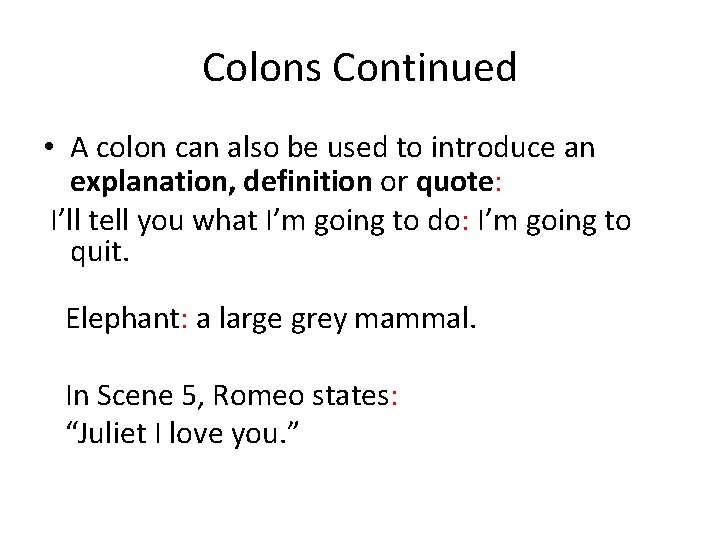
Colons Continued • A colon can also be used to introduce an explanation, definition or quote: I’ll tell you what I’m going to do: I’m going to quit. Elephant: a large grey mammal. In Scene 5, Romeo states: “Juliet I love you. ”
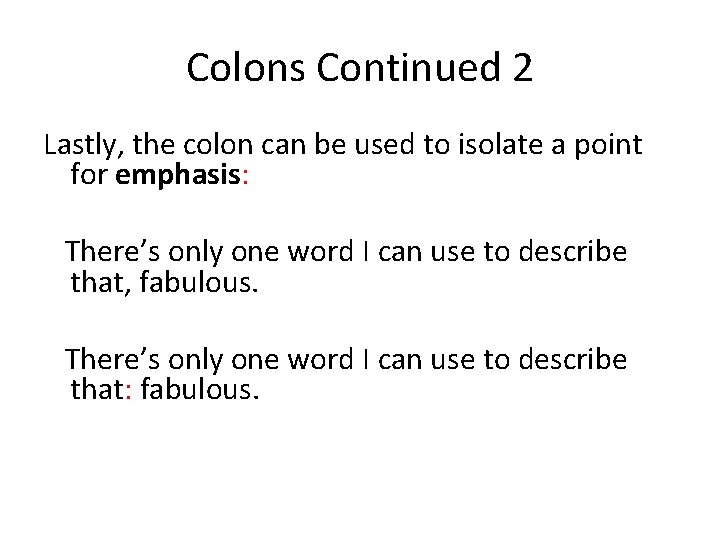
Colons Continued 2 Lastly, the colon can be used to isolate a point for emphasis: There’s only one word I can use to describe that, fabulous. There’s only one word I can use to describe that: fabulous.
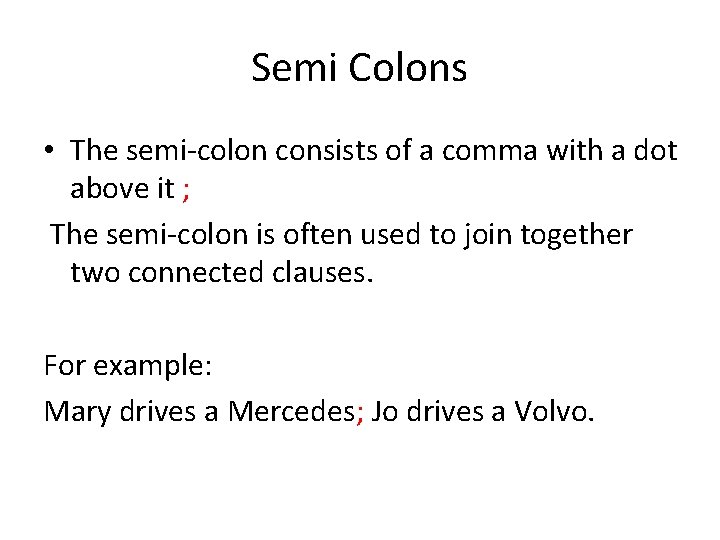
Semi Colons • The semi-colon consists of a comma with a dot above it ; The semi-colon is often used to join together two connected clauses. For example: Mary drives a Mercedes; Jo drives a Volvo.
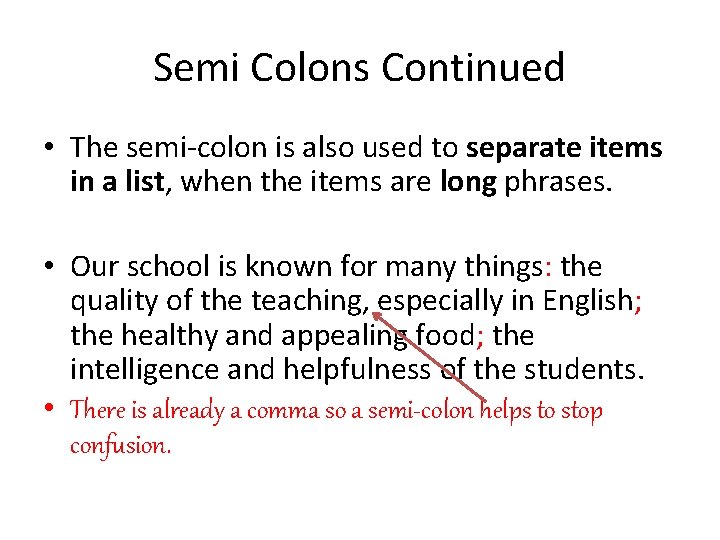
Semi Colons Continued • The semi-colon is also used to separate items in a list, when the items are long phrases. • Our school is known for many things: the quality of the teaching, especially in English; the healthy and appealing food; the intelligence and helpfulness of the students. • There is already a comma so a semi-colon helps to stop confusion.
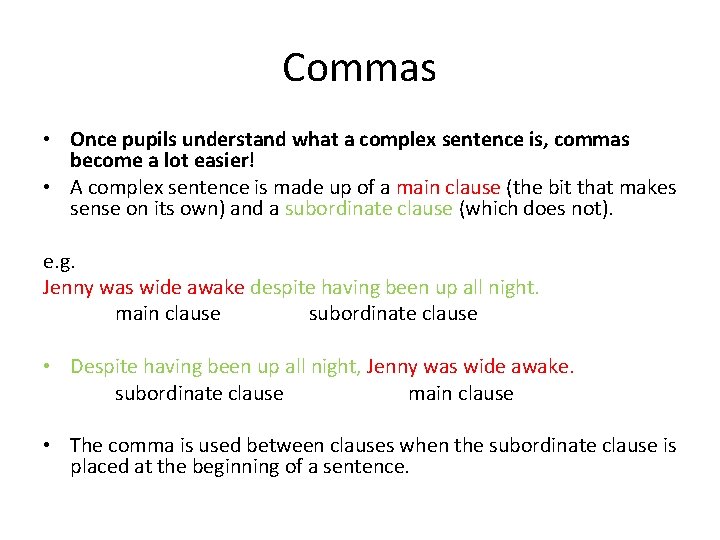
Commas • Once pupils understand what a complex sentence is, commas become a lot easier! • A complex sentence is made up of a main clause (the bit that makes sense on its own) and a subordinate clause (which does not). e. g. Jenny was wide awake despite having been up all night. main clause subordinate clause • Despite having been up all night, Jenny was wide awake. subordinate clause main clause • The comma is used between clauses when the subordinate clause is placed at the beginning of a sentence.
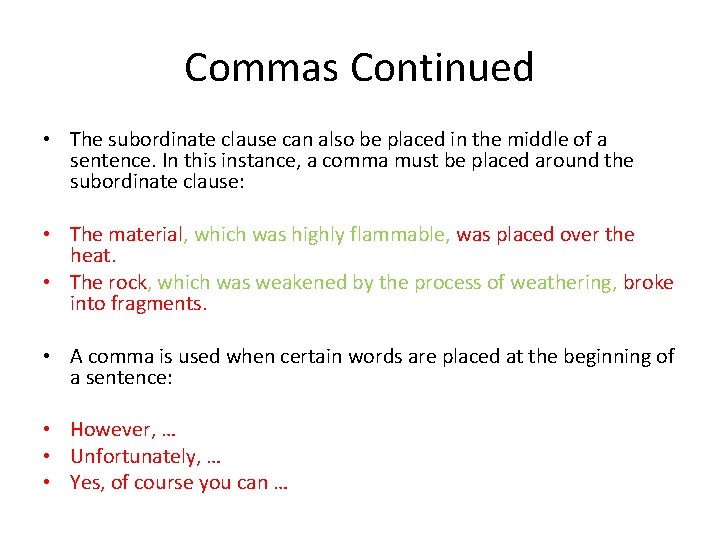
Commas Continued • The subordinate clause can also be placed in the middle of a sentence. In this instance, a comma must be placed around the subordinate clause: • The material, which was highly flammable, was placed over the heat. • The rock, which was weakened by the process of weathering, broke into fragments. • A comma is used when certain words are placed at the beginning of a sentence: • However, … • Unfortunately, … • Yes, of course you can …
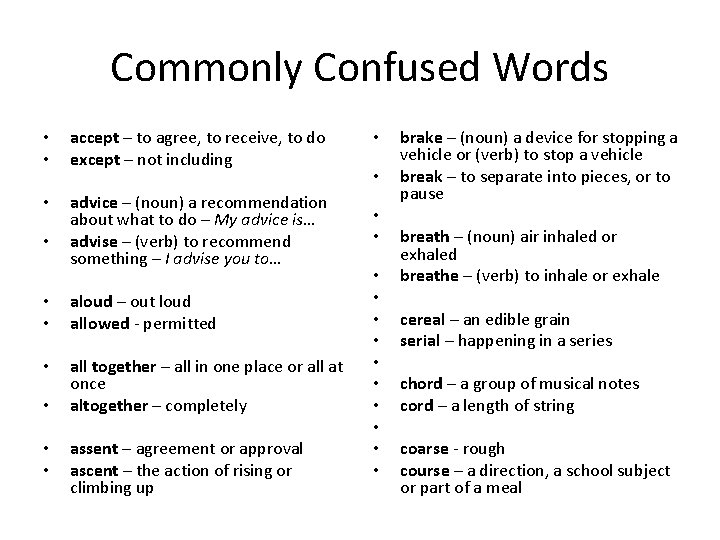
Commonly Confused Words • • accept – to agree, to receive, to do except – not including • advice – (noun) a recommendation about what to do – My advice is… advise – (verb) to recommend something – I advise you to… • • • aloud – out loud allowed - permitted • all together – all in one place or all at once altogether – completely • • • assent – agreement or approval ascent – the action of rising or climbing up • • • • brake – (noun) a device for stopping a vehicle or (verb) to stop a vehicle break – to separate into pieces, or to pause breath – (noun) air inhaled or exhaled breathe – (verb) to inhale or exhale cereal – an edible grain serial – happening in a series chord – a group of musical notes cord – a length of string coarse - rough course – a direction, a school subject or part of a meal
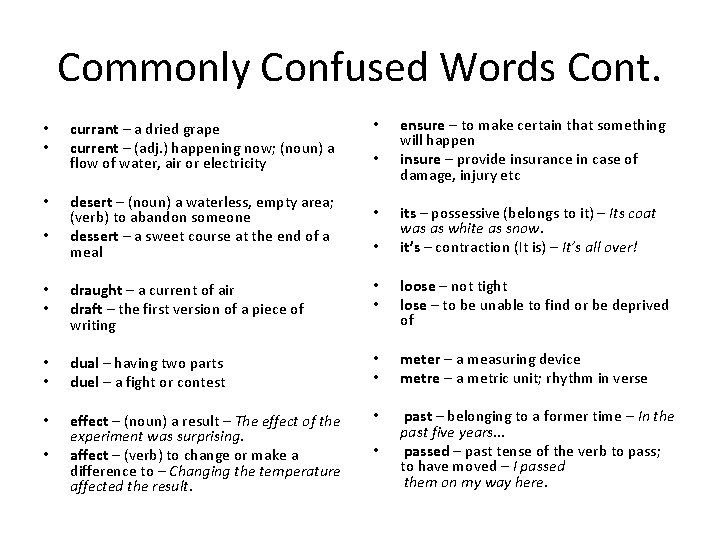
Commonly Confused Words Cont. • • currant – a dried grape current – (adj. ) happening now; (noun) a flow of water, air or electricity • desert – (noun) a waterless, empty area; (verb) to abandon someone dessert – a sweet course at the end of a meal • • • ensure – to make certain that something will happen insure – provide insurance in case of damage, injury etc its – possessive (belongs to it) – Its coat was as white as snow. it’s – contraction (It is) – It’s all over! • • draught – a current of air draft – the first version of a piece of writing • • loose – not tight lose – to be unable to find or be deprived of • • dual – having two parts duel – a fight or contest • • meter – a measuring device metre – a metric unit; rhythm in verse • effect – (noun) a result – The effect of the experiment was surprising. affect – (verb) to change or make a difference to – Changing the temperature affected the result. • past – belonging to a former time – In the past five years… passed – past tense of the verb to pass; to have moved – I passed them on my way here. • •
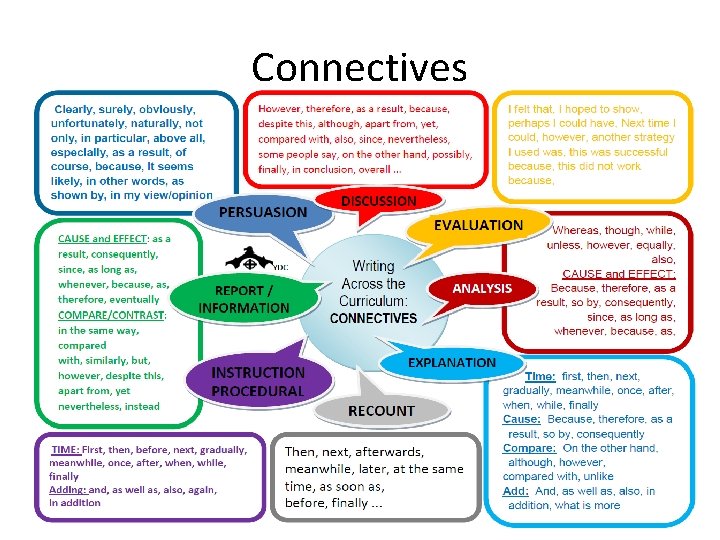
Connectives
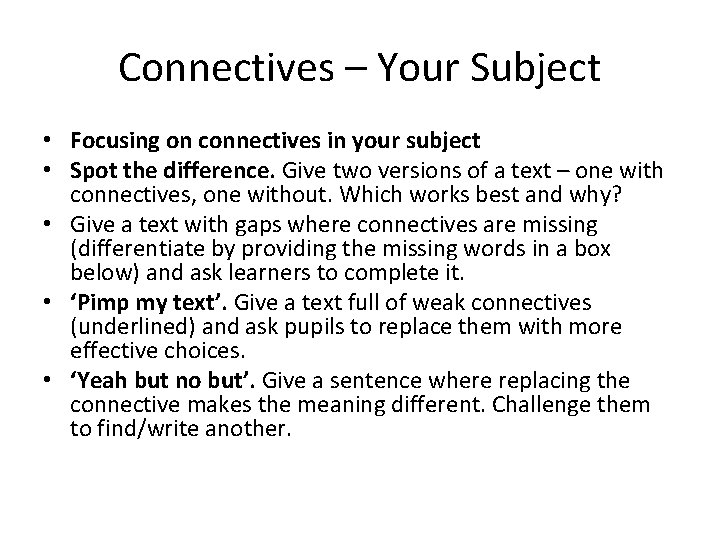
Connectives – Your Subject • Focusing on connectives in your subject • Spot the difference. Give two versions of a text – one with connectives, one without. Which works best and why? • Give a text with gaps where connectives are missing (differentiate by providing the missing words in a box below) and ask learners to complete it. • ‘Pimp my text’. Give a text full of weak connectives (underlined) and ask pupils to replace them with more effective choices. • ‘Yeah but no but’. Give a sentence where replacing the connective makes the meaning different. Challenge them to find/write another.
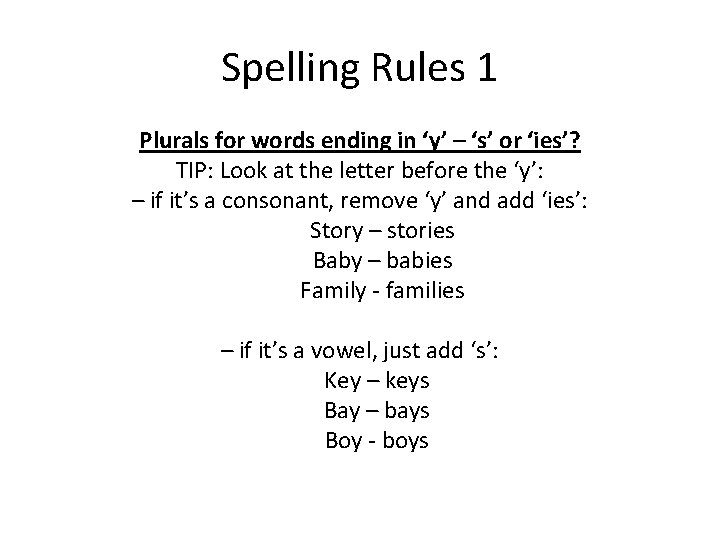
Spelling Rules 1 Plurals for words ending in ‘y’ – ‘s’ or ‘ies’? TIP: Look at the letter before the ‘y’: – if it’s a consonant, remove ‘y’ and add ‘ies’: Story – stories Baby – babies Family - families – if it’s a vowel, just add ‘s’: Key – keys Bay – bays Boy - boys
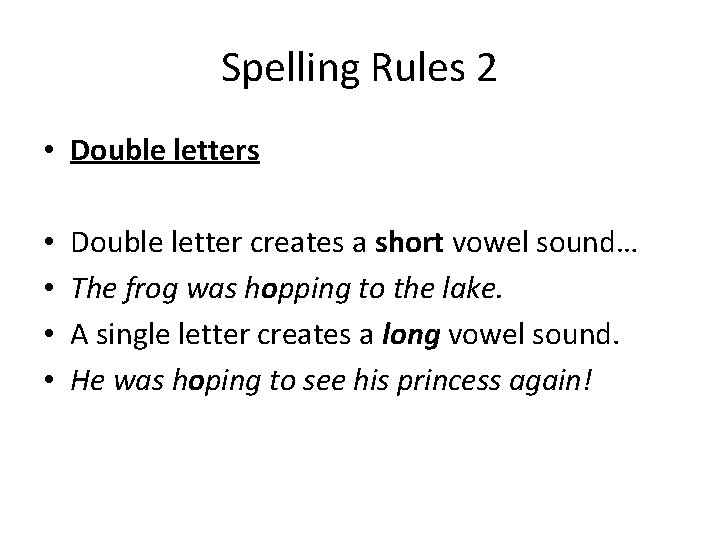
Spelling Rules 2 • Double letters • • Double letter creates a short vowel sound… The frog was hopping to the lake. A single letter creates a long vowel sound. He was hoping to see his princess again!
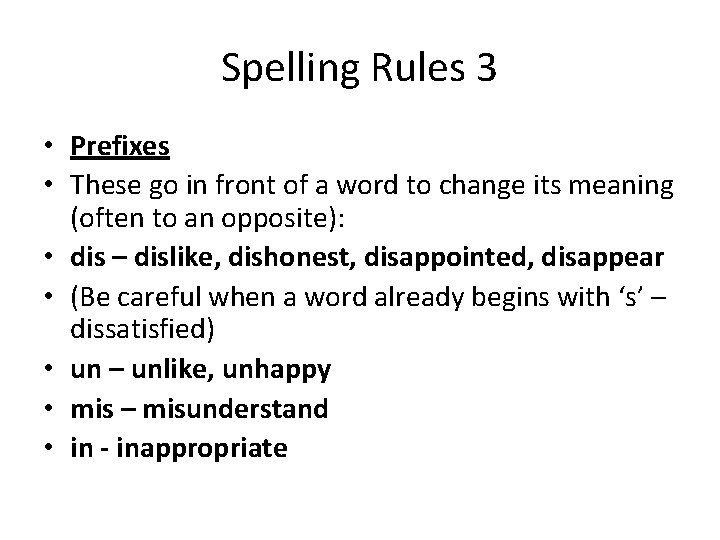
Spelling Rules 3 • Prefixes • These go in front of a word to change its meaning (often to an opposite): • dis – dislike, dishonest, disappointed, disappear • (Be careful when a word already begins with ‘s’ – dissatisfied) • un – unlike, unhappy • mis – misunderstand • in - inappropriate
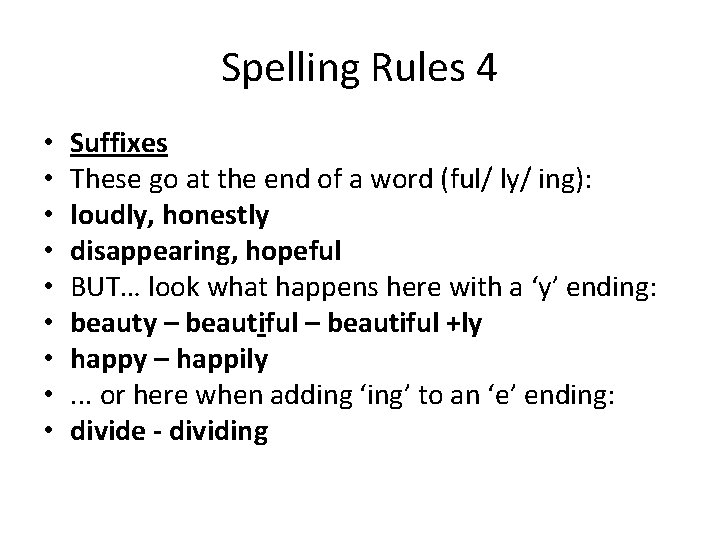
Spelling Rules 4 • • • Suffixes These go at the end of a word (ful/ ly/ ing): loudly, honestly disappearing, hopeful BUT… look what happens here with a ‘y’ ending: beauty – beautiful +ly happy – happily. . . or here when adding ‘ing’ to an ‘e’ ending: divide - dividing
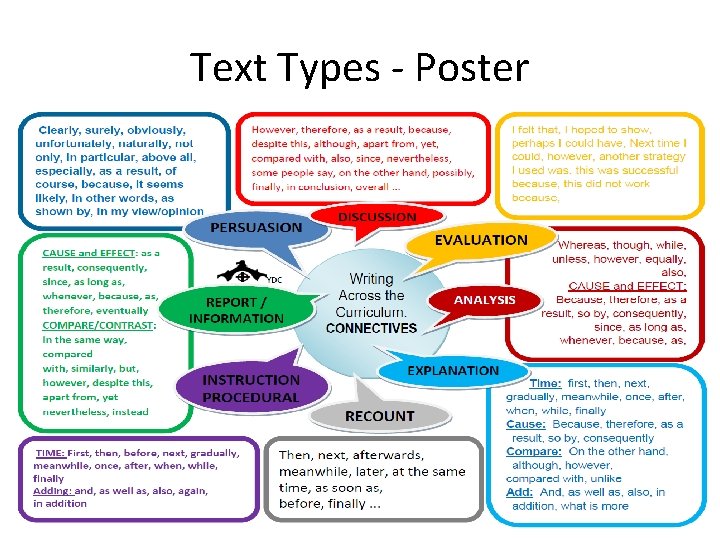
Text Types - Poster
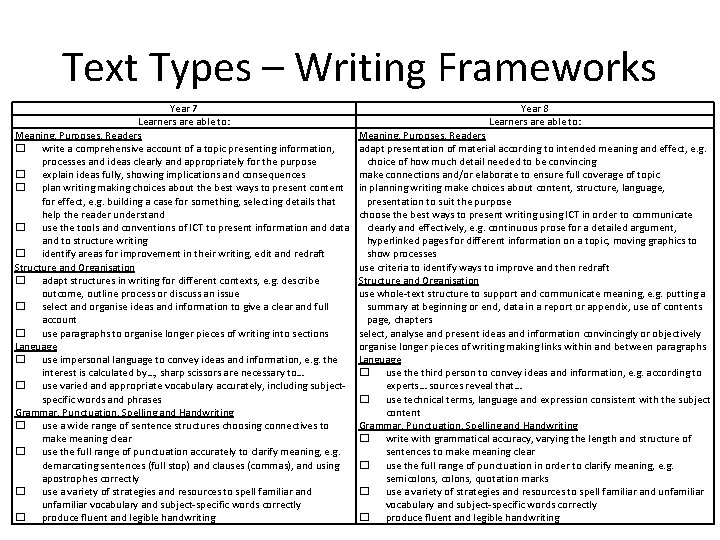
Text Types – Writing Frameworks Year 7 Learners are able to: Meaning, Purposes, Readers � write a comprehensive account of a topic presenting information, processes and ideas clearly and appropriately for the purpose � explain ideas fully, showing implications and consequences � plan writing making choices about the best ways to present content for effect, e. g. building a case for something, selecting details that help the reader understand � use the tools and conventions of ICT to present information and data and to structure writing � identify areas for improvement in their writing, edit and redraft Structure and Organisation � adapt structures in writing for different contexts, e. g. describe outcome, outline process or discuss an issue � select and organise ideas and information to give a clear and full account � use paragraphs to organise longer pieces of writing into sections Language � use impersonal language to convey ideas and information, e. g. the interest is calculated by…, sharp scissors are necessary to… � use varied and appropriate vocabulary accurately, including subjectspecific words and phrases Grammar, Punctuation, Spelling and Handwriting � use a wide range of sentence structures choosing connectives to make meaning clear � use the full range of punctuation accurately to clarify meaning, e. g. demarcating sentences (full stop) and clauses (commas), and using apostrophes correctly � use a variety of strategies and resources to spell familiar and unfamiliar vocabulary and subject-specific words correctly � produce fluent and legible handwriting Year 8 Learners are able to: Meaning, Purposes, Readers adapt presentation of material according to intended meaning and effect, e. g. choice of how much detail needed to be convincing make connections and/or elaborate to ensure full coverage of topic in planning writing make choices about content, structure, language, presentation to suit the purpose choose the best ways to present writing using ICT in order to communicate clearly and effectively, e. g. continuous prose for a detailed argument, hyperlinked pages for different information on a topic, moving graphics to show processes use criteria to identify ways to improve and then redraft Structure and Organisation use whole-text structure to support and communicate meaning, e. g. putting a summary at beginning or end, data in a report or appendix, use of contents page, chapters select, analyse and present ideas and information convincingly or objectively organise longer pieces of writing making links within and between paragraphs Language � use third person to convey ideas and information, e. g. according to experts… sources reveal that… � use technical terms, language and expression consistent with the subject content Grammar, Punctuation, Spelling and Handwriting � write with grammatical accuracy, varying the length and structure of sentences to make meaning clear � use the full range of punctuation in order to clarify meaning, e. g. semicolons, quotation marks � use a variety of strategies and resources to spell familiar and unfamiliar vocabulary and subject-specific words correctly � produce fluent and legible handwriting
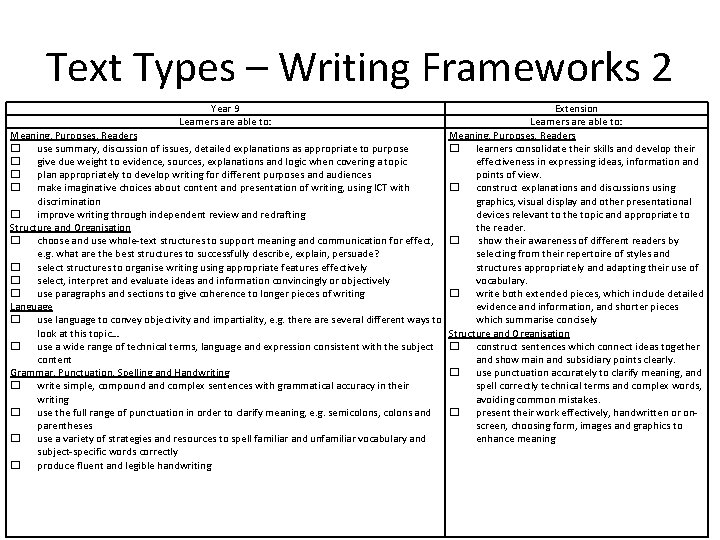
Text Types – Writing Frameworks 2 Year 9 Learners are able to: Extension Learners are able to: Meaning, Purposes, Readers � use summary, discussion of issues, detailed explanations as appropriate to purpose � learners consolidate their skills and develop their � give due weight to evidence, sources, explanations and logic when covering a topic effectiveness in expressing ideas, information and � plan appropriately to develop writing for different purposes and audiences points of view. � make imaginative choices about content and presentation of writing, using ICT with � construct explanations and discussions using discrimination graphics, visual display and other presentational � improve writing through independent review and redrafting devices relevant to the topic and appropriate to Structure and Organisation the reader. � choose and use whole-text structures to support meaning and communication for effect, � show their awareness of different readers by e. g. what are the best structures to successfully describe, explain, persuade? selecting from their repertoire of styles and � select structures to organise writing using appropriate features effectively structures appropriately and adapting their use of � select, interpret and evaluate ideas and information convincingly or objectively vocabulary. � use paragraphs and sections to give coherence to longer pieces of writing � write both extended pieces, which include detailed Language evidence and information, and shorter pieces � use language to convey objectivity and impartiality, e. g. there are several different ways to which summarise concisely look at this topic… Structure and Organisation � use a wide range of technical terms, language and expression consistent with the subject � construct sentences which connect ideas together content and show main and subsidiary points clearly. Grammar, Punctuation, Spelling and Handwriting � use punctuation accurately to clarify meaning, and � write simple, compound and complex sentences with grammatical accuracy in their spell correctly technical terms and complex words, writing avoiding common mistakes. � use the full range of punctuation in order to clarify meaning, e. g. semicolons, colons and � present their work effectively, handwritten or onparentheses screen, choosing form, images and graphics to � use a variety of strategies and resources to spell familiar and unfamiliar vocabulary and enhance meaning subject-specific words correctly � produce fluent and legible handwriting
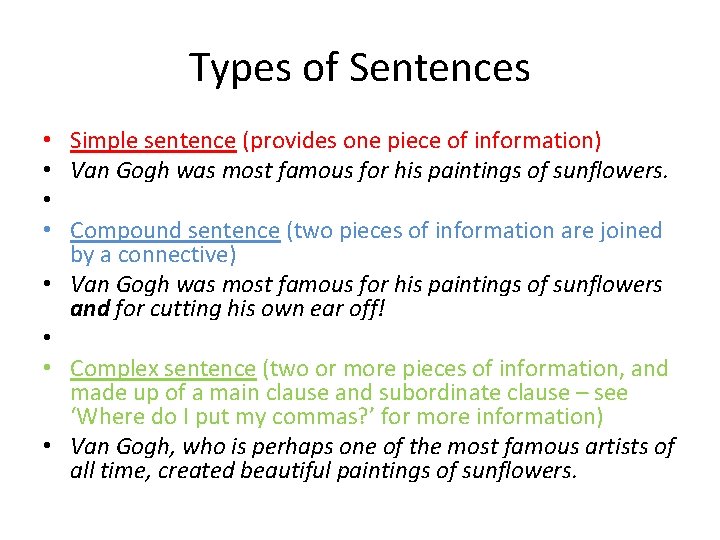
Types of Sentences • • Simple sentence (provides one piece of information) Van Gogh was most famous for his paintings of sunflowers. Compound sentence (two pieces of information are joined by a connective) Van Gogh was most famous for his paintings of sunflowers and for cutting his own ear off! Complex sentence (two or more pieces of information, and made up of a main clause and subordinate clause – see ‘Where do I put my commas? ’ for more information) Van Gogh, who is perhaps one of the most famous artists of all time, created beautiful paintings of sunflowers.
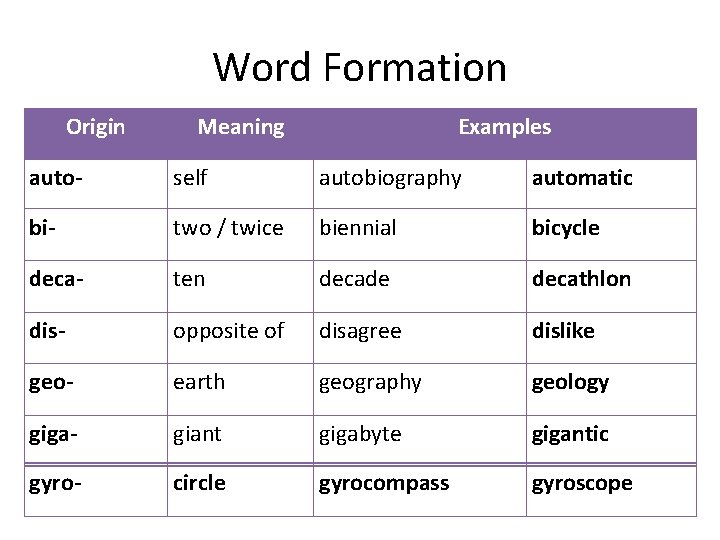
Word Formation Origin Meaning Examples auto- self autobiography automatic bi- two / twice biennial bicycle deca- ten decade decathlon dis- opposite of disagree dislike geo- earth geography geology giga- giant gigabyte gigantic gyro- circle gyrocompass gyroscope
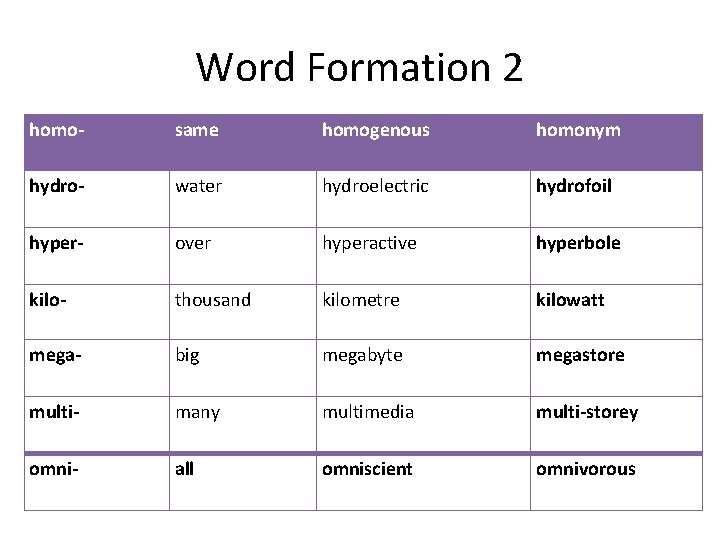
Word Formation 2 homo- same homogenous homonym hydro- water hydroelectric hydrofoil hyper- over hyperactive hyperbole kilo- thousand kilometre kilowatt mega- big megabyte megastore multi- many multimedia multi-storey omni- all omniscient omnivorous
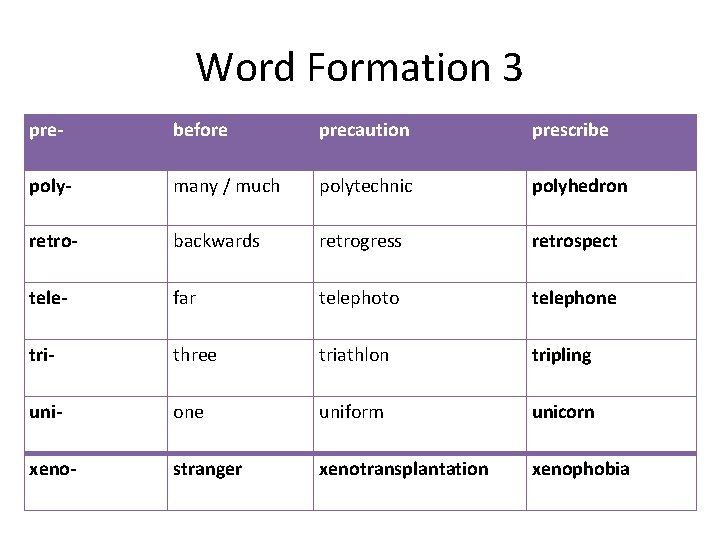
Word Formation 3 pre- before precaution prescribe poly- many / much polytechnic polyhedron retro- backwards retrogress retrospect tele- far telephoto telephone tri- three triathlon tripling uni- one uniform unicorn xeno- stranger xenotransplantation xenophobia