
Literacy in CTE A Sample SLO Process Eric
- Slides: 20
Literacy in CTE A Sample SLO Process Eric Larsen Effectiveness Project Support CESA 6
What makes a good literacy SLO? • CONNECTIONS! – Content that you teach – A Specific Disciplinary Literacy Content Standard from the CCSS – Pre and post assessments – Rubrics for scoring
First things first! • Do we know what we teach? • Seems like a simple question, but truly CTE has brand new standards. • Review them at the http: //cte. dpi. wi. gov/cte_standards website.
To make this easier… • Think about one course you teach and review the standards that way. • Take for example the Agriculture and Natural Resources Curriculum. • There are many standards, but I could narrow in on Plant Science and really concentrate on just those standards and learning targets.
Take about ten minutes…. • To get to know your content in one specific area. • Jot down the main standards that you would teach in this class. • Do not worry about minute details, just main topics of instruction.
You have more standards! • In each of the CTE Standards is a section on connection to the Common Core State Standards. • Find the section on Disciplinary Literacy. • These are also standards that every discipline is responsible for. • Read through these, and also note in the upper right hand corner of the standards pages are little letters • RH= Reading History • RST= Reading Science and Technical Subjects (better choice for CTE) • WHST= the writing standards are for all.
Get to know these! • Spend about 10 minutes discussing at your table some of these standards.
So, maybe we have an idea… • Maybe my concern is I want to really know how well students develop a specific vocabulary in my content. • Any content teaches vocabulary. But, how kids use it may or may not be currently assessed in your classroom.
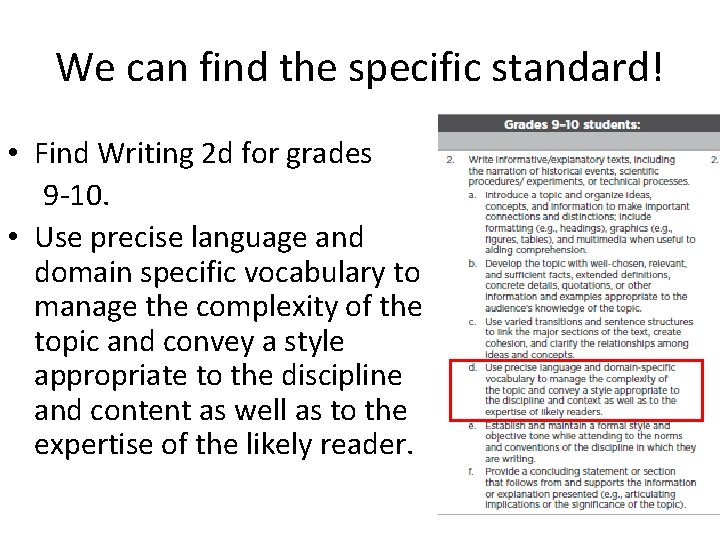
We can find the specific standard! • Find Writing 2 d for grades 9 -10. • Use precise language and domain specific vocabulary to manage the complexity of the topic and convey a style appropriate to the discipline and content as well as to the expertise of the likely reader.
What does this mean? • Are the students able to write a informative, narrative or opinion paper and use specific content vocabulary to express their point of view.
How do I make this work? • Begin your course with a writing prompt. • Give them a content specific scenario and ask them to write a response to specific criteria. • Then assess it using a standard rubric.
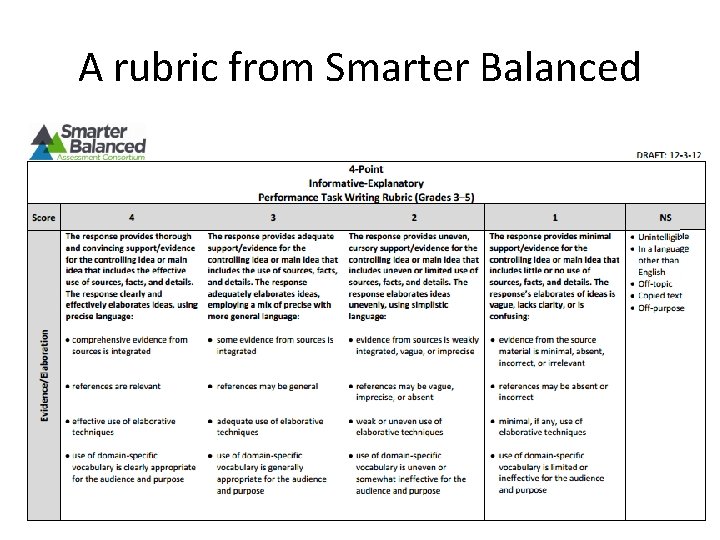
A rubric from Smarter Balanced
Assess each student’s writing • Use the rubric to generate baseline data. • Collect each child’s score and create a table with your scores, concentrating on just this one aspect of the CCSS Disciplinary Literacy Standards. • This now gives you baseline Literacy evidence to use in an SLO.
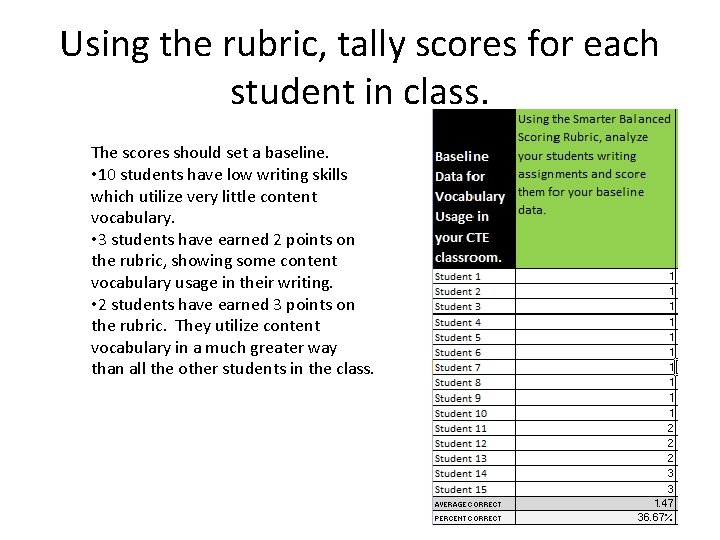
Using the rubric, tally scores for each student in class. The scores should set a baseline. • 10 students have low writing skills which utilize very little content vocabulary. • 3 students have earned 2 points on the rubric, showing some content vocabulary usage in their writing. • 2 students have earned 3 points on the rubric. They utilize content vocabulary in a much greater way than all the other students in the class.
To measure the growth of your students… • Give a mid semester or mid-year assignment of the same type • Use the same rubric to assess the growth of your students • Use the same data table to add more data points to keep track of student progress. • Follow this up with an end of year assessment as well.
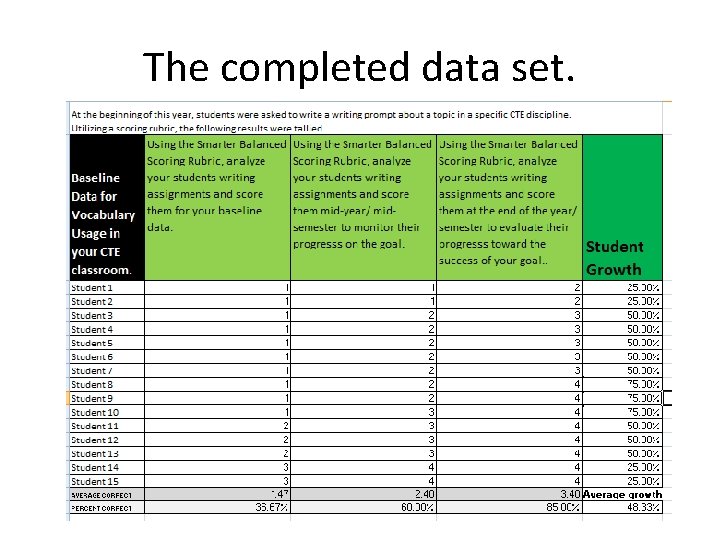
The completed data set.
What are the goals? • An increase in domain specific vocabulary. • Using writing to express the ideas of your content area. • An increase in all students vocabulary usage to show growth in every level. • In this case, the class as a whole averaged over 48% growth in categories from the start of the year to the end.
So, now we know how to look at literacy…now what? • What would a good SLO have looked like for the previous data set? • How do we tier it? • Why should we tier it? • What is the difference between growth and attainment SLOs?
Where to find Samples… • Click on the link below to view Sample SLOs • http: //www. livebinders. com/play? id=95 0936&backurl=/shelf/my#anchor • Click on HS and find the marketing SLO example.
SMART SLO practice • Utilizing the data sets for several different CTE content areas, we will now practice the art of crafting a smart goal for the content most relevant to your job. • Divide into job alike groups and spend 30 minutes analyzing your data set and then discussing what a potential SLO could look like with the baseline data that you have seen. • Write the SLOs on a large sheet of white paper • Discuss the SLO from both an attainment and a growth perspective.