
Literacy Design Collaborative Planning Tools and Resources for
Literacy Design Collaborative: Planning Tools and Resources for Teaching Literacy Skills in All Content Areas
Introductions Please use this powerpoint as a template to adapt and insert your own contact information and professional details here and on slides 3, 19 -21. 3 Insert your information here! Jane Doe Principal jane. doe@school. org 999 -9999
Goals and Agenda 1. Introductions 2. Learn about the Literacy Design Collaborative (LDC’s) planning resources 3 ● ● 3. Revisiting the shifts of the CCSS Writing strong assignments/tasks Planning standards-driven literacy instruction Teaching discipline-specific literacy skills Experience the LDC planning tools ● LDC Core. Tools 4. LDC’s i 3 Grant - The LDC i 3 Grant is provided as an example; insert your project ● What schools get ● Expectations for schools/teachers
Common Core Instructional Shifts and Demands ▪ Increasing rigor and relevance 3 ▪ Sharing responsibility of teaching reading across content areas ▪ Building knowledge through content-rich nonfiction and informational text ▪ Reading, writing, speaking and listening grounded in evidence from texts ▪ Practicing regularly with complex text and academic vocabulary ▪ Emphasizing 3 modes of academic writing: narrative, informational/explanatory and argumentative ▪ Addressing grade level literacy outcomes
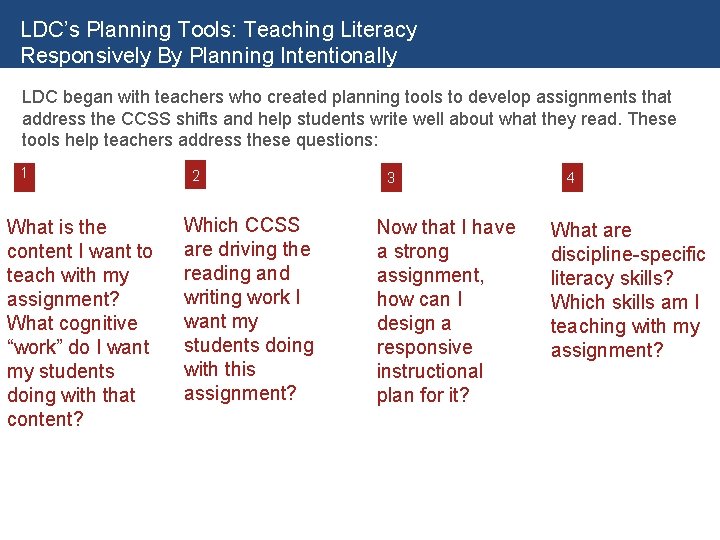
LDC’s Planning Tools: Teaching Literacy Responsively By Planning Intentionally LDC began with teachers who created planning tools to develop assignments that address the CCSS shifts and help students write well about what they read. These tools help teachers address these questions: 1 What is the content I want to teach with my assignment? What cognitive “work” do I want my students doing with that content? 2 Which CCSS are driving the reading and writing work I want my students doing with this assignment? 3 Now that I have a strong assignment, how can I design a responsive instructional plan for it? 4 3 What are discipline-specific literacy skills? Which skills am I teaching with my assignment?
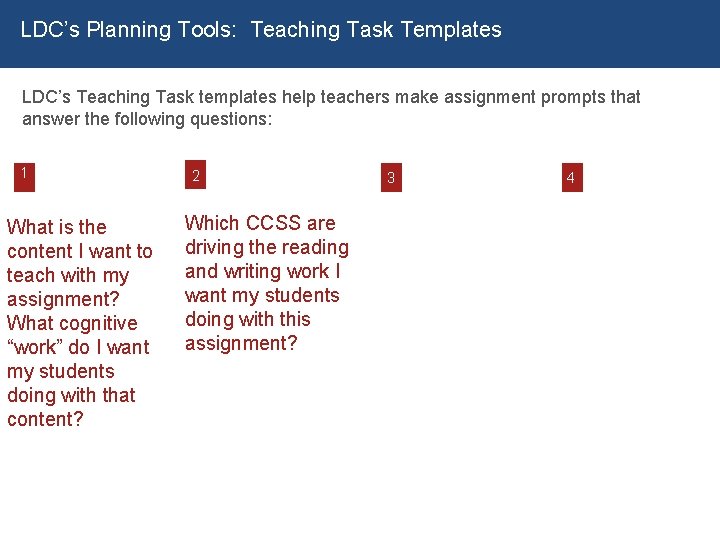
LDC’s Planning Tools: Teaching Task Templates LDC’s Teaching Task templates help teachers make assignment prompts that answer the following questions: 1 What is the content I want to teach with my assignment? What cognitive “work” do I want my students doing with that content? 2 Which CCSS are driving the reading and writing work I want my students doing with this assignment? 3 4 3

Using LDC’s Teaching Task Templates to Build Your Writing Assignment Prompts The Teaching Task templates provide a structure for students to write in response to reading. 3
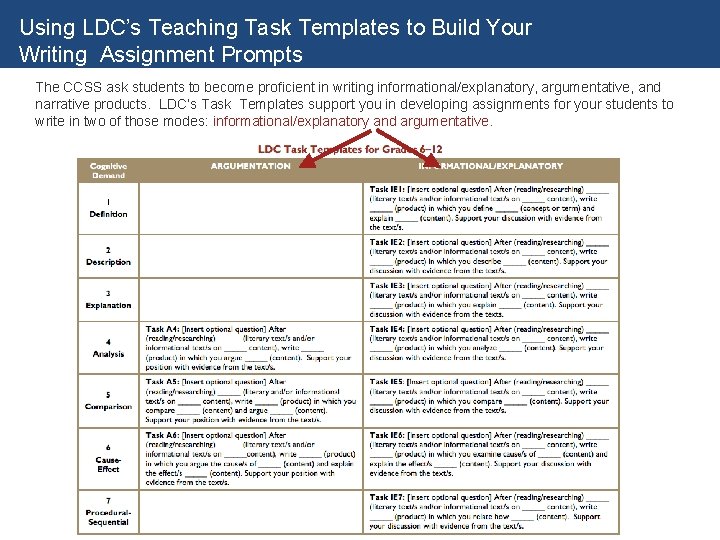
Using LDC’s Teaching Task Templates to Build Your Writing Assignment Prompts The CCSS ask students to become proficient in writing informational/explanatory, argumentative, and narrative products. LDC’s Task Templates support you in developing assignments for your students to write in two of those modes: informational/explanatory and argumentative. 3
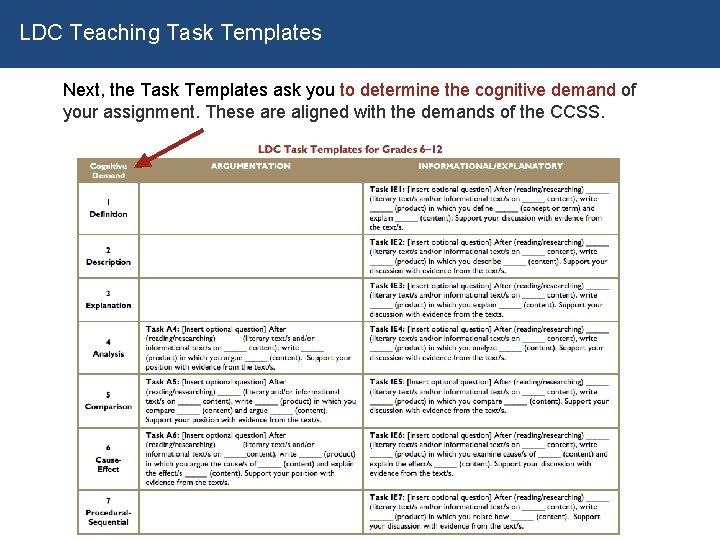
LDC Teaching Task Templates Next, the Task Templates ask you to determine the cognitive demand of your assignment. These are aligned with the demands of the CCSS. 3
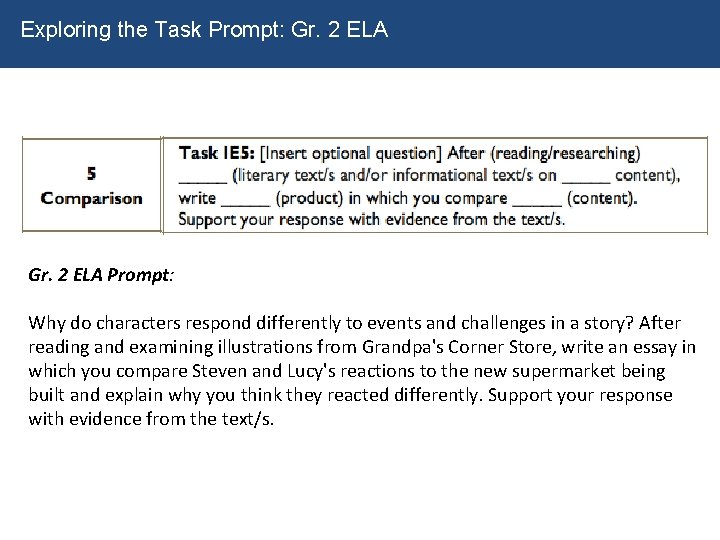
Exploring the Task Prompt: Gr. 2 ELA 3 Gr. 2 ELA Prompt: Why do characters respond differently to events and challenges in a story? After reading and examining illustrations from Grandpa's Corner Store, write an essay in which you compare Steven and Lucy's reactions to the new supermarket being built and explain why you think they reacted differently. Support your response with evidence from the text/s.
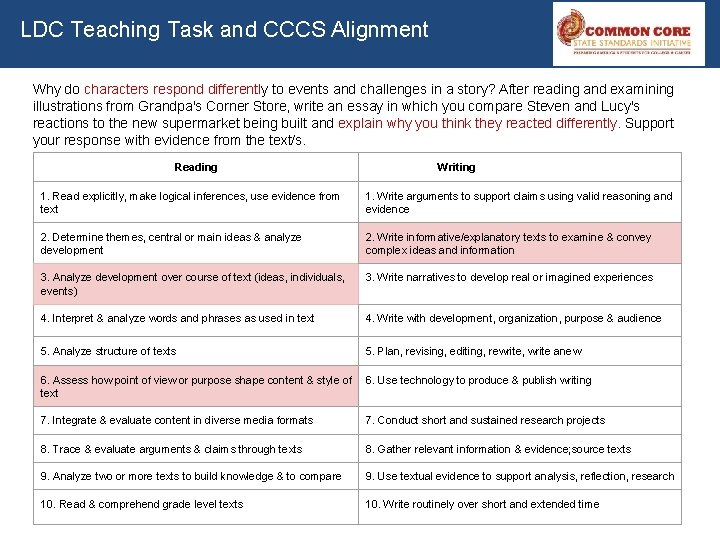
LDC Teaching Task and CCCS Alignment Why do characters respond differently to events and challenges in a story? After reading and examining illustrations from Grandpa's Corner Store, write an essay in which you compare Steven and Lucy's reactions to the new supermarket being built and explain why you think they reacted differently. Support your response with evidence from the text/s. Reading Writing 3 1. Read explicitly, make logical inferences, use evidence from text 1. Write arguments to support claims using valid reasoning and evidence 2. Determine themes, central or main ideas & analyze development 2. Write informative/explanatory texts to examine & convey complex ideas and information 3. Analyze development over course of text (ideas, individuals, events) 3. Write narratives to develop real or imagined experiences 4. Interpret & analyze words and phrases as used in text 4. Write with development, organization, purpose & audience 5. Analyze structure of texts 5. Plan, revising, editing, rewrite, write anew 6. Assess how point of view or purpose shape content & style of text 6. Use technology to produce & publish writing 7. Integrate & evaluate content in diverse media formats 7. Conduct short and sustained research projects 8. Trace & evaluate arguments & claims through texts 8. Gather relevant information & evidence; source texts 9. Analyze two or more texts to build knowledge & to compare 9. Use textual evidence to support analysis, reflection, research 10. Read & comprehend grade level texts 10. Write routinely over short and extended time
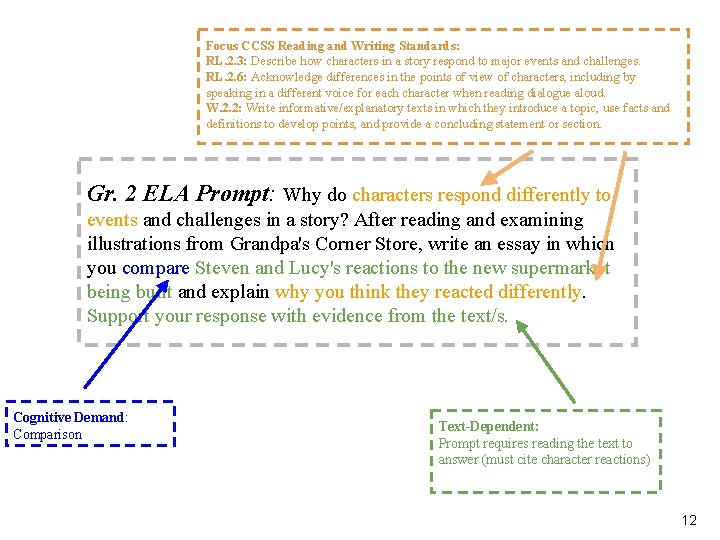
Focus CCSS Reading and Writing Standards: RL. 2. 3: Describe how characters in a story respond to major events and challenges. RL. 2. 6: Acknowledge differences in the points of view of characters, including by speaking in a different voice for each character when reading dialogue aloud. W. 2. 2: Write informative/explanatory texts in which they introduce a topic, use facts and definitions to develop points, and provide a concluding statement or section. Gr. 2 ELA Prompt: Why do characters respond differently to events and challenges in a story? After reading and examining illustrations from Grandpa's Corner Store, write an essay in which you compare Steven and Lucy's reactions to the new supermarket being built and explain why you think they reacted differently. Support your response with evidence from the text/s. Cognitive Demand: Comparison Text-Dependent: Prompt requires reading the text to answer (must cite character reactions) 12
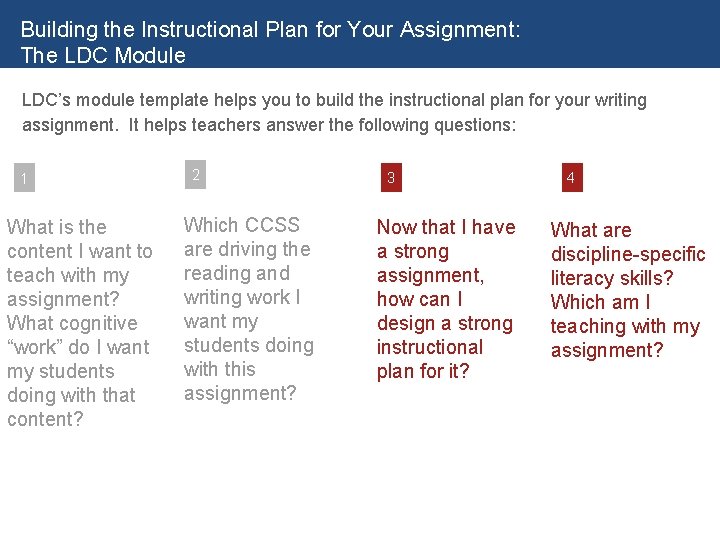
Building the Instructional Plan for Your Assignment: The LDC Module LDC’s module template helps you to build the instructional plan for your writing assignment. It helps teachers answer the following questions: 1 What is the content I want to teach with my assignment? What cognitive “work” do I want my students doing with that content? 2 Which CCSS are driving the reading and writing work I want my students doing with this assignment? 3 Now that I have a strong assignment, how can I design a strong instructional plan for it? 4 3 What are discipline-specific literacy skills? Which am I teaching with my assignment?
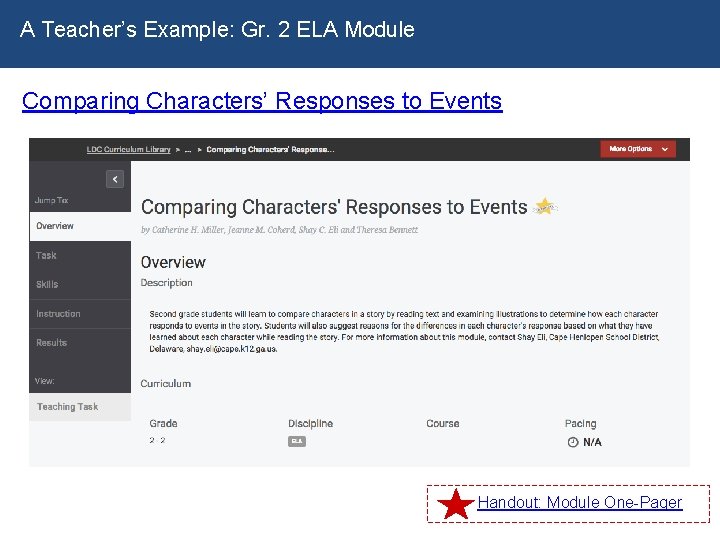
A Teacher’s Example: Gr. 2 ELA Module Comparing Characters’ Responses to Events 3 Handout: Module One-Pager
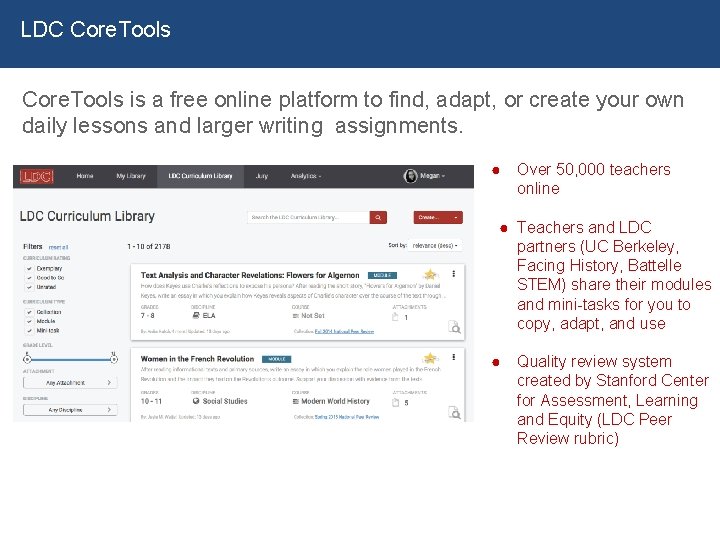
LDC Core. Tools is a free online platform to find, adapt, or create your own daily lessons and larger writing assignments. ● Over 50, 000 teachers online ● Teachers and LDC partners (UC Berkeley, Facing History, Battelle STEM) share their modules and mini-tasks for you to copy, adapt, and use ● Quality review system created by Stanford Center for Assessment, Learning and Equity (LDC Peer Review rubric)
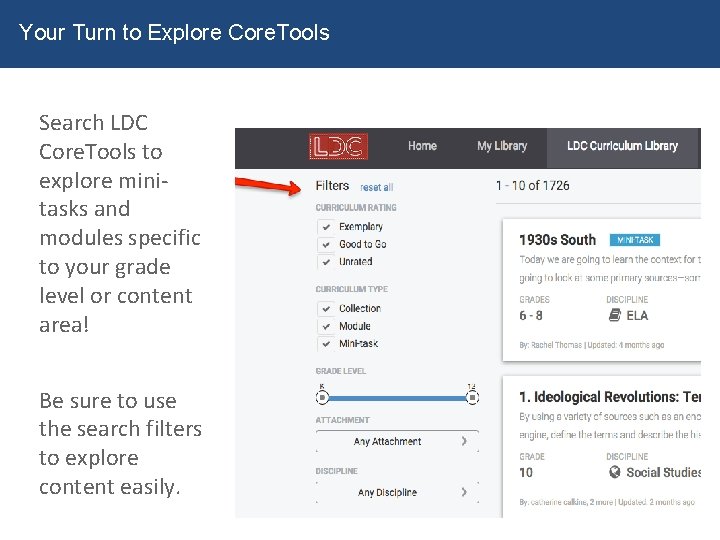
Your Turn to Explore Core. Tools Search LDC Core. Tools to explore minitasks and modules specific to your grade level or content area! Be sure to use the search filters to explore content easily. 3
Understanding Disciplinary Literacy ● The LDC module template helps you build an assignment that teaches the literacy skills key to a 3 content area. (Reading a novel is different from reading a lab report!) ● LDC mini-tasks are daily lesson plans to teach skill. Check out Facing History and Battelle mini-tasks for history and science lessons! Handout: Disciplinary Understandings
Let’s Discuss! 1. How might the LDC planning tools support you in addressing the Common Core standards? In teaching your students to read and write well? 2. What are you wondering? 3
LDC’s i 3 Grant: What Schools Get - i 3 Grant information provided as an example Virtual and In-Person Coaching for Teachers ● In September: ○ Coach joins first planning meeting ● Every week: ○ Coach provides written feedback on instructional plans ● Every other week: ○ Coach facilitates planning meeting via video conference ● In spring: ○ In-person LDC peer review training Handout: LDC Supports and Requirements 3 Coaching for LDC Project Liaison (Teacher Leader) ● Monthly virtual meetings with coach ● Optional coach-facilitated online discussions with other teacher leaders using private Teaching Channel Team group ● In September: 1 day paid training with coach Support for Principals ● Initial goal and benchmark setting ● Quarterly support visits from district LDC Specialist Additional Virtual Professional Learning Experiences ● Free enrollment to LDC’s online courses (can lead to salary credit) ● Access to national learning community and content experts (such as Facing History and Ourselves webinars)
LDC’s i 3 Grant: Expectations of Schools - i 3 Grant information provided as an example Teacher Responsibilities 1. Teach at least two modules each school year. 2. Participate in weekly collaborative planning meetings with team, which 3 include: a. Instructional planning (using LDC Core. Tools); b. Analysis of student work from mini-tasks and modules; c. Discussion of classroom implementation of mini-tasks and modules; d. Revision of instruction based on student outcomes. 3. Participate in weekly online coach-led discussions (using Teaching Channel). Project Liaison Responsibilities 1. All same as teacher 2. Monthly 30 -min meeting/call with coach to plan PLC work and develop instructional leadership skills 3. Facilitate communication between planning team, coach, and principal 4. Participate in summer training (paid)
Next Steps 1. Create a free Core. Tools account at https: //coretools. ldc. org/ 1. Explore modules and mini-tasks for your grade level/content area 1. Insert your steps here! 3
- Slides: 21