
ListsTuples Example Write a program to keep track
![Lists • Ordered set of values scores=[90. 5, 73, 87] • Each value accessed](https://slidetodoc.com/presentation_image_h2/19e4d61aabd403ff9c5ad09c048b884c/image-3.jpg "Lists • Ordered set of values scores=[90. 5, 73, 87] • Each value accessed")
![Example scores: 90. 5 73 scores=[90. 5, 73, 87] 87](https://slidetodoc.com/presentation_image_h2/19e4d61aabd403ff9c5ad09c048b884c/image-4.jpg "Example scores: 90. 5 73 scores=[90. 5, 73, 87] 87")
![Operators -- A lot like strings • Concatenation first_scores=[90, 56, 87] second_scores=[67, 100, 89]](https://slidetodoc.com/presentation_image_h2/19e4d61aabd403ff9c5ad09c048b884c/image-11.jpg "Operators -- A lot like strings • Concatenation first_scores=[90, 56, 87] second_scores=[67, 100, 89]")
![Mutability • Lists are mutable - they can be changed scores[90. 5, 73, 82]](https://slidetodoc.com/presentation_image_h2/19e4d61aabd403ff9c5ad09c048b884c/image-12.jpg "Mutability • Lists are mutable - they can be changed scores[90. 5, 73, 82]")
![Aliasing • Reference assignment scores=[90. 5, 73, 82] new_scores = scores[0] = 100 #new_scores[0]](https://slidetodoc.com/presentation_image_h2/19e4d61aabd403ff9c5ad09c048b884c/image-13.jpg "Aliasing • Reference assignment scores=[90. 5, 73, 82] new_scores = scores[0] = 100 #new_scores[0]")
![Cloning scores=[90. 5, 73, 82] new_scores = scores[: ] scores[0] = 100 #new_scores[0] DOES](https://slidetodoc.com/presentation_image_h2/19e4d61aabd403ff9c5ad09c048b884c/image-14.jpg "Cloning scores=[90. 5, 73, 82] new_scores = scores[: ] scores[0] = 100 #new_scores[0] DOES")
![Nested Lists exam_scores=[[90, 67, 34], [46, 99, 87], [89, 78, 67], [87, 85]] #could](https://slidetodoc.com/presentation_image_h2/19e4d61aabd403ff9c5ad09c048b884c/image-21.jpg "Nested Lists exam_scores=[[90, 67, 34], [46, 99, 87], [89, 78, 67], [87, 85]] #could")
![Nested Lists exam_scores=[[90, 67, 34], [46, 99, 87], [89, 78, 67], [87, 85]] #could](https://slidetodoc.com/presentation_image_h2/19e4d61aabd403ff9c5ad09c048b884c/image-22.jpg "Nested Lists exam_scores=[[90, 67, 34], [46, 99, 87], [89, 78, 67], [87, 85]] #could")
- Slides: 25
Lists/Tuples
Example • Write a program to keep track of all students’ scores on exam 1. • Need a list of everyone’s score • Use 14 doubles • What about next semester?
Lists • Ordered set of values scores=[90. 5, 73, 87] • Each value accessed by using [ ] and index scores[1] #would be 73 • A list can contain different types -- including other lists scores=[90. 5, 73, 87, “Mickey”, [67, 89]] • A list can be empty scores=[]
Example scores: 90. 5 73 scores=[90. 5, 73, 87] 87
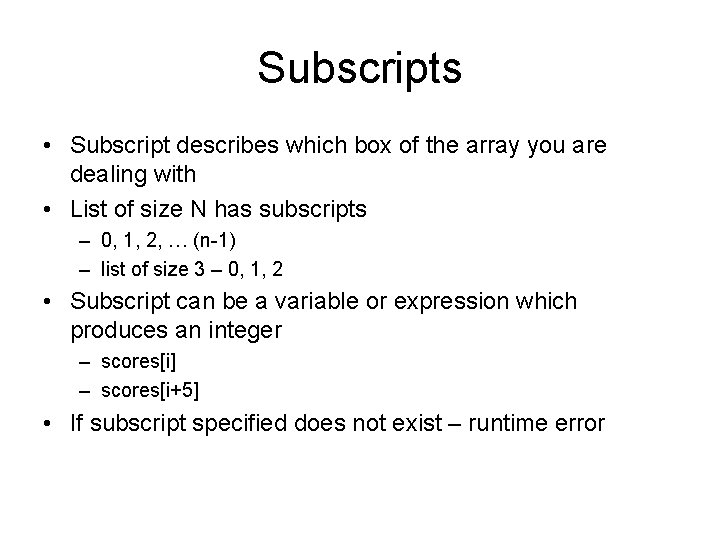
Subscripts • Subscript describes which box of the array you are dealing with • List of size N has subscripts – 0, 1, 2, … (n-1) – list of size 3 – 0, 1, 2 • Subscript can be a variable or expression which produces an integer – scores[i] – scores[i+5] • If subscript specified does not exist – runtime error
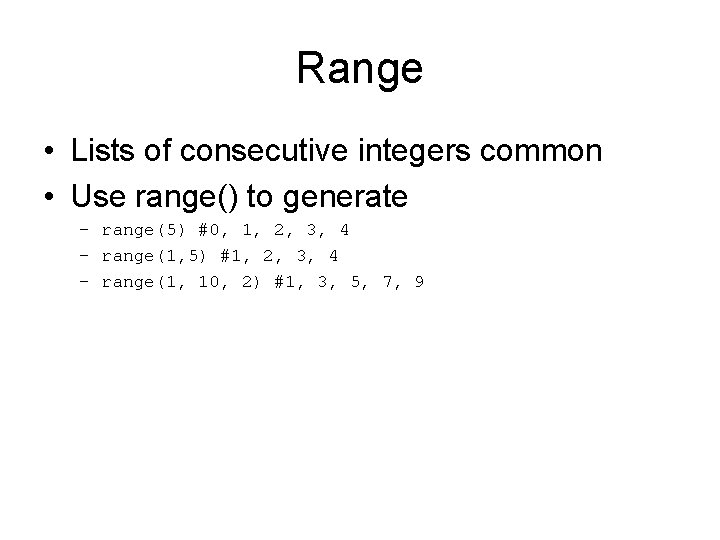
Range • Lists of consecutive integers common • Use range() to generate – range(5) #0, 1, 2, 3, 4 – range(1, 5) #1, 2, 3, 4 – range(1, 10, 2) #1, 3, 5, 7, 9
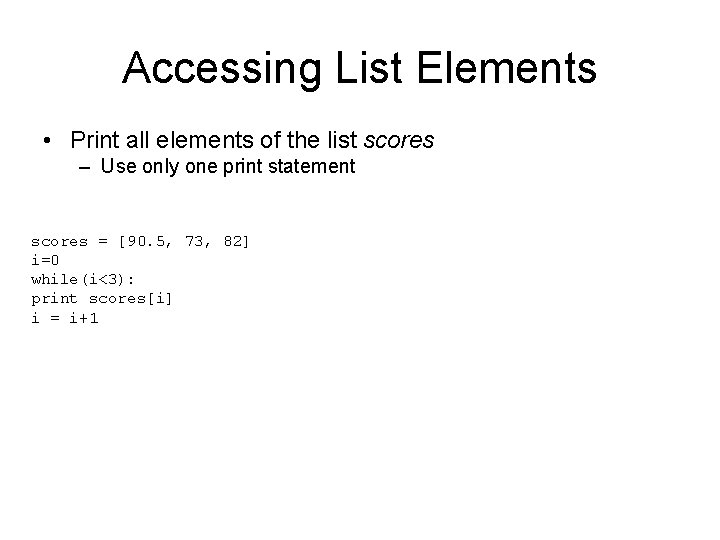
Accessing List Elements • Print all elements of the list scores – Use only one print statement
Accessing List Elements • Print all elements of the list scores – Use only one print statement scores = [90. 5, 73, 82] i=0 while(i<3): print scores[i] i = i+1
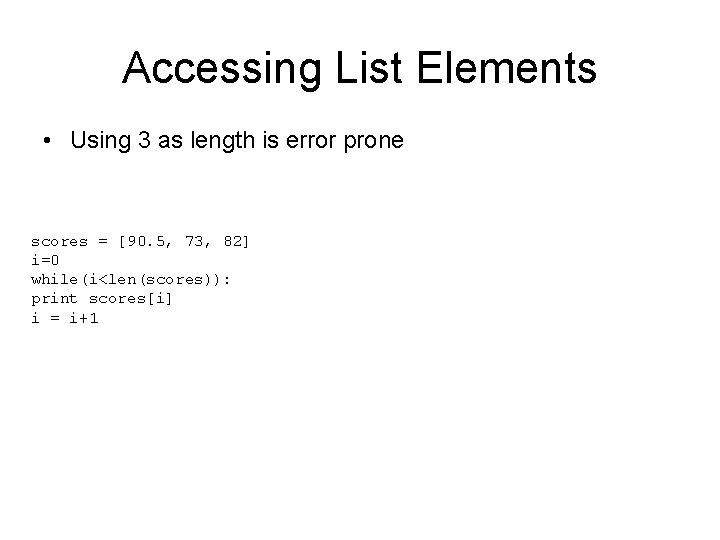
Accessing List Elements • Using 3 as length is error prone scores = [90. 5, 73, 82] i=0 while(i<len(scores)): print scores[i] i = i+1
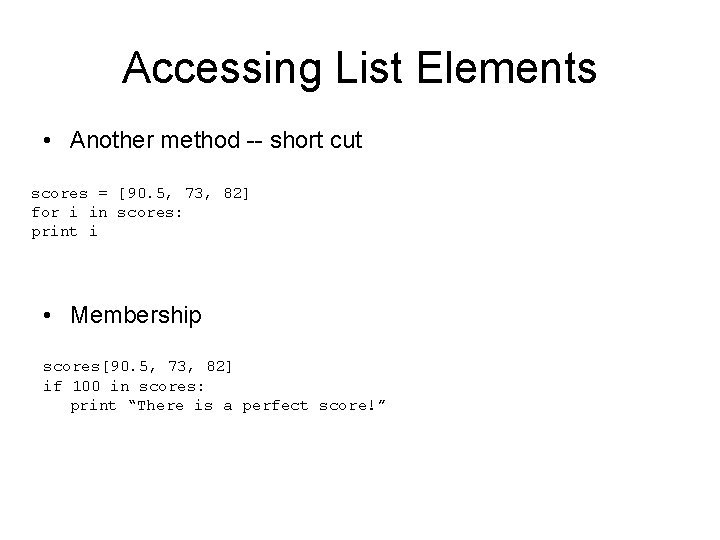
Accessing List Elements • Another method -- short cut scores = [90. 5, 73, 82] for i in scores: print i • Membership scores[90. 5, 73, 82] if 100 in scores: print “There is a perfect score!”
Operators -- A lot like strings • Concatenation first_scores=[90, 56, 87] second_scores=[67, 100, 89] all_scores = first_scores+second_scores • Slices all_scores[2: 4] #yields [87, 67] more_scores=all_scores[: ] #makes a copy of all_scores
Mutability • Lists are mutable - they can be changed scores[90. 5, 73, 82] scores[1] = 100 #scores is now [90. 5, 100, 82] • Lists can grow - using append function – append takes 1 argument scores. append(12) scores. append([56, 78, 34]) • Lists can shrink - using del function – del takes an element or slice del scores[2] del scores[1: 3] • Other functions - sort, reverse
Aliasing • Reference assignment scores=[90. 5, 73, 82] new_scores = scores[0] = 100 #new_scores[0] changes scores 90. 5 73 82 new_scores
Cloning scores=[90. 5, 73, 82] new_scores = scores[: ] scores[0] = 100 #new_scores[0] DOES NOT change scores 90. 5 73 82 new_scores 90. 5 73 82
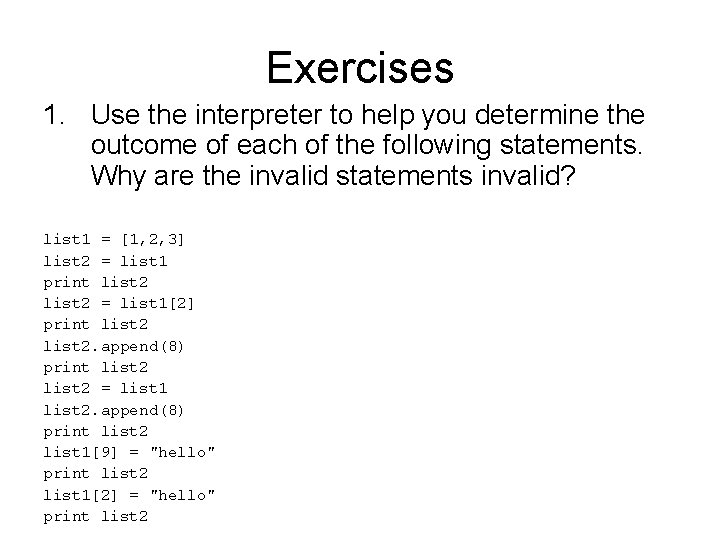
Exercises 1. Use the interpreter to help you determine the outcome of each of the following statements. Why are the invalid statements invalid? list 1 = [1, 2, 3] list 2 = list 1 print list 2 = list 1[2] print list 2. append(8) print list 2 = list 1 list 2. append(8) print list 2 list 1[9] = "hello" print list 2 list 1[2] = "hello" print list 2
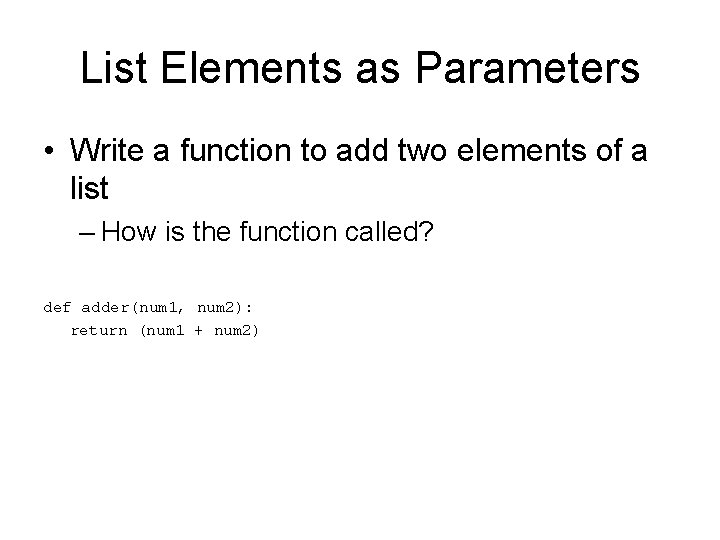
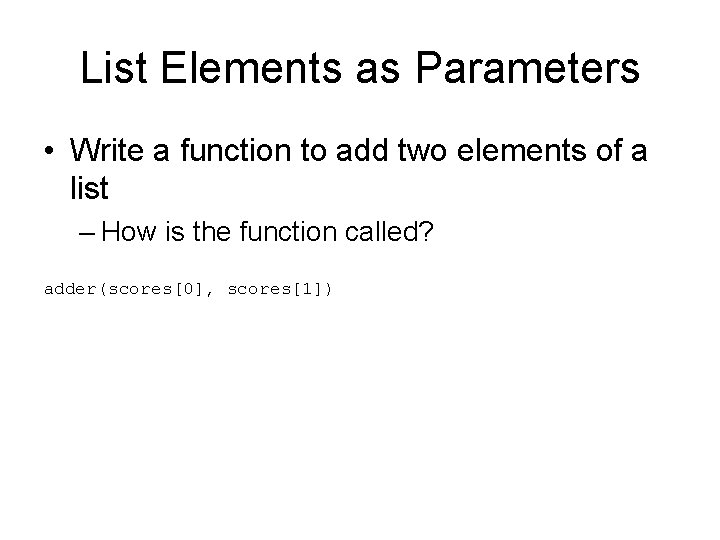
List Elements as Parameters • Write a function to add two elements of a list
List Elements as Parameters • Write a function to add two elements of a list – How is the function called? def adder(num 1, num 2): return (num 1 + num 2)
List Elements as Parameters • Write a function to add two elements of a list – How is the function called? adder(scores[0], scores[1])
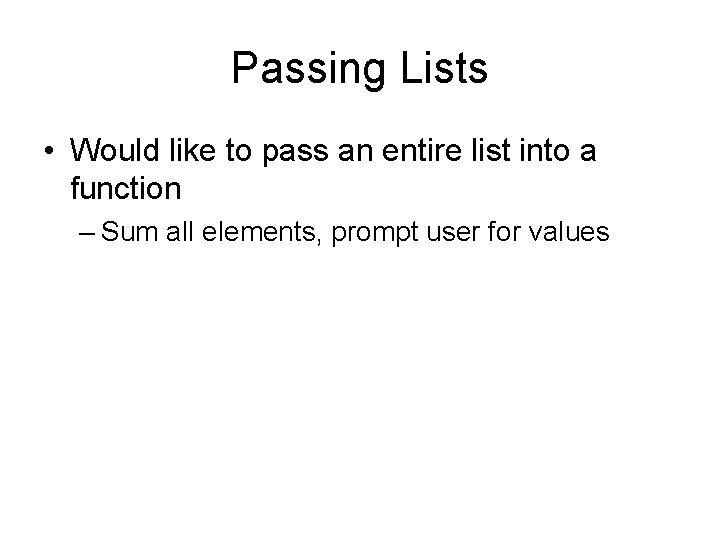
Passing Lists • Would like to pass an entire list into a function – Sum all elements, prompt user for values
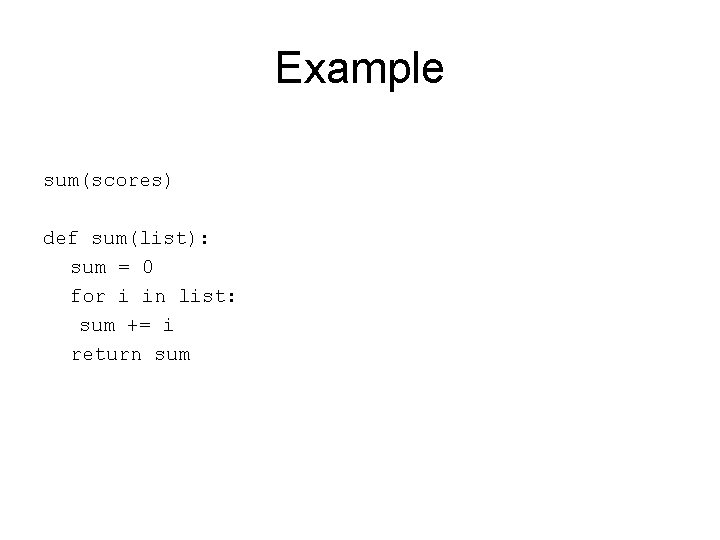
Example sum(scores) def sum(list): sum = 0 for i in list: sum += i return sum
Nested Lists exam_scores=[[90, 67, 34], [46, 99, 87], [89, 78, 67], [87, 85]] #could represent three scores for four students • Access second score of third student
Nested Lists exam_scores=[[90, 67, 34], [46, 99, 87], [89, 78, 67], [87, 85]] #could represent three scores for four students • Access second score of third student exam_scores[2][2] 0 1 2 3 0 1 90 46 89 87 67 99 78 87 2 34 87 67 85
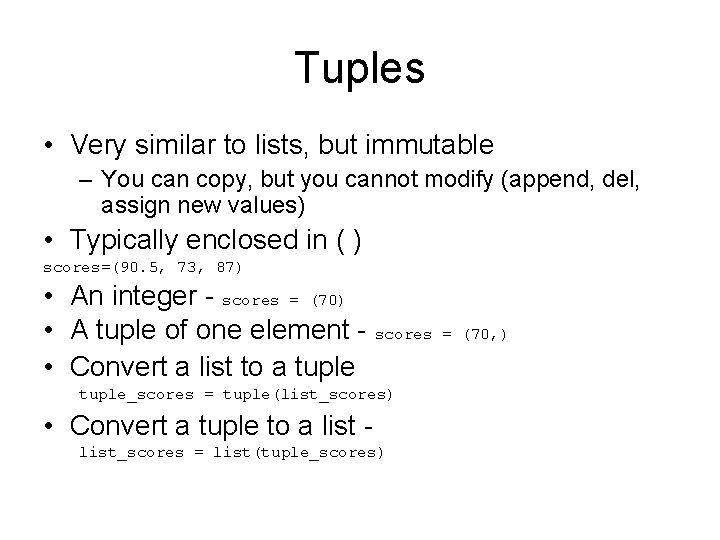
Tuples • Very similar to lists, but immutable – You can copy, but you cannot modify (append, del, assign new values) • Typically enclosed in ( ) scores=(90. 5, 73, 87) • An integer - scores = (70) • A tuple of one element - scores • Convert a list to a tuple_scores = tuple(list_scores) • Convert a tuple to a list_scores = list(tuple_scores) = (70, )
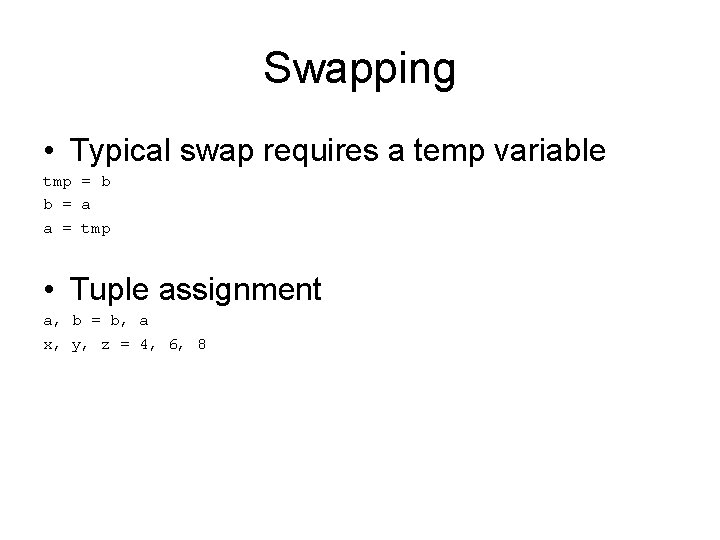
Swapping • Typical swap requires a temp variable tmp = b b = a a = tmp • Tuple assignment a, b = b, a x, y, z = 4, 6, 8
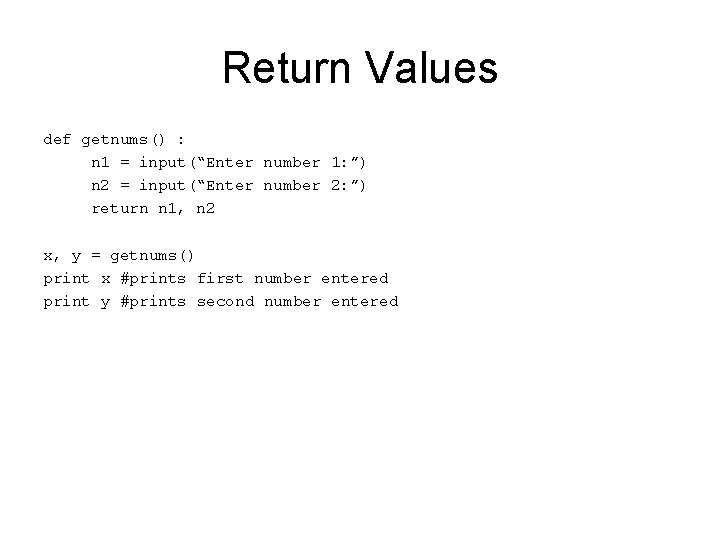
Return Values def getnums() : n 1 = input(“Enter number 1: ”) n 2 = input(“Enter number 2: ”) return n 1, n 2 x, y = getnums() print x #prints first number entered print y #prints second number entered