
LISTENING SKILL 7 LISTEN FOR NEGATIVE EXPRESSIONS Negative



- Slides: 28
LISTENING
SKILL 7 LISTEN FOR NEGATIVE EXPRESSIONS
Negative expressions are very common in Listening Part A, and the most common kind of correct response to a negative statement is a positive statement containing a word with an opposite meaning
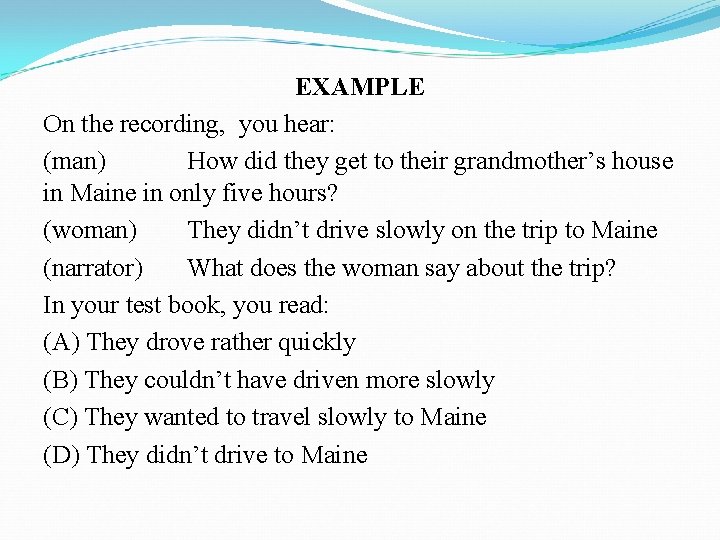
EXAMPLE On the recording, you hear: (man) How did they get to their grandmother’s house in Maine in only five hours? (woman) They didn’t drive slowly on the trip to Maine (narrator) What does the woman say about the trip? In your test book, you read: (A) They drove rather quickly (B) They couldn’t have driven more slowly (C) They wanted to travel slowly to Maine (D) They didn’t drive to Maine
The correct answer is answer (A). If they did not drive slowly to Maine, this means that they drove rather quickly. Notice that the correct answer uses quickly, the opposite of slowly. The answers that use slowly are not correct.
TYPES OF NEGATIVE EXPRESSIONS Expression Regular negative: not or n’t Example Tom is not sad about the results Correct answer Not sad = happy
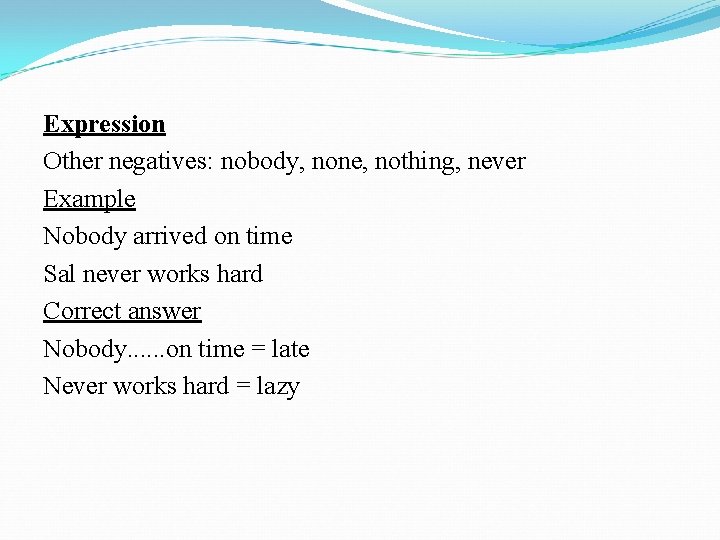
Expression Other negatives: nobody, none, nothing, never Example Nobody arrived on time Sal never works hard Correct answer Nobody. . . on time = late Never works hard = lazy
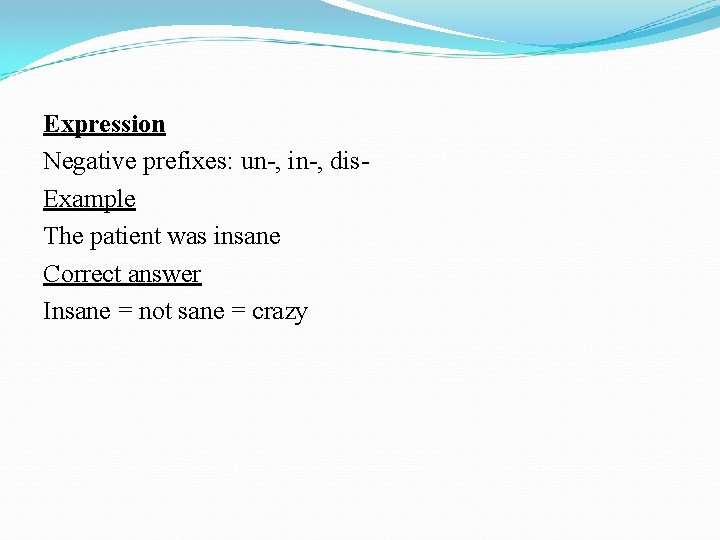
Expression Negative prefixes: un-, in-, dis. Example The patient was insane Correct answer Insane = not sane = crazy
SKILL 8 LISTEN FOR DOUBLE NEGATIVE EXPRESSIONS
It is possible for two negative ideas to appear in one sentence, and the result can be quite confusing
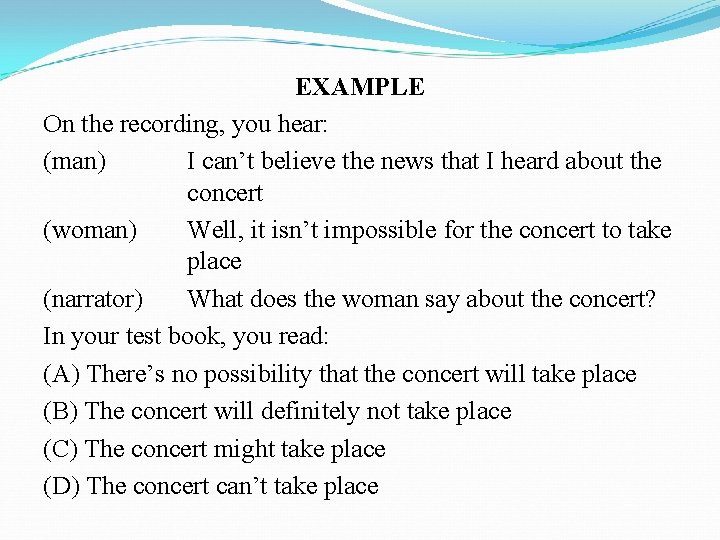
EXAMPLE On the recording, you hear: (man) I can’t believe the news that I heard about the concert (woman) Well, it isn’t impossible for the concert to take place (narrator) What does the woman say about the concert? In your test book, you read: (A) There’s no possibility that the concert will take place (B) The concert will definitely not take place (C) The concert might take place (D) The concert can’t take place
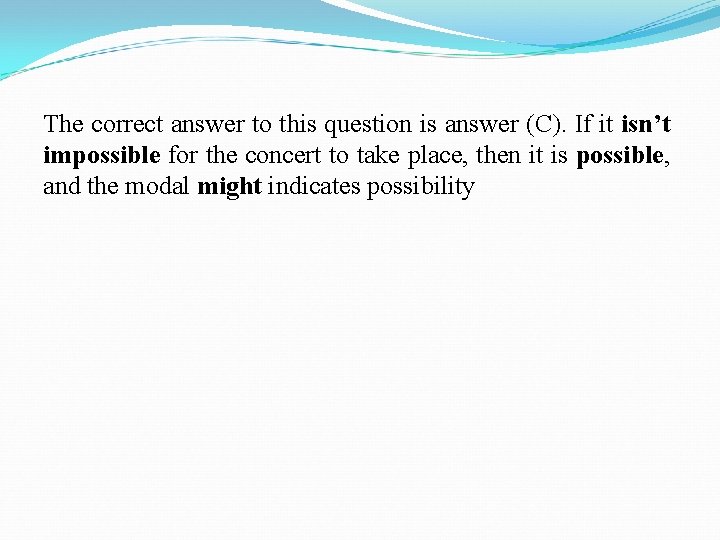
The correct answer to this question is answer (C). If it isn’t impossible for the concert to take place, then it is possible, and the modal might indicates possibility
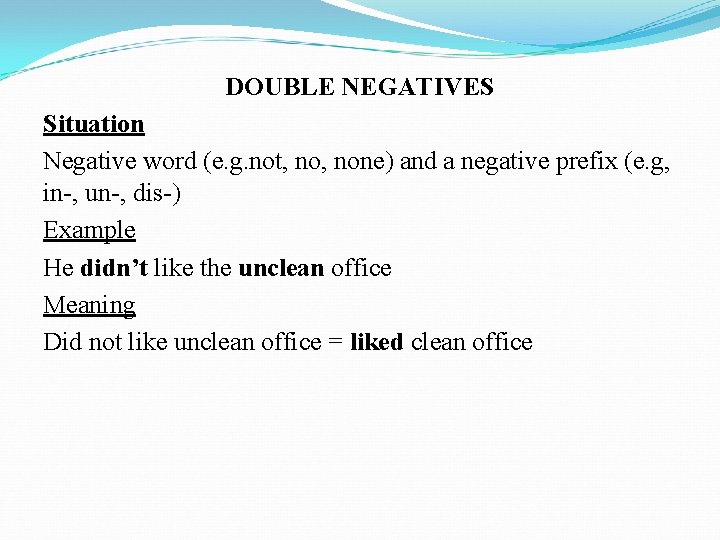
DOUBLE NEGATIVES Situation Negative word (e. g. not, none) and a negative prefix (e. g, in-, un-, dis-) Example He didn’t like the unclean office Meaning Did not like unclean office = liked clean office
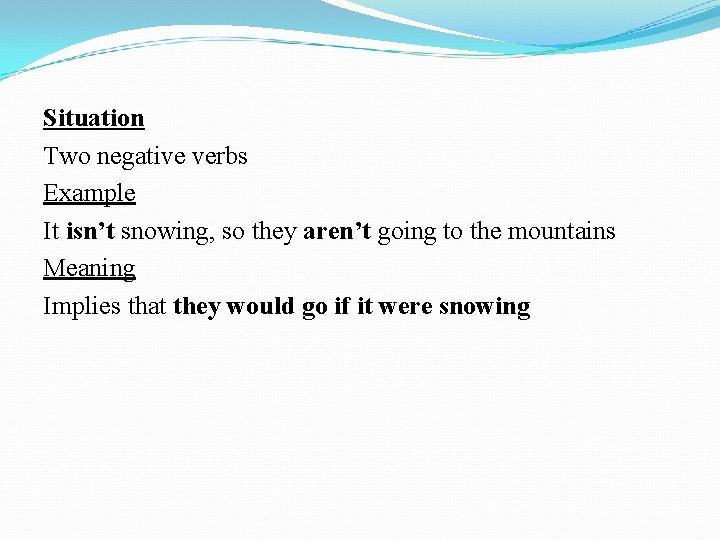
Situation Two negative verbs Example It isn’t snowing, so they aren’t going to the mountains Meaning Implies that they would go if it were snowing
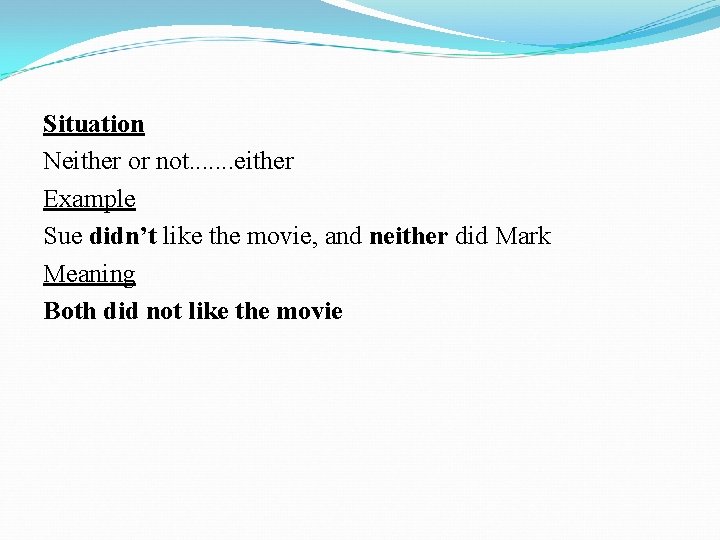
Situation Neither or not. . . . either Example Sue didn’t like the movie, and neither did Mark Meaning Both did not like the movie
SKILL 9 LISTEN FOR “ALMOST NEGATIVE” EXPRESSIONS
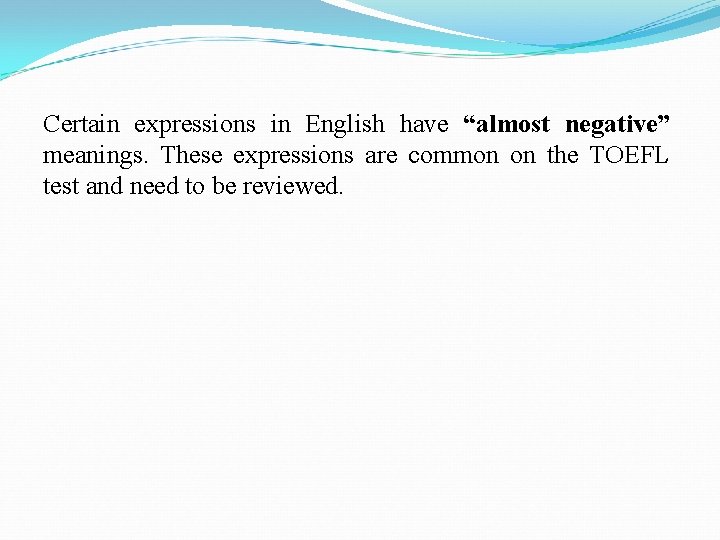
Certain expressions in English have “almost negative” meanings. These expressions are common on the TOEFL test and need to be reviewed.
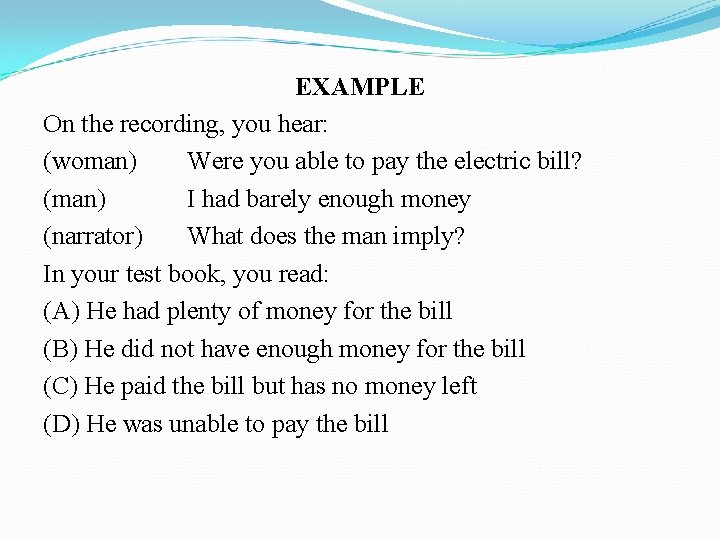
EXAMPLE On the recording, you hear: (woman) Were you able to pay the electric bill? (man) I had barely enough money (narrator) What does the man imply? In your test book, you read: (A) He had plenty of money for the bill (B) He did not have enough money for the bill (C) He paid the bill but has no money left (D) He was unable to pay the bill
In the man’s statement, the word enough indicates that there was enough, so he did pay the bill. However, it was barely enough, so he almost did not have enough and certainly has no money left. The correct answer is therefore answer (C)
COMMON “ALMOST NEGATIVE” EXPRESSIONS Meaning Almost none Expression Hardly, barely, scarcely, only Example There is hardly any food in the refrigerator
Meaning Almost never Expression Rarely, seldom Example He rarely drives to work
SKILL 10 LISTEN FOR NEGATIVES WITH COMPARATIVES
Negatives can be used with comparative. A sentences with a negative and a comparative has a superlative, or very strong, meaning.
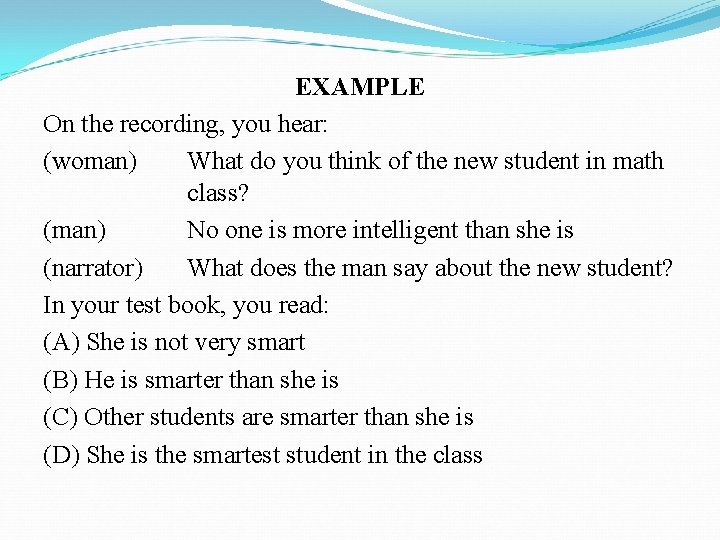
EXAMPLE On the recording, you hear: (woman) What do you think of the new student in math class? (man) No one is more intelligent than she is (narrator) What does the man say about the new student? In your test book, you read: (A) She is not very smart (B) He is smarter than she is (C) Other students are smarter than she is (D) She is the smartest student in the class
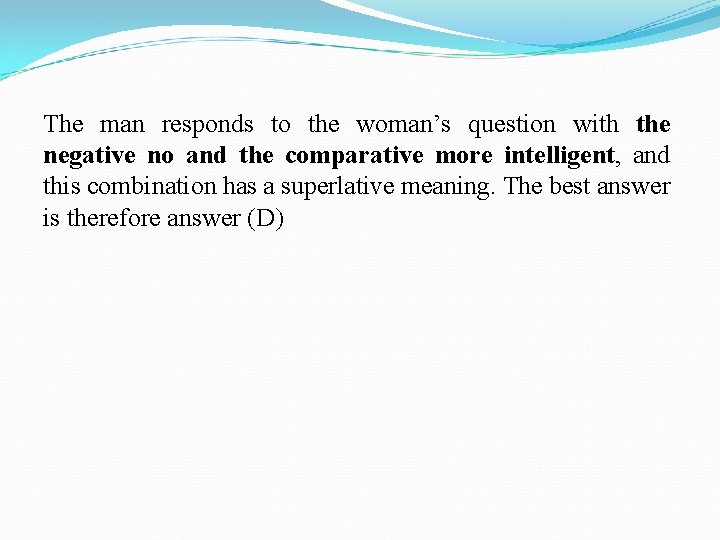
The man responds to the woman’s question with the negative no and the comparative more intelligent, and this combination has a superlative meaning. The best answer is therefore answer (D)
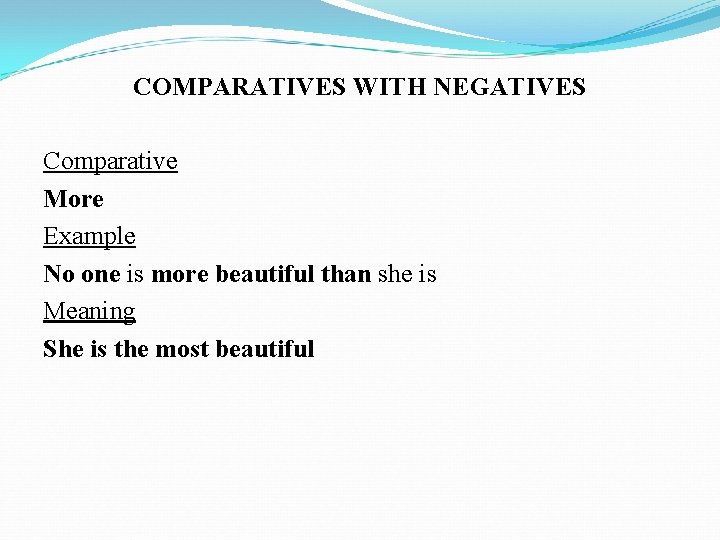
COMPARATIVES WITH NEGATIVES Comparative More Example No one is more beautiful than she is Meaning She is the most beautiful
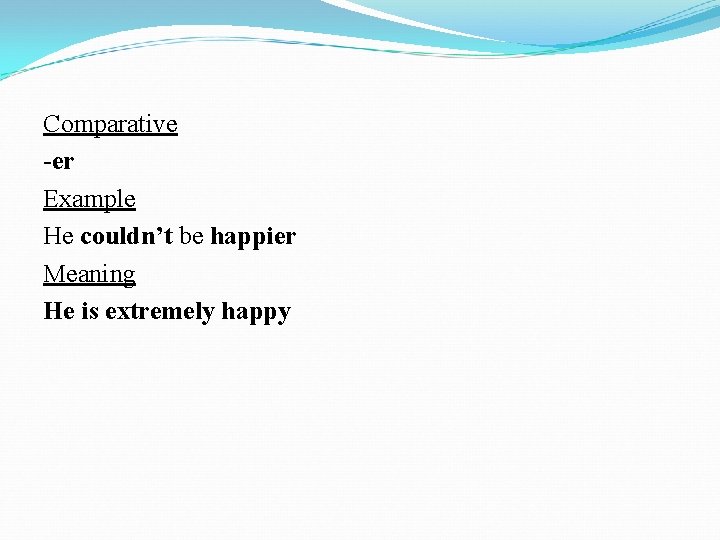
Comparative -er Example He couldn’t be happier Meaning He is extremely happy