
Listening Module 1 LM 1 Resource 2 LM
- Slides: 17
Listening Module 1 (LM 1) Resource 2
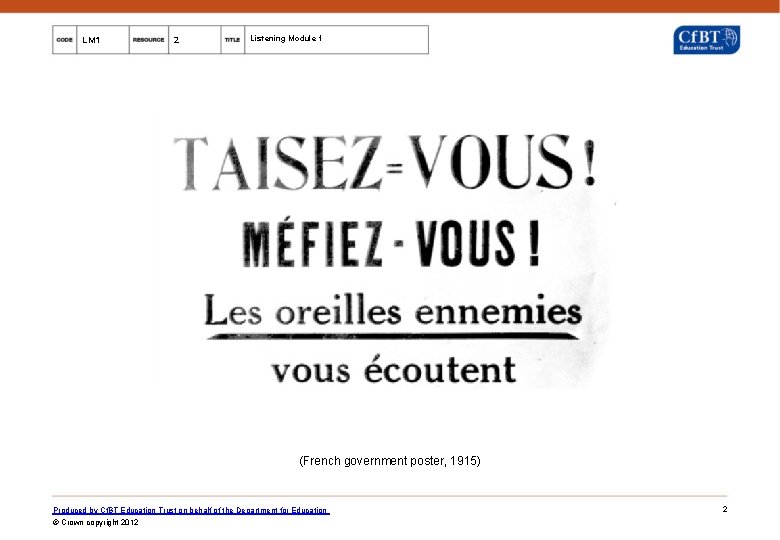
LM 1 2 Listening Module 1 (French government poster, 1915) Produced by Cf. BT Education Trust on behalf of the Department for Education © Crown copyright 2012 2
LM 1 2 Listening Module 1 Starter: Speed Dating Participants sit in two rows facing one another. One row of teachers has starter questions printed on card (either handed to them or already on the chairs to which they have to move). They ask the person facing them the question. The person answering has about 30 seconds to answer. The course facilitator will give a signal (e. g. bell / hooter etc. ) for the teachers answering the questions to all stand up and move one place down the line to the next question. This is repeated until most have answered most questions. Produced by Cf. BT Education Trust on behalf of the Department for Education © Crown copyright 2012 3
LM 1 2 Listening Module 1 Which aspects of listening could we improve? ‘Although students’ listening skills were generally satisfactory, they were not always strong because their development in some of the schools visited relied too heavily on exercises from text books. Opportunities for students to listen to teachers’ requests and instructions in the target languages and to listen to and respond to other students were limited. The skill of listening in order to respond orally appeared very much in decline in some of the classrooms visited. Moreover, the least academically able students were often not given enough support to make sense of what they were hearing. ’ [Para 53, ‘Modern languages: Achievement and challenge 2007 -2010’, Ofsted, publ. Jan. 2011] Produced by Cf. BT Education Trust on behalf of the Department for Education © Crown copyright 2012 4
LM 1 2 Listening Module 1 • What types of things do your students listen to in the target language in your school? • Which aspects of students’ listening skills could most benefit from some improvement? • Does the teaching of listening skills feature in your schemes of work / learning? (How does it appear? If not there, why not? ) • Which types of listening resources and activities have (a) the best and (b) the least impact with your classes? • What interesting or different activities do you use to vary listening tasks? • Which aspects of listening do pupils find hard or off-putting? Why? Produced by Cf. BT Education Trust on behalf of the Department for Education © Crown copyright 2012 5
LM 1 2 Listening Module 1 Objectives • How is listening learned and taught in your school? How can this be enhanced? • • • What types of listening sources do you use? Where can you find new listening sources? What types of listening activities do you use? Produced by Cf. BT Education Trust on behalf of the Department for Education © Crown copyright 2012 6
LM 1 2 Listening Module 1 Pre-course task follow-up In smaller groups, discuss the listening materials you use which are not in the text book and how you use them. Where does the material come from? (FLA, your voice, website, song from CD, DVD etc. ) How do you use the material with classes? Consider how to find good quality listening materials and how to devise engaging activities which develop students’ listening skills. Produced by Cf. BT Education Trust on behalf of the Department for Education © Crown copyright 2012 7
LM 1 2 Listening Module 1 Listening resources Drama / transactional role play / authentic listening or listening produced for learners? One / two / many speakers? Native speaker? / Authentic? / Teacher’s voice? / Other students’ voices? / Dialogue? Presentation? Quality of recording? (Speakers? IWB? Do students speak up in presentations? ) Age appropriate? Engaging for teenagers? Affective learning? Which learners could make use of this resource? (How) could it be adapted for more/less advanced learners? Do others in the group know of similar resources? Where do they take theirs from? Musicians / websites / CDs etc. How do students respond to the resource? (Do follow-up activities go beyond factual recall? ) Does the listening aid intercultural understanding? Differentiation by task? / support? (Visual clues? / Title and context given? / Unusual vocabulary given? ) Produced by Cf. BT Education Trust on behalf of the Department for Education © Crown copyright 2012 8
LM 1 2 Listening Module 1 Developing listening skills Students need training and practice in all skills. Build on learning in primary school in literacy, group work and language learning: • Eye contact / body language; ‘listen’ is an anagram of ‘silent’ • Start with gist comprehension • Don’t panic • Use other clues e. g. visual clues / known language / context / titles • Anticipate / predict the type of thing which they will hear • Use the Phone-Grapheme Connection (PGC) to help decode new language • Know the purpose of the listening (e. g. for detail/ enjoyment/ inference/ gist/ to generate a similar piece of language / look for bias / find an opinion etc. ) • What else? Produced by Cf. BT Education Trust on behalf of the Department for Education © Crown copyright 2012 9
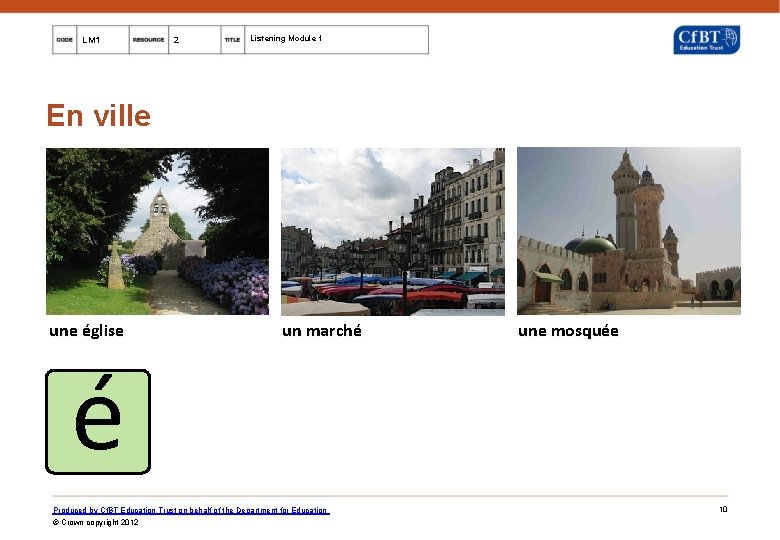
LM 1 2 Listening Module 1 En ville une église un marché une mosquée é Produced by Cf. BT Education Trust on behalf of the Department for Education © Crown copyright 2012 10
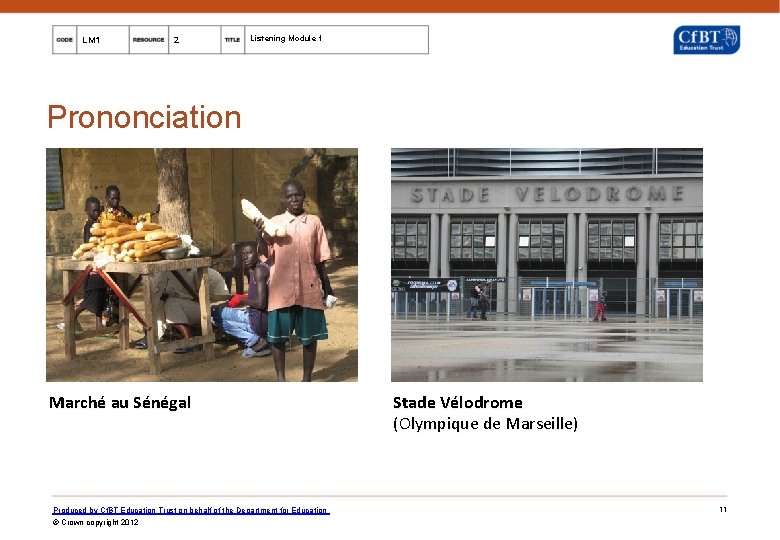
LM 1 2 Listening Module 1 Prononciation Marché au Sénégal Produced by Cf. BT Education Trust on behalf of the Department for Education © Crown copyright 2012 Stade Vélodrome (Olympique de Marseille) 11
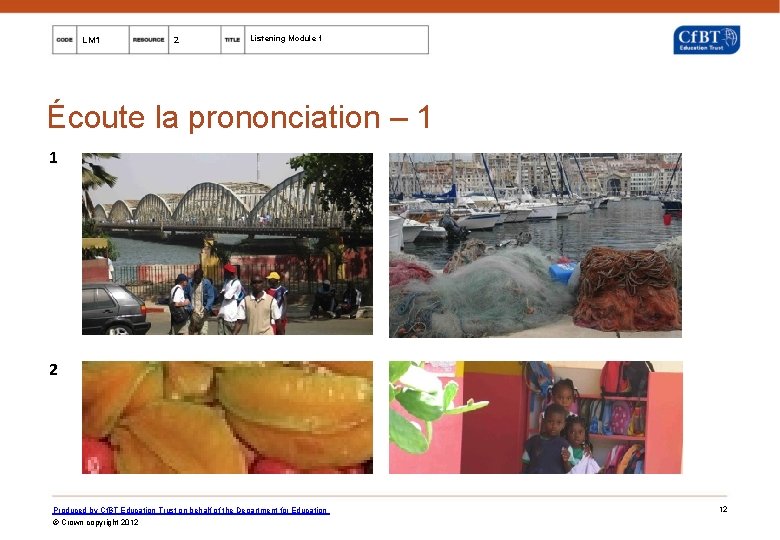
LM 1 2 Listening Module 1 Écoute la prononciation – 1 1 2 Produced by Cf. BT Education Trust on behalf of the Department for Education © Crown copyright 2012 12
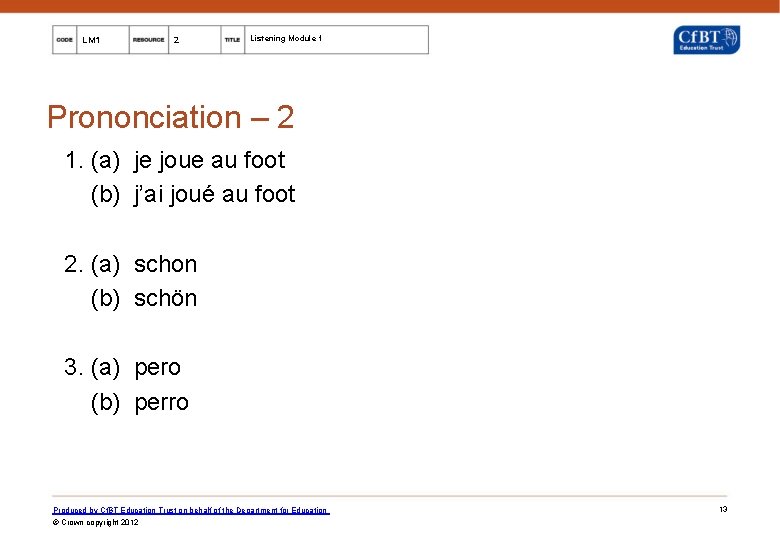
LM 1 2 Listening Module 1 Prononciation – 2 1. (a) je joue au foot (b) j’ai joué au foot 2. (a) schon (b) schön 3. (a) pero (b) perro Produced by Cf. BT Education Trust on behalf of the Department for Education © Crown copyright 2012 13
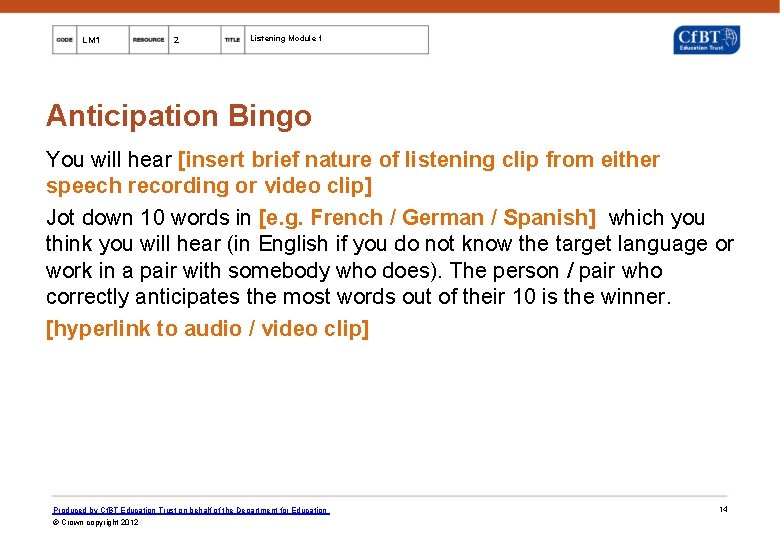
LM 1 2 Listening Module 1 Anticipation Bingo You will hear [insert brief nature of listening clip from either speech recording or video clip] Jot down 10 words in [e. g. French / German / Spanish] which you think you will hear (in English if you do not know the target language or work in a pair with somebody who does). The person / pair who correctly anticipates the most words out of their 10 is the winner. [hyperlink to audio / video clip] Produced by Cf. BT Education Trust on behalf of the Department for Education © Crown copyright 2012 14
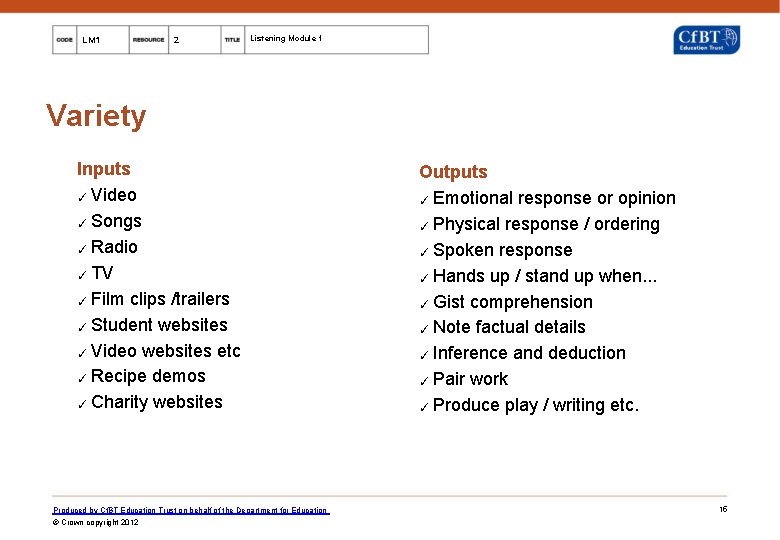
LM 1 2 Listening Module 1 Variety Inputs ✓ Video ✓ Songs ✓ Radio ✓ TV ✓ Film clips /trailers ✓ Student websites ✓ Video websites etc ✓ Recipe demos ✓ Charity websites Produced by Cf. BT Education Trust on behalf of the Department for Education © Crown copyright 2012 Outputs ✓ Emotional response or opinion ✓ Physical response / ordering ✓ Spoken response ✓ Hands up / stand up when. . . ✓ Gist comprehension ✓ Note factual details ✓ Inference and deduction ✓ Pair work ✓ Produce play / writing etc. 15
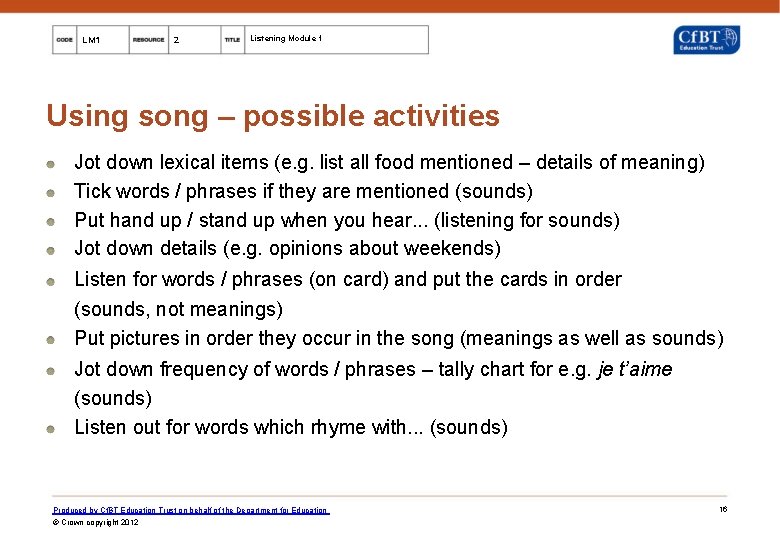
LM 1 2 Listening Module 1 Using song – possible activities Jot down lexical items (e. g. list all food mentioned – details of meaning) Tick words / phrases if they are mentioned (sounds) Put hand up / stand up when you hear. . . (listening for sounds) Jot down details (e. g. opinions about weekends) Listen for words / phrases (on card) and put the cards in order (sounds, not meanings) Put pictures in order they occur in the song (meanings as well as sounds) Jot down frequency of words / phrases – tally chart for e. g. je t’aime (sounds) Listen out for words which rhyme with. . . (sounds) Produced by Cf. BT Education Trust on behalf of the Department for Education © Crown copyright 2012 16
LM 1 2 Listening Module 1 Have you been listening. . . ? Which of the listening sources will you use more in your language lessons? Which type of activity will you try out (again)? How will you develop listening skills explicitly with students? Produced by Cf. BT Education Trust on behalf of the Department for Education © Crown copyright 2012 17