
Listening and Reading MFL Subject Network Why is
Listening and Reading MFL Subject Network Why is it so hard. Meetings Arthur Terry. 02/10/18 Dates: Wednesday 3 rd October 2018 Wednesday 23 rd January 2018 Wednesday 15 th May 2018
Agenda: • What are the biggest issues for your MFL team currently? • What does progress in receptive skills look like? Which skill for which grade? • What is decoding? What is inference? What is deduction? What’s the difference? • What do students actually have to be able to do? What type of questions are they asked which require inference? • How can we develop these skills? Who needs to develop these skills? • AOB
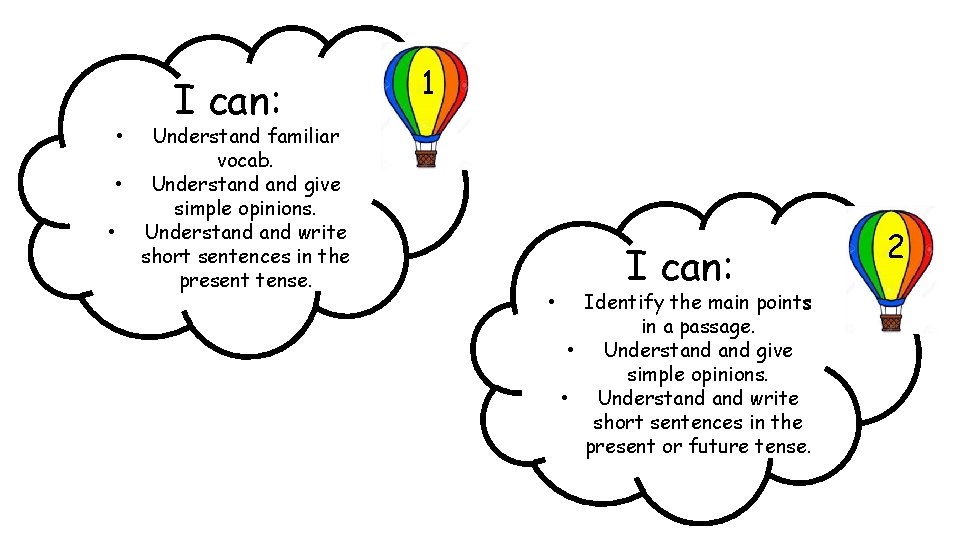
I can: Understand familiar vocab. • Understand give simple opinions. • Understand write short sentences in the present tense. • 1 • I can: Identify the main points in a passage. • Understand give simple opinions. • Understand write short sentences in the present or future tense. 2
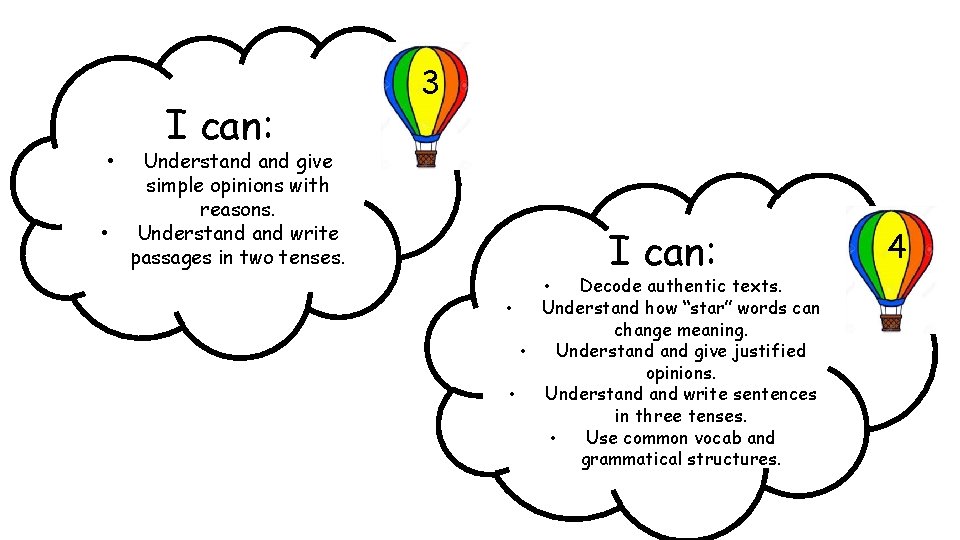
• • I can: Understand give simple opinions with reasons. Understand write passages in two tenses. 3 I can: • Decode authentic texts. • Understand how “star” words can change meaning. • Understand give justified opinions. • Understand write sentences in three tenses. • Use common vocab and grammatical structures. 4
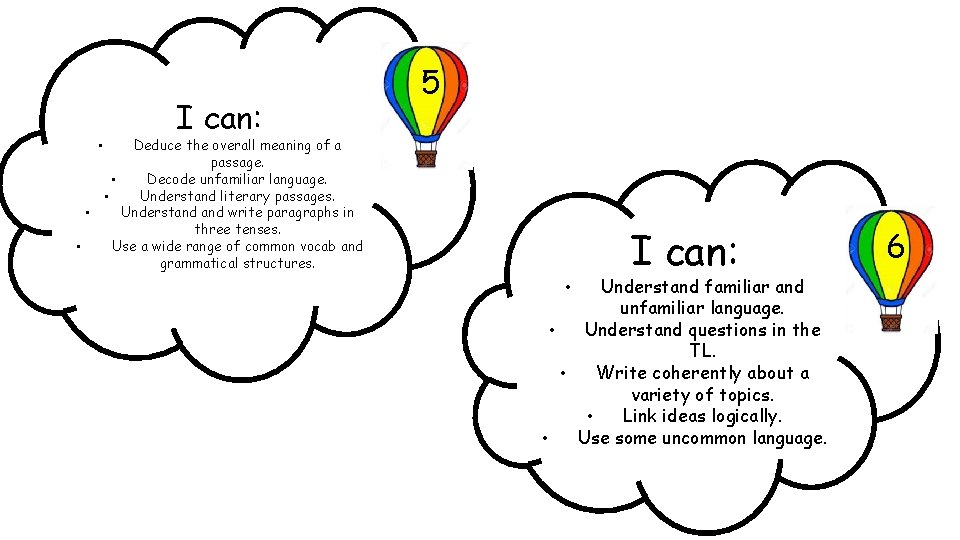
• • • I can: 5 Deduce the overall meaning of a passage. • Decode unfamiliar language. • Understand literary passages. Understand write paragraphs in three tenses. Use a wide range of common vocab and grammatical structures. I can: Understand familiar and unfamiliar language. • Understand questions in the TL. • Write coherently about a variety of topics. • Link ideas logically. • Use some uncommon language. • 6
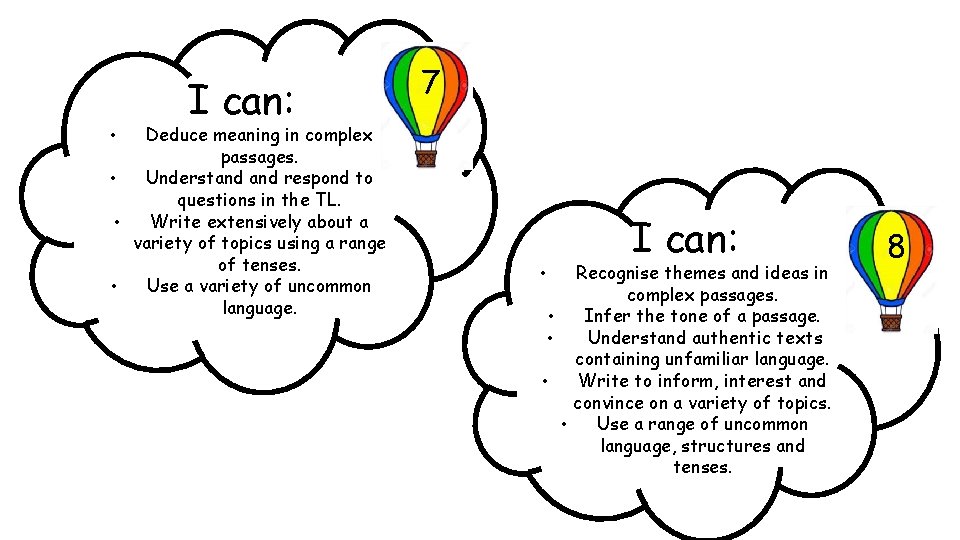
I can: Deduce meaning in complex passages. • Understand respond to questions in the TL. • Write extensively about a variety of topics using a range of tenses. • Use a variety of uncommon language. • 7 I can: Recognise themes and ideas in complex passages. • Infer the tone of a passage. • Understand authentic texts containing unfamiliar language. • Write to inform, interest and convince on a variety of topics. • Use a range of uncommon language, structures and tenses. • 8

I can: Extract key points and abstract ideas from complex passages. • Infer meaning in authentic and literary works. • Write long passages with very few errors. • Expand on all ideas using a range of uncommon language, structures and tenses. • 9
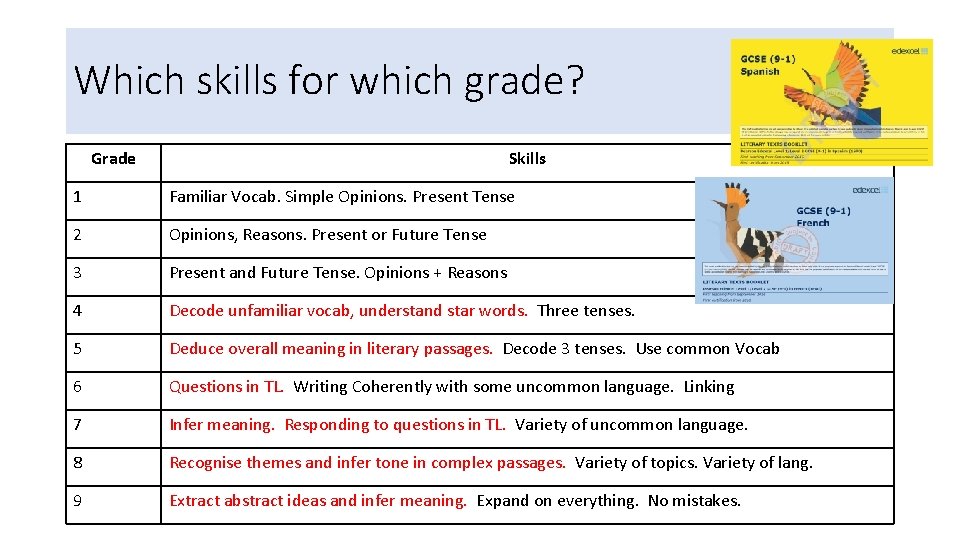
Which skills for which grade? Grade Skills 1 Familiar Vocab. Simple Opinions. Present Tense 2 Opinions, Reasons. Present or Future Tense 3 Present and Future Tense. Opinions + Reasons 4 Decode unfamiliar vocab, understand star words. Three tenses. 5 Deduce overall meaning in literary passages. Decode 3 tenses. Use common Vocab 6 Questions in TL. Writing Coherently with some uncommon language. Linking 7 Infer meaning. Responding to questions in TL. Variety of uncommon language. 8 Recognise themes and infer tone in complex passages. Variety of topics. Variety of lang. 9 Extract abstract ideas and infer meaning. Expand on everything. No mistakes.
Decode, Deduce and Infer. What’s the difference? • Decode – to discover the meaning of information written in a code. • Deduce – the process of reaching a decision or answer by thinking about the known facts. • Infer – to work something out based on reasoning. If the police find a body in the library with a knife sticking out, the deduction would be that they had been murdered. The inference would be that someone didn't like them.
How can students decode unfamiliar vocabulary? • READ • Synonyms. Lexical Field. Synonymous Phrases. Clines. • Developing English Literacy – Cognates and near cognates
READ • Read the question properly. • Example. What extra pieces of information can you work out? • Annotate the title. Which TL words should I expect to see / hear? • Do the question!
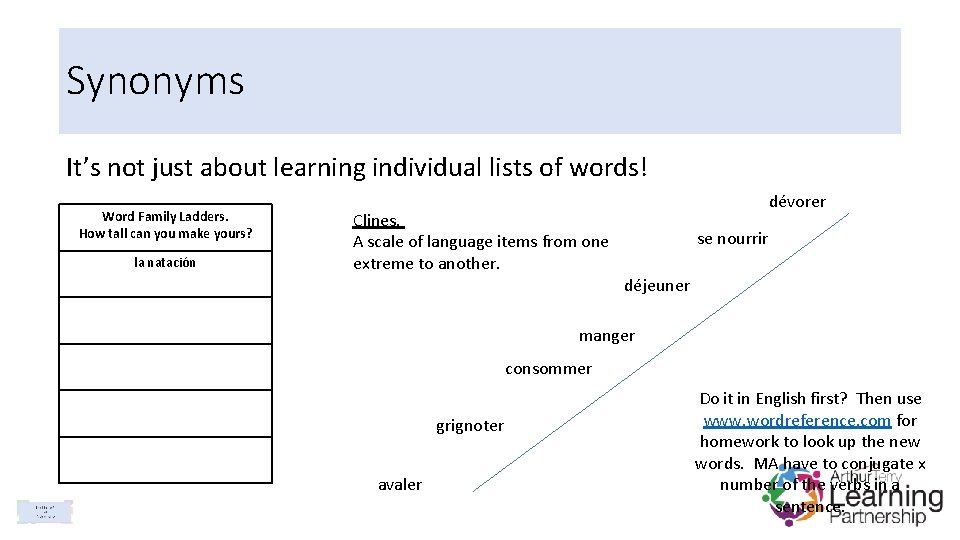
Synonyms It’s not just about learning individual lists of words! Word Family Ladders. How tall can you make yours? la natación Clines. A scale of language items from one extreme to another. dévorer se nourrir déjeuner manger consommer grignoter avaler Do it in English first? Then use www. wordreference. com for homework to look up the new words. MA have to conjugate x number of the verbs in a sentence.
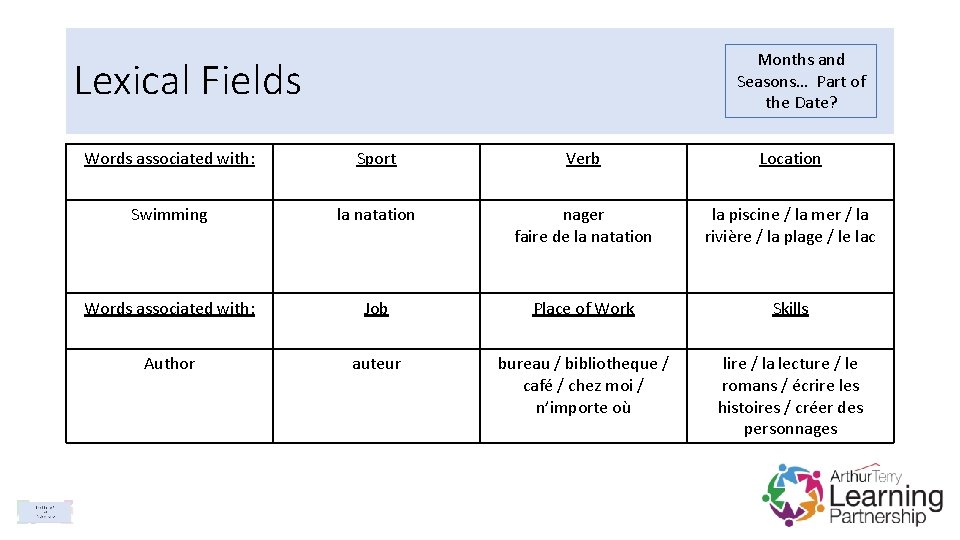
Months and Seasons… Part of the Date? Lexical Fields Words associated with: Sport Verb Location Swimming la natation nager faire de la natation la piscine / la mer / la rivière / la plage / le lac Words associated with: Job Place of Work Skills Author auteur bureau / bibliotheque / café / chez moi / n’importe où lire / la lecture / le romans / écrire les histoires / créer des personnages
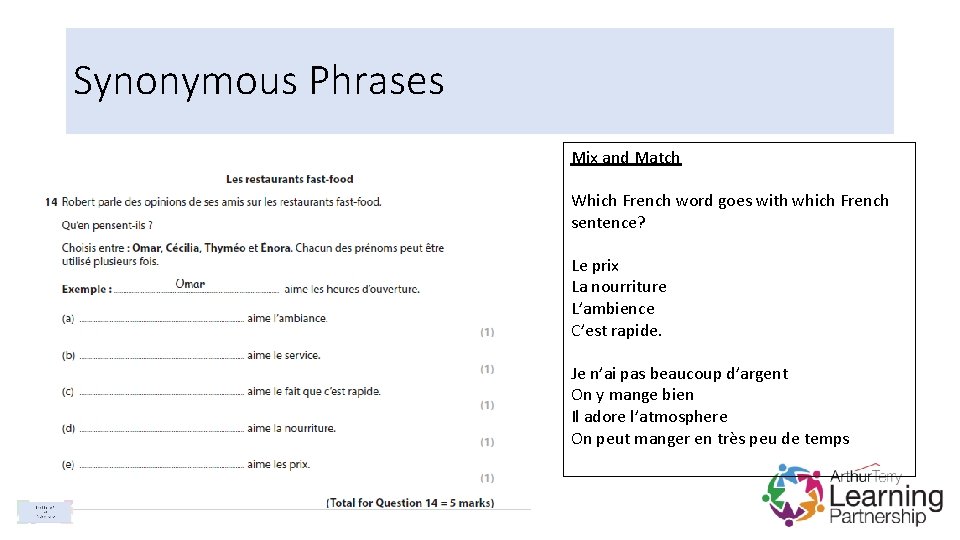
Synonymous Phrases Mix and Match Which French word goes with which French sentence? Le prix La nourriture L’ambience C’est rapide. Je n’ai pas beaucoup d’argent On y mange bien Il adore l’atmosphere On peut manger en très peu de temps
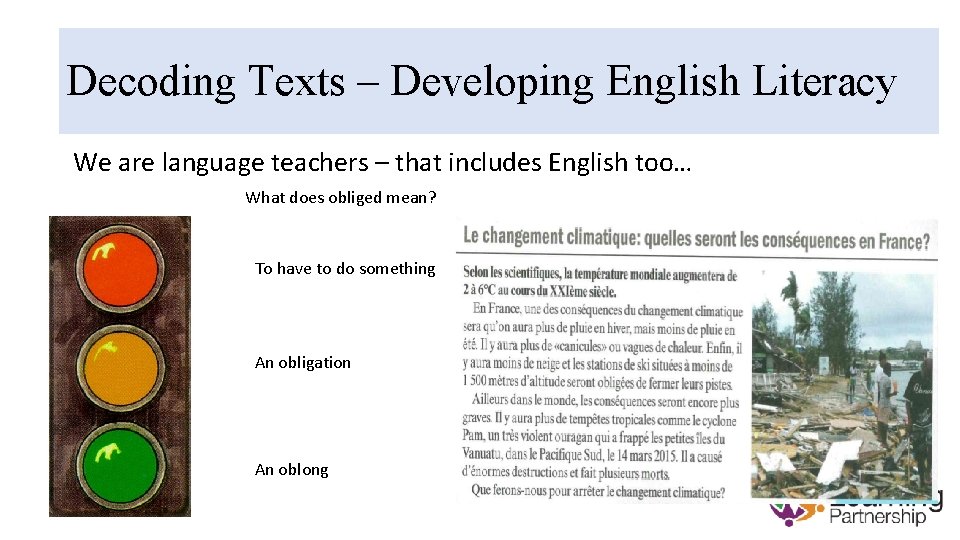
Speaking Activities in Lessons. English Literacy Decoding Texts – Developing We are language teachers – that includes English too… What does obliged mean? To have to do something An obligation An oblong
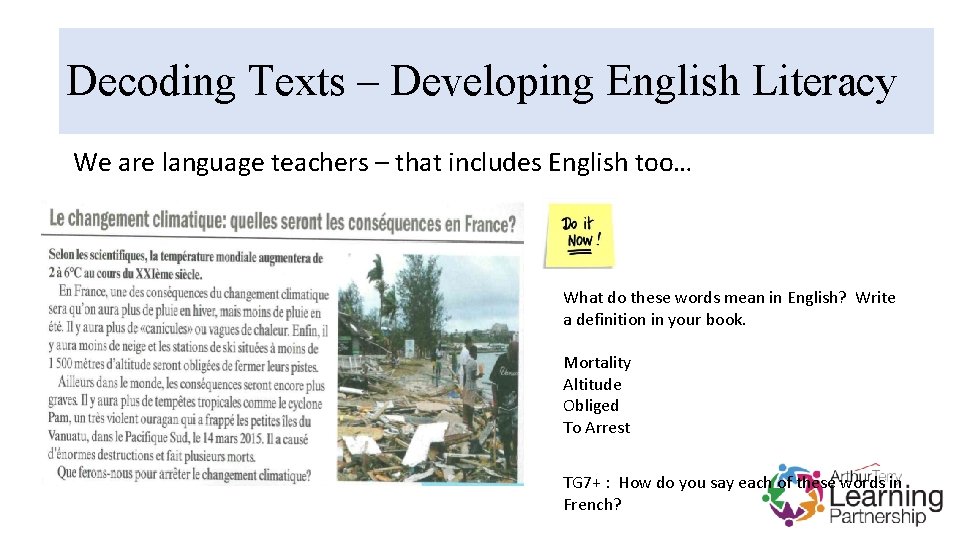
Speaking Activities in Lessons. English Literacy Decoding Texts – Developing We are language teachers – that includes English too… What do these words mean in English? Write a definition in your book. Mortality Altitude Obliged To Arrest TG 7+ : How do you say each of these words in French?
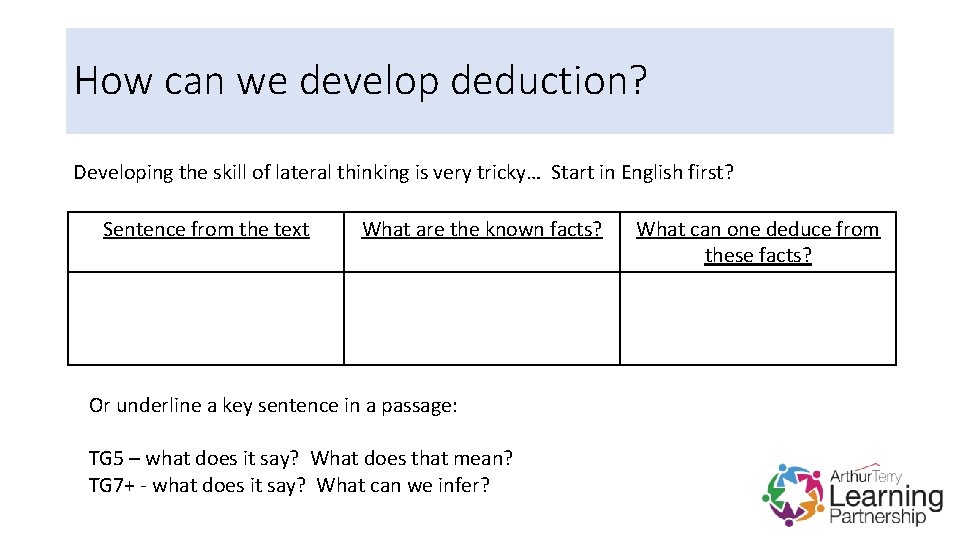
How can we develop deduction? Developing the skill of lateral thinking is very tricky… Start in English first? Sentence from the text What are the known facts? Or underline a key sentence in a passage: TG 5 – what does it say? What does that mean? TG 7+ - what does it say? What can we infer? What can one deduce from these facts?
What do the inference questions look like? • Infer how someone is feeling about something • Infer what someone might be thinking • Infer future intentions • Infer what the weather might be like • Infer the reason why something might have happened
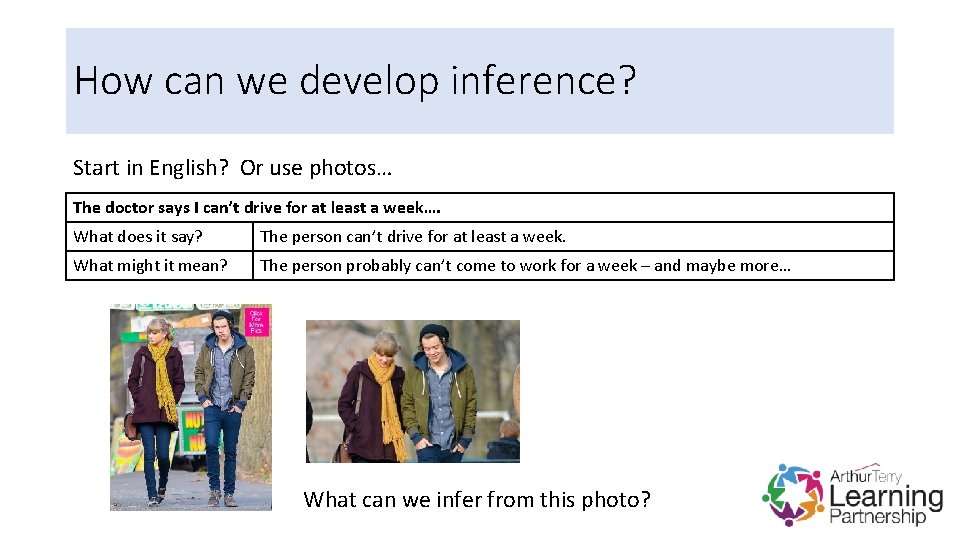
How can we develop inference? Start in English? Or use photos… The doctor says I can’t drive for at least a week…. What does it say? The person can’t drive for at least a week. What might it mean? The person probably can’t come to work for a week – and maybe more… What can we infer from this photo?
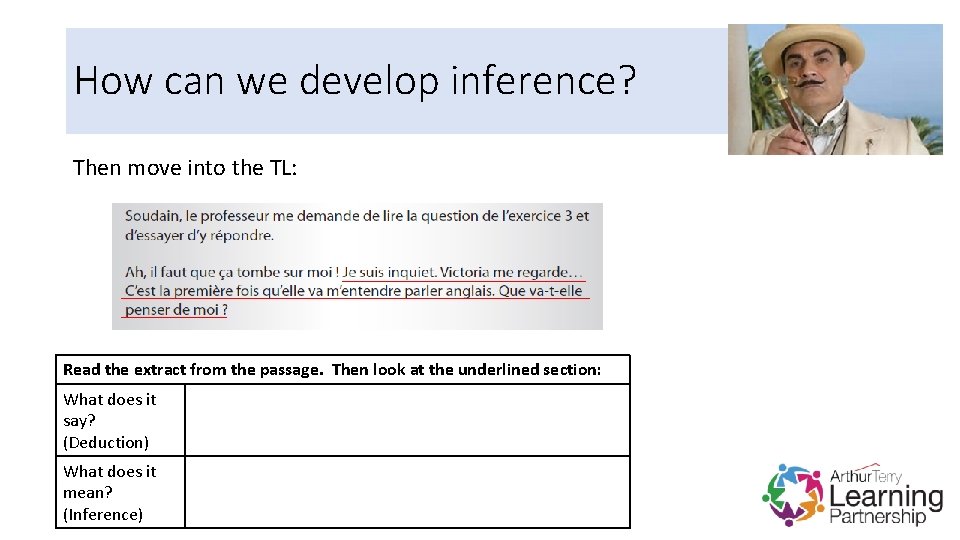
How can we develop inference? Then move into the TL: Read the extract from the passage. Then look at the underlined section: What does it say? (Deduction) What does it mean? (Inference)
- Slides: 20