
Listening Actively The Receivers Challenge Wisdom is the
- Slides: 19
Listening Actively: The Receiver’s Challenge "Wisdom is the reward you get for a lifetime of listening when you'd have preferred to talk. " - Doug Larson 1
Works Cited w Brownell, Judi. 1987. Listening: The toughest management skill. The Cornell H. R. A. Quarterly, February 1987: 65 -71. w Decker, Bert. 1992. You’ve got to be believed to be heard: Reach the first brain to communicate in business and life. New York, NY: St. Martin’s Press. w Decker, Bert. 1996. The art of communicating: Achieving interpersonal impact in business. Revised edition. Menlo Park, CA: Crisp Learning. w www. Quotegarden. com : Listening. Accessed 10/31/03. 2
Verbal & Non-Verbal Communication w Concepts: Rapport n Non-Verbal Messages n Asking Good Questions n Sincere Paraphrasing n Active Listening n 3
Rapport Being in sync with other people, verbally and non-verbally, so they are comfortable and have trust and confidence in you 4
Non-Verbal Messages “What you do speaks so loud I can’t hear what you say. ” Ralph Waldo Emerson 5
Non-Verbal Messages w Bert Decker’s book is titled “You’ve got to be believed to be heard” for a reason! w He discusses two factors The Eye Factor n The Energy Factor n w What people see 6
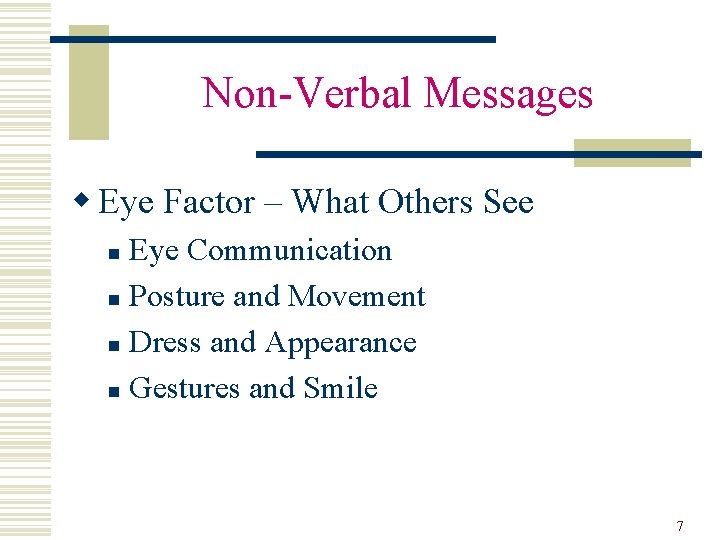
Non-Verbal Messages w Eye Factor – What Others See Eye Communication n Posture and Movement n Dress and Appearance n Gestures and Smile n 7
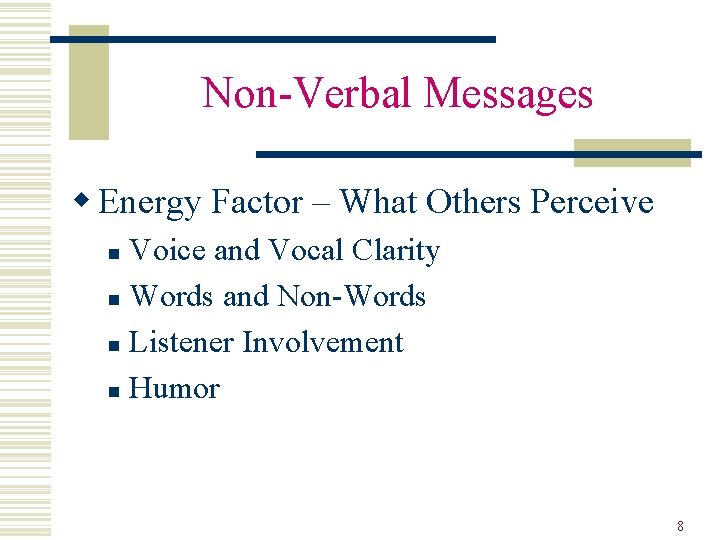
Non-Verbal Messages w Energy Factor – What Others Perceive Voice and Vocal Clarity n Words and Non-Words n Listener Involvement n Humor n 8
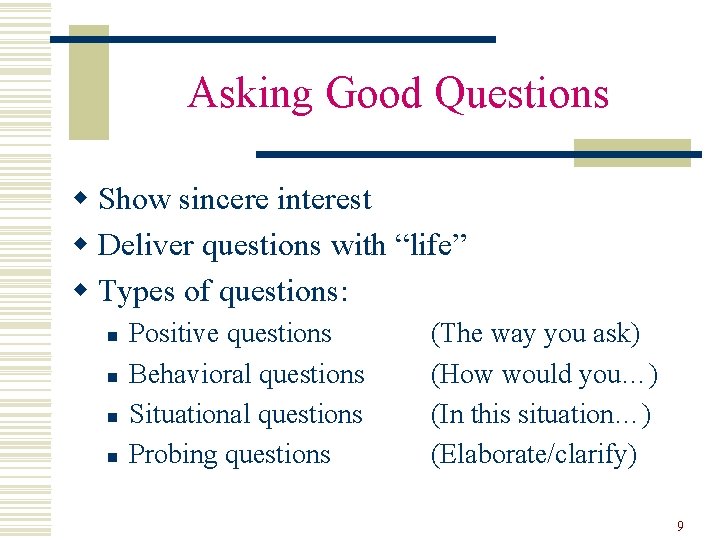
Asking Good Questions w Show sincere interest w Deliver questions with “life” w Types of questions: n n Positive questions Behavioral questions Situational questions Probing questions (The way you ask) (How would you…) (In this situation…) (Elaborate/clarify) 9
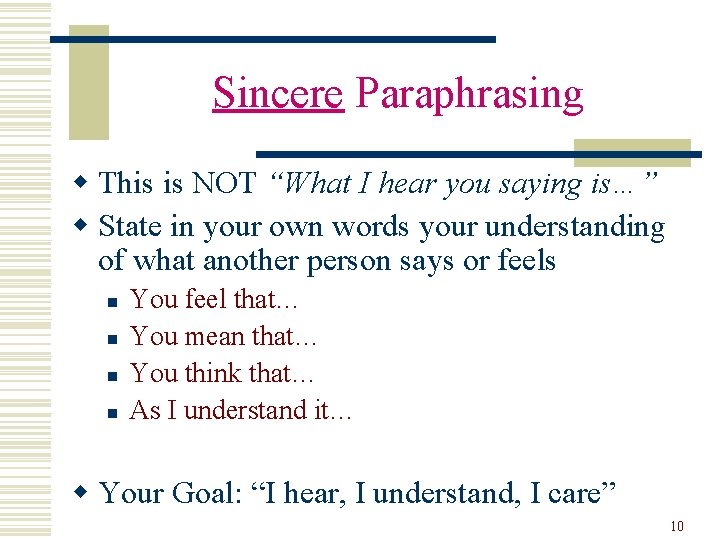
Sincere Paraphrasing w This is NOT “What I hear you saying is…” w State in your own words your understanding of what another person says or feels n n You feel that… You mean that… You think that… As I understand it… w Your Goal: “I hear, I understand, I care” 10
Active Listening w Be engaged w Truly hear and process the message w Avoid distractions 11
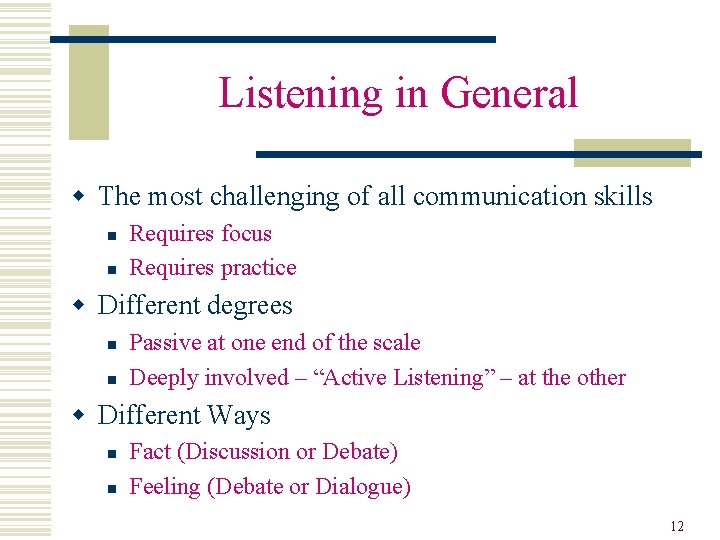
Listening in General w The most challenging of all communication skills n n Requires focus Requires practice w Different degrees n n Passive at one end of the scale Deeply involved – “Active Listening” – at the other w Different Ways n n Fact (Discussion or Debate) Feeling (Debate or Dialogue) 12
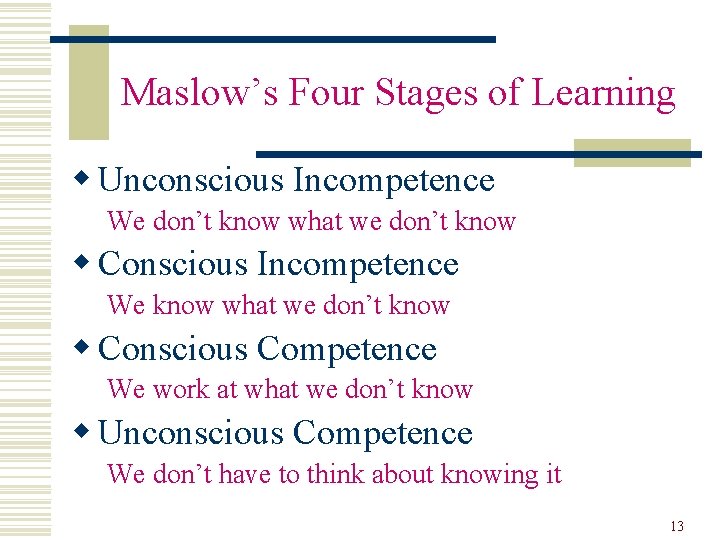
Maslow’s Four Stages of Learning w Unconscious Incompetence We don’t know what we don’t know w Conscious Incompetence We know what we don’t know w Conscious Competence We work at what we don’t know w Unconscious Competence We don’t have to think about knowing it 13
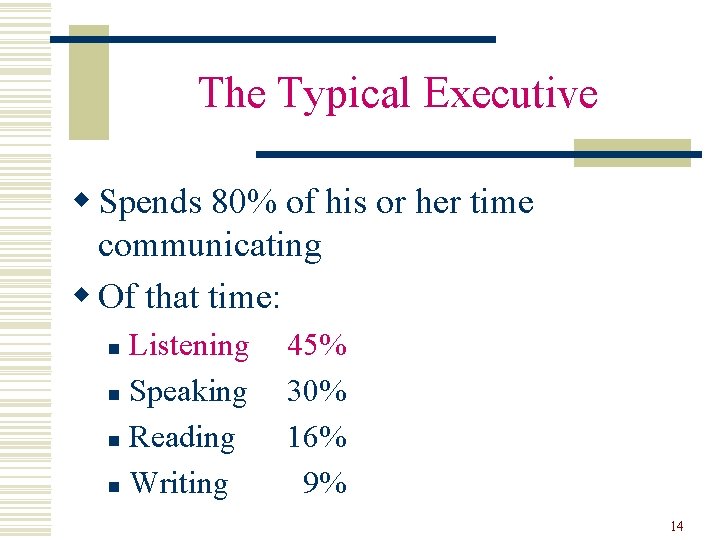
The Typical Executive w Spends 80% of his or her time communicating w Of that time: Listening n Speaking n Reading n Writing n 45% 30% 16% 9% 14
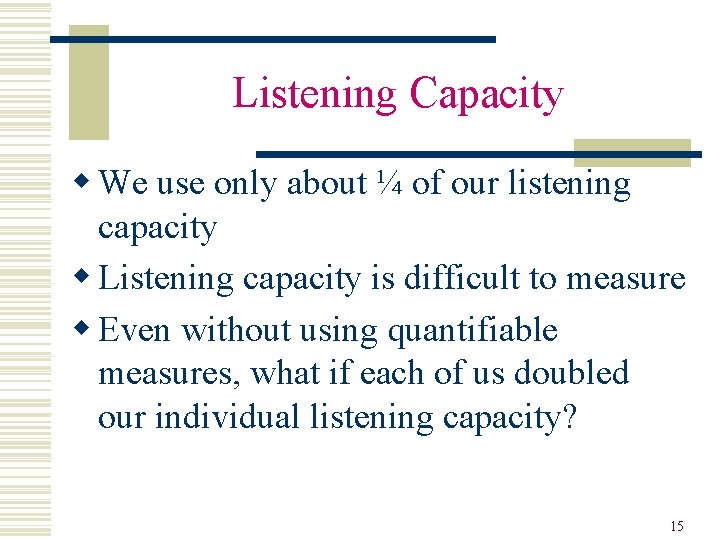
Listening Capacity w We use only about ¼ of our listening capacity w Listening capacity is difficult to measure w Even without using quantifiable measures, what if each of us doubled our individual listening capacity? 15
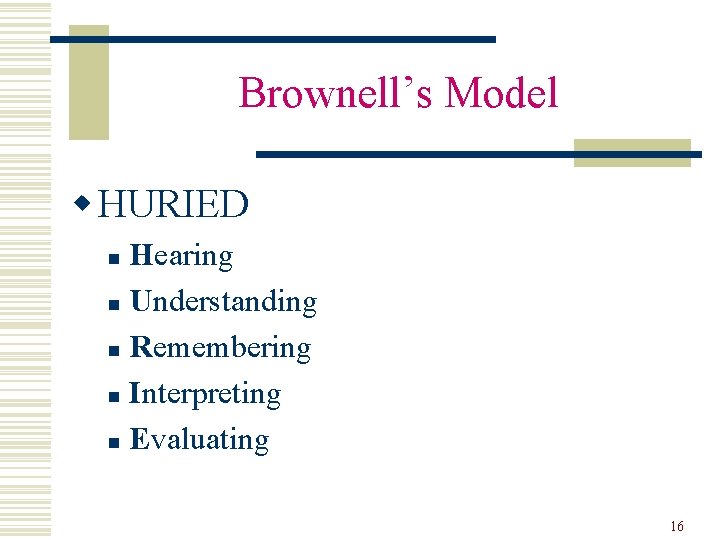
Brownell’s Model w HURIED Hearing n Understanding n Remembering n Interpreting n Evaluating n 16
Hearing w Essential Actions: Concentrate on what the speaker is saying n Allow the entire message to be delivered without interruption n w Be comfortable with silence w Avoid Distractions w “It’s about them, not you!” 17
Something to ponder… w Speaking: 130 -160 words per minute w We can process aural information at a rate of up to 700 words per minute w On average, we listen three times faster than most people talk w What can we do with that unused mental time? Listening: The Toughest Management Skill, pg. 66 -67 18
In Closing… “The most important thing in communication is to hear what isn't being said. ” Peter F. Drucker 19