
List comprehensions UW CSE 140 Winter 2013 Ways

![Types of comprehension List [ i*2 for i in range(3) ] Set { i*2](https://slidetodoc.com/presentation_image_h2/7e3e515f962d7083befdacec45d245c6/image-7.jpg "Types of comprehension List [ i*2 for i in range(3) ] Set { i*2")


- Slides: 14
List comprehensions UW CSE 140 Winter 2013
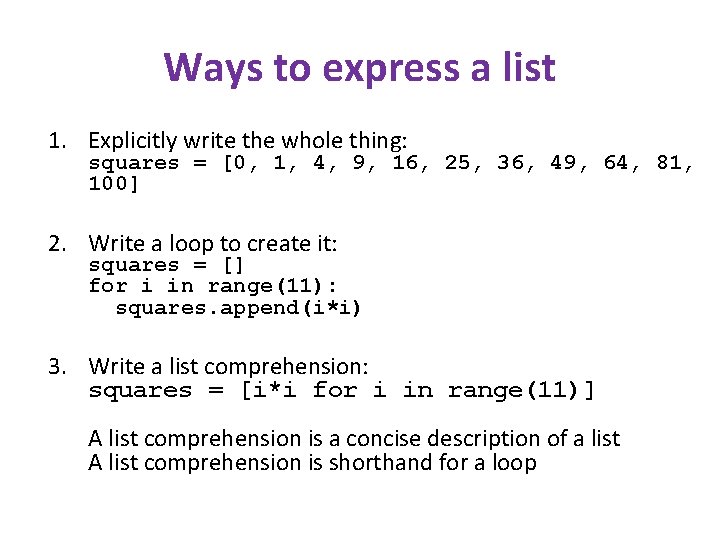
Ways to express a list 1. Explicitly write the whole thing: squares = [0, 1, 4, 9, 16, 25, 36, 49, 64, 81, 100] 2. Write a loop to create it: squares = [] for i in range(11): squares. append(i*i) 3. Write a list comprehension: squares = [i*i for i in range(11)] A list comprehension is a concise description of a list A list comprehension is shorthand for a loop
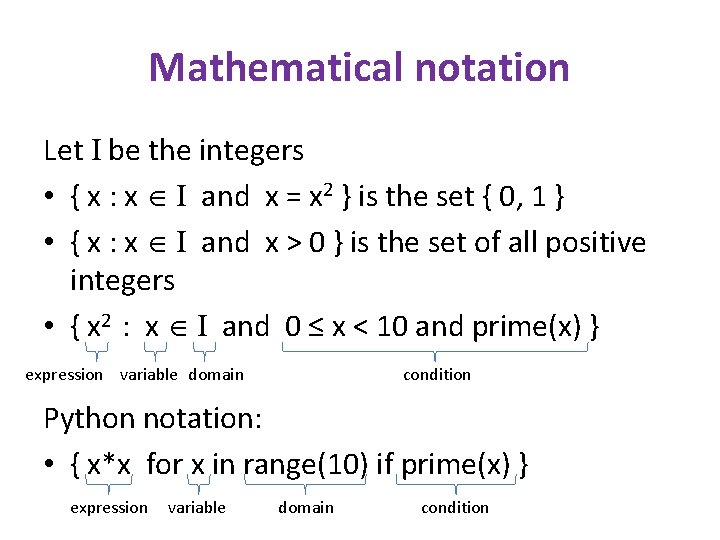
Mathematical notation Let I be the integers • { x : x I and x = x 2 } is the set { 0, 1 } • { x : x I and x > 0 } is the set of all positive integers • { x 2 : x I and 0 ≤ x < 10 and prime(x) } expression variable domain condition Python notation: • { x*x for x in range(10) if prime(x) } expression variable domain condition
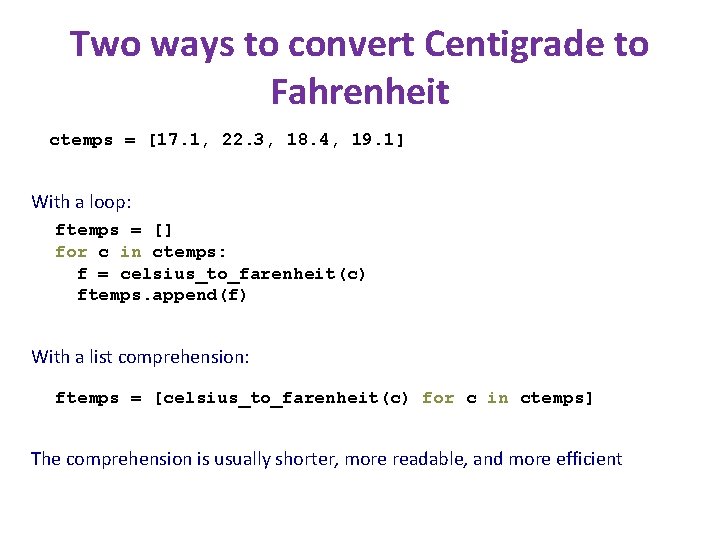
Two ways to convert Centigrade to Fahrenheit ctemps = [17. 1, 22. 3, 18. 4, 19. 1] With a loop: ftemps = [] for c in ctemps: f = celsius_to_farenheit(c) ftemps. append(f) With a list comprehension: ftemps = [celsius_to_farenheit(c) for c in ctemps] The comprehension is usually shorter, more readable, and more efficient
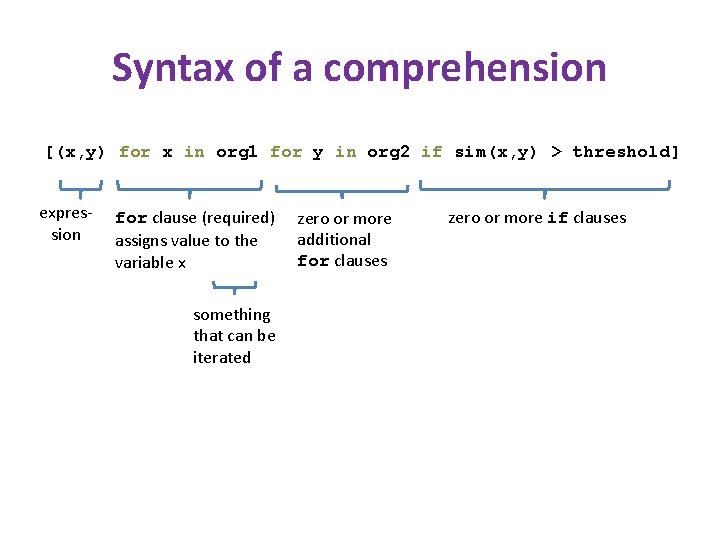
Syntax of a comprehension [(x, y) for x in org 1 for y in org 2 if sim(x, y) > threshold] expression for clause (required) assigns value to the variable x something that can be iterated zero or more additional for clauses zero or more if clauses
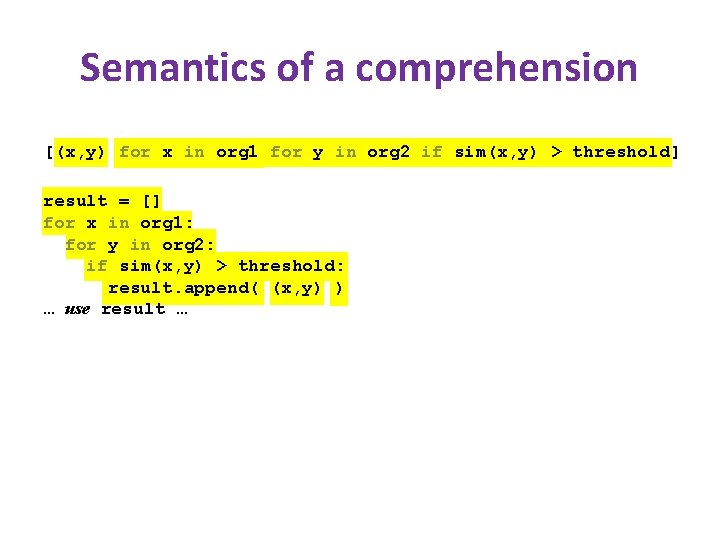
Semantics of a comprehension [(x, y) for x in org 1 for y in org 2 if sim(x, y) > threshold] result = [] for x in org 1: for y in org 2: if sim(x, y) > threshold: result. append( (x, y) ) … use result …
Types of comprehension List [ i*2 for i in range(3) ] Set { i*2 for i in range(3)} Dictionary d = {key: value for item in sequence …} { i: i*2 for i in range(3)}
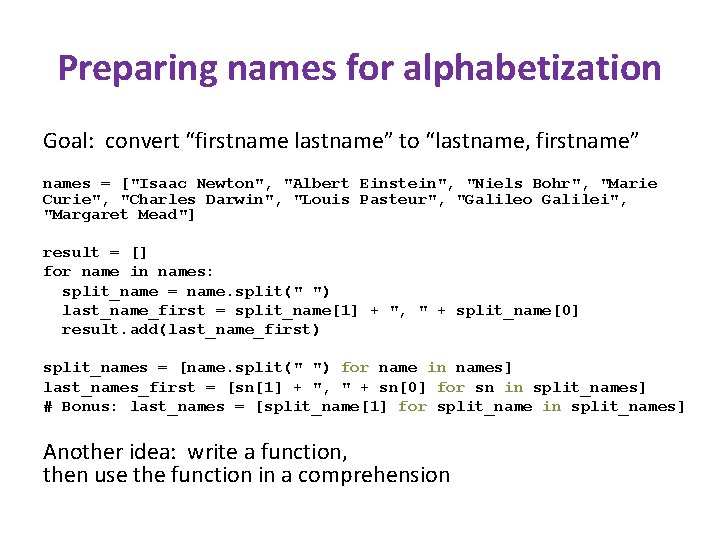
Preparing names for alphabetization Goal: convert “firstname lastname” to “lastname, firstname” names = ["Isaac Newton", "Albert Einstein", "Niels Bohr", "Marie Curie", "Charles Darwin", "Louis Pasteur", "Galileo Galilei", "Margaret Mead"] result = [] for name in names: split_name = name. split(" ") last_name_first = split_name[1] + ", " + split_name[0] result. add(last_name_first) split_names = [name. split(" ") for name in names] last_names_first = [sn[1] + ", " + sn[0] for sn in split_names] # Bonus: last_names = [split_name[1] for split_name in split_names] Another idea: write a function, then use the function in a comprehension
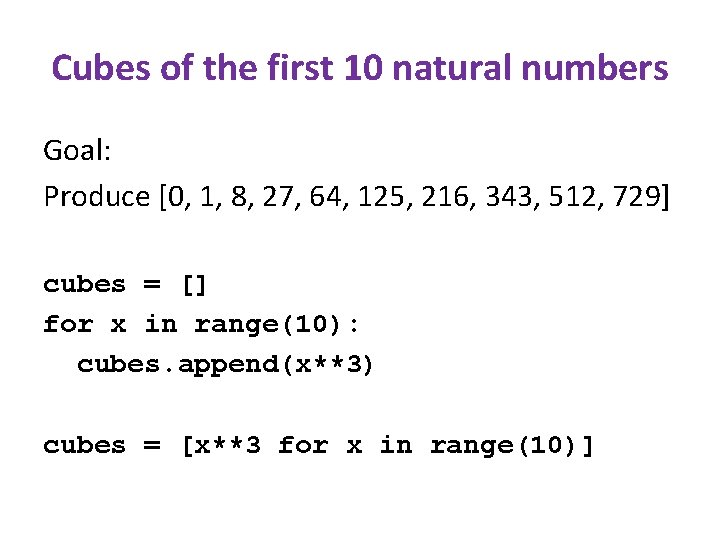
Cubes of the first 10 natural numbers Goal: Produce [0, 1, 8, 27, 64, 125, 216, 343, 512, 729] cubes = [] for x in range(10): cubes. append(x**3) cubes = [x**3 for x in range(10)]
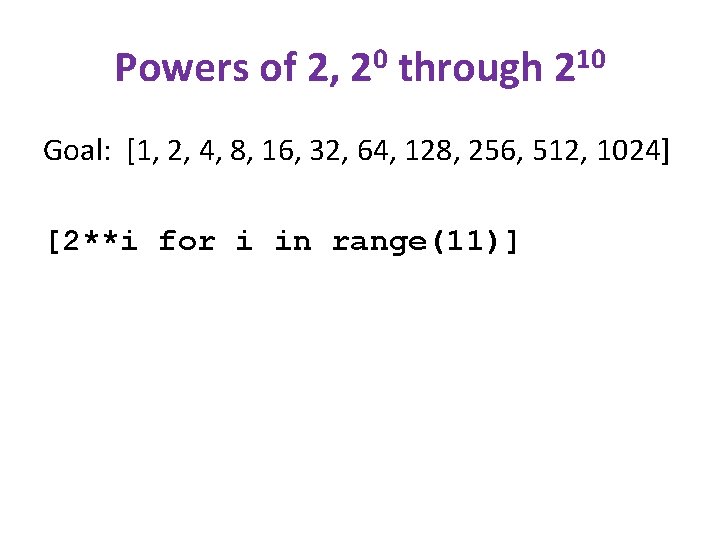
Powers of 2, 20 through 210 Goal: [1, 2, 4, 8, 16, 32, 64, 128, 256, 512, 1024] [2**i for i in range(11)]
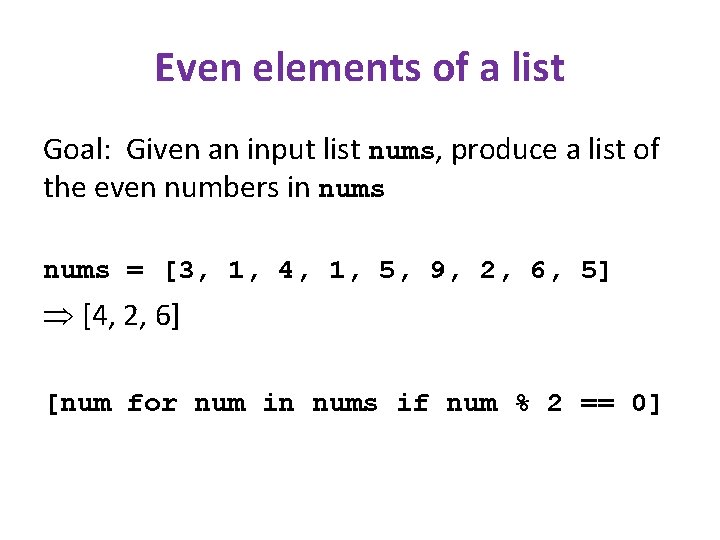
Even elements of a list Goal: Given an input list nums, produce a list of the even numbers in nums = [3, 1, 4, 1, 5, 9, 2, 6, 5] [4, 2, 6] [num for num in nums if num % 2 == 0]
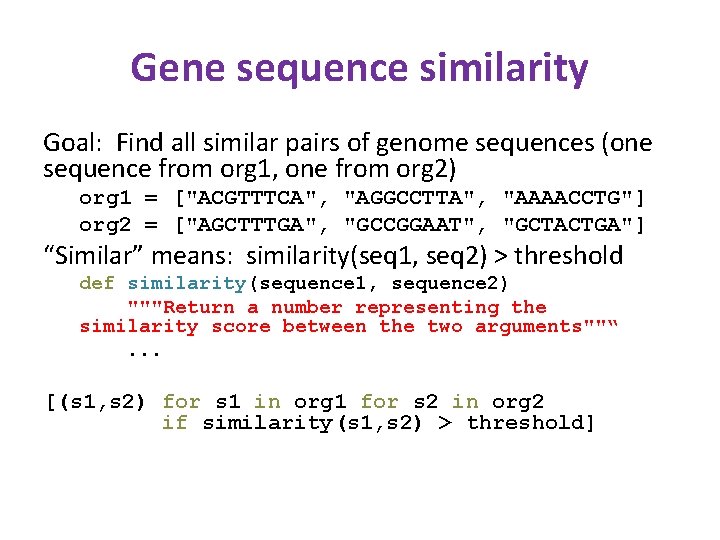
Gene sequence similarity Goal: Find all similar pairs of genome sequences (one sequence from org 1, one from org 2) org 1 = ["ACGTTTCA", "AGGCCTTA", "AAAACCTG"] org 2 = ["AGCTTTGA", "GCCGGAAT", "GCTACTGA"] “Similar” means: similarity(seq 1, seq 2) > threshold def similarity(sequence 1, sequence 2) """Return a number representing the similarity score between the two arguments""“. . . [(s 1, s 2) for s 1 in org 1 for s 2 in org 2 if similarity(s 1, s 2) > threshold]
All above-average 2 -die rolls Result list should be a list of 2 -tuples: [(2, 6), (3, 5), (3, 6), (4, 4), (4, 5), (4, 6), (5, 3), (5, 4), (5, 5), (5, 6), (6, 2), (6, 3), (6, 4), (6, 5), (6, 6)] [(r 1, r 2) for r 1 in [1, 2, 3, 4, 5, 6] for r 2 in [1, 2, 3, 4, 5, 6] if r 1 + r 2 > 7] [(r 1, r 2) for r 1 in range(1, 7) for r 2 in range(8 -x, 7)]
Get more practice • Use comprehensions where appropriate • Convert loops to comprehensions • Convert comprehensions to loops