
List and define the six levels of organization
- Slides: 33
List and define the six levels of organization in ecology, from the most specific to the most complex. individual (organism)- a single living organism population- a group of individuals that belong to the same species in a given area community- a group of different populations in a given area ecosystem- all the living and nonliving things in a given area biome- a group of ecosystems that share similar climates and typical organisms. biosphere- anywhere on earth life exists.
The branch of biology dealing with interactions among organisms and between organisms and their environment is called Ecology
The simplest grouping of more than one kind of organism in the biosphere is community
The lowest level of environmental complexity that includes living and nonliving factors is the ecosystem
Plants are Autotrophs and primary producers
How do most primary producers make their own food? by using light energy to make carbohydrates
In which way are plants in a sunny mountain meadow and sulfur bacteria in a deep-sea volcanic vent alike? They both produce carbohydrates and oxygen.
In what way are herbivores and carnivores alike? They both obtain energy by consuming other organisms.
The total amount of living tissue within a given trophic level is called the biomass
A model of the complex feeding interactions among organisms in a community from producers to decomposers is called a Food web
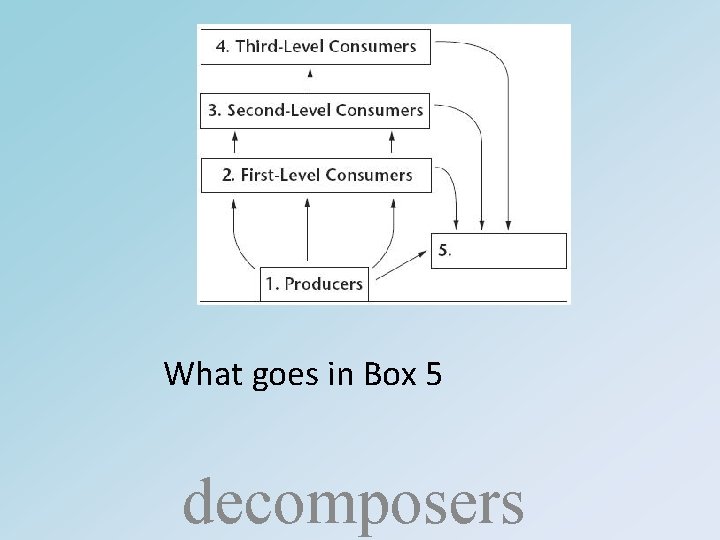
What goes in Box 5 decomposers
A word that means the same thing as consumer is heterotroph
What are three kinds of ecological pyramids? Biomass, energy, numbers
Animals that get energy by eating the carcasses of other animals that have been killed by predators or have died of natural causes are called scavengers
Each of the following is an abiotic factor in the environment EXCEPT a. plant life. b. soil type. c. rainfall. d. temperature. a. Plant life
What animals eat both producers and consumers? omnivores
Organisms that break down organic matter and return it to the environment are called decomposers
An ecologist who is studying a group of ecosystems that have similar climates and are home to similar organisms is studying a biome
Producers release ______into the atmosphere during the process of photosynthesis. oxygen
Animals that feed on plants are called consumers
In an ecological pyramid, the biomass of living things _______ at each higher level. decrease
Seawater, sand on a beach, pebbles in the sand, and humidity are all examples of _____ factors at a seashore. abiotic
The study of interactions among organisms and between organisms and their physical surroundings is called ecology
Organisms within an ecosystem are __________ factors in that ecosystem biotic
Autotrophs capture energy from sunlight or __________ to produce food. chemicals
Plant-eating animals such as cows are called __________. Herbivores/consumers
Why are decomposers the final consumers in every food chain? In time, all living things die regardless of where they are in the food chain. The decomposers break down the remains of dead plants and animals, releasing substances that are reused by other organisms in the ecosystem.
List three biotic and three abiotic factors that determine the survival of a rabbit in a temperate forest. Biotic factors may include: plants the rabbit eats, predators that eat the rabbit, and animals that compete with the rabbit for food and territory. Abiotic factors may include: temperature, rainfall, and space.
Why might a pyramid of numbers be turned upside down? Explain your answer with an example. Sometimes consumers are much less massive than the organisms they feed upon. For example, thousands of insects may graze on a single tree. The tree has a lot of biomass, but it is only one organism. So the “base” of the pyramid will be small and the next level up will be wider.
How does a food web differ from a food chain? A food chain is a series of steps in which organisms transfer energy by eating and being eaten. A food web is a feeding relationship among the various organisms in an ecosystem that forms a network of complex interactions. A food web links all the food chains in an ecosystem together.
Describe the two sources of energy that fuel life on Earth, and explain how they do so. Sunlight is the main energy source for life on Earth, since it fuels photosynthesis in plants, which make up most of Earth’s primary producers. Inorganic chemical compounds provide energy for Earth’s other primary producers, the organisms that carry on chemosynthesis. Primary producers capture energy from sunlight or chemicals and use that energy to produce food for themselves. They then become food for other organisms.
How do carnivores, herbivores, omnivores, and scavengers differ in the way they obtain food? Carnivores kill and eat other animals, herbivores eat plants, and omnivores eat both plants and animals. Scavengers eat carcasses of animals that have been killed by predators or have died from natural causes.
What is at the base of all ecological pyramids? producers