
LISP primitives on sequences n FIRST or CAR
- Slides: 18
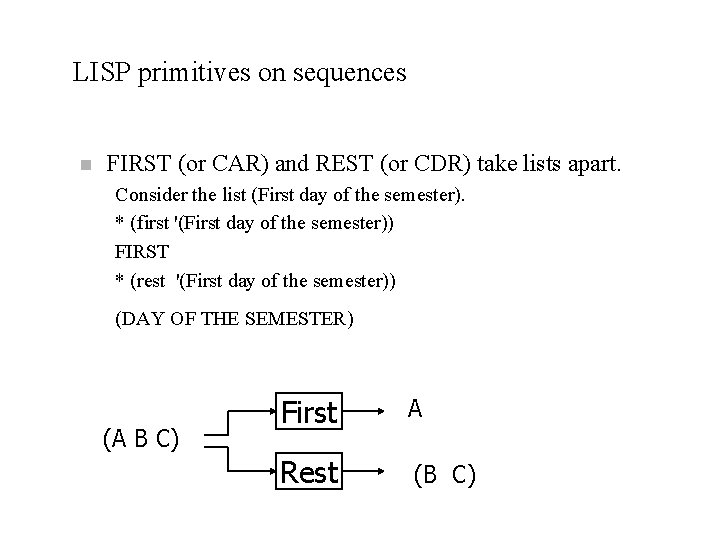
LISP primitives on sequences n FIRST (or CAR) and REST (or CDR) take lists apart. Consider the list (First day of the semester). * (first '(First day of the semester)) FIRST * (rest '(First day of the semester)) (DAY OF THE SEMESTER) (A B C) First A Rest (B C)
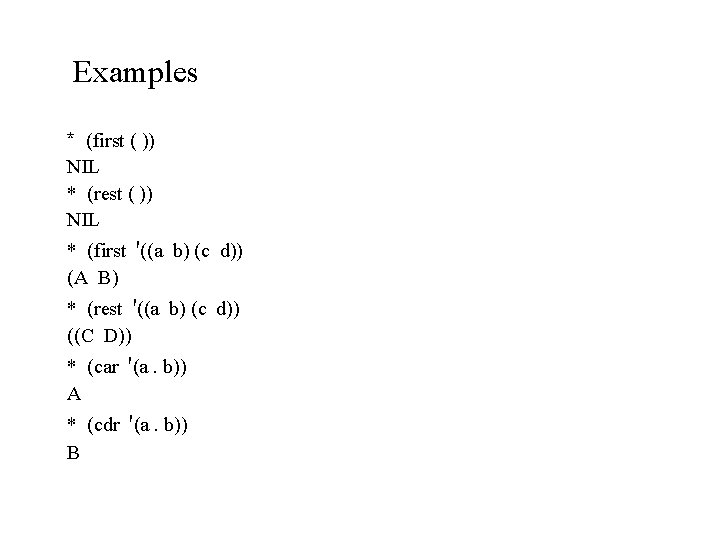
Examples * (first ( )) NIL * (rest ( )) NIL * (first '((a b) (c d)) (A B) * (rest '((a b) (c d)) ((C D)) * (car '(a. b)) A * (cdr '(a. b)) B
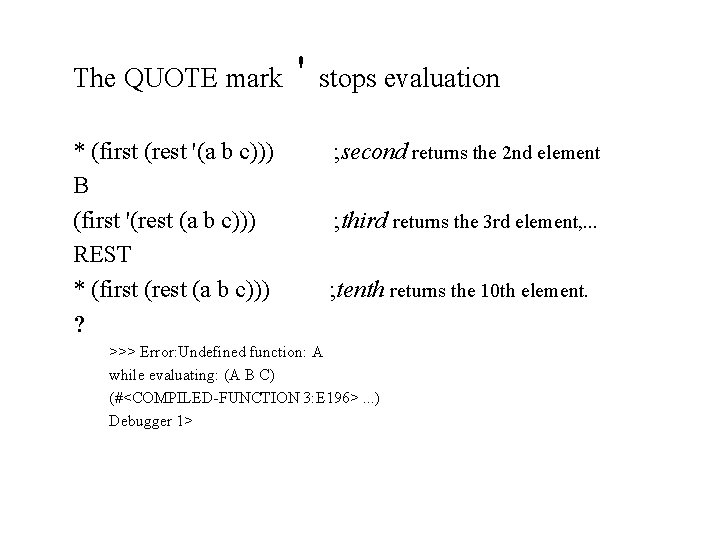
The QUOTE mark * (first (rest '(a b c))) B (first '(rest (a b c))) REST * (first (rest (a b c))) ? ' stops evaluation ; second returns the 2 nd element ; third returns the 3 rd element, . . . ; tenth returns the 10 th element. >>> Error: Undefined function: A while evaluating: (A B C) (#<COMPILED-FUNCTION 3: E 196>. . . ) Debugger 1>
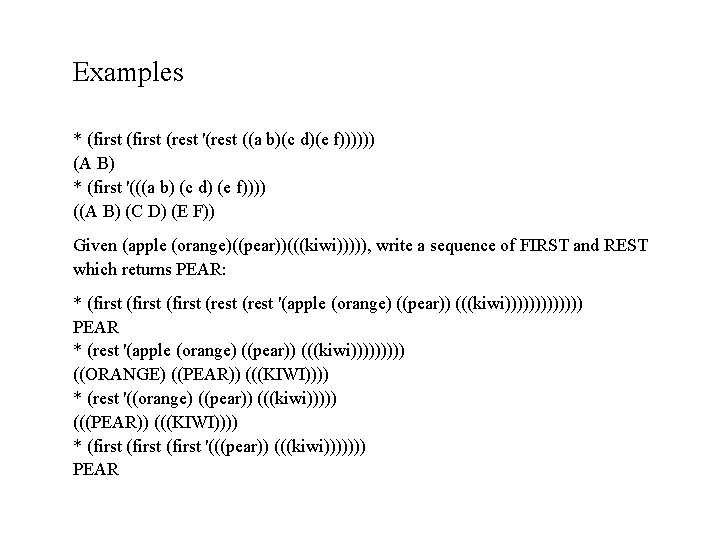
Examples * (first (rest '(rest ((a b)(c d)(e f)))))) (A B) * (first '(((a b) (c d) (e f)))) ((A B) (C D) (E F)) Given (apple (orange)((pear))(((kiwi))))), write a sequence of FIRST and REST which returns PEAR: * (first (rest '(apple (orange) ((pear)) (((kiwi))))))) PEAR * (rest '(apple (orange) ((pear)) (((kiwi))))) ((ORANGE) ((PEAR)) (((KIWI)))) * (rest '((orange) ((pear)) (((kiwi))))) (((PEAR)) (((KIWI)))) * (first '(((pear)) (((kiwi))))))) PEAR
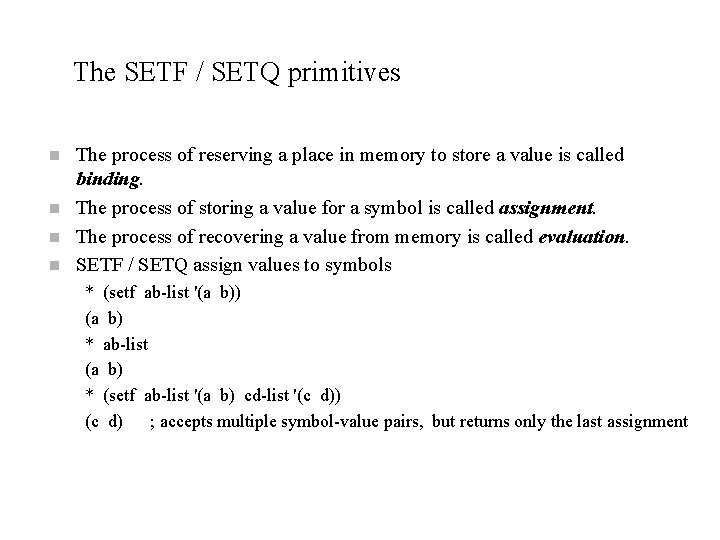
The SETF / SETQ primitives n n The process of reserving a place in memory to store a value is called binding. The process of storing a value for a symbol is called assignment. The process of recovering a value from memory is called evaluation. SETF / SETQ assign values to symbols * (setf ab-list '(a b)) (a b) * ab-list (a b) * (setf ab-list '(a b) cd-list '(c d)) (c d) ; accepts multiple symbol-value pairs, but returns only the last assignment
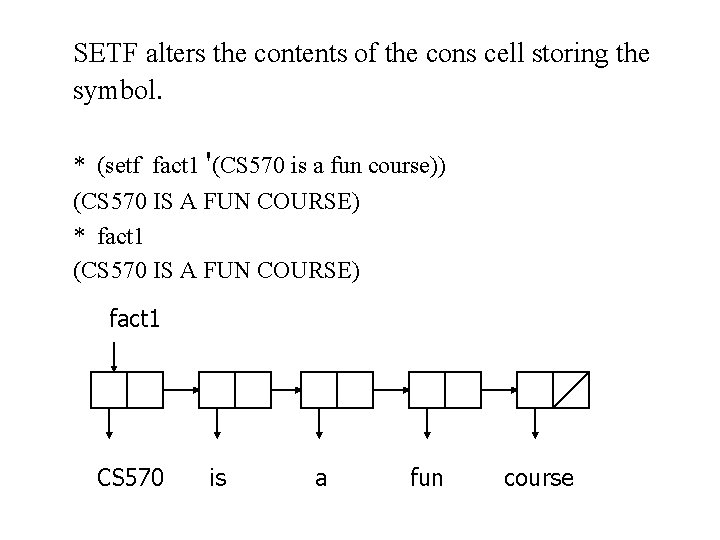
SETF alters the contents of the cons cell storing the symbol. * (setf fact 1 '(CS 570 is a fun course)) (CS 570 IS A FUN COURSE) * fact 1 (CS 570 IS A FUN COURSE) fact 1 CS 570 is a fun course
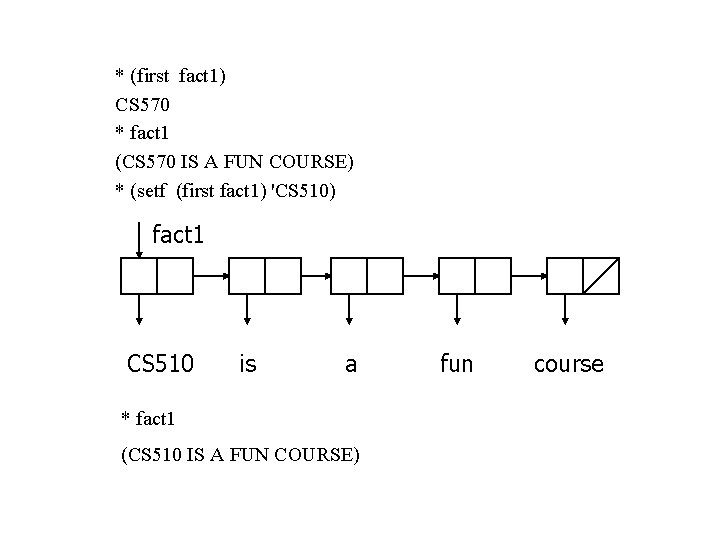
* (first fact 1) CS 570 * fact 1 (CS 570 IS A FUN COURSE) * (setf (first fact 1) 'CS 510) fact 1 CS 510 is a * fact 1 (CS 510 IS A FUN COURSE) fun course
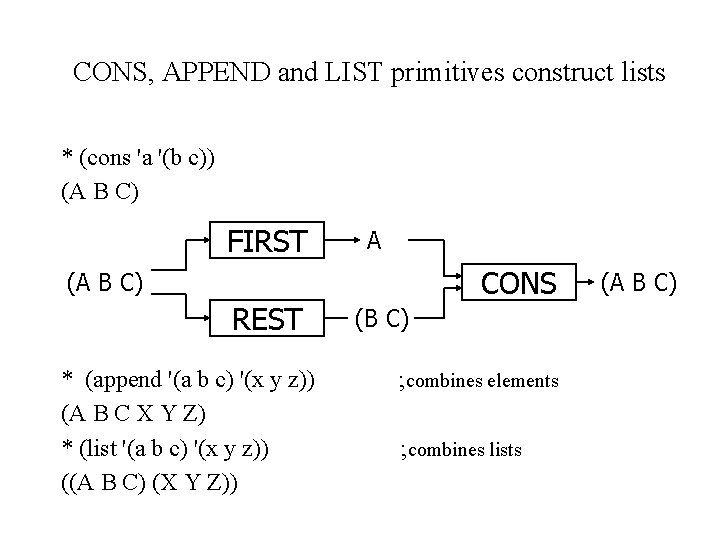
CONS, APPEND and LIST primitives construct lists * (cons 'a '(b c)) (A B C) FIRST A CONS (A B C) REST * (append '(a b c) '(x y z)) (A B C X Y Z) * (list '(a b c) '(x y z)) ((A B C) (X Y Z)) (B C) ; combines elements ; combines lists (A B C)
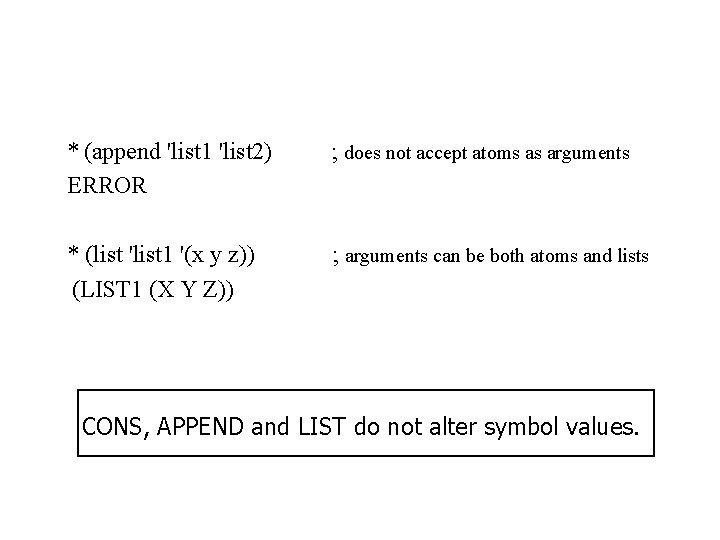
* (append 'list 1 'list 2) ERROR ; does not accept atoms as arguments * (list 'list 1 '(x y z)) (LIST 1 (X Y Z)) ; arguments can be both atoms and lists CONS, APPEND and LIST do not alter symbol values.
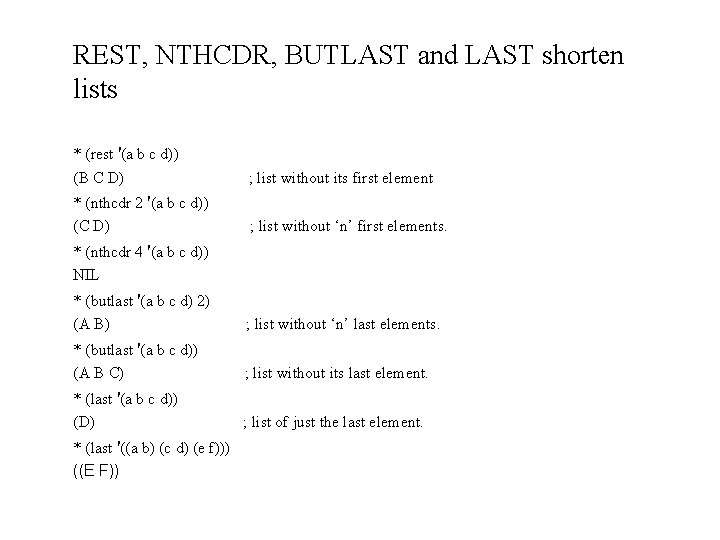
REST, NTHCDR, BUTLAST and LAST shorten lists * (rest '(a b c d)) (B C D) ; list without its first element * (nthcdr 2 '(a b c d)) (C D) ; list without ‘n’ first elements. * (nthcdr 4 '(a b c d)) NIL * (butlast '(a b c d) 2) (A B) ; list without ‘n’ last elements. * (butlast '(a b c d)) (A B C) ; list without its last element. * (last '(a b c d)) (D) ; list of just the last element. * (last '((a b) (c d) (e f))) ((E F))
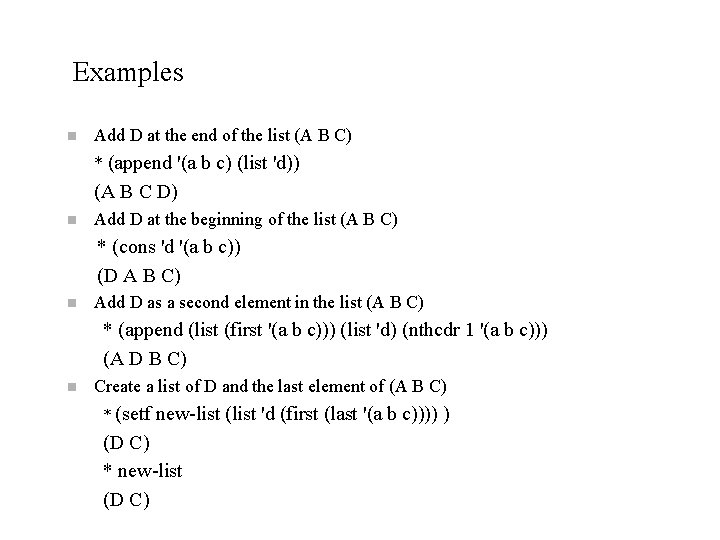
Examples n Add D at the end of the list (A B C) * (append '(a b c) (list 'd)) (A B C D) n Add D at the beginning of the list (A B C) * (cons 'd '(a b c)) (D A B C) n Add D as a second element in the list (A B C) * (append (list (first '(a b c))) (list 'd) (nthcdr 1 '(a b c))) (A D B C) n Create a list of D and the last element of (A B C) * (setf new-list (list 'd (first (last '(a b c)))) ) (D C) * new-list (D C)
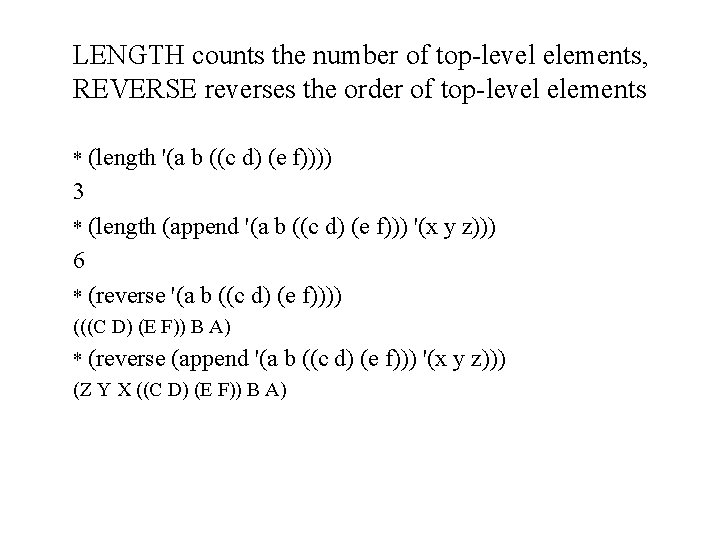
LENGTH counts the number of top-level elements, REVERSE reverses the order of top-level elements * (length '(a b ((c d) (e f)))) 3 * (length (append '(a b ((c d) (e f))) '(x y z))) 6 * (reverse '(a b ((c (((C D) (E F)) B A) d) (e f)))) * (reverse (append '(a b (Z Y X ((C D) (E F)) B A) ((c d) (e f))) '(x y z)))
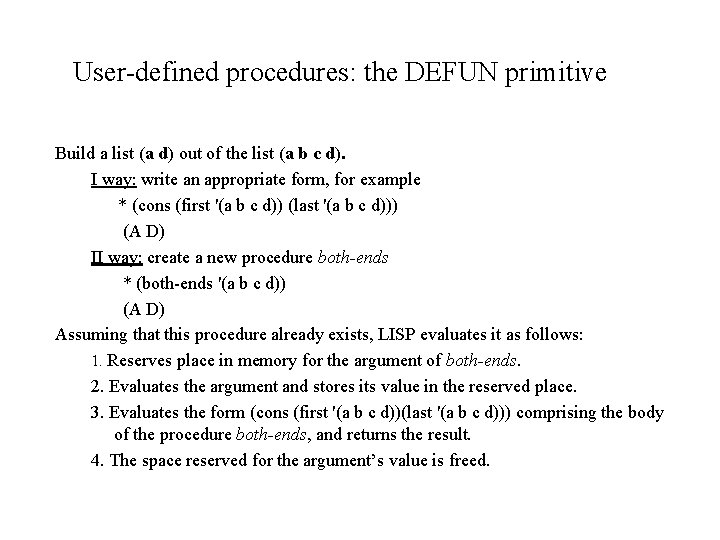
User-defined procedures: the DEFUN primitive Build a list (a d) out of the list (a b c d). I way: write an appropriate form, for example * (cons (first '(a b c d)) (last '(a b c d))) (A D) II way: create a new procedure both-ends * (both-ends '(a b c d)) (A D) Assuming that this procedure already exists, LISP evaluates it as follows: 1. Reserves place in memory for the argument of both-ends. 2. Evaluates the argument and stores its value in the reserved place. 3. Evaluates the form (cons (first '(a b c d))(last '(a b c d))) comprising the body of the procedure both-ends, and returns the result. 4. The space reserved for the argument’s value is freed.
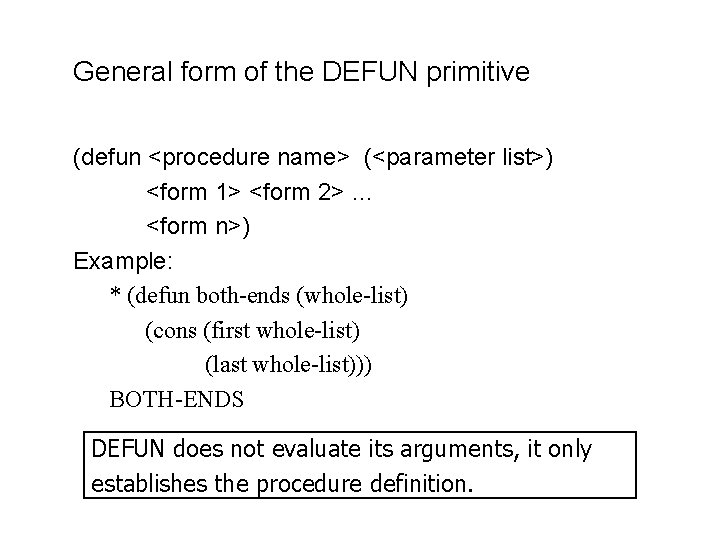
General form of the DEFUN primitive (defun <procedure name> (<parameter list>) <form 1> <form 2> … <form n>) Example: * (defun both-ends (whole-list) (cons (first whole-list) (last whole-list))) BOTH-ENDS DEFUN does not evaluate its arguments, it only establishes the procedure definition.
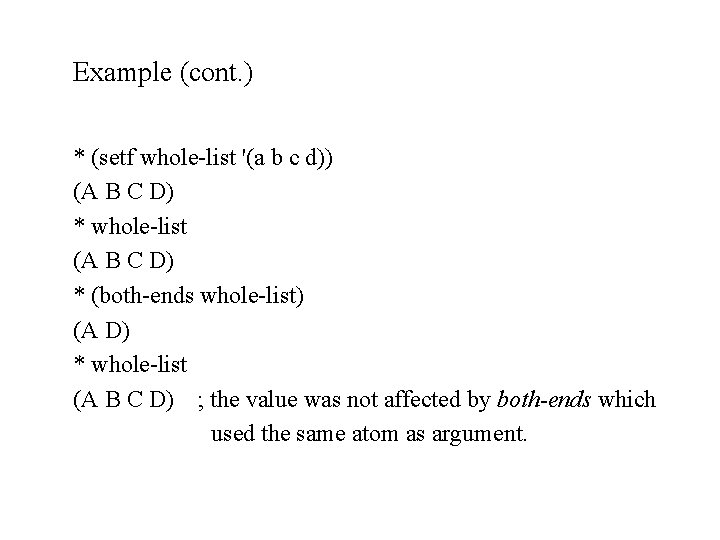
Example (cont. ) * (setf whole-list '(a b c d)) (A B C D) * whole-list (A B C D) * (both-ends whole-list) (A D) * whole-list (A B C D) ; the value was not affected by both-ends which used the same atom as argument.
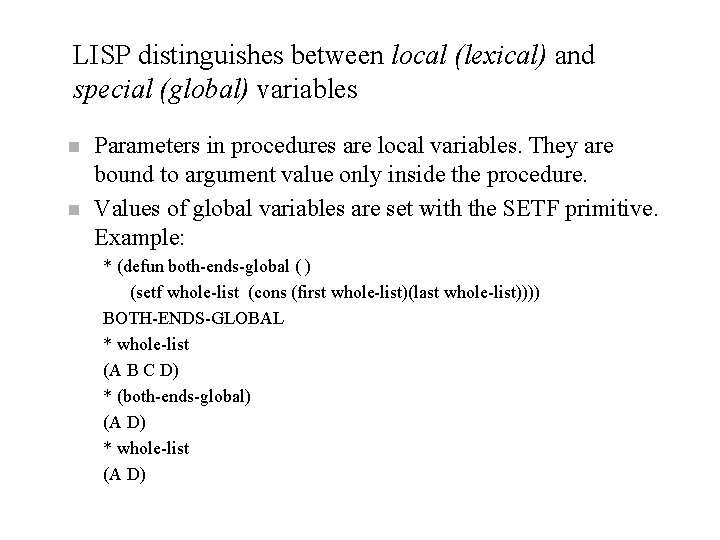
LISP distinguishes between local (lexical) and special (global) variables n n Parameters in procedures are local variables. They are bound to argument value only inside the procedure. Values of global variables are set with the SETF primitive. Example: * (defun both-ends-global ( ) (setf whole-list (cons (first whole-list)(last whole-list)))) BOTH-ENDS-GLOBAL * whole-list (A B C D) * (both-ends-global) (A D) * whole-list (A D)
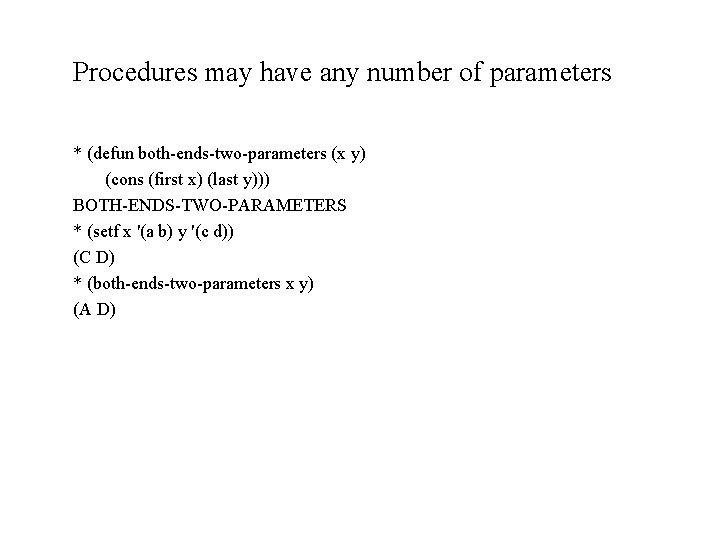
Procedures may have any number of parameters * (defun both-ends-two-parameters (x y) (cons (first x) (last y))) BOTH-ENDS-TWO-PARAMETERS * (setf x '(a b) y '(c d)) (C D) * (both-ends-two-parameters x y) (A D)
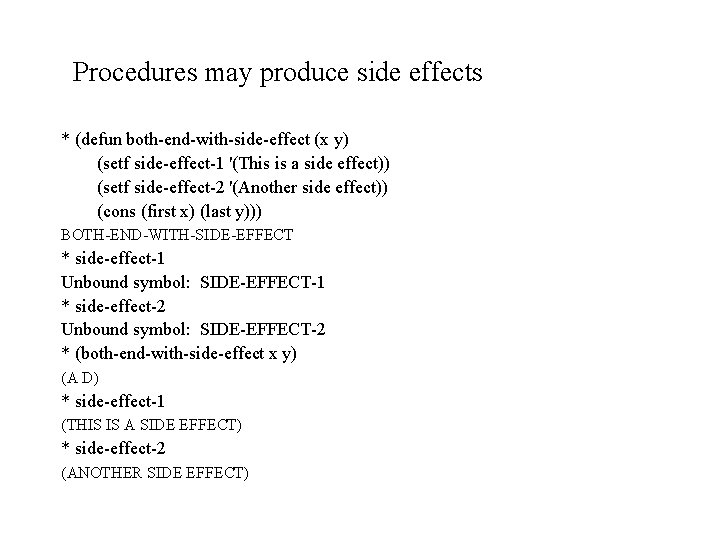
Procedures may produce side effects * (defun both-end-with-side-effect (x y) (setf side-effect-1 '(This is a side effect)) (setf side-effect-2 '(Another side effect)) (cons (first x) (last y))) BOTH-END-WITH-SIDE-EFFECT * side-effect-1 Unbound symbol: SIDE-EFFECT-1 * side-effect-2 Unbound symbol: SIDE-EFFECT-2 * (both-end-with-side-effect x y) (A D) * side-effect-1 (THIS IS A SIDE EFFECT) * side-effect-2 (ANOTHER SIDE EFFECT)