
LISP Deployment Scenarios Darrel Lewis and Margaret Wasserman



- Slides: 17
LISP Deployment Scenarios Darrel Lewis and Margaret Wasserman IETF 76, Hiroshima, Japan
Agenda • Introduction : Deployment scenario implication for the LISP Specification • Survey of LISP Network Elements – – – XTRs Map Servers Map Resolvers Proxy ITRs Proxy ETRs • Gauge level of interest in developing an informational draft 2
Introduction • The goal of this presentation is to inform the community about how we are expecting LISP to be deployed – Help to bound the discussion within practical scenarios • Covers cases we expect to be most common, not all possibilities are covered • For each element we’ll discuss possible deployment scenarios – And hopefully the tradeoffs • For each element we’ll discuss the impact of deployment scenarios on the spec 3
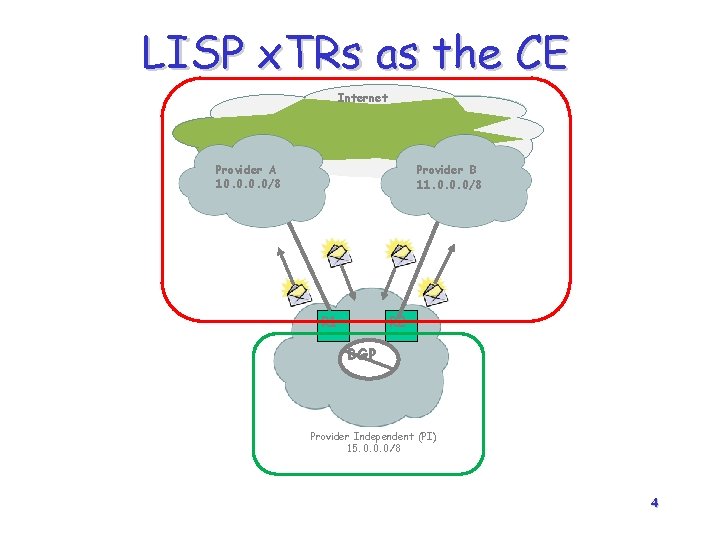
LISP x. TRs as the CE Internet Provider A 10. 0/8 Provider B 11. 0. 0. 0/8 R 1 R 2 BGP Provider Independent (PI) 15. 0. 0. 0/8 4
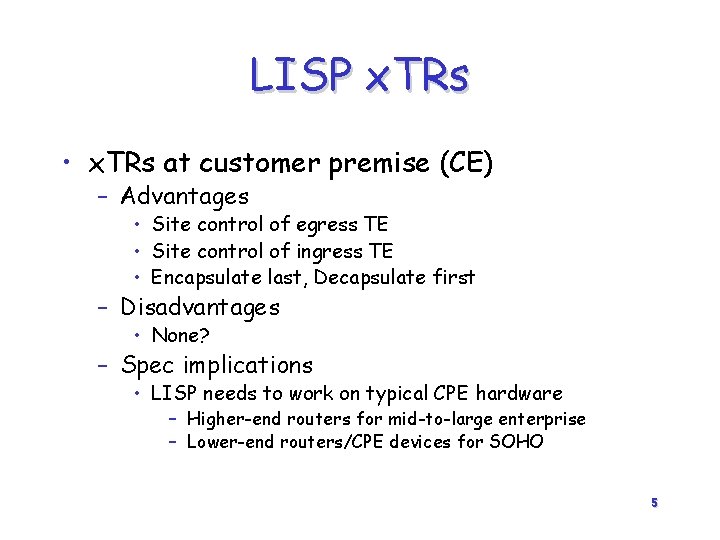
LISP x. TRs • x. TRs at customer premise (CE) – Advantages • Site control of egress TE • Site control of ingress TE • Encapsulate last, Decapsulate first – Disadvantages • None? – Spec implications • LISP needs to work on typical CPE hardware – Higher-end routers for mid-to-large enterprise – Lower-end routers/CPE devices for SOHO 5
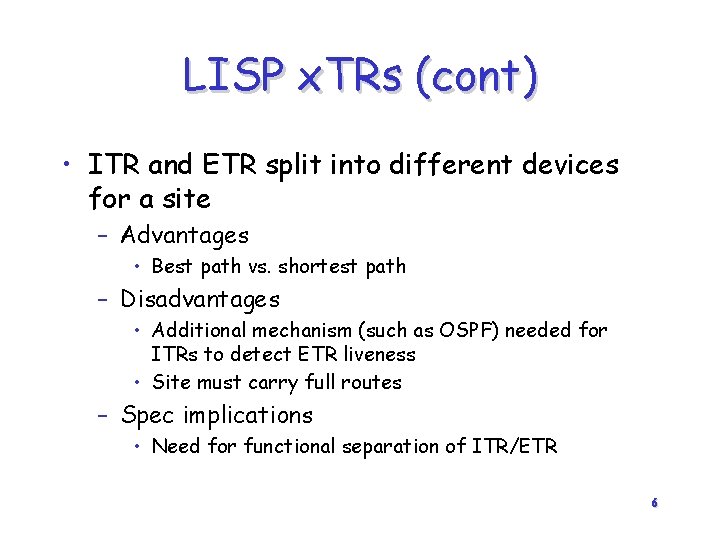
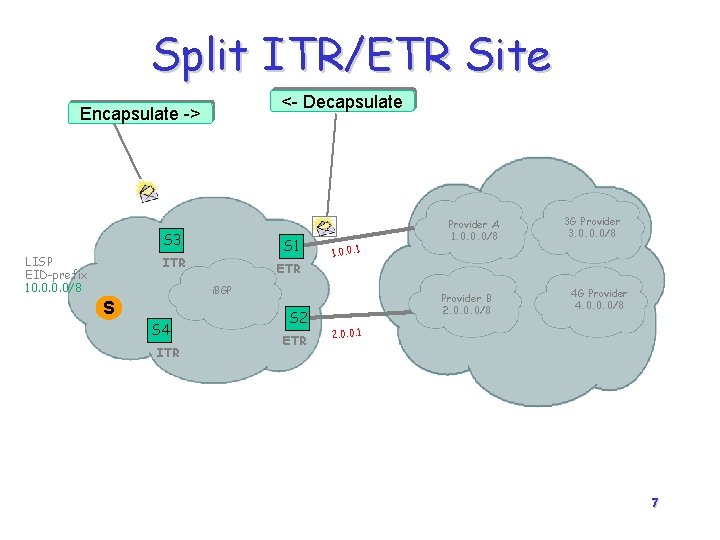
LISP x. TRs (cont) • ITR and ETR split into different devices for a site – Advantages • Best path vs. shortest path – Disadvantages • Additional mechanism (such as OSPF) needed for ITRs to detect ETR liveness • Site must carry full routes – Spec implications • Need for functional separation of ITR/ETR 6
Split ITR/ETR Site <- Decapsulate Encapsulate -> S 3 LISP EID-prefix 10. 0/8 S 1 ITR ETR 1. 0. 0. 1 i. BGP S S 4 ITR S 2 ETR Provider A 1. 0. 0. 0/8 Provider B 2. 0. 0. 0/8 3 G Provider 3. 0. 0. 0/8 4 G Provider 4. 0. 0. 0/8 2. 0. 0. 1 7
LISP x. TRs • x. TRs at the Provider Edge (PE) – Advantages • Site doesn’t have to upgrade CE • Multi-homing to a single SP might work – Degenerate of the VPN case local NAT in – Disadvantages • Site loses control of egress TE • Locator liveness is problematic – Implications • LISP would need to work on typical PE hardware 8
LISP x. TRs (cont) • x. TRs for Inter-Service Provider TE – Advantages • Separate mapping database shared between service providers • Bilateral agreements allow traffic engineering across multiple MPLS ASes – Disadvantages • Extra header, add’l looked, database maintenance – Implications • Requires support for two levels of LISP headers 9
Map Server • Authenticated Map Register messages are sent to Map Servers by ETRs • Map Server(s) will probably be provided by an EID registrar • Redundant servers are desirable • Impacts: – Need mechanism to configure EID prefix(es), keys and map server address(es) on ETRs 10
Map Resolver • Map Requests are sent to Map Resolvers by ITRs • Map resolvers will probably be provided by Internet Service Providers • Impacts: – Need DHCP option or other mechanism to configure map resolver address(es) on ITRs 11
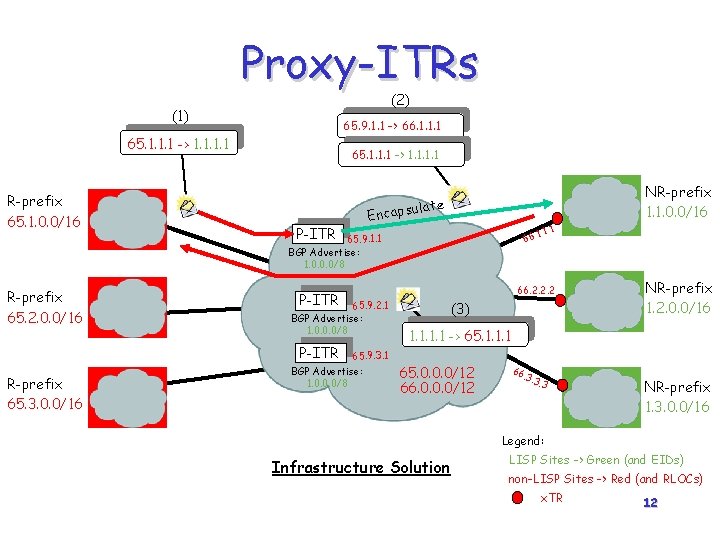
Proxy-ITRs (2) (1) 65. 9. 1. 1 -> 66. 1. 1. 1 65. 1. 1. 1 -> 1. 1 R-prefix 65. 1. 0. 0/16 65. 1. 1. 1 -> 1. 1 P-ITR NR-prefix 1. 1. 0. 0/16 late Encapsu R-prefix 65. 2. 0. 0/16 P-ITR R-prefix 65. 3. 0. 0/16 66. 2. 2. 2 P-ITR 65. 9. 2. 1 BGP Advertise: 1. 0. 0. 0/8 65. 9. 3. 1 BGP Advertise: 1. 0. 0. 0/8 1 1. 1. 66. 65. 9. 1. 1 BGP Advertise: 1. 0. 0. 0/8 (3) NR-prefix 1. 2. 0. 0/16 1. 1 -> 65. 1. 1. 1 65. 0. 0. 0/12 66 . 3. 3. 3 NR-prefix 1. 3. 0. 0/16 Legend: Infrastructure Solution LISP Sites -> Green (and EIDs) non-LISP Sites -> Red (and RLOCs) x. TR 12
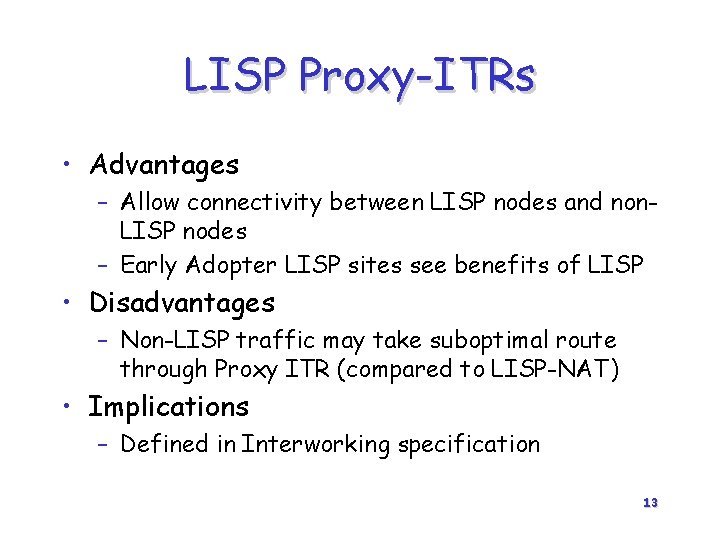
LISP Proxy-ITRs • Advantages – Allow connectivity between LISP nodes and non. LISP nodes – Early Adopter LISP sites see benefits of LISP • Disadvantages – Non-LISP traffic may take suboptimal route through Proxy ITR (compared to LISP-NAT) • Implications – Defined in Interworking specification 13
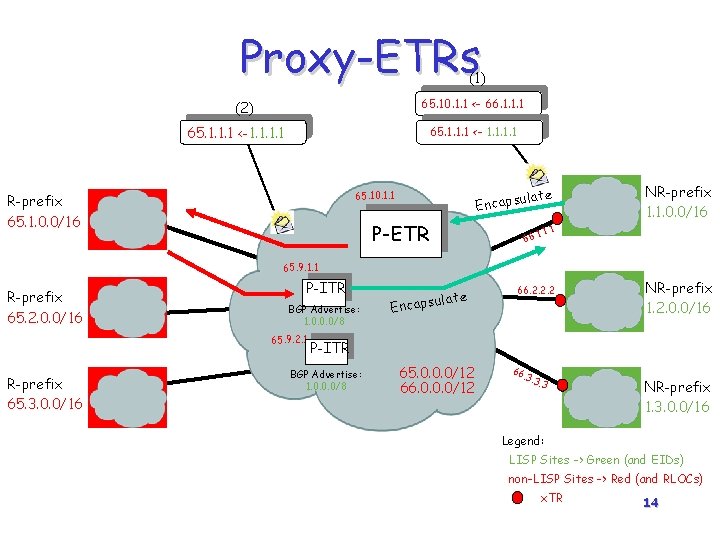
Proxy-ETRs (1) 65. 10. 1. 1 <- 66. 1. 1. 1 (2) 65. 1. 1. 1 <-1. 1 65. 1. 1. 1 <- 1. 1 late 65. 10. 1. 1 R-prefix 65. 1. 0. 0/16 Encapsu P-ETR NR-prefix 1. 1. 0. 0/16 1 1. 1. 66. 65. 9. 1. 1 R-prefix 65. 2. 0. 0/16 P-ITR BGP Advertise: 1. 0. 0. 0/8 65. 9. 2. 1 R-prefix 65. 3. 0. 0/16 late Encapsu 66. 2. 2. 2 NR-prefix 1. 2. 0. 0/16 P-ITR BGP Advertise: 1. 0. 0. 0/8 65. 0. 0. 0/12 66 . 3. 3. 3 NR-prefix 1. 3. 0. 0/16 Legend: LISP Sites -> Green (and EIDs) non-LISP Sites -> Red (and RLOCs) x. TR 14
LISP Proxy-ETRs • Advantages – Allows LISP nodes in sites with URPF restrictions to communicate with non-LISP nodes – Allows LISP in sites without natvie IPv 6 support to communication with LISP nodes that have only v 6 RLOCs – Can (should? !) be separate devices from Proxy. ITRs • Disadvantages – Packets may take longer path through P-ETR • Implications – Defined in Interworking specification 15
Early Adopter/Experimental • x. TRs behind a NAT – Advantages: • Allows LISP connectivity to/from sites behind a NAT for test network/early deployment – Disadvantages: • Somewhat Complex to configure – Implications: • Limited NAT traversal needed – 1 x. TR at global address, static port forwarding for 4341 & 4342 – Dynamic Locator in ETR Database • Needed for short term, when LISP is not integrated with provider-supplied CPE 16
Wrap UP • Is further work needed in this area? • Should we write an informational draft? 17